

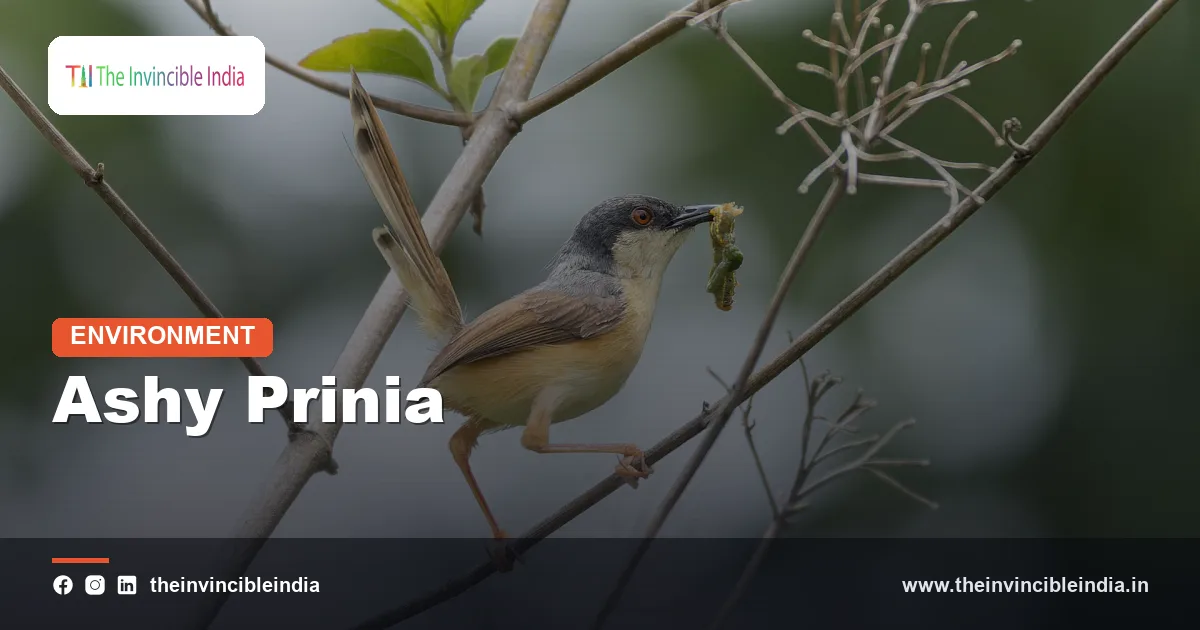
The ashy prinia (Prinia socialis) is a tiny, long-tailed warbler of gardens, scrub and farmland across India and the rest of the Indian subcontinent, easily recognised by its slate-grey upperparts, rusty-orange underparts, cocked tail and loud snapping call. It belongs to the family Cisticolidae, the cisticolas and allies, and is also called the ashy wren-warbler because its habit of holding the tail upright resembles that of a wren.
The ashy prinia is one of the commonest small birds in Indian gardens and hedges, where it hops through low vegetation catching insects and builds a neat, woven nest of grass and leaves. This guide explains how to identify the ashy prinia, how it differs from other prinias, where it lives, what it eats, how it nests, and why it adapts so well to human landscapes. Details were last checked on 23 October 2026.
| Quick Fact | Detail |
|---|---|
| Common names | Ashy prinia, ashy wren-warbler |
| Scientific name | Prinia socialis |
| Family | Cisticolidae (cisticolas and allies) |
| Size | About 13 cm including the long tail; weight roughly 10 g |
| Distinctive marks | Slate-grey back, rufous underparts, white throat, long tail with white tips, cocked posture |
| Range | Most of the Indian subcontinent, including Pakistan, India, Nepal, Bangladesh and Sri Lanka |
| Habitat | Gardens, hedges, scrub, tall grass, farmland and open woodland edges |
| Conservation status | Least Concern on the IUCN Red List |
Key Takeaways
- The ashy prinia (Prinia socialis) is a tiny resident warbler of the Indian subcontinent that is common in gardens, scrub and farmland.
- The ashy prinia has slate-grey upperparts, rufous to orange-buff underparts, a long tail tipped with white and a habit of cocking the tail upright.
- The ashy prinia feeds almost entirely on small insects and spiders, which it picks from leaves and stems in low vegetation.
- The ashy prinia builds a small, neat, oval nest of grass and plant fibres with a side entrance, often stitched to leaves with spider silk.
- The ashy prinia changes appearance with the seasons, with breeding birds showing a longer tail and richer colours than non-breeding birds.
- The IUCN lists the ashy prinia as Least Concern, and the species is widespread and tolerant of human-modified habitats.
What is the ashy prinia?
The ashy prinia is a small, active, long-tailed warbler-like bird that lives in South Asia. It is a resident, meaning it stays in the same region throughout the year, and it is among the easiest small birds to find in Indian gardens and fields.
The bird belongs to the genus Prinia, a group of small, tail-flicking, insect-eating birds sometimes called wren-warblers. The genus has several members in India, which can be confusing, but the ashy prinia is the one with a clear grey back and a rusty belly. Both sexes look much the same, and the species is sometimes called the ashy wren-warbler in older books.
How do you identify an ashy prinia?
You identify an ashy prinia by its slate-grey back and head, plain rufous or orange-buff underparts, a whitish throat, a pale eyebrow in some plumages, and a long, graduated tail with a black band near the tip and white outer feather tips. The eye is reddish-brown and the bill is thin and dark.
The bird is about the size of a sparrow, but much slimmer because of its tail, which makes up nearly half its length. It often holds the tail upright or over the back and flicks it from side to side. In breeding plumage, the underparts are a richer rusty colour and the tail is longer, while in the non-breeding season the tail is shorter, the upperparts browner and the underparts paler, which can cause confusion with other prinias.
Field identification checklist
- Slate-grey crown and back.
- Rusty to buff belly and flanks.
- Long, cocked tail with white tips and a dark band.
- Restless, hopping movements low in hedges and grass.
- A sharp, repeated “tit-tit-tit” call.
Where is the ashy prinia found in India?
The ashy prinia is found across most of India, from the plains of the north to the southern peninsula, and also in Pakistan, Nepal, Bangladesh and Sri Lanka. It is a resident species and is most common in lowlands and foothills.
The bird occurs in many habitats, including gardens, hedgerows, roadside scrub, cultivated fields, reed and grass patches, and the edges of open woodland. It avoids very dense forest and treeless deserts, and it is less common at high altitudes. Because it is both widespread and common, the ashy prinia is often one of the first small birds a beginner learns to identify, and it is regularly recorded on bird counts around the country.
What does the ashy prinia eat?
The ashy prinia eats small insects and spiders, which it picks from leaves, stems and the ground. It is an insectivore and rarely takes plant food.
Typical prey includes small beetles, caterpillars, flies, aphids, ants and the eggs and larvae of insects. The bird hops and clambers through shrubs, grass tufts and flower stalks, peering into leaf clusters and sometimes making short flutters to snatch an insect. By removing pests from gardens and crops, the ashy prinia is a quiet ally of gardeners and farmers. It also visits flowering plants occasionally, probably to catch insects attracted to them.
What does the call of the ashy prinia sound like?
The call of the ashy prinia is a sharp, repeated, snapping “tit-tit-tit” or “chip-chip-chip” often delivered from a low perch with the tail cocked. The song is a series of short, rhythmic, wheezy or ringing notes that the male repeats persistently.
Males sing mainly in the breeding season, from a bush top, wire or stalk, often rising and falling in a bouncing display. The notes carry well but can be mistaken for an insect or a tiny mechanical click. Pairs also keep in touch with soft contact notes while moving through vegetation. Learning the call is one of the quickest ways to locate this bird, since it is often heard before it is seen.
The snapping call also doubles as an alarm. When a cat, snake or hawk approaches, ashy prinias often scold loudly from cover while flicking the tail, and the noise can alert other small birds nearby. Birdwatchers sometimes follow this sound to find a predator that would otherwise be hidden in the foliage.
How does the ashy prinia nest?
The ashy prinia builds a small, neat, oval or ball-shaped nest of fine grass, plant fibres and cobweb, with a side entrance, placed low in a shrub, tall grass or crop. The nest is often held together by stitching leaves with spider silk and plant fibre, a skill shared with some other warblers.
The female lays about three to five glossy eggs, often reddish-brown or brick-red in colour, though shades vary. Both parents feed the chicks with insects. The breeding season is usually linked to the rains, which supply the insect food needed for the young, and it varies from region to region. Nests are small and hard to spot, which helps protect them, but they are sometimes lost to crows, snakes, cats and agricultural work.
How is the ashy prinia different from other prinias?
The ashy prinia differs from other Indian prinias mainly through its plain slate-grey back, rufous underparts and white-tipped tail, whereas the others are browner, paler, streaked or more yellow. Several prinias share habitat, so careful viewing helps.
| Species | Key difference from the ashy prinia |
|---|---|
| Plain prinia | Sandy-brown above, pale buff below, with a pale eyebrow and a plain tail; the commonest lookalike |
| Jungle prinia | Larger and stouter, with a heavier bill and a long, dull tail; browner overall |
| Rufous-fronted prinia | Rufous forehead, dark brown above and buff below, often a short tail |
| Grey-breasted prinia | Brown upperparts with a grey band across the breast, restricted to the Himalayan foothills |
| Yellow-bellied prinia | Greenish upperparts with a yellow belly, usually found in tall wet grass |
| Graceful prinia | Streaked back with a very long tail and pale underparts, often in dry scrub |
The most reliable clue is the colour contrast between a grey back and a rusty belly, a combination found only in the ashy prinia among common garden birds.
Why does the ashy prinia look different through the year?
The ashy prinia looks different through the year because it moults between a breeding and a non-breeding plumage, changing tail length, back colour and the intensity of the underparts. This seasonal change is typical of many prinias.
In the breeding season, the tail is long and the colours are bold, with a slate-grey back and rich rufous underparts. In the non-breeding season, the tail is shorter, the back becomes browner or greyer-brown and the belly looks paler and duller. Regional populations also differ slightly in tone, which has led to several named subspecies. Because of these differences, beginners sometimes mistake non-breeding birds for plain prinias, so it is worth checking tail pattern and eye colour.
Why does the ashy prinia do so well around people?
The ashy prinia does well around people because it needs only low shrubs, tall grass and a supply of small insects, all of which are plentiful in gardens, hedges and farms. It builds a small nest and is not fussy about the plants it uses.
Gardens with layered vegetation, such as hedges, flowering shrubs and patches of grass, suit it well, and it often nests close to houses. It is small and quick, so predators find it hard to catch, and it breeds rapidly in good seasons. Heavy pesticide use, removal of hedgerows and tidy lawns without shrubs can reduce its numbers locally. In general, though, the ashy prinia is one of the most successful small birds of the subcontinent.
Is the ashy prinia protected in India?
The ashy prinia is not considered threatened, and the IUCN classes it as Least Concern, but like other wild birds in India it is legally protected from capture, trade and killing under the Wildlife (Protection) Act, 1972. Keeping wild birds in cages is generally prohibited.
The species has a very large range and a large population, so it is not a conservation priority. Even so, small birds of hedges and scrub depend on the continued presence of low, layered vegetation. Where roadside shrubs are cleared, field edges are sprayed, or gardens are replaced by paving, local numbers can drop. Citizen-science programmes, including bird counts and online checklists, help track such changes over time.
How can you attract and watch ashy prinias?
You can watch ashy prinias by looking and listening in hedges, tall grass and shrubby edges in the early morning, and you can attract them by planting native shrubs and avoiding pesticides. A pair of binoculars and some patience is enough.
- Plant dense, native shrubs and leave a patch of tall grass unmown.
- Avoid chemical sprays so that insects stay available as food.
- Listen for the sharp “tit-tit-tit” call and look low in bushes.
- Keep a shallow dish of clean water for drinking and bathing.
- Do not disturb nests, and trim hedges outside the breeding season.
Bottom Line
The ashy prinia is a tiny, common and beneficial resident bird of Indian gardens, hedges and fields, recognised by its grey back, rusty belly, cocked tail and snapping call. It eats insects, builds a neat woven nest and thrives alongside people. Simple measures, such as keeping native shrubs and avoiding pesticides, help it flourish.
Frequently Asked Questions
Is the ashy prinia the same as the ashy wren-warbler?
Yes, the ashy prinia and the ashy wren-warbler are the same bird, Prinia socialis. Ashy prinia is the name used in most modern checklists, while ashy wren-warbler appears in older field guides.
What does the ashy prinia eat?
The ashy prinia eats small insects and spiders, such as beetles, caterpillars, flies and aphids. It picks them from leaves, stems and the ground while hopping through low vegetation.
How can I tell an ashy prinia from a plain prinia?
An ashy prinia has a slate-grey back and rusty-orange underparts, while a plain prinia is sandy-brown above and pale buff below. The plain prinia also shows a pale eyebrow, and its tail is less strongly marked with white tips.
Does the ashy prinia migrate?
No, the ashy prinia is a resident bird that stays in the same region through the year. It may make small local movements, but it does not undertake long-distance migration.
Where does the ashy prinia build its nest?
The ashy prinia builds its nest low in shrubs, tall grass or crops, often within a metre or two of the ground. The nest is a small oval of grass and plant fibres with a side entrance, sometimes stitched to leaves with spider silk.
Is the ashy prinia a threatened bird?
No, the ashy prinia is listed as Least Concern by the IUCN. It is widespread, common and tolerant of gardens and farmland, though local numbers can fall when hedges and scrub are cleared or pesticides are overused.
{“@context”:”https://schema.org”,”@graph”:[{“@type”:”FAQPage”,”mainEntity”:[{“@type”:”Question”,”name”:”Is the ashy prinia the same as the ashy wren-warbler?”,”acceptedAnswer”:{“@type”:”Answer”,”text”:”Yes, the ashy prinia and the ashy wren-warbler are the same bird, Prinia socialis. Ashy prinia is the name used in most modern checklists, while ashy wren-warbler appears in older field guides.”}},{“@type”:”Question”,”name”:”What does the ashy prinia eat?”,”acceptedAnswer”:{“@type”:”Answer”,”text”:”The ashy prinia eats small insects and spiders, such as beetles, caterpillars, flies and aphids. It picks them from leaves, stems and the ground while hopping through low vegetation.”}},{“@type”:”Question”,”name”:”How can I tell an ashy prinia from a plain prinia?”,”acceptedAnswer”:{“@type”:”Answer”,”text”:”An ashy prinia has a slate-grey back and rusty-orange underparts, while a plain prinia is sandy-brown above and pale buff below. The plain prinia also shows a pale eyebrow, and its tail is less strongly marked with white tips.”}},{“@type”:”Question”,”name”:”Does the ashy prinia migrate?”,”acceptedAnswer”:{“@type”:”Answer”,”text”:”No, the ashy prinia is a resident bird that stays in the same region through the year. It may make small local movements, but it does not undertake long-distance migration.”}},{“@type”:”Question”,”name”:”Where does the ashy prinia build its nest?”,”acceptedAnswer”:{“@type”:”Answer”,”text”:”The ashy prinia builds its nest low in shrubs, tall grass or crops, often within a metre or two of the ground. The nest is a small oval of grass and plant fibres with a side entrance, sometimes stitched to leaves with spider silk.”}},{“@type”:”Question”,”name”:”Is the ashy prinia a threatened bird?”,”acceptedAnswer”:{“@type”:”Answer”,”text”:”No, the ashy prinia is listed as Least Concern by the IUCN. It is widespread, common and tolerant of gardens and farmland, though local numbers can fall when hedges and scrub are cleared or pesticides are overused.”}}]}]}


