

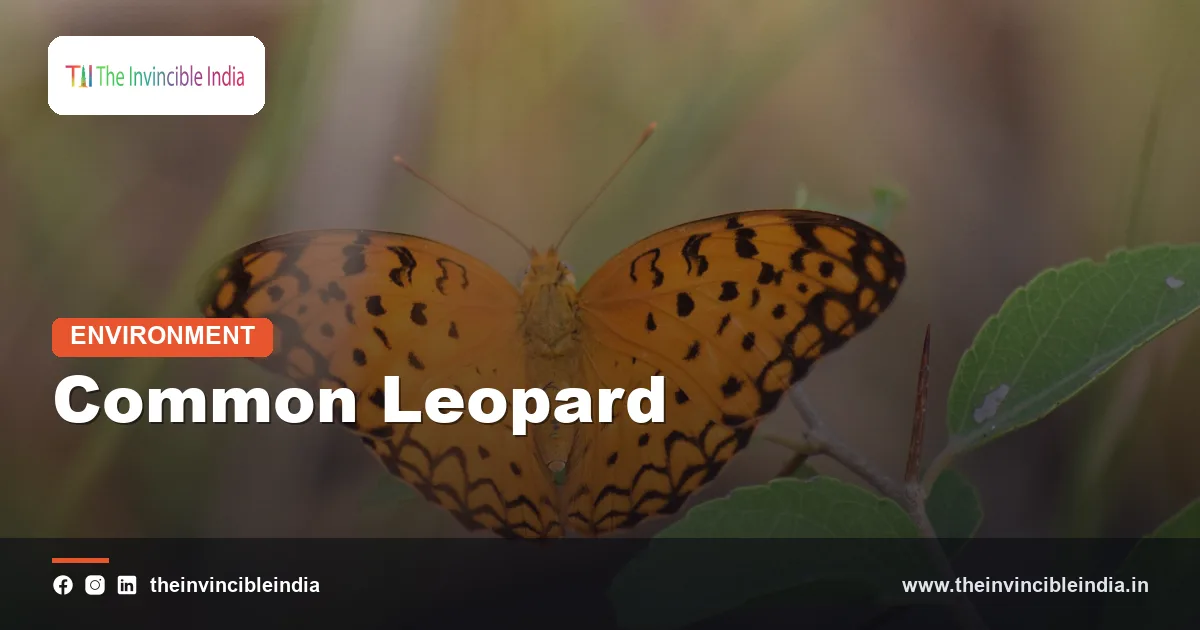
The common leopard butterfly (Phalanta phalantha) is a bright orange, black-spotted butterfly of the family Nymphalidae, named for its leopard-like pattern, and it is a familiar sight in gardens, open scrub and forest edges across India. The common leopard butterfly is a fast, active flier that basks with its wings open, drinks from damp soil and visits many kinds of flowers, which makes it one of the easiest orange butterflies to watch.
This explainer covers how to identify the common leopard butterfly, where it lives in India, what its caterpillars eat, how it feeds and behaves, and how it differs from the tawny coster and other similar spotted orange butterflies. It was last reviewed on 23 October 2026.
| Common name | Common leopard (also called leopard lacewing) |
|---|---|
| Scientific name | Phalanta phalantha (Drury, 1773) |
| Family and subfamily | Nymphalidae (brush-footed butterflies), Heliconiinae |
| Wingspan | Roughly 5 to 6 cm |
| Appearance | Orange wings covered in black spots and short bars, with a pale underside bearing darker spots |
| Caterpillar food plants | Willow-family (Salicaceae) plants such as Flacourtia (governor’s plum) and Scolopia |
| Habitat | Gardens, scrub, open woodland, riverbanks and forest edges |
| Behaviour | Basks with wings open; mud-puddles; fast, darting flight; territorial males |
| Range | Africa, South Asia, South-East Asia and parts of Australasia |
Key Takeaways
- The common leopard butterfly (Phalanta phalantha) is an orange butterfly covered in black spots, belonging to the family Nymphalidae and the subfamily Heliconiinae.
- Common leopard caterpillars feed on plants of the willow family (Salicaceae), such as Flacourtia, which are widely planted as hedge and fruit shrubs in India.
- The common leopard butterfly mud-puddles, which means that adults sip moisture and minerals from wet soil, and it also visits many garden flowers for nectar.
- The common leopard butterfly often basks with its wings fully open in the sun, which shows its spotted pattern clearly and makes it easy to photograph.
- The common leopard is a faster, more robust flier than the tawny coster, and the two can be told apart by their flight, wing shape and spot arrangement.
- The common leopard butterfly is widespread and adaptable, and it is not considered threatened in India.
What is the common leopard butterfly?
The common leopard butterfly is a medium-sized orange butterfly with black leopard-like spots that is common across Africa and Asia, including most of India. It belongs to the genus Phalanta, which is a small group of spotted orange butterflies in the subfamily Heliconiinae.
The species was described by the British entomologist Dru Drury in 1773. In English it is called the common leopard, and in some regions the leopard lacewing, and the “leopard” name comes from the rows of dark spots across the orange ground colour. It is one of several butterflies in India with a big-cat common name.
The common leopard is among the most adaptable butterflies in the country. It breeds on shrubs that are also grown for fruit and hedges, so it can live comfortably in towns, villages and farm edges as well as in natural habitat.
How do you identify a common leopard butterfly?
A common leopard butterfly is identified by its warm orange upperside, evenly scattered black spots and a pale, spotted underside, combined with a quick, darting flight. The upper wing surface is a rich orange-yellow with black dots, short lines and a dark margin, giving a pattern that resembles a leopard’s coat.
Key field marks
- Upperside: bright orange with small black spots and bars across both wings, and a dark border bearing a row of small spots.
- Underside: a paler yellowish-buff with darker spots and a pattern of fine lines, so a perched butterfly with closed wings looks rather different from one with wings open.
- Shape: rounded forewings and slightly scalloped hindwings.
- Flight: fast, darting and low, often returning to the same perch.
- Posture: commonly basks in sunny spots with the wings spread flat.
Females are usually a little paler and larger than males, with more extensive dark markings. Both sexes are conspicuous, which makes the species a good starting point for photographers.
Where does the common leopard live in India?
The common leopard lives across most of India, from sea level up to the foothills of the Himalayas, wherever its host shrubs and nectar flowers grow. It is found throughout the peninsula, the Gangetic plains, the Western and Eastern Ghats and the north-east, and is rarely absent from a warm garden.
Typical habitats include:
- Gardens, parks and campuses, including those in large cities
- Open scrub and dry thorn forest
- Deciduous woodland and forest clearings
- Riverbanks, canal edges and damp roadside patches
- Hedgerows and orchard boundaries
The butterfly is on the wing for much of the year, with a peak in and after the monsoon. Outside India it ranges through Sri Lanka, South-East Asia and parts of Australasia, and the species also occurs across much of Africa.
What do common leopard caterpillars eat?
Common leopard caterpillars eat the leaves of shrubs and trees in the willow family, Salicaceae. In India, the best-known host plants are Flacourtia species, such as governor’s plum (Flacourtia indica), and other plants in the same group, including Scolopia and, in some places, willows (Salix).
The female lays eggs singly or in small groups on the young leaves. The caterpillars are dark, spiny and rather bristly, and they feed in the open on leaves, which the host plant replaces quickly. The pupa hangs from a twig or leaf and is pale and mottled, helping it blend into the foliage.
Why does a Heliconiinae butterfly use willow-family plants?
Most Heliconiinae butterflies use passionflower family plants, but the genus Phalanta has shifted to Salicaceae. This difference is one of the features that makes the common leopard different from the tawny coster, another Indian Heliconiinae butterfly that feeds on passion vines.
How does the common leopard feed and behave?
The common leopard feeds on flower nectar, rotting fruit, tree sap and mineral-rich damp soil, and it basks in sunlight with its wings spread flat. This varied diet allows the butterfly to live in many habitats and to remain active through much of the year.
Mud-puddling
Mud-puddling is the habit of gathering at wet sand, mud or animal dung to drink moisture and take in sodium and other minerals. Male common leopards are often seen mud-puddling in groups along streams and damp tracks, sometimes alongside other butterflies such as blues, emigrants and swallowtails.
Basking and territory
Basking allows the butterfly to warm its flight muscles. Males often defend a sunny perch, darting out to chase intruders and then returning to the same spot. This pattern of behaviour helps photographers, because a disturbed common leopard usually comes back.
How does the common leopard differ from the tawny coster?
The common leopard differs from the tawny coster in its faster flight, broader wings and evenly spotted pattern, and in the plants its caterpillars use. Both butterflies are orange with black spots and both are Heliconiinae, so they are often confused by beginners.
| Feature | Common leopard | Tawny coster |
|---|---|---|
| Scientific name | Phalanta phalantha | Acraea terpsicore |
| Flight | Fast, darting, strong | Slow, weak, fluttering |
| Wing shape | Broad, rounded, slightly scalloped | Narrow forewings, rounded hindwings |
| Pattern | Orange with evenly scattered black spots and bars | Orange with black spots and a darker forewing tip |
| Caterpillar food | Willow family (e.g. Flacourtia) | Passionflower family (e.g. Passiflora foetida) |
| Defence | Speed and alertness | Toxic chemicals and warning colours |
The common leopard also resembles other spotted orange butterflies such as the angled castor, but the leopard’s rounder wings and bold spot pattern are usually enough to separate them.
What is the life cycle of the common leopard butterfly?
The common leopard butterfly has a complete life cycle of egg, caterpillar, pupa and adult, and in warm parts of India it produces several generations each year. The cycle from egg to adult may take about a month in warm weather.
- Egg: small, pale and dome-shaped, laid on new host leaves.
- Caterpillar: dark and spiny, feeding on leaves through several growth stages.
- Pupa: a hanging chrysalis, mottled in cream and brown, attached by the tail end.
- Adult: a spotted orange butterfly that lives for a few weeks.
Population numbers rise after rain, when host plants put out fresh shoots. In dry seasons, the butterfly may decline locally or move to wetter areas.
Why does the common leopard matter ecologically?
The common leopard matters ecologically as a pollinator, as prey for birds, lizards and spiders, and as a useful indicator of garden and scrub health. Adult butterflies carry pollen between flowers, and their caterpillars feed other insects such as parasitic wasps.
The butterfly is also valuable for education and citizen science. Its bright colours, predictable basking and tolerance of urban habitats mean it is regularly recorded on platforms such as iNaturalist, adding to long-term knowledge of butterfly ranges and flight seasons in India.
The common leopard is not threatened. It depends, however, on a mix of host shrubs and nectar plants, so it does less well in gardens that are paved, heavily sprayed or planted only with sterile ornamentals.
How can you attract common leopards to a garden?
You can attract common leopards to a garden by planting nectar-rich flowers, keeping a host shrub such as Flacourtia and providing a damp patch of soil. These three elements supply food for adults, food for caterpillars and the minerals that males seek.
- Plant lantana, tridax, zinnia, marigold and pentas for nectar.
- Grow a native host shrub or small tree in a sunny corner.
- Keep a shallow dish of wet sand or soil in a sunny, sheltered place.
- Avoid insecticides and herbicides in the area used by butterflies.
- Leave a few bare, sunny stones or paths for basking.
Observing and photographing the butterflies is a safe and enjoyable activity, and recording sightings online provides useful data for researchers.
What threats does the common leopard butterfly face?
The common leopard butterfly faces few serious threats, because it is mobile, breeds quickly and uses widely planted host shrubs. The main pressures are local ones that affect almost all butterflies in towns and farmland.
- Pesticides: sprays used on crops, roadside plants and ornamental gardens kill caterpillars and adults.
- Habitat tidying: removal of hedgerows, scrub and wild fruit shrubs reduces breeding sites.
- Paving and concrete: sealed surfaces remove the damp soil that males use for mud-puddling.
- Climate and rainfall change: shifts in monsoon timing can alter when host plants produce fresh leaves.
Butterfly monitoring groups in India treat the common leopard as a reliable “everyday” species. A sudden drop in its numbers in a known area is a useful early sign that something in the local habitat, such as heavy spraying or loss of shrubs, has changed.
When is the best time to see the common leopard butterfly?
The best time to see the common leopard butterfly is on a sunny morning, between about eight and eleven o’clock, when the butterflies warm up and bask with their wings open. In the heat of the afternoon the common leopard becomes more restless and moves between shady and sunny patches.
Seasonally, the common leopard butterfly can be found in almost every month in warm regions of India, but sightings climb noticeably during the monsoon and in the weeks that follow. In north India, numbers dip in winter and rise again in spring. Cloudy, rainy days are poor for watching because the butterflies shelter among leaves with their wings closed.
Patience is more useful than equipment. A watcher who stands quietly near a flowering shrub, a damp patch or a sunlit perch will usually see the same common leopard return several times, which allows close observation of its feeding and basking habits and good photographs of both the upper and under surfaces of the wings.
Beginners can use the common leopard butterfly as a reference species. Once its colour, spotting and basking habit are familiar, other orange butterflies become much easier to separate, because each of them differs from the common leopard in flight speed, wing shape or perching behaviour.
Bottom Line
The common leopard butterfly is an adaptable, leopard-spotted orange butterfly that breeds on willow-family shrubs, drinks from damp soil and basks in the sun. It is widespread across India, not threatened, and a rewarding species for beginners to learn. Gardens with nectar flowers, a host shrub and a damp patch will often attract it.
Frequently Asked Questions
What is a common leopard butterfly?
A common leopard butterfly is a medium-sized orange butterfly with black leopard-like spots, scientifically named Phalanta phalantha. It belongs to the family Nymphalidae and is found across India, Africa and South-East Asia. It lives in gardens, scrub and forest edges.
What do common leopard caterpillars eat?
Common leopard caterpillars eat the leaves of willow-family (Salicaceae) plants. In India the best-known host plants are Flacourtia species such as governor’s plum, along with relatives such as Scolopia. The female lays eggs on young leaves.
Why does the common leopard butterfly mud-puddle?
The common leopard mud-puddles to take in water and minerals such as sodium from wet soil. Males in particular gather at damp patches along streams and tracks. The minerals support their activity and help in reproduction.
How can you tell a common leopard from a tawny coster?
A common leopard flies faster and more strongly, has broader rounded wings and an evenly spotted pattern, while the tawny coster flies slowly with narrower forewings. Their caterpillars also eat different plants: willow-family shrubs for the leopard and passion vines for the coster. The tawny coster is also chemically toxic.
Where is the common leopard butterfly found in India?
The common leopard butterfly is found across most of India, from the plains to the Himalayan foothills. It is common in gardens, open scrub, riverbanks, forest edges and hedgerows. It is seen for much of the year, with a peak after the monsoon.
Is the common leopard butterfly rare or protected?
No, the common leopard is a widespread and adaptable species and is not considered rare or threatened. It can decline locally where host shrubs and nectar flowers are removed or where pesticides are heavily used. Gardens with flowers and a host shrub often attract it.
{“@context”:”https://schema.org”,”@graph”:[{“@type”:”FAQPage”,”mainEntity”:[{“@type”:”Question”,”name”:”What is a common leopard butterfly?”,”acceptedAnswer”:{“@type”:”Answer”,”text”:”A common leopard butterfly is a medium-sized orange butterfly with black leopard-like spots, scientifically named Phalanta phalantha. It belongs to the family Nymphalidae and is found across India, Africa and South-East Asia. It lives in gardens, scrub and forest edges.”}},{“@type”:”Question”,”name”:”What do common leopard caterpillars eat?”,”acceptedAnswer”:{“@type”:”Answer”,”text”:”Common leopard caterpillars eat the leaves of willow-family (Salicaceae) plants. In India the best-known host plants are Flacourtia species such as governor’s plum, along with relatives such as Scolopia. The female lays eggs on young leaves.”}},{“@type”:”Question”,”name”:”Why does the common leopard butterfly mud-puddle?”,”acceptedAnswer”:{“@type”:”Answer”,”text”:”The common leopard mud-puddles to take in water and minerals such as sodium from wet soil. Males in particular gather at damp patches along streams and tracks. The minerals support their activity and help in reproduction.”}},{“@type”:”Question”,”name”:”How can you tell a common leopard from a tawny coster?”,”acceptedAnswer”:{“@type”:”Answer”,”text”:”A common leopard flies faster and more strongly, has broader rounded wings and an evenly spotted pattern, while the tawny coster flies slowly with narrower forewings. Their caterpillars also eat different plants: willow-family shrubs for the leopard and passion vines for the coster. The tawny coster is also chemically toxic.”}},{“@type”:”Question”,”name”:”Where is the common leopard butterfly found in India?”,”acceptedAnswer”:{“@type”:”Answer”,”text”:”The common leopard butterfly is found across most of India, from the plains to the Himalayan foothills. It is common in gardens, open scrub, riverbanks, forest edges and hedgerows. It is seen for much of the year, with a peak after the monsoon.”}},{“@type”:”Question”,”name”:”Is the common leopard butterfly rare or protected?”,”acceptedAnswer”:{“@type”:”Answer”,”text”:”No, the common leopard is a widespread and adaptable species and is not considered rare or threatened. It can decline locally where host shrubs and nectar flowers are removed or where pesticides are heavily used. Gardens with flowers and a host shrub often attract it.”}}]}]}


