

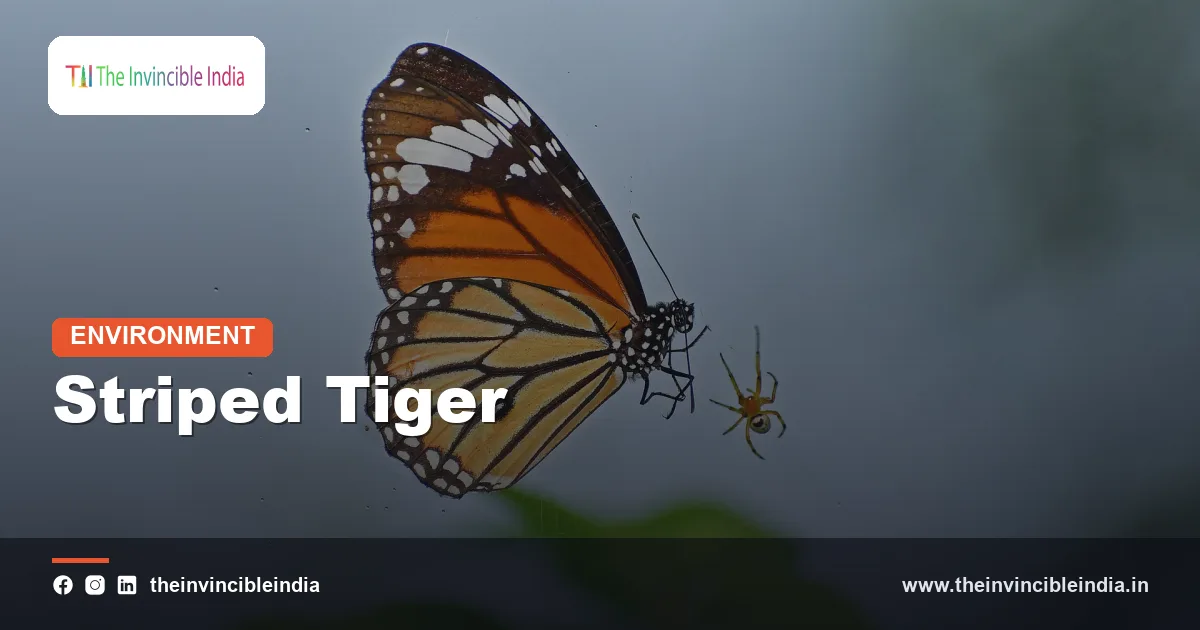
The striped tiger (Danaus genutia), also called the common tiger, is an orange butterfly with bold black veins and stripes, belonging to the milkweed butterfly subfamily Danainae, and it is toxic to predators because its caterpillars feed on milkweed-family plants. The striped tiger is a common, strong-flying butterfly across India and Asia, and it is a classic example of warning colouration and mimicry.
This explainer sets out how to identify the striped tiger, where it lives in India, what its caterpillars eat, why it is toxic, how it migrates locally, and how it differs from its close relative the plain tiger. It was last reviewed on 23 October 2026.
| Common name | Striped tiger (also called common tiger) |
|---|---|
| Scientific name | Danaus genutia (Cramer, 1779) |
| Family and subfamily | Nymphalidae (brush-footed butterflies), Danainae (milkweed butterflies) |
| Wingspan | Roughly 7 to 8.5 cm |
| Appearance | Orange wings with black veins, black-and-white tipped forewings and a black border spotted with white |
| Caterpillar food plants | Milkweed family (Apocynaceae), including Tylophora, Cynanchum, Calotropis and related climbers |
| Defence | Cardiac glycosides (cardenolides) taken from host plants; warning colours |
| Habitat | Gardens, open woodland, scrub, farmland edges and forest clearings |
| Range | South Asia and South-East Asia to southern China, Taiwan and northern Australia |
Key Takeaways
- The striped tiger (Danaus genutia) is a large orange butterfly with black-striped veins, belonging to the milkweed butterfly subfamily Danainae.
- Striped tiger caterpillars feed on milkweed-family plants and store toxic cardiac glycosides, which make both the caterpillar and the adult distasteful to predators.
- The striped tiger is the stripe-veined cousin of the plain tiger (Danaus chrysippus), and the two share a genus and a similar warning-colour strategy.
- The striped tiger is a model species in mimicry, which means that other, edible butterflies imitate its colours to gain protection from predators.
- The striped tiger makes seasonal local movements, particularly around the monsoon, and is often seen gliding low over gardens and open ground.
- The striped tiger is common and widespread in India and is not considered threatened.
What is the striped tiger butterfly?
The striped tiger is a large, orange, strong-flying butterfly in the milkweed butterfly group, widespread across India and Asia. The species belongs to the genus Danaus, the same genus as the plain tiger and the famous North American monarch butterfly (Danaus plexippus).
It was described by the Dutch entomologist Pieter Cramer in 1779. Its alternative name, the common tiger, is widely used in India, while “striped tiger” refers to the bold black stripes that run along the veins of the wings. The related genus Tirumala contains the blue tigers, and the genus Parantica contains the glassy tigers, so “tiger” is a name for a group of toxic Danainae rather than for one species alone.
The butterfly is a flagship example for the study of chemical defence and mimicry, and it is among the first species taught in butterfly identification courses in India.
How do you identify a striped tiger?
A striped tiger is identified by its bright orange wings with strongly outlined black veins, a black forewing tip with white spots, and a slow, gliding flight. The black veins give the wings a stained-glass look that is more marked than in any other common Indian orange butterfly.
Key field marks
- Upperside: orange with heavy black veins, which form stripes on both the forewing and the hindwing.
- Forewing tip: black with a band of white spots, a pattern shared with the plain tiger.
- Margin: a black border dotted with small white spots on both wings.
- Males: carry a small black scent patch on the hindwing, which is used in courtship.
- Flight: slow, strong and gliding, with relaxed wingbeats.
Females are similar to males but lack the scent patch. The striped tiger is large for an orange butterfly, and its pattern is conspicuous at a distance, which is consistent with its warning function.
Where does the striped tiger live in India?
The striped tiger lives across most of India, from the plains and peninsula to the Western Ghats, the north-east and the lower Himalayan slopes. It is a butterfly of open and semi-open country and is most often found where milkweed host plants and flowering shrubs grow close together.
Typical habitats include:
- Gardens, parks and campuses
- Scrub, grassland edges and farmland boundaries
- Light woodland and forest clearings
- Riverbanks and roadside verges
- Coastal and low hill regions
The species is present throughout the year in warm regions, with the greatest numbers during and after the monsoon. Its overall range extends from Sri Lanka and India through South-East Asia to southern China, Taiwan and northern Australia.
What do striped tiger caterpillars eat?
Striped tiger caterpillars eat the leaves of milkweed-family plants (Apocynaceae), including climbers such as Tylophora and Cynanchum and shrubs such as Calotropis. These plants contain milky latex and toxic compounds that protect them from most herbivores, but striped tiger larvae are adapted to feed on them.
The caterpillar is easy to recognise. It is banded in black, white and yellow, with soft, fleshy filaments at the front and rear that wave when the animal is disturbed. These bright bands are a warning signal to predators, just like the adult’s orange colouring.
The pupa is a smooth green chrysalis with small gold and black marks. It hangs from a stem or leaf and is also protected by the toxins accumulated in the body during the caterpillar stage.
Why is the striped tiger toxic to predators?
The striped tiger is toxic because its caterpillars absorb cardiac glycosides, also called cardenolides, from their milkweed food plants and keep them in the body through adulthood. These chemicals disrupt heart function in many vertebrates, so a bird that eats a striped tiger often vomits and learns to avoid similar-looking butterflies.
Several features reinforce this chemical defence:
- Bright orange-and-black colouring that predators remember.
- Leathery, flexible wings and body that survive a trial attack and are easy to release.
- Slow, conspicuous flight that does not depend on speed for escape.
- Toxins present in all stages from caterpillar to adult.
The striped tiger poses no known danger to people. The toxicity is a defence against predators, and the butterfly should still be observed rather than handled.
What is mimicry, and how does the striped tiger take part?
Mimicry is the resemblance of one species to another so that predators confuse them, and the striped tiger takes part as a toxic model that other butterflies imitate. In Müllerian mimicry, several toxic species share a similar warning pattern, so predators learn one pattern faster. In Batesian mimicry, an edible species copies a toxic one.
| Type of mimicry | Who benefits | Example involving tigers |
|---|---|---|
| Müllerian | Several toxic species share the cost of predator learning | Striped tiger and plain tiger, which have similar orange-and-black patterns |
| Batesian | An edible species gains protection by looking toxic | Edible butterflies such as the common mime (Papilio clytia), which imitates tigers and crows |
Because many Indian orange butterflies resemble tigers, mimicry is a popular subject for school and nature-club activities. The striped tiger gives a clear and visible demonstration of how natural selection can shape colours and patterns.
How does the striped tiger differ from the plain tiger?
The striped tiger differs from the plain tiger mainly in its heavy black wing veins and stripes, its larger size and its more rounded orange-and-black pattern. The plain tiger (Danaus chrysippus) has a smoother, plainer orange body colour with black and white wing tips and fewer dark vein markings.
| Feature | Striped tiger | Plain tiger |
|---|---|---|
| Scientific name | Danaus genutia | Danaus chrysippus |
| Size | Larger, about 7 to 8.5 cm | Slightly smaller |
| Veins | Boldly black, forming stripes | Mostly orange with little black striping |
| Forewing tip | Black with white spots | Black with a white band and spots |
| Defence | Cardiac glycosides from milkweeds | Cardiac glycosides from milkweeds |
| Behaviour | Gliding, local movements | Gliding, wide-ranging and migratory |
The two species share host plants and habitats, and they are often seen flying together. Learning to separate them is a good test of observation skills.
Does the striped tiger migrate?
Yes, the striped tiger makes seasonal local movements in India, particularly around the monsoon, although it does not make the long-distance journey associated with the monarch. In peninsular India, tigers and crows (Euploea species) are among the butterflies that are sometimes seen gathering and moving in large numbers before and during the rains.
Such movements are a response to changing weather and to the availability of host plants and flowers. Researchers and citizen scientists study them using sightings and tagging, and the movements are an important part of the story of Indian butterfly migration.
Outside the migratory season, the striped tiger is generally a local butterfly, patrolling a home patch of gardens, hedgerows and open ground. It roosts at night on shrubs and trees, sometimes in loose groups.
What is the life cycle of the striped tiger?
The striped tiger completes a four-stage life cycle of egg, caterpillar, pupa and adult, and in warm parts of India it breeds in several generations each year. Development from egg to adult takes about a month in warm weather.
- Egg: small, ribbed and pale, laid singly on a milkweed leaf.
- Caterpillar: banded black, white and yellow, with soft filaments, growing through five stages.
- Pupa: a green chrysalis with gold-and-black dots.
- Adult: feeds on nectar from a range of flowers and can live for several weeks.
Male striped tigers also visit certain plants, such as heliotropes, to collect alkaloids that they convert into chemicals used in courtship.
Why does the striped tiger matter, and how can you protect it?
The striped tiger matters as a pollinator, as a warning-coloured prey species and as an indicator of healthy milkweed habitat, and you can protect it by keeping host plants in the garden. Milkweed climbers and shrubs are often treated as weeds and removed, which reduces the places where striped tiger caterpillars can feed.
- Leave native milkweed climbers such as Tylophora and Cynanchum where they grow wild.
- Plant nectar flowers such as lantana, pentas, zinnia and heliotrope.
- Avoid insecticides, which kill caterpillars along with pests.
- Do not remove caterpillars from host plants, since they are not garden pests.
- Photograph and record sightings on citizen-science platforms.
Which other butterflies are called tigers in India?
Several toxic butterflies in the subfamily Danainae are called tigers in India, and the striped tiger is only one of them. All of them are orange, blue or glassy-patterned butterflies whose caterpillars feed on milkweed-family plants and whose adults advertise their toxins.
- Plain tiger (Danaus chrysippus): the closest relative, plainer orange and widely migratory.
- Blue tigers (Tirumala species): blue-streaked on a dark ground, well known for monsoon movements in the Western Ghats.
- Glassy tigers (Parantica species): pale, translucent bluish streaks on dark wings.
- Crows (Euploea species): dark brown Danainae that often fly alongside the tigers.
Together, these butterflies form a loose Danainae community that shares host plants, warning colours and, in many cases, seasonal movement routes. Learning the striped tiger is a good first step towards identifying the rest of the group.
Where and when can you watch the striped tiger?
The best places to watch the striped tiger are sunny gardens, hedgerows and open scrub with flowering shrubs, and the best time is a warm morning during or just after the monsoon. The striped tiger glides slowly from flower to flower, so it is easy to follow and photograph.
In the cooler months, the striped tiger is less active in the early morning and warms up later, often basking on low shrubs before flying. Watching a striped tiger for a few minutes usually reveals its habits: it patrols a regular route, stops at the same flowers, and returns to roost in the same cluster of vegetation at dusk.
Because the striped tiger is toxic and slow, it is relatively fearless and allows close approach. Even so, it should never be netted, held or chased, since damage to the wings reduces its ability to fly and feed. Photographs, notes and online sightings are the best ways to take part in butterfly study.
Bottom Line
The striped tiger is a conspicuous orange butterfly that survives by being toxic and advertising the fact, and it shows how chemical defence and mimicry work in nature. It is common and widespread in India, so the best way to help it is to leave milkweed host plants growing and to avoid pesticide use.
Frequently Asked Questions
What is a striped tiger butterfly?
A striped tiger is a large orange butterfly with bold black wing veins, scientifically named Danaus genutia and also called the common tiger. It belongs to the milkweed butterfly subfamily Danainae. It is widespread in India and across Asia.
Is the striped tiger butterfly poisonous?
Yes, the striped tiger is toxic to many predators, but it is harmless to humans. Its caterpillars absorb cardiac glycosides from milkweed-family host plants and keep them as adults. The bright orange-and-black colouring warns predators to avoid it.
What is the difference between a striped tiger and a plain tiger?
A striped tiger has bold black veins and stripes on its orange wings and is slightly larger, while a plain tiger is more evenly orange with fewer dark veins. Both belong to the genus Danaus and both are toxic. The plain tiger is better known for its wide-ranging movements.
What do striped tiger caterpillars eat?
Striped tiger caterpillars eat milkweed-family (Apocynaceae) plants such as Tylophora, Cynanchum and Calotropis. These plants contain toxic compounds that the caterpillars store for their own defence. The caterpillars are banded in black, white and yellow, with soft filaments.
Why is the striped tiger important in the study of mimicry?
The striped tiger is a toxic model that other butterflies imitate to gain protection from predators. It shares a pattern with the plain tiger, which is Müllerian mimicry, and it is copied by edible butterflies such as the common mime, which is Batesian mimicry. This makes it a standard example in biology teaching.
Does the striped tiger migrate in India?
The striped tiger makes seasonal local movements, especially around the monsoon, but it does not make the very long journeys of the monarch. In peninsular India tigers and crows are sometimes seen moving in large numbers before and during the rains. Outside those periods it stays within a home area of gardens and open ground.
{“@context”:”https://schema.org”,”@graph”:[{“@type”:”FAQPage”,”mainEntity”:[{“@type”:”Question”,”name”:”What is a striped tiger butterfly?”,”acceptedAnswer”:{“@type”:”Answer”,”text”:”A striped tiger is a large orange butterfly with bold black wing veins, scientifically named Danaus genutia and also called the common tiger. It belongs to the milkweed butterfly subfamily Danainae. It is widespread in India and across Asia.”}},{“@type”:”Question”,”name”:”Is the striped tiger butterfly poisonous?”,”acceptedAnswer”:{“@type”:”Answer”,”text”:”Yes, the striped tiger is toxic to many predators, but it is harmless to humans. Its caterpillars absorb cardiac glycosides from milkweed-family host plants and keep them as adults. The bright orange-and-black colouring warns predators to avoid it.”}},{“@type”:”Question”,”name”:”What is the difference between a striped tiger and a plain tiger?”,”acceptedAnswer”:{“@type”:”Answer”,”text”:”A striped tiger has bold black veins and stripes on its orange wings and is slightly larger, while a plain tiger is more evenly orange with fewer dark veins. Both belong to the genus Danaus and both are toxic. The plain tiger is better known for its wide-ranging movements.”}},{“@type”:”Question”,”name”:”What do striped tiger caterpillars eat?”,”acceptedAnswer”:{“@type”:”Answer”,”text”:”Striped tiger caterpillars eat milkweed-family (Apocynaceae) plants such as Tylophora, Cynanchum and Calotropis. These plants contain toxic compounds that the caterpillars store for their own defence. The caterpillars are banded in black, white and yellow, with soft filaments.”}},{“@type”:”Question”,”name”:”Why is the striped tiger important in the study of mimicry?”,”acceptedAnswer”:{“@type”:”Answer”,”text”:”The striped tiger is a toxic model that other butterflies imitate to gain protection from predators. It shares a pattern with the plain tiger, which is Mu00fcllerian mimicry, and it is copied by edible butterflies such as the common mime, which is Batesian mimicry. This makes it a standard example in biology teaching.”}},{“@type”:”Question”,”name”:”Does the striped tiger migrate in India?”,”acceptedAnswer”:{“@type”:”Answer”,”text”:”The striped tiger makes seasonal local movements, especially around the monsoon, but it does not make the very long journeys of the monarch. In peninsular India tigers and crows are sometimes seen moving in large numbers before and during the rains. Outside those periods it stays within a home area of gardens and open ground.”}}]}]}


