

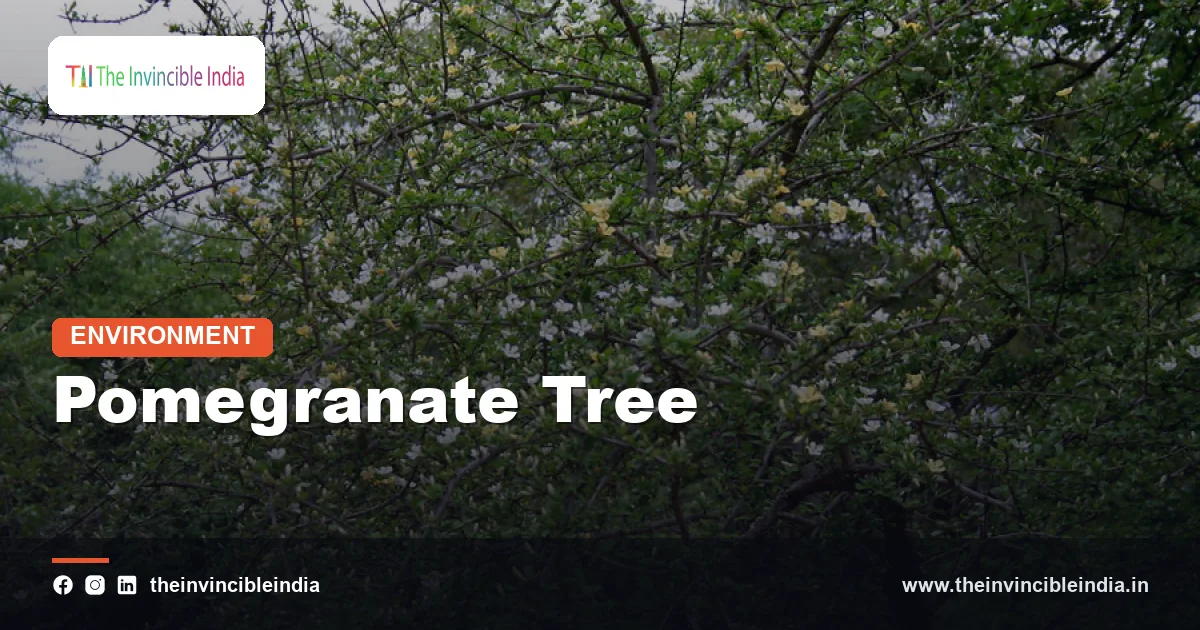
The pomegranate tree (Punica granatum), called anar in Hindi and dadima in Sanskrit, is a hardy, shrubby, small fruit tree that produces round, leathery-skinned fruits packed with ruby-red, juicy seeds called arils, and India is one of the world’s largest pomegranate producers. The tree is native to the region stretching from Iran to northern India, has been cultivated in the subcontinent since ancient times, and today supports a major horticulture industry led by Maharashtra.
The pomegranate tree in India is prized for its tolerance of drought and heat, its ability to grow in poor and mildly saline soils, and the export value of its fruit. This explainer describes what the pomegranate tree is, where and how it grows, its main varieties and cultivation practices, and what its fruit offers nutritionally.
Quick Facts
| Attribute | Details |
|---|---|
| Common names | Pomegranate; anar (Hindi), dadima (Sanskrit), dalimb (Marathi), dalimbe (Kannada), madalai (Tamil), danimma (Telugu) |
| Scientific name | Punica granatum |
| Plant family | Lythraceae (earlier placed in its own family, Punicaceae) |
| Origin | Western and Central Asia, from Iran towards northern India; cultivated in India for many centuries |
| Tree type | Deciduous to semi-evergreen shrub or small tree, usually 3 to 5 metres tall |
| Leading Indian states | Maharashtra (the largest), followed by Karnataka, Gujarat, Andhra Pradesh and Rajasthan |
| Popular varieties | Bhagwa (Kesar), Ganesh, Mridula, Arakta, Ruby |
| Geographical Indication | Solapur Anar, associated with Solapur district in Maharashtra |
| Fruit maturity | About five to six months from flowering |
Key Takeaways
- The pomegranate tree (Punica granatum) is a drought-hardy shrubby tree of West and Central Asian origin that has been grown in India for many centuries.
- Maharashtra is the leading pomegranate-producing state in India, with districts such as Solapur, Nashik, Sangli, Pune and Ahmednagar forming the core growing region.
- Pomegranate growers in India schedule flowering through a system called bahar, which lets them time the crop to avoid rain, disease pressure or low-price periods.
- Bhagwa, also called Kesar, is the dominant commercial pomegranate variety in India, valued for its deep red skin, red arils and good keeping quality.
- Bacterial blight, locally known as telya, is among the most damaging diseases of the pomegranate tree in India and can sharply reduce orchard yield.
- Pomegranate arils provide vitamin C, fibre and plant polyphenols, and the fruit is eaten fresh, juiced or dried as anardana for cooking.
What is the pomegranate tree?
The pomegranate tree is a small, many-stemmed deciduous or semi-evergreen tree whose fruit has a tough, reddish-pink rind enclosing hundreds of seeds, each wrapped in juicy, translucent flesh. Botanists classify the plant as Punica granatum, and the species name granatum refers to the many-grained interior of the fruit.
The tree typically grows to three to five metres, often with spiny twigs and narrow, glossy leaves. The showy orange-red flowers are funnel-shaped and appear in clusters on new shoots. The fruit is topped by a persistent, crown-like calyx, which is a familiar shape in Indian art and symbolism.
Pomegranates are among the oldest cultivated fruit trees in the world, and their cultivation is documented across ancient Persia, the Mediterranean and South Asia. The Sanskrit term dadima appears in classical Indian texts, and the fruit has long had a place in Ayurvedic and folk traditions, as well as in religious and festive occasions.
Where is the pomegranate tree grown in India?
The pomegranate tree is grown mainly in the semi-arid regions of western and southern India, with Maharashtra the largest producing state, followed by Karnataka, Gujarat, Andhra Pradesh and Rajasthan. The crop has expanded greatly in the last few decades because of its profitability on dry land.
Within Maharashtra, Solapur, Sangli, Nashik, Ahmednagar, Pune, Satara and Dhule districts are significant growing areas. Solapur in particular is known for its pomegranate, and the product has been registered as Solapur Anar under the Geographical Indications of Goods (Registration and Protection) Act, 1999, which links the name to the region of origin.
Smaller pockets exist in Madhya Pradesh, Tamil Nadu, Telangana and Himachal Pradesh. In the lower Himalayan region, wild pomegranate trees, known locally as daru, grow on slopes, and their sour seeds are dried to make anardana. Current area and production figures are published by the National Horticulture Board and should be checked there for the latest values.
What climate and soil does the pomegranate tree need?
The pomegranate tree grows best in a hot, dry climate with a long summer, moderate winters and low humidity during fruit development, and it adapts to a wide range of soils provided they drain well. It is among the more tolerant fruit crops for drought, heat and mildly saline or alkaline conditions.
- Temperature: Warm to hot weather during fruiting improves fruit colour, sugar and aril development. Cool conditions reduce the colour intensity of the rind and arils.
- Rainfall and humidity: Moderate rainfall is acceptable, but high humidity and rain during flowering and fruiting increase disease and cracking.
- Soil: Well-drained loam, sandy loam and even shallow, gravelly soils are suitable. Waterlogging damages roots and invites wilt and rot.
- Salinity: The tree tolerates moderate salinity better than many fruit species, which is one reason it is promoted in marginal lands.
Even though the tree is tolerant, regular and timely irrigation during flowering and fruit growth is needed for a commercial crop, because irregular watering is a major cause of fruit cracking.
What is the bahar system in pomegranate cultivation?
The bahar system is the practice in India of deliberately timing the flowering and fruiting of pomegranate by regulating water and rest periods, so that the crop matures in a chosen season. Because pomegranate trees can flower almost year-round in tropical conditions, growers choose a bahar to match climate, water availability and market prices.
| Bahar (flowering season) | Approximate flowering period | Approximate harvest period |
|---|---|---|
| Ambe bahar | January to February | June to August |
| Mrig bahar | June to July | November to January |
| Hasta bahar | September to October | February to April |
Growers induce a chosen bahar by withholding water for a period, which stresses the tree and makes it shed leaves, and then restoring irrigation along with pruning and fertilisers. The best choice depends on local rainfall and water supply, since Mrig bahar, for example, is influenced by the monsoon, and Hasta and Ambe bahar require reliable irrigation. Dates above are approximate and vary by region and year.
How is the pomegranate tree propagated and cultivated?
The pomegranate tree is commercially propagated from hardwood cuttings or air layers rather than seed, so that every plant is a true copy of a selected variety. Planted in pits at wide spacing, the trees begin bearing in about two to three years and remain commercially productive for roughly fifteen to twenty-five years under good management.
Planting and spacing
Cuttings are rooted in nurseries and then planted out, usually at the start of the monsoon, at spacings such as 4.5 by 3 metres, though closer planting is also used. Farmers apply farmyard manure in the planting pit and train the young plant with several main stems, rather than a single trunk.
Irrigation
Drip irrigation is widely adopted in Maharashtra and Karnataka because it conserves water and allows controlled watering. Steady, measured moisture during fruit development reduces cracking, and many commercial orchards pair drip systems with mulching.
Pruning and training
Annual pruning removes dry, diseased and crossing branches and suckers from the base, and it keeps the canopy open for light and spray penetration. Pruning is often done as part of the bahar treatment.
Fruit bagging and harvest
Many growers cover developing fruits with protective bags to improve skin finish and reduce pest and sun damage, especially for export-grade fruit. The fruit is harvested when the rind colour deepens and a metallic sound is heard on tapping, typically five to six months after flowering. Pomegranates do not ripen further after picking, so harvest timing matters.
What are the main varieties of pomegranate in India?
The main varieties of pomegranate in India are Bhagwa (also called Kesar), Ganesh, Mridula, Arakta and Ruby, with Bhagwa dominating commercial and export orchards. Variety choice affects colour, sweetness, seed hardness and shelf life.
| Variety | Notable features |
|---|---|
| Bhagwa (Kesar) | Deep saffron-red skin, bright red arils, soft seeds and long shelf life; the leading commercial and export variety |
| Ganesh | An older, widely grown selection with pinkish-red arils and soft seeds |
| Mridula | A variety with dark red arils and soft seeds, developed by an agricultural research institution in Maharashtra |
| Arakta | Selected for its red arils and soft seeds, with medium to large fruit |
| Ruby | A deep red variety with attractive colour, grown in south India |
Soft-seeded types are generally preferred for fresh eating, while sour wild or hard-seeded types are used for anardana. Research bodies such as the National Research Centre on Pomegranate in Solapur, a unit of the Indian Council of Agricultural Research (ICAR), work on improved varieties and orchard practices.
What diseases and pests affect the pomegranate tree?
The most serious problem of the pomegranate tree in India is bacterial blight, known locally as telya, along with fruit borer, wilt, fruit cracking and fungal spots. These problems are worst in humid or rainy conditions and in orchards with poor sanitation.
- Bacterial blight (telya): Caused by the bacterium Xanthomonas axonopodis pv. punicae, it produces dark spots on leaves, stems and fruit and can cause heavy losses. Control relies on clean planting material, orchard hygiene, pruning of infected parts and carefully timed sprays.
- Fruit borer (anar butterfly): Larvae enter flowers and developing fruit and cause rot inside. Fruit bagging is a common protective method.
- Wilt: Soil-borne fungal wilt kills trees, particularly where drainage is poor.
- Fruit cracking: A physiological disorder linked to uneven watering and sudden humidity changes, and it opens the fruit to rot.
Because blight spreads through water and tools, extension services advise using certified plants and following local disease advisories rather than relying on spraying alone.
Why does the pomegranate matter to India’s economy and farmers?
The pomegranate matters because it is a high-value, drought-tolerant fruit crop that converted large stretches of dry western and southern India into profitable orchards and supports a sizeable export trade. Its keeping quality allows shipping to distant markets, including the Gulf countries, parts of Europe and other regions.
The rise of drip irrigation, improved planting material and cold storage has helped the sector. For small and medium farmers in rain-shadow districts, pomegranate has often delivered better returns per unit of water than traditional field crops, although the investment cost and disease risk are substantial.
The industry also involves processing. Juice, concentrate, arils packed in ready-to-eat cups, and dried anardana are produced for domestic and overseas markets, adding value beyond the whole fruit.
How is the pomegranate used and what does it offer nutritionally?
The pomegranate is eaten fresh as arils, pressed into juice, dried as anardana or used as a souring agent in Indian cooking, and it provides vitamin C, dietary fibre and plant polyphenols. The edible part is the aril, while the rind and membranes are bitter and are not usually eaten.
- Fresh arils: Eaten plain or added to salads, raita, chaat and desserts.
- Juice: Pressed from arils and consumed fresh or bottled.
- Anardana: Dried sour seeds, often from wild trees, used in chutneys, chaat masala, curries and spice blends.
- Traditional uses: The rind and flowers have long featured in folk and Ayurvedic preparations, although scientific support for specific medicinal claims varies and remains limited.
Studies show that pomegranate contains antioxidant compounds such as punicalagins and anthocyanins, but evidence for treating diseases is not established, and the fruit is best regarded as a healthy food. People taking prescription medicines, particularly blood pressure or blood-thinning drugs, should check with a doctor about regular consumption of large amounts of pomegranate juice.
How does the pomegranate compare with other drought-tolerant fruit trees?
The pomegranate stands out among drought-tolerant fruit trees for its storage life, export demand and tolerance of salinity, though it needs more careful disease management than some hardier species. The table below compares it with three other dryland fruit crops.
| Tree | Water need | Shelf life of fruit | Main strength |
|---|---|---|---|
| Pomegranate | Low to moderate | Long; suitable for export | High value; salinity tolerance |
| Custard apple | Low | Very short | Thrives on poor stony land |
| Ber (Indian jujube) | Very low | Short to moderate | Extreme hardiness |
| Guava | Moderate | Short to moderate | Adaptable with two crops yearly |
Bottom Line
The pomegranate tree is one of India’s most successful dryland fruit crops, anchored in Maharashtra and sustained by bahar timing, drip irrigation and strong export demand. Its returns are real but depend on clean planting material and constant vigilance against bacterial blight.
Frequently Asked Questions
What is a pomegranate called in Hindi?
A pomegranate is called anar in Hindi and dadima in Sanskrit. In Marathi it is known as dalimb. The scientific name of the species is Punica granatum.
Which state is the largest producer of pomegranate in India?
Maharashtra is the largest pomegranate-producing state in India. Districts such as Solapur, Nashik, Sangli, Pune and Ahmednagar are the main centres. Karnataka, Gujarat, Andhra Pradesh and Rajasthan also grow significant quantities.
How long does a pomegranate tree take to bear fruit?
A pomegranate tree usually begins to bear fruit about two to three years after planting when propagated from cuttings. The first crop is small, and yields rise over the following years. A well-managed orchard stays commercially productive for roughly fifteen to twenty-five years.
What is the bahar system in pomegranate farming?
The bahar system is a method of timing pomegranate flowering by controlling water and rest periods. Growers choose Ambe, Mrig or Hasta bahar based on rainfall, irrigation and market prices. This lets them align harvest with favourable conditions and avoid periods of heavy rain or disease pressure.
What is telya disease in pomegranate?
Telya is the local name for bacterial blight of pomegranate, caused by the bacterium Xanthomonas axonopodis pv. punicae. It causes dark spots on leaves, stems and fruit and can lead to heavy losses. Control depends on clean planting material, sanitation, pruning and timely sprays.
Is pomegranate good for health?
Pomegranate is a nutritious fruit that offers vitamin C, fibre and antioxidant polyphenols, and it can be part of a balanced diet. Evidence that it treats specific diseases is limited. People on regular medication should ask a doctor before drinking large amounts of pomegranate juice.
{“@context”:”https://schema.org”,”@graph”:[{“@type”:”FAQPage”,”mainEntity”:[{“@type”:”Question”,”name”:”What is a pomegranate called in Hindi?”,”acceptedAnswer”:{“@type”:”Answer”,”text”:”A pomegranate is called anar in Hindi and dadima in Sanskrit. In Marathi it is known as dalimb. The scientific name of the species is Punica granatum.”}},{“@type”:”Question”,”name”:”Which state is the largest producer of pomegranate in India?”,”acceptedAnswer”:{“@type”:”Answer”,”text”:”Maharashtra is the largest pomegranate-producing state in India. Districts such as Solapur, Nashik, Sangli, Pune and Ahmednagar are the main centres. Karnataka, Gujarat, Andhra Pradesh and Rajasthan also grow significant quantities.”}},{“@type”:”Question”,”name”:”How long does a pomegranate tree take to bear fruit?”,”acceptedAnswer”:{“@type”:”Answer”,”text”:”A pomegranate tree usually begins to bear fruit about two to three years after planting when propagated from cuttings. The first crop is small, and yields rise over the following years. A well-managed orchard stays commercially productive for roughly fifteen to twenty-five years.”}},{“@type”:”Question”,”name”:”What is the bahar system in pomegranate farming?”,”acceptedAnswer”:{“@type”:”Answer”,”text”:”The bahar system is a method of timing pomegranate flowering by controlling water and rest periods. Growers choose Ambe, Mrig or Hasta bahar based on rainfall, irrigation and market prices. This lets them align harvest with favourable conditions and avoid periods of heavy rain or disease pressure.”}},{“@type”:”Question”,”name”:”What is telya disease in pomegranate?”,”acceptedAnswer”:{“@type”:”Answer”,”text”:”Telya is the local name for bacterial blight of pomegranate, caused by the bacterium Xanthomonas axonopodis pv. punicae. It causes dark spots on leaves, stems and fruit and can lead to heavy losses. Control depends on clean planting material, sanitation, pruning and timely sprays.”}},{“@type”:”Question”,”name”:”Is pomegranate good for health?”,”acceptedAnswer”:{“@type”:”Answer”,”text”:”Pomegranate is a nutritious fruit that offers vitamin C, fibre and antioxidant polyphenols, and it can be part of a balanced diet. Evidence that it treats specific diseases is limited. People on regular medication should ask a doctor before drinking large amounts of pomegranate juice.”}}]}]}


