

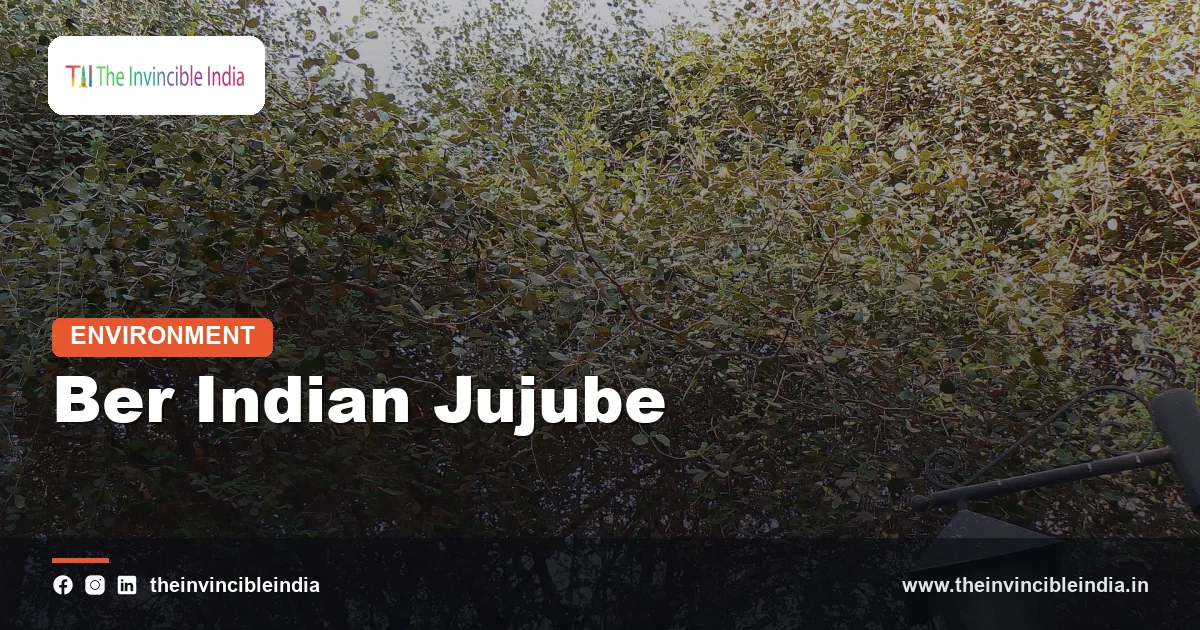
The ber tree (Ziziphus mauritiana), also called the Indian jujube, is a thorny, extremely hardy fruit tree of the dry plains of India that bears small, crunchy, sweet-tart fruits known as ber in winter and early spring. Native to tropical Asia and growing wild across large parts of the subcontinent, the ber tree survives heat, drought and poor soils that defeat most other orchard crops.
The ber tree in India serves several roles at once: it is a fruit crop, a fodder and fuel tree, and an important host plant for the lac insect. This explainer covers what the ber tree is, where it grows, how it is grafted and pruned, its main varieties, its link to lac production and the nutritional value of its fruit.
Quick Facts
| Attribute | Details |
|---|---|
| Common names | Ber, bor, bair (Hindi and regional); Indian jujube, Indian plum; elanthai (Tamil), regu pandu (Telugu), bor (Marathi) |
| Scientific name | Ziziphus mauritiana |
| Plant family | Rhamnaceae (the buckthorn family) |
| Origin | Tropical South and Southeast Asia; wild and cultivated in India since ancient times |
| Tree type | Evergreen to deciduous, thorny tree, usually 4 to 10 metres tall |
| Fruiting season | Mainly January to March, depending on variety and region |
| Key growing regions | Rajasthan, Uttar Pradesh, Haryana, Punjab, Gujarat, Madhya Pradesh, Maharashtra, Bihar and West Bengal |
| Popular varieties | Umran, Gola, Seb, Banarasi Karaka, Kaithli, Mundia |
| Notable ecological role | Host plant for the lac insect (Kerria lacca) |
Key Takeaways
- The ber tree (Ziziphus mauritiana) is a thorny, drought-hardy fruit tree native to tropical Asia that grows wild and in orchards across the dry plains of India.
- Ber fruit in India ripens mainly between January and March, and it is eaten fresh, dried, pickled or made into candy and powder.
- Commercial ber orchards in India are made by budding improved varieties such as Umran, Gola and Seb onto hardy seedling rootstocks.
- Annual hard pruning in the hot, leafless summer period is essential for the ber tree because the fruit forms on shoots of the current season.
- The ber tree is a recognised host plant for the lac insect, which produces the resin from which shellac is made.
- Ber fruit is a good source of vitamin C and fibre, and its tolerance of drought makes the tree a valuable crop for poor, rainfed land.
What is the ber tree?
The ber tree is a spiny, medium-sized tree of the buckthorn family that produces small round or oval fruits with a thin, edible skin, sweet crisp flesh and a single hard stone. The scientific name is Ziziphus mauritiana, and it is often called the Indian jujube to distinguish it from the Chinese jujube, Ziziphus jujuba, a related species grown in cooler regions.
The tree has a deep taproot, drooping branches and paired thorns at the leaf joints, one straight and one hooked. The leaves are glossy green above and whitish and downy underneath. Small, greenish-yellow flowers appear in clusters on new shoots, and the fruits range from olive-sized to nearly the size of a small apple in improved varieties.
Wild ber, often called jangli ber, is smaller and more sour. The cultivated forms, produced by grafting or budding, are larger, sweeter and more uniform. In Indian culture the fruit appears in folklore, including the well-known story of Shabari offering ber to Rama in the Ramayana tradition, and in regional festivals such as the Maharashtra practice of bor nhan, in which small children are showered with ber fruits in winter.
Where is the ber tree grown in India?
The ber tree is grown across the dry and semi-arid plains of India, notably in Rajasthan, Uttar Pradesh, Haryana, Punjab, Gujarat, Madhya Pradesh, Maharashtra, Bihar and West Bengal. It is also commonly seen on village boundaries, wastelands and field bunds in almost every state outside the high Himalaya.
Commercial orchards are concentrated in the drier north-western and central states, where the long hot summer and cool, dry winter suit the crop. Parts of Rajasthan, Haryana and Uttar Pradesh are noted for large-scale ber cultivation, while eastern states such as Bihar and West Bengal contribute through both orchards and homestead trees.
The Central Institute for Arid Horticulture (CIAH) in Bikaner, under the Indian Council of Agricultural Research (ICAR), is one of the institutions that works on improving ber and other hardy fruit crops for arid regions. Current area and production figures are reported by the National Horticulture Board and state agencies.
What climate and soil does the ber tree need?
The ber tree needs a hot, dry climate with a clear dry season and tolerates drought, heat and a wide range of soils, including sandy, saline and poor stony ground. It is among the most undemanding fruit trees grown in India.
- Climate: Hot summers and mild, dry winters are ideal. The tree sheds many of its leaves in the hot summer and enters a short rest period before new growth appears with the early monsoon.
- Soil: It grows in sandy loam, light clay and even mildly saline or alkaline soils, though deep, well-drained soil gives the best yields.
- Water: The deep taproot reaches moisture far below the surface, so ber survives on very little rainfall. Occasional irrigation during flowering and fruit growth increases fruit size.
- Frost: The tree is sensitive to severe frost, particularly when young.
These traits explain why ber has been promoted for wasteland development, rainfed horticulture and dryland farming systems, where it provides income with minimal inputs.
How is the ber tree propagated and grown?
The ber tree is propagated commercially by budding a chosen variety onto a seedling rootstock, usually of Ziziphus mauritiana, and the budded plants are then set out in orchards at the start of the monsoon. Orchards typically start bearing fruit in the second or third year.
Rootstock and budding
Seedlings are raised from seed in nursery beds or bags and, once they have reached pencil thickness, are budded in the rainy season using techniques such as patch or T-budding. The rootstock supplies the deep root system and drought tolerance, while the bud supplies the variety’s fruit quality. In some areas, wild ber trees growing on a farm are converted by budding them in place.
Pruning
Pruning is the single most important management practice. Ber flowers and fruits on the new shoots of the current season, so growers cut back the previous year’s growth heavily during the hot, leafless period in April and May. This produces a flush of fresh shoots after the first rains, and these bear the crop. Without pruning, the tree becomes tangled and yields poorly.
Irrigation and manuring
Light irrigation after pruning and during fruit set helps, though excess watering at flowering can reduce fruit set. Farmyard manure and balanced fertilisers are applied around the tree at the start of the growth cycle.
Harvest
Fruits are hand-picked as they colour from green to yellowish-green or golden. Because ripening is uneven, several pickings are normal across the season. Ripe ber is perishable at room temperature, so marketing is generally quick.
What are the main varieties of ber in India?
The main varieties of ber in India include Umran, Gola, Seb, Banarasi Karaka, Kaithli and Mundia, and they differ in fruit size, sweetness, shape and harvest time. Umran is widely regarded as the leading commercial variety in the north.
| Variety | Notable features |
|---|---|
| Umran | Large, oval, golden-yellow to orange fruit; sweet and good for the market; a leading commercial type |
| Gola | Round, medium-sized fruit; early maturing and widely grown in the north |
| Seb | Rounded fruit resembling a small apple, as the Hindi name suggests; good for fresh eating |
| Banarasi Karaka | A well-known selection from the Varanasi region with large fruit and good keeping quality |
| Kaithli | A late-maturing type with sweet, medium to large fruit |
| Mundia | Small round fruit, known for hardiness and use in drier areas |
Research institutions have released additional selections suited to arid and semi-arid regions. Early, mid-season and late varieties are often planted together so that harvest is spread over several weeks.
What is the connection between the ber tree and lac?
The ber tree is one of the important host plants of the lac insect (Kerria lacca), which feeds on the sap of its twigs and secretes a resinous substance called lac, used to make shellac. India has long been among the leading lac producers in the world, and ber is one of several hosts used for lac cultivation, along with palas and kusum.
Lac farming is carried out mainly in central and eastern India, including Jharkhand, Chhattisgarh, Madhya Pradesh, Odisha and West Bengal, with some activity in Maharashtra and other states. Tribal and rural communities depend on it as a source of income. Cultivators place brood lac, which contains the young insects, on the host tree, where the insects settle on the twigs and secrete lac over several months before it is harvested as stick lac.
Shellac is used in wood finishes, sealing wax, some food glazes, pharmaceutical coatings and traditional products such as bangles. Alongside lac, ber has also been reported as a food plant for some silk-producing insects, including tasar silkworm in certain regions, which adds to its value as a multipurpose tree. Lac production on ber has to be balanced with fruit production, because heavy lac infestation weakens the twigs that bear fruit.
How is ber fruit used and is it nutritious?
Ber fruit is eaten fresh, dried, pickled or processed into candy, jam and powder, and it is a good source of vitamin C and dietary fibre. The ripe fruit has a crisp, apple-like texture with a sweet-sour taste, while overripe or dried fruit becomes chewy and date-like.
- Fresh fruit: Eaten whole, often with salt and chilli in street preparations.
- Ber chutney and pickle: Sour or semi-ripe ber is cooked or fermented as a condiment.
- Dried ber and ber powder: Sun-dried fruit and powdered ber are used in sweet and sour preparations, including the Maharashtra and Gujarat bor churna type of snack.
- Candy and preserves: Ber is processed into candy, murabba and jam, which extend its short season.
Nutrient content varies with variety and ripeness, and the fruit is often described as rich in vitamin C. The tree’s leaves, bark and roots feature in traditional medicine, and the leaves are lopped as animal fodder in dry regions. Scientific evidence for specific medicinal uses is limited, so ber is best regarded as a nutritious seasonal food rather than a remedy.
What pests and diseases affect the ber tree?
The main problems of the ber tree are fruit fly, powdery mildew, leaf-eating insects and, in some regions, the lac or scale insects that can build up on twigs. Most are manageable through orchard sanitation, pruning and timely control measures.
- Fruit fly: Maggots infest ripening fruit and make it unfit to eat. Collecting and destroying fallen fruit and using traps are commonly advised.
- Powdery mildew: A white fungal growth on leaves and fruit, more common in cool, humid winter weather during fruiting.
- Leaf-eating caterpillars and beetles: These defoliate young shoots and are managed with sprays when numbers rise.
- Stem and root problems: Waterlogging and poor drainage can damage roots and weaken trees.
Pruning residue should be cleared from the orchard, because it harbours pests and diseases. Extension services recommend integrated management rather than routine blanket spraying.
Why does the ber tree matter for dryland India?
The ber tree matters because it gives rural households in dry regions a reliable fruit, fodder, fuel and lac-host tree that survives drought with minimal cost. A mature tree can continue to yield for many years on land that would otherwise be left barren.
Ber is therefore part of many agroforestry and wasteland-development schemes. The thorny branches are also used to make field fences. Where orchards are grafted and pruned properly, ber can generate a good income per unit of water, and the harvest in winter and early spring falls in a gap when few other fruits are in season.
The main constraints are the short post-harvest life of ripe fruit, the labour for pruning and picking, and fruit fly damage. Improved storage, drying and processing are the main routes to wider markets.
How does ber compare with other dryland fruit trees?
Ber is the hardiest of the common dryland fruit trees and needs the least water, though its fruit has a shorter shelf life than pomegranate. The table compares ber with other crops often grown on dry land in India.
| Tree | Main season | Water need | Notable feature |
|---|---|---|---|
| Ber (Indian jujube) | January to March | Very low | Hosts lac insect; needs annual pruning |
| Pomegranate | Varies by bahar | Low to moderate | Long shelf life; strong export demand |
| Custard apple | August to October | Low | Creamy pulp; very perishable |
| Amla (Indian gooseberry) | October to January | Low | Very high vitamin C; used in processing |
Bottom Line
The ber tree is an exceptionally tough Indian fruit tree that turns dry, poor land into a source of winter fruit, fodder and lac. Budded varieties and annual pruning are the keys to good yields, while the tree’s role as a lac host links it to an old rural industry.
Frequently Asked Questions
What is ber called in English?
Ber is called the Indian jujube in English. It is sometimes also called the Indian plum or Indian date. The scientific name of the species is Ziziphus mauritiana.
When is ber in season in India?
Ber is in season in India mainly from January to March. Early varieties may start in December and late ones continue into spring. Exact timing depends on the variety and region.
Why is the ber tree pruned every year?
The ber tree is pruned every year because it bears fruit on the new shoots of the current season. Growers cut the previous year’s growth back hard during the hot, leafless summer, and the tree then produces fresh, fruit-bearing shoots after the first rains. Skipping pruning leads to tangled branches and poor yields.
How is the ber tree linked to lac production?
The ber tree is a host plant for the lac insect, Kerria lacca, which feeds on its twigs and secretes lac resin. This resin is processed into shellac. India is among the leading lac producers, and ber is one of several host trees used.
What is the difference between ber and Chinese jujube?
Ber, or Indian jujube, is Ziziphus mauritiana, a tropical species suited to hot, dry plains. Chinese jujube is Ziziphus jujuba, a related species that tolerates colder climates. The two have similar fruits but differ in tree habit and climate needs.
Is ber good for health?
Ber is a nutritious fruit that offers vitamin C and dietary fibre, and it can be a healthy part of a varied diet. Traditional medicine uses various parts of the tree, but scientific proof for specific medical benefits is limited. The fruit should be seen as food, not treatment.
{“@context”:”https://schema.org”,”@graph”:[{“@type”:”FAQPage”,”mainEntity”:[{“@type”:”Question”,”name”:”What is ber called in English?”,”acceptedAnswer”:{“@type”:”Answer”,”text”:”Ber is called the Indian jujube in English. It is sometimes also called the Indian plum or Indian date. The scientific name of the species is Ziziphus mauritiana.”}},{“@type”:”Question”,”name”:”When is ber in season in India?”,”acceptedAnswer”:{“@type”:”Answer”,”text”:”Ber is in season in India mainly from January to March. Early varieties may start in December and late ones continue into spring. Exact timing depends on the variety and region.”}},{“@type”:”Question”,”name”:”Why is the ber tree pruned every year?”,”acceptedAnswer”:{“@type”:”Answer”,”text”:”The ber tree is pruned every year because it bears fruit on the new shoots of the current season. Growers cut the previous year’s growth back hard during the hot, leafless summer, and the tree then produces fresh, fruit-bearing shoots after the first rains. Skipping pruning leads to tangled branches and poor yields.”}},{“@type”:”Question”,”name”:”How is the ber tree linked to lac production?”,”acceptedAnswer”:{“@type”:”Answer”,”text”:”The ber tree is a host plant for the lac insect, Kerria lacca, which feeds on its twigs and secretes lac resin. This resin is processed into shellac. India is among the leading lac producers, and ber is one of several host trees used.”}},{“@type”:”Question”,”name”:”What is the difference between ber and Chinese jujube?”,”acceptedAnswer”:{“@type”:”Answer”,”text”:”Ber, or Indian jujube, is Ziziphus mauritiana, a tropical species suited to hot, dry plains. Chinese jujube is Ziziphus jujuba, a related species that tolerates colder climates. The two have similar fruits but differ in tree habit and climate needs.”}},{“@type”:”Question”,”name”:”Is ber good for health?”,”acceptedAnswer”:{“@type”:”Answer”,”text”:”Ber is a nutritious fruit that offers vitamin C and dietary fibre, and it can be a healthy part of a varied diet. Traditional medicine uses various parts of the tree, but scientific proof for specific medical benefits is limited. The fruit should be seen as food, not treatment.”}}]}]}


