

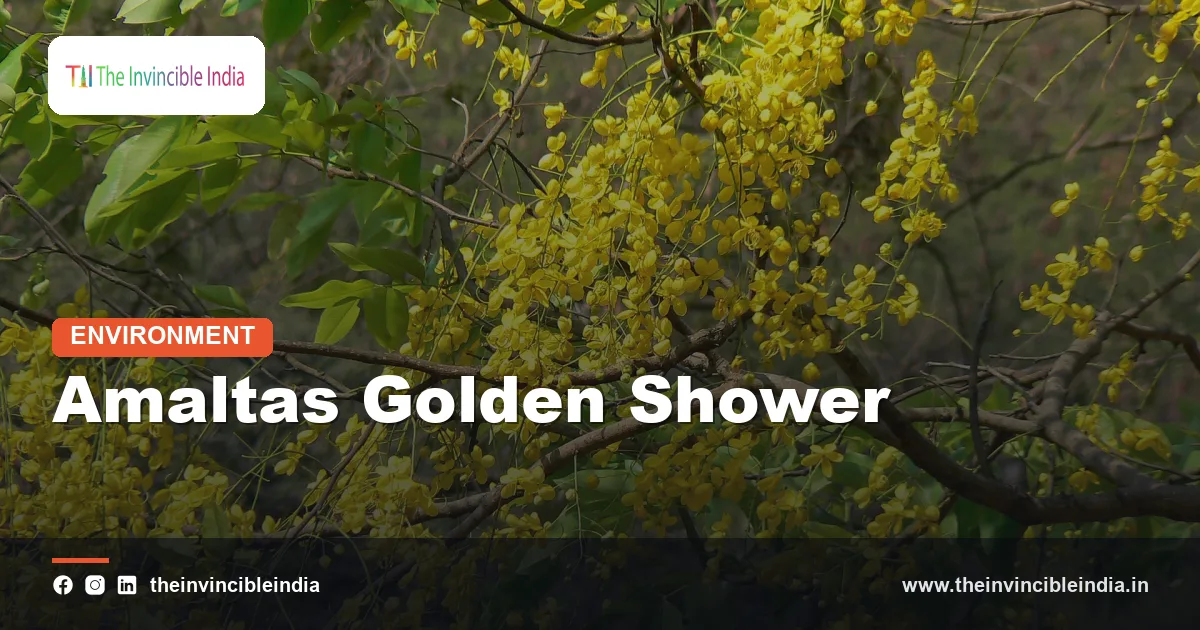
Amaltas (Cassia fistula), also called the golden shower tree or Indian laburnum, is a medium-sized deciduous tree of the pea family that covers itself in long, hanging chains of bright yellow flowers during the Indian summer. Native to the Indian subcontinent and parts of Southeast Asia, amaltas is a familiar sight on city avenues, in gardens and along roadsides from April to June, and it is the state flower of Kerala, where it is called Kani Konna.
Beyond its beauty, amaltas is known for its long cylindrical seed pods, its hard durable wood and its long record in traditional Indian medicine. This explainer covers what amaltas is, how to identify it, when and where it blooms, its cultural role, its uses and the cautions that apply.
| Attribute | Detail |
|---|---|
| Common names | Amaltas (Hindi), golden shower tree, Indian laburnum, purging cassia, konna (Malayalam), sarakkonrai (Tamil), bahava (Marathi), rela (Telugu) |
| Scientific name | Cassia fistula |
| Plant family | Fabaceae (subfamily Caesalpinioideae) |
| Native range | Indian subcontinent and neighbouring Southeast Asia |
| Tree type | Deciduous, 8 to 15 metres tall, with a spreading crown |
| Flowering season | Roughly April to June |
| Official recognition | State flower of Kerala; national flower of Thailand |
| Festival link | Vishu, the Malayalam New Year, where the flowers feature in the Vishukkani arrangement |
| Distinctive feature | Dark, cylindrical pods 30 to 60 centimetres long |
Key Takeaways
- Amaltas (Cassia fistula) is a deciduous tree of the pea family that is famous for pendulous chains of golden-yellow flowers in April to June.
- Amaltas is the state flower of Kerala, where it is known as Kani Konna and is placed in the Vishukkani display on the Malayalam New Year.
- The amaltas fruit is a dark, cylindrical pod up to about 60 centimetres long, containing seeds embedded in sweet, dark, sticky pulp.
- Amaltas pulp has been used in traditional medicine as a mild laxative, but excessive use can cause stomach cramps and other side effects.
- Amaltas is hardy, tolerates heat and dry spells, and is widely planted along avenues, in parks and in home gardens across India.
- Amaltas is also the national flower of Thailand, where the species is known as ratchaphruek.
What is the amaltas tree?
The amaltas tree is a deciduous, medium-sized tree, scientifically Cassia fistula, that belongs to the legume family Fabaceae and is best known for its showy hanging flowers. The English name golden shower describes the way long, yellow flower clusters hang from the branches, while the alternative name Indian laburnum compares it with the yellow-flowered laburnum of Europe.
Amaltas is native to the Indian subcontinent and extends into Sri Lanka, Myanmar, Thailand and parts of Southeast Asia. The tree has been planted widely in tropical and subtropical regions elsewhere, including the Middle East, Africa and the Caribbean, and is common in botanical gardens and city parks.
In Sanskrit texts the tree appears under names such as aragvadha and rajavriksha, the latter meaning king of trees, which points to long-standing regard for the plant in Indian tradition. Regional names vary widely: it is konna in Malayalam, sarakkonrai in Tamil, rela in Telugu, kakke in Kannada, bahava in Marathi, garmalo in Gujarati and sonalu in Bengali.
How can you identify amaltas?
Amaltas can be identified by its compound leaves, its drooping racemes of five-petalled yellow flowers and its long, dark, stick-like pods. When the tree is not in bloom, the pods, which hang from the branches for months, are the most reliable clue.
Leaves
The leaves are pinnately compound, with four to eight pairs of oval leaflets, each leaflet roughly 5 to 15 centimetres long and with a smooth edge. New leaves are pale and glossy, and the tree sheds most of them in late winter or early spring before flowering.
Flowers
The flowers are bright yellow, about 4 to 7 centimetres across, and have five spreading petals and ten stamens of unequal length. They hang in loose racemes that can be 30 to 50 centimetres long and have a mild, sweet fragrance. Individual flowers last only a few days, but successive opening along the raceme keeps the display going for weeks.
Pods and seeds
The pods are cylindrical, 30 to 60 centimetres long, and turn from green to dark brown or nearly black as they mature. Inside, the pod is divided by thin cross partitions into many chambers, each holding a flat, brown seed surrounded by dark, sweet and sticky pulp. The pod does not split open naturally; it drops or decays on the ground.
Bark and habit
Young bark is smooth and grey and becomes rougher with age. The crown is open and spreading, and mature trees often reach 10 to 12 metres, occasionally more.
When does amaltas bloom?
Amaltas blooms from about April to June, during the hottest and driest part of the Indian year, and the peak display in north India usually falls in May. In the south and in Kerala, flowering often begins earlier, in March and April, so that the first flowers are ready for Vishu in mid-April.
The timing of the bloom depends on weather. A cold winter followed by warm, dry weather tends to produce a heavy, synchronised flowering, while unseasonal rain may reduce the display. Trees growing in shade or poor light may flower weakly.
- Leaf fall happens before or during early flowering, so the first flowers may open on partly bare branches.
- Flowering continues over several weeks, with young leaves appearing as the flowers fade.
- Petals drop to form a yellow carpet beneath the tree.
- Pods develop after flowering and ripen over the following months.
Amaltas often flowers together with other summer trees, such as the red gulmohar (Delonix regia), the purple jacaranda in some cities and the pink-flowering cassia species, creating colourful seasonal avenues.
Why is amaltas the state flower of Kerala?
Amaltas is the state flower of Kerala because the tree, known locally as Kani Konna, is closely tied to Vishu, the Malayalam New Year festival celebrated in April. The golden flowers are an essential part of Vishukkani, the auspicious arrangement that family members view first thing on Vishu morning.
The Vishukkani is set up the previous evening in a prayer room or on a table. It typically includes an image of Krishna, a mirror, rice, fruits, vegetables, gold ornaments, a lit lamp and a bunch of konna flowers. The belief is that seeing auspicious objects first on the New Year brings prosperity for the coming year.
Vishu falls in the Malayalam month of Medam, roughly mid-April, which coincides with the peak of konna flowering in Kerala. The festival and the flower are so closely linked that the tree is commonly seen in village homesteads, temple grounds and roadside plantings across the state.
Outside India, the same species is the national flower of Thailand, where it is known as ratchaphruek and is associated with royal tradition and national pride.
Where does amaltas grow in India?
Amaltas grows across most of India, from the plains of the north to the Western Ghats and the southern coast, and from sea level up to about 1,200 metres in suitable warm sites. It is found naturally in dry deciduous and mixed forests and is extensively planted in towns.
The tree tolerates heat, moderate drought and a range of soils, although it grows best in deep, well-drained loam in full sun. Young plants are sensitive to hard frost, so the species is less common in high-altitude and very cold regions.
| Region | Typical amaltas presence |
|---|---|
| North India plains | Common avenue and park tree; peak bloom around May |
| Central India | Occurs in dry deciduous forest and is widely planted |
| Western Ghats and Konkan | Found in forest edges and village groves |
| Kerala and south India | Prominent homestead and festival tree; blooms near Vishu |
| Eastern India | Planted along roads and in gardens; known as sonalu in Bengali |
What are the amaltas pods used for?
The amaltas pods are used mainly in traditional medicine, where the dark pulp inside the pod has been prescribed as a gentle laxative, and the pods are also gathered as a seasonal curiosity because of their length and rattling seeds. Ayurvedic texts name the plant aragvadha and describe its pulp, bark, leaves and flowers in several formulations.
The pulp is dark brown, sweet and slightly sticky, with a smell some people find unpleasant. Within rural communities the pulp has been used in home remedies and in some cattle treatments. However, taking the pulp in large amounts can lead to abdominal cramps, nausea and diarrhoea, so it should be used only on advice from a qualified practitioner.
- The seeds are hard and are not eaten.
- Pods can remain on the tree for many months and add to the winter and spring appearance of the tree.
- Children sometimes play with the dried pods because the seeds rattle inside.
- Pregnant women and people with digestive illnesses are advised to avoid self-medication with the pulp.
How is amaltas used in avenues and gardens?
Amaltas is used as an avenue, park and garden tree because it is quick to establish, tolerates heat, and provides a long and spectacular flowering display during a season when little else is in bloom. Municipal bodies and landscape designers often plant it in mixed lines with gulmohar, jacaranda and kachnar to extend the colour calendar through spring and summer.
The open crown gives light shade, which allows grass or smaller shrubs to grow beneath. Leaf litter is light and decomposes quickly. The main nuisance is falling petals and, later, large pods, which can mess pavements and car parks.
Planting tips
- Choose a sunny site with well-drained soil and room for a spreading crown.
- Avoid planting directly over drains or very close to buildings.
- Water young plants regularly through their first two summers.
- Prune lightly after flowering to remove dead wood and shape the crown.
What other uses does amaltas have?
Amaltas has several secondary uses: its heartwood is hard and durable and has been used for posts, tool handles and farm implements, its bark has been used as a source of tannin, and its flowers and leaves have served in folk preparations. The sapwood is lighter in colour and less durable than the dark heartwood.
Honeybees and other insects visit the flowers for nectar and pollen, so the tree helps local pollinators in the hot season. The trees also support birds, which perch in the crown and eat insects found among the leaves.
Because the tree is a legume of the subfamily Caesalpinioideae, its seeds are borne in pods, but unlike many other legumes, amaltas is not generally relied upon as a major nitrogen-fixing crop tree. Its value lies mostly in its beauty, shade and traditional products.
How do you grow amaltas from seed?
Amaltas is grown from seed by soaking or scarifying the hard seeds to break dormancy and then sowing them in a well-drained mix. Soaking in warm water for a day, or gently nicking the seed coat, usually improves germination, and seedlings emerge within one to three weeks.
Young plants grow quickly and may flower within about four to six years, though flowering age depends on site and care. They need full sun and protection from frost and strong wind during their first years. Mature trees need little care and withstand dry spells.
A few cautions apply. Amaltas can be affected by leaf-eating caterpillars, scale insects and fungal leaf spots, usually without serious harm. Dead wood should be removed because branches may become brittle with age.
How is amaltas different from similar yellow-flowered trees?
Amaltas differs from similar trees mainly by its hanging flower chains, its long dark pods and its summer bloom. Several other trees are often confused with it by casual observers, so the comparison below sets out the main points.
| Tree | Flower colour and form | Season | Fruit |
|---|---|---|---|
| Amaltas (Cassia fistula) | Yellow, five petals, long hanging chains | April to June | Long cylindrical dark pod |
| Gulmohar (Delonix regia) | Red-orange, upright clusters | April to June | Flat woody pod |
| Copper pod (Peltophorum pterocarpum) | Yellow, upright panicles | Spring to monsoon | Flat, reddish pod |
| Laburnum (Laburnum anagyroides) | Yellow, hanging; grows in cool climates | Late spring | Small pea-like pod; poisonous |
| Pink cassia (Cassia javanica) | Pink to coral, in clusters | Summer | Long pod |
Bottom Line
Amaltas is a tree where botany, culture and landscape meet: a hardy summer bloomer, a symbol of the Malayalam New Year and a long-standing plant of Indian traditional medicine. It is an excellent choice for avenues and gardens, while its pods and pulp should be treated with caution.
Frequently Asked Questions
What is amaltas called in English?
Amaltas is called the golden shower tree or Indian laburnum in English, and its botanical name is Cassia fistula. It is also known as the purging cassia because of the traditional laxative use of its pod pulp.
Is amaltas the state flower of Kerala?
Yes, amaltas is the state flower of Kerala, where it is known as Kani Konna or konna. The golden flowers are part of the Vishukkani display on Vishu, the Malayalam New Year in mid-April.
When does amaltas flower in India?
Amaltas flowers mainly between April and June, during the hot dry season, and the peak in north India is usually in May. In Kerala and the south the first flowers can appear in March or April, in time for Vishu.
Are amaltas pods edible?
No, the amaltas pods are not eaten as food. The sweet dark pulp inside has been used in traditional medicine as a mild laxative, but large amounts can cause cramps and diarrhoea, so it should be used only on expert advice.
Is amaltas the same as gulmohar?
No, amaltas and gulmohar are different trees that bloom in the same hot season. Amaltas has hanging chains of yellow flowers and long cylindrical pods, while gulmohar (Delonix regia) has upright clusters of red-orange flowers and flat, woody pods.
Can amaltas be grown in a home garden?
Yes, amaltas can be grown in a home garden if there is enough space for a spreading tree that reaches around 10 metres. It needs full sun and well-drained soil, grows readily from seed, and requires little care once established.
{“@context”:”https://schema.org”,”@graph”:[{“@type”:”FAQPage”,”mainEntity”:[{“@type”:”Question”,”name”:”What is amaltas called in English?”,”acceptedAnswer”:{“@type”:”Answer”,”text”:”Amaltas is called the golden shower tree or Indian laburnum in English, and its botanical name is Cassia fistula. It is also known as the purging cassia because of the traditional laxative use of its pod pulp.”}},{“@type”:”Question”,”name”:”Is amaltas the state flower of Kerala?”,”acceptedAnswer”:{“@type”:”Answer”,”text”:”Yes, amaltas is the state flower of Kerala, where it is known as Kani Konna or konna. The golden flowers are part of the Vishukkani display on Vishu, the Malayalam New Year in mid-April.”}},{“@type”:”Question”,”name”:”When does amaltas flower in India?”,”acceptedAnswer”:{“@type”:”Answer”,”text”:”Amaltas flowers mainly between April and June, during the hot dry season, and the peak in north India is usually in May. In Kerala and the south the first flowers can appear in March or April, in time for Vishu.”}},{“@type”:”Question”,”name”:”Are amaltas pods edible?”,”acceptedAnswer”:{“@type”:”Answer”,”text”:”No, the amaltas pods are not eaten as food. The sweet dark pulp inside has been used in traditional medicine as a mild laxative, but large amounts can cause cramps and diarrhoea, so it should be used only on expert advice.”}},{“@type”:”Question”,”name”:”Is amaltas the same as gulmohar?”,”acceptedAnswer”:{“@type”:”Answer”,”text”:”No, amaltas and gulmohar are different trees that bloom in the same hot season. Amaltas has hanging chains of yellow flowers and long cylindrical pods, while gulmohar (Delonix regia) has upright clusters of red-orange flowers and flat, woody pods.”}},{“@type”:”Question”,”name”:”Can amaltas be grown in a home garden?”,”acceptedAnswer”:{“@type”:”Answer”,”text”:”Yes, amaltas can be grown in a home garden if there is enough space for a spreading tree that reaches around 10 metres. It needs full sun and well-drained soil, grows readily from seed, and requires little care once established.”}}]}]}


