

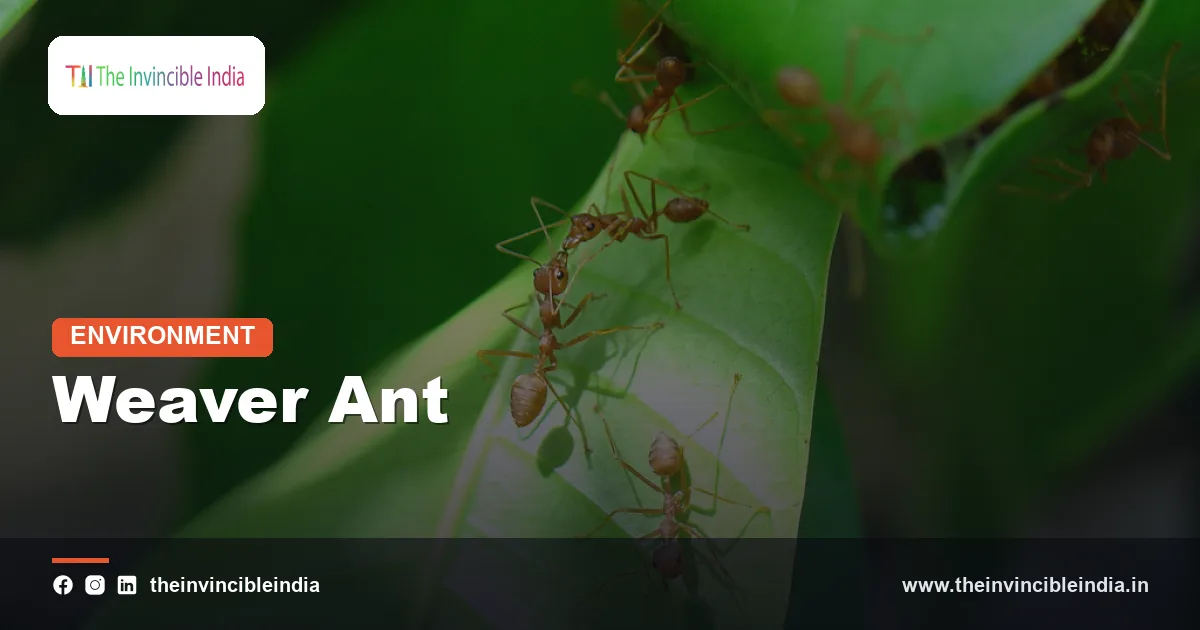
The weaver ant is a tree-dwelling ant, Oecophylla smaragdina in Asia, that builds its nests by stitching living leaves together with silk produced by its own larvae. Found across India in mango, cashew, citrus and forest trees, the reddish-orange weaver ant lives in huge, well-organised colonies, defends its territory fiercely with bites and a spray of formic acid, and has been used for centuries as a natural pest controller.
The weaver ant is often called the red ant or green tree ant, and it is a favourite of ecologists because of its cooperation, its nest-building technique and its effect on the trees it lives in. This explainer covers what the weaver ant is, how it builds its nests, how its colony works, its role in pest control, and its place in the food culture of Odisha and central India.
| Quick Facts | Details |
|---|---|
| Common names | Weaver ant, green tree ant, red ant, leaf-nest ant |
| Scientific name (Asia) | Oecophylla smaragdina (family Formicidae, subfamily Formicinae) |
| Relatives | Only two living species in the genus: the Asian-Australasian O. smaragdina and the African O. longinoda |
| Worker size | Roughly 5 to 10 mm; major workers are larger than minor workers |
| Colour | Orange to reddish-brown, with a greenish tone in some populations |
| Nest type | Leaf nests stitched with larval silk, often many nests across several trees |
| Colony size | Can reach hundreds of thousands of workers |
| Defence | Powerful bite and sprayed formic acid; no functional sting |
| Human uses | Biological pest control in orchards; food in Odisha, Chhattisgarh and Jharkhand; fish bait and bird feed |
Key Takeaways
- The weaver ant, Oecophylla smaragdina, builds nests by pulling living leaves together and fastening them with silk that its own larvae produce.
- A single weaver ant colony can contain hundreds of thousands of workers and occupy many nests spread over several trees, with usually one egg-laying queen per colony.
- Weaver ants cannot sting but defend their trees by biting and spraying formic acid, and they attack caterpillars, beetles and other insects that threaten the host tree.
- Farmers in Asia, Africa and Australia have used weaver ants as a biological control agent in citrus, mango, cashew and cocoa, and the practice is documented from ancient China.
- In parts of Odisha, Chhattisgarh and Jharkhand, weaver ants and their larvae are eaten as a protein-rich food, including the red ant chutney of Mayurbhanj that received a Geographical Indication tag in 2024.
- Weaver ants are harmless to human health apart from painful bites, and they are best left alone on fruit trees where they protect crops.
What is a weaver ant?
A weaver ant is a medium-sized, tree-dwelling ant of the genus Oecophylla that builds nests from living leaves joined by larval silk. The genus has only two living species: Oecophylla smaragdina in tropical Asia and Australia, and Oecophylla longinoda in tropical Africa.
The ants belong to the family Formicidae and the subfamily Formicinae, a group that includes carpenter ants and wood ants. Like all formicines, weaver ants lack a working sting and rely on formic acid as a chemical weapon. Their long legs, large eyes and quick, agile movements make them well suited to life among leaves and branches.
The name comes from the way they build. Workers literally weave a nest from leaves, which makes the weaver ant one of the few animals known to use its own young as a living tool.
Where do weaver ants live in India?
Weaver ants live across the warmer, wetter and forested parts of India, including the Western Ghats, southern India, the east coast, Odisha, Chhattisgarh, Jharkhand, West Bengal and the north-east, as well as the Andaman and Nicobar Islands. They need trees with soft, flexible leaves, warm weather and enough insect prey.
They nest in many tree species, such as mango, jackfruit, citrus, guava, cashew, sal and teak. Weaver ants are rarely found in dry deserts or at high altitude. Within a suitable tree, a colony may use a handful of nests or dozens, and its territory can stretch over many neighbouring trees through trails along branches and across the ground.
How does a weaver ant build its nest?
A weaver ant builds its nest by forming living chains of workers that pull leaf edges together, while other workers hold larvae in their jaws and use them like glue guns to bind the edges with silk. The method is a famous example of insect cooperation.
- Selecting the leaves: Scouts choose leaves that can be bent and joined.
- Pulling: Workers grip the leaf edge, and others grip the workers’ waists to form chains that drag the leaves into position, sometimes across gaps that look too wide for individual ants.
- Stitching: Other workers carry late-stage larvae and gently move them back and forth between the leaf edges. The larvae release silk from glands in their mouthparts, binding the leaves together.
- Finishing: The silk dries into a papery sheet, and the nest becomes a firm, ball-shaped shelter that is waterproof enough for the monsoon.
Adult weaver ants do not produce usable silk themselves. The silk glands belong to the larvae, which is why a nest needs a supply of brood. New nests are added as the colony grows, and old ones may be repaired or abandoned.
How is a weaver ant colony organised?
A weaver ant colony is organised around a single queen, large and small workers, and a short-lived group of winged males and new queens. A colony is a super-organism in which every individual has a role, and no ant is in charge of the others.
| Caste | Role |
|---|---|
| Queen | Lays all the eggs; larger body; usually one functional queen per colony |
| Major workers | Larger, long-legged ants that forage, patrol, defend, hunt and build nests |
| Minor workers | Smaller ants that stay in the nest, tend the brood and look after the queen |
| Males and new queens | Winged reproductives produced seasonally; males die soon after mating |
Colonies are polydomous, meaning the ants occupy several nests at once, and a core nest houses the queen and eggs. Workers recognise nestmates through a shared chemical signature, and they communicate by touch and by laying scent trails. They mark their territory with chemical signals, and encounters with ants from other colonies often end in violent fights.
A colony can take a year or more to become established, and mature colonies can last for several years.
What does a weaver ant eat?
A weaver ant eats insects and other small animals, as well as sugary liquids such as honeydew and plant nectar. The diet is a mix of protein from prey and carbohydrate from sweet secretions.
- Prey: Caterpillars, beetles, bugs, flies and other insects that wander onto the host tree. Workers kill larger prey by swarming over it, pinning it down and spraying it with acid.
- Honeydew: Weaver ants tend sap-sucking insects such as scale insects, mealybugs and some bugs, and drink the sugary honeydew they excrete.
- Nectar: Extra-floral nectaries on certain plants and flowers supply energy.
- Carrion: Dead insects and other small animals are also carried back to the nest.
Food is shared within the colony by mouth-to-mouth feeding, which spreads nutrition quickly among thousands of workers. The larvae are fed protein, which is also what powers their silk production.
Do weaver ants sting or bite?
Weaver ants do not sting, but they bite readily and can spray formic acid, which makes the bite sting and burn, especially on fresh cuts. The bite is not dangerous, although it can be painful and stressful if hundreds of ants run over the skin.
When a tree is disturbed, workers rush out from the nests and swarm over the intruder. They clamp their jaws on the skin and curl their abdomens to squirt formic acid into the bite. For most people, this causes a short-lived burning pain and mild redness. Washing the area with water and applying a cooling lotion is enough. People who are allergic to insect bites should be careful around weaver ant trees.
Anyone climbing a mango or cashew tree to pick fruit should look for the leaf nests first, which look like tight clusters of dried leaves, and avoid shaking the branches.
How are weaver ants used for pest control?
Weaver ants are used for pest control by encouraging colonies in orchards, where the ants hunt insects that damage fruit and foliage and keep many pests away from the trees. It is among the oldest known forms of biological control.
The earliest written record comes from China, where, in a text dating to around the 4th century CE, farmers placed nests of a citrus-dwelling ant in orchards to protect the fruit. Later, the practice spread across South-East Asia. Modern field studies in cashew, mango, citrus, cocoa and other tree crops in Australia, Africa and Asia have found that trees with weaver ants often have less pest damage and sometimes better yields and fruit quality than those without them.
Advantages and drawbacks
- Advantages: low cost, natural and self-renewing; reduces the need for pesticides; protects against a range of pests.
- Drawbacks: the ants bite pickers; they tend honeydew-producing insects such as mealybugs, which can increase local numbers of those pests; and conventional pesticide sprays can destroy the colonies.
The benefits outweigh the drawbacks in many orchards, especially where growers prefer to minimise chemicals. Researchers also suggest that the ants should be encouraged by connecting tree canopies with ropes or branches and by providing sugar sources in dry periods.
Why do people in Odisha and Chhattisgarh eat weaver ants?
People in parts of Odisha, Chhattisgarh and Jharkhand eat weaver ants because they are an accessible, protein-rich traditional food with a tangy, lemony flavour from the formic acid. Tribal and rural communities in these regions collect nests from trees and use the ants and their larvae in chutneys.
The best known preparation is the red ant chutney, known as kai chutney in Odisha, made by crushing ants with ingredients such as ginger, garlic, chilli and salt. The red ant chutney of the Mayurbhanj district was given a Geographical Indication (GI) tag in 2024. Similar chutneys, sometimes called chapda in Chhattisgarh, are made in the Bastar region and are traditionally taken during the monsoon months, when they are valued for being refreshing and are believed by communities to relieve cold and fatigue.
The chutney is high in protein and contains several vitamins and minerals, but any health claims should be treated cautiously. Elsewhere in Asia, weaver ant larvae and pupae are eaten, sold as bird feed and used as fish bait. Collection can harm colonies if it is excessive, so sustainable harvesting is important.
What are the natural enemies of weaver ants?
The natural enemies of weaver ants include pangolins, birds, spiders, lizards and other ant species, as well as parasites and diseases. Several animals have evolved to feed on ants directly, and a few mimic or exploit them.
- Pangolins and other ant-eaters: have sticky tongues and tough skins that protect them from bites.
- Birds: some birds, such as drongos and certain tits, raid nests for larvae.
- Spiders: some jumping spiders mimic ants or prey on workers.
- Competing ants: other tree-dwelling ant species fight for territory.
- Humans: harvest nests for food and bait.
Despite its aggressive reputation, a colony can lose ground when its host trees are felled, when broad-spectrum pesticides are sprayed, or when climate and land use change rapidly.
Are weaver ants good or bad for trees?
Weaver ants are generally good for trees, since they remove leaf-eating insects and defend the plant, but they can be a mixed blessing because they also protect honeydew-producing insects. The net effect depends on the crop and the pest.
In fruit and plantation crops such as mango, cashew and citrus, the ants are usually seen as allies. In crops where the sap-suckers they farm are major pests, farmers may need a balanced strategy. The ants also modify the nest tree, because leaf stitching can bend and sometimes dry out leaves, although healthy trees tolerate it well.
Bottom Line
The weaver ant is a remarkable insect: a leaf-stitching, silk-using, cooperative builder whose colonies guard trees, feed people in tribal India and illustrate natural pest control. Respecting these ants and avoiding indiscriminate spraying lets them keep doing useful work in India’s orchards and forests.
Frequently Asked Questions
How does a weaver ant make its nest?
A weaver ant makes its nest by joining living leaves with silk. Workers form chains to pull the leaf edges together, while other workers hold larvae and move them back and forth along the seam. The larvae release silk that glues the leaves into a firm nest.
Do weaver ants sting?
No, weaver ants do not sting, because they lack a working stinger. They defend themselves by biting and spraying formic acid into the wound, which causes a burning sensation. The pain is usually brief, and the ants are not dangerous except to people who are allergic.
Are weaver ants good for mango and cashew trees?
Yes, weaver ants usually benefit mango, cashew and citrus trees by hunting insects that attack leaves and fruit. Studies in Asia, Africa and Australia show that trees with weaver ants often suffer less pest damage. One drawback is that the ants protect honeydew-producing insects such as mealybugs.
Do people really eat weaver ants in India?
Yes, people in parts of Odisha, Chhattisgarh and Jharkhand eat weaver ants and their larvae, often as a chutney. The red ant chutney from Mayurbhanj in Odisha received a Geographical Indication tag in 2024. The chutney has a tangy flavour from formic acid and is also valued for its protein.
How big is a weaver ant colony?
A mature weaver ant colony can contain hundreds of thousands of workers and occupy many leaf nests across several trees. A colony usually has one egg-laying queen, and the workers are divided into larger foragers and defenders and smaller nest workers. The scale of the colony is the reason it can control pests so effectively.
What is the difference between a weaver ant and a red ant?
Weaver ant is the specific name for ants of the genus Oecophylla, which build leaf nests in trees. Red ant is a loose popular name used for several unrelated reddish ants, including the weaver ant in some regions. A weaver ant can be recognised by its stitched leaf nest and long legs, while many other red ants nest in soil.
{“@context”:”https://schema.org”,”@graph”:[{“@type”:”FAQPage”,”mainEntity”:[{“@type”:”Question”,”name”:”How does a weaver ant make its nest?”,”acceptedAnswer”:{“@type”:”Answer”,”text”:”A weaver ant makes its nest by joining living leaves with silk. Workers form chains to pull the leaf edges together, while other workers hold larvae and move them back and forth along the seam. The larvae release silk that glues the leaves into a firm nest.”}},{“@type”:”Question”,”name”:”Do weaver ants sting?”,”acceptedAnswer”:{“@type”:”Answer”,”text”:”No, weaver ants do not sting, because they lack a working stinger. They defend themselves by biting and spraying formic acid into the wound, which causes a burning sensation. The pain is usually brief, and the ants are not dangerous except to people who are allergic.”}},{“@type”:”Question”,”name”:”Are weaver ants good for mango and cashew trees?”,”acceptedAnswer”:{“@type”:”Answer”,”text”:”Yes, weaver ants usually benefit mango, cashew and citrus trees by hunting insects that attack leaves and fruit. Studies in Asia, Africa and Australia show that trees with weaver ants often suffer less pest damage. One drawback is that the ants protect honeydew-producing insects such as mealybugs.”}},{“@type”:”Question”,”name”:”Do people really eat weaver ants in India?”,”acceptedAnswer”:{“@type”:”Answer”,”text”:”Yes, people in parts of Odisha, Chhattisgarh and Jharkhand eat weaver ants and their larvae, often as a chutney. The red ant chutney from Mayurbhanj in Odisha received a Geographical Indication tag in 2024. The chutney has a tangy flavour from formic acid and is also valued for its protein.”}},{“@type”:”Question”,”name”:”How big is a weaver ant colony?”,”acceptedAnswer”:{“@type”:”Answer”,”text”:”A mature weaver ant colony can contain hundreds of thousands of workers and occupy many leaf nests across several trees. A colony usually has one egg-laying queen, and the workers are divided into larger foragers and defenders and smaller nest workers. The scale of the colony is the reason it can control pests so effectively.”}},{“@type”:”Question”,”name”:”What is the difference between a weaver ant and a red ant?”,”acceptedAnswer”:{“@type”:”Answer”,”text”:”Weaver ant is the specific name for ants of the genus Oecophylla, which build leaf nests in trees. Red ant is a loose popular name used for several unrelated reddish ants, including the weaver ant in some regions. A weaver ant can be recognised by its stitched leaf nest and long legs, while many other red ants nest in soil.”}}]}]}


