

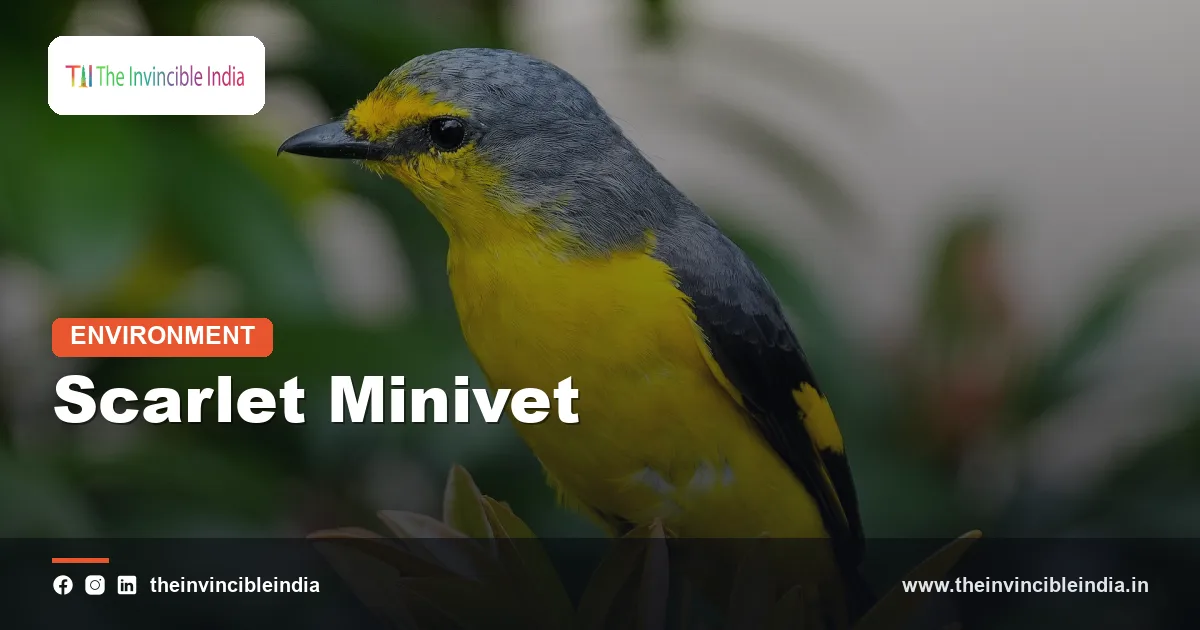
The scarlet minivet is a small, brilliantly coloured forest songbird of the family Campephagidae, in which the adult male is glossy black above with vivid scarlet-red underparts and wing patches, and the female is grey-olive with yellow in the same places. Found in wooded country across India, from the Himalayan foothills and the north-east to the Western Ghats, it hunts insects in the upper canopy in lively, noisy flocks.
The scarlet minivet is one of the most eye-catching birds of Indian forests, often described as a flame moving through the leaves. This article explains its identification, taxonomy, range, diet, flock behaviour, breeding and conservation, and shows how to tell it from its smaller, more widespread relative, the small minivet.
| Quick Facts: Scarlet Minivet | |
|---|---|
| Scientific name | Pericrocotus speciosus (older and some regional treatments use Pericrocotus flammeus) |
| Family | Campephagidae (cuckoo-shrikes, trillers and minivets) |
| Size | Roughly 19 to 20 cm, with a fairly long, graduated tail |
| Male plumage | Glossy black head, back and wings with scarlet-red breast, belly, rump and wing bars |
| Female plumage | Grey-olive upperparts with yellow forehead, breast, rump and wing bars |
| Range in India | Himalayan foothills, north-east, Eastern and Western Ghats and other well-wooded hill and forest regions |
| Habitat | Broadleaved evergreen and moist deciduous forest, forest edges and well-wooded country |
| Diet | Mostly insects and caterpillars taken in the canopy; occasionally some fruit |
| Conservation status | IUCN Least Concern; protected under the Wildlife (Protection) Act, 1972 |
Key Takeaways
- The scarlet minivet is a canopy-dwelling songbird of Indian forests in which the male is black and scarlet and the female is grey-olive and yellow.
- Scarlet minivets live in lively flocks of a dozen or more birds that move through treetops, calling constantly while they hunt for insects and caterpillars.
- The scarlet minivet belongs to the family Campephagidae, which groups cuckoo-shrikes, trillers and minivets, and whose members have loosely attached rump feathers that can be fluffed up.
- The scarlet minivet is larger than the small minivet, and its male is scarlet-red where the small minivet male is orange and grey.
- Scarlet minivets build a small, neat cup nest high in a tree, camouflaged with lichen and bound with spider silk, and the pair share nesting duties.
- The scarlet minivet is classified as Least Concern by the IUCN, but it depends on tall, intact forest canopy, so extensive tree felling reduces its habitat.
What is the scarlet minivet?
The scarlet minivet is a forest passerine in the genus Pericrocotus, a group of small, brightly coloured insect-eating birds found in South and South-East Asia. Minivets are named for their resemblance to miniature versions of the larger cuckoo-shrikes, and they are among the most colourful members of the family.
The scarlet minivet is a sexually dimorphic species, which means the male and female look different. This feature, together with the sociable habits of the group, makes the species one of the easiest forest birds to recognise even for beginners. The name “scarlet” refers to the male’s deep red colour, a shade that is richer and redder than the orange of many other minivets.
Taxonomy is not fully settled. Older field guides treated several red minivets as a single, widespread species called the scarlet minivet, with the scientific name Pericrocotus flammeus. Later work led some authorities to split the group into separate species, and a separate orange minivet is recognised in some checklists, with different checklists assigning the peninsular and island populations differently. For readers, the practical point is that “scarlet minivet” in India usually refers to the large red-and-black minivet of forest canopies, and local differences in plumage exist between regions.
How can you identify a scarlet minivet?
A scarlet minivet can be identified by size and colour: a slim, long-tailed bird of about 19 to 20 cm, with a glossy black head and back and bright scarlet underparts in the male, or a yellow-and-olive pattern in the female. The wings show a red or yellow patch, forming a wing bar that flashes in flight.
The male
The adult male has a glossy black head, throat, back and wings, with a scarlet-red breast, belly and rump. A scarlet bar crosses the black wing, and the outer tail feathers carry red patches. When the bird flies across a forest gap in sunlight, it looks like a drifting spark.
The female
The female is greyer above, with an olive-grey back and a yellow forehead, throat, breast and belly. The yellow rump and wing bar replace the male’s red, and the tail has yellow edges. The pattern closely matches the male’s, with red swapped for yellow.
Young birds
Young birds resemble the female, and young males gradually acquire patches of red as they mature. A bird showing mixed yellow and orange on a black base is typically a young male in transition.
Similar species
- Small minivet: a smaller bird with an orange male and a grey back; found in lighter woodland and gardens.
- Long-tailed minivet: a longer-tailed species of the Himalayas with a different head pattern.
- Short-billed minivet: a bird of the Himalayan and north-eastern forests with a short bill and scarlet male plumage.
- Rosy minivet: a Himalayan species with a pinkish tone in the male.
Where does the scarlet minivet live in India?
The scarlet minivet lives in forested regions across India, including the Himalayan foothills, the north-east, parts of central and eastern India and the forests of the Western Ghats and other peninsular hills. Its distribution is patchy because it depends on well-grown forest with tall trees.
The bird prefers evergreen, semi-evergreen and moist deciduous forest, where it spends most of its time high in the canopy. It also frequents forest edges, clearings, riverine woodland and tall plantations of shade trees. In some places, small groups visit well-wooded gardens and tea or coffee estates, though it is much less commonly seen in towns than the small minivet.
The species, or closely related forms treated as the same species in older books, occurs in Sri Lanka and across mainland South-East Asia, covering a wide belt of tropical Asian forest. In India, it tends to be commoner in the hills and at moderate elevations. Some altitudinal movement takes place, with birds moving to lower altitudes in winter in colder regions.
What does the scarlet minivet eat?
The scarlet minivet eats mainly insects, such as caterpillars, beetles, bugs, moths and flying insects, which it gleans from leaves and branches or catches in short aerial sallies. It sometimes takes small fruit and berries, but these form only a small part of its diet.
Feeding is acrobatic. A minivet flits from branch to branch, hovering briefly to pluck an insect from the underside of a leaf, or darts out to snatch a flying insect and returns to the same perch. The slender, slightly hooked bill is well adapted for this kind of precise picking.
Because the birds forage collectively, they cover trees quickly and flush insects for each other. Scarlet minivets often join mixed hunting flocks of other small forest birds, such as drongos, warblers, tits and flycatchers, where each species feeds in a slightly different way. This arrangement improves feeding efficiency and provides extra eyes to watch for predators.
Why do scarlet minivets live in flocks?
Scarlet minivets live in flocks because group foraging helps them find insects and detect predators more efficiently than a lone bird could. The flocks usually contain a dozen or more birds, with males and females mixed, and they keep up a constant chorus of thin, whistling calls.
The call is a clear, high-pitched whistle, repeated in a chain as the group moves, and it helps the flock stay together in dense foliage. A flock tends to move from tree to tree in a loose stream, with individual birds crossing gaps one after another.
During the breeding season the flock breaks up into pairs. Outside it, flocks may merge into larger groups when food is abundant, and they roost together at night in a tree. The social structure of the flock is flexible: individuals may join and leave, and it is common to see small groups of males separated from mixed groups.
How does the scarlet minivet breed and nest?
The scarlet minivet breeds by building a small, shallow cup nest high on a horizontal branch, usually well above the ground, and lays a small clutch of speckled eggs. The nest is camouflaged with lichen and bound with spider silk, so that it looks like a knot on the branch.
Both sexes build the nest, using fine twigs, grass, bark strips and cobweb, and both take turns incubating the eggs and feeding the chicks. The usual clutch is about three or four eggs. The breeding season varies by region, falling mostly in spring and early summer in northern and hill areas and at somewhat different times in the south.
The nest’s small size and camouflage are its main defences. Pairs tend to select a spot among thin outer branches, where larger predators are less likely to reach it. When intruders approach, the adults give sharp alarm calls and may mob predators.
| Feature | Scarlet minivet | Small minivet |
|---|---|---|
| Approximate length | 19 to 20 cm | 15 to 16 cm |
| Male colour | Glossy black with scarlet-red | Grey and black with orange-red |
| Female colour | Grey-olive with yellow | Grey with pale yellow |
| Habitat | Tall forest canopy | Open woodland, gardens and scrub |
| Typical group size | Dozens at times; mixed flocks | Small to medium flocks |
| Nest | Cup of twigs, lichen and spider silk high in a tree | Smaller cup on a thin fork |
What is special about the minivet family?
The minivets, cuckoo-shrikes and trillers of the family Campephagidae are distinguished by long, pointed wings, a slender body and stiff, loosely attached rump feathers that can be raised in display or alarm. The family name means “caterpillar eaters”, reflecting the importance of caterpillars in the diet.
Within the family, minivets form a distinct group of smaller birds with strongly coloured males. The colours are produced by carotenoid pigments, which birds cannot make themselves and obtain from their food, so the brightness of a male may signal good foraging success. Scientists studying plumage in other red and yellow birds have suggested that brighter males may have better access to quality food, though this has not been tested thoroughly in each minivet species.
The family is widespread in the Old World tropics, and India has several minivet species, including the scarlet, small, long-tailed, short-billed, rosy, grey-chinned and ashy minivets. Birdwatchers often single them out because of the vivid males and flocking behaviour.
Is the scarlet minivet threatened?
The scarlet minivet is not currently threatened and is listed as Least Concern by the IUCN because of its wide range across South and South-East Asia. In India, it is a protected wild bird under the Wildlife (Protection) Act, 1972.
The species is nevertheless sensitive to loss of tall forest. Logging, clearing for agriculture and plantations, fragmentation and the conversion of mixed forest into monoculture reduce its habitat. The bird tolerates some degraded forest, but cannot live in treeless landscapes. Local trapping for the cage-bird trade occurs rarely, and the species does not adapt well to captivity.
Helpful measures
- Protect large, mature trees and forest corridors in the Western Ghats, Himalayas and north-east.
- Maintain native canopy trees on tea, coffee and cardamom estates.
- Avoid pesticide spraying in forest edges and plantations that harm insect prey.
- Support citizen-science bird counts, which help to track changes in range.
How can you see a scarlet minivet?
A scarlet minivet is best seen in good forest in the morning, when flocks are active in the canopy, and the easiest way to locate a flock is to listen for the thin, repeated whistling calls and then look up. Binoculars are essential because the birds are usually high in the trees.
- Visit well-wooded sanctuaries and forest trails in the hills, particularly near forest openings and edges where light reaches the canopy.
- Scan the tops of tall trees for flashes of red, and follow the birds as they cross gaps.
- Check roadside trees near streams in forested regions, where flocks sometimes come low.
- Be patient: a moving flock can pass quickly, and males show best in sunlight.
The scarlet minivet is a good bird for photography and bird counts because of its bold colour, but care should be taken not to disturb nests. Photographers should avoid playing calls at nesting pairs.
Bottom Line
The scarlet minivet is a vivid, social canopy bird whose red-and-black males and yellow females make it one of the most recognisable songbirds of Indian forests. Protecting tall, intact canopy trees is the best way to safeguard it.
Frequently Asked Questions
What is a scarlet minivet?
The scarlet minivet is a small songbird of the family Campephagidae, found in Indian forests. The male is glossy black with scarlet-red underparts, while the female is grey-olive with yellow. It lives in flocks and feeds on insects high in the canopy.
How is a male scarlet minivet different from a female?
The male scarlet minivet has black upperparts and scarlet-red underparts, rump and wing bars. The female has grey-olive upperparts and yellow in the same places. The pattern is the same, but red is replaced by yellow in the female.
Where can you find scarlet minivets in India?
Scarlet minivets can be found in forests across India, including the Himalayan foothills, the north-east, the Eastern Ghats and the Western Ghats. They prefer tall evergreen and moist deciduous forest with a good canopy. They are less often seen in towns than the small minivet.
What do scarlet minivets eat?
Scarlet minivets eat mainly insects such as caterpillars, beetles, bugs and moths. They glean them from leaves or catch them in short flights from a perch. Fruit forms only a small part of the diet.
Is the scarlet minivet the same as the small minivet?
The scarlet minivet is not the same as the small minivet; they are different species of the same genus. The scarlet minivet is larger and the male is scarlet-red and black, whereas the small minivet is smaller and the male is orange and grey. The scarlet minivet prefers forest canopy, while the small minivet is common in open woodland and gardens.
Is the scarlet minivet protected in India?
The scarlet minivet is protected in India under the Wildlife (Protection) Act, 1972, which prohibits hunting and capture of wild birds. The IUCN lists it as Least Concern because of its wide range. Its long-term survival still depends on keeping tall forest intact.
{“@context”:”https://schema.org”,”@graph”:[{“@type”:”FAQPage”,”mainEntity”:[{“@type”:”Question”,”name”:”What is a scarlet minivet?”,”acceptedAnswer”:{“@type”:”Answer”,”text”:”The scarlet minivet is a small songbird of the family Campephagidae, found in Indian forests. The male is glossy black with scarlet-red underparts, while the female is grey-olive with yellow. It lives in flocks and feeds on insects high in the canopy.”}},{“@type”:”Question”,”name”:”How is a male scarlet minivet different from a female?”,”acceptedAnswer”:{“@type”:”Answer”,”text”:”The male scarlet minivet has black upperparts and scarlet-red underparts, rump and wing bars. The female has grey-olive upperparts and yellow in the same places. The pattern is the same, but red is replaced by yellow in the female.”}},{“@type”:”Question”,”name”:”Where can you find scarlet minivets in India?”,”acceptedAnswer”:{“@type”:”Answer”,”text”:”Scarlet minivets can be found in forests across India, including the Himalayan foothills, the north-east, the Eastern Ghats and the Western Ghats. They prefer tall evergreen and moist deciduous forest with a good canopy. They are less often seen in towns than the small minivet.”}},{“@type”:”Question”,”name”:”What do scarlet minivets eat?”,”acceptedAnswer”:{“@type”:”Answer”,”text”:”Scarlet minivets eat mainly insects such as caterpillars, beetles, bugs and moths. They glean them from leaves or catch them in short flights from a perch. Fruit forms only a small part of the diet.”}},{“@type”:”Question”,”name”:”Is the scarlet minivet the same as the small minivet?”,”acceptedAnswer”:{“@type”:”Answer”,”text”:”The scarlet minivet is not the same as the small minivet; they are different species of the same genus. The scarlet minivet is larger and the male is scarlet-red and black, whereas the small minivet is smaller and the male is orange and grey. The scarlet minivet prefers forest canopy, while the small minivet is common in open woodland and gardens.”}},{“@type”:”Question”,”name”:”Is the scarlet minivet protected in India?”,”acceptedAnswer”:{“@type”:”Answer”,”text”:”The scarlet minivet is protected in India under the Wildlife (Protection) Act, 1972, which prohibits hunting and capture of wild birds. The IUCN lists it as Least Concern because of its wide range. Its long-term survival still depends on keeping tall forest intact.”}}]}]}


