

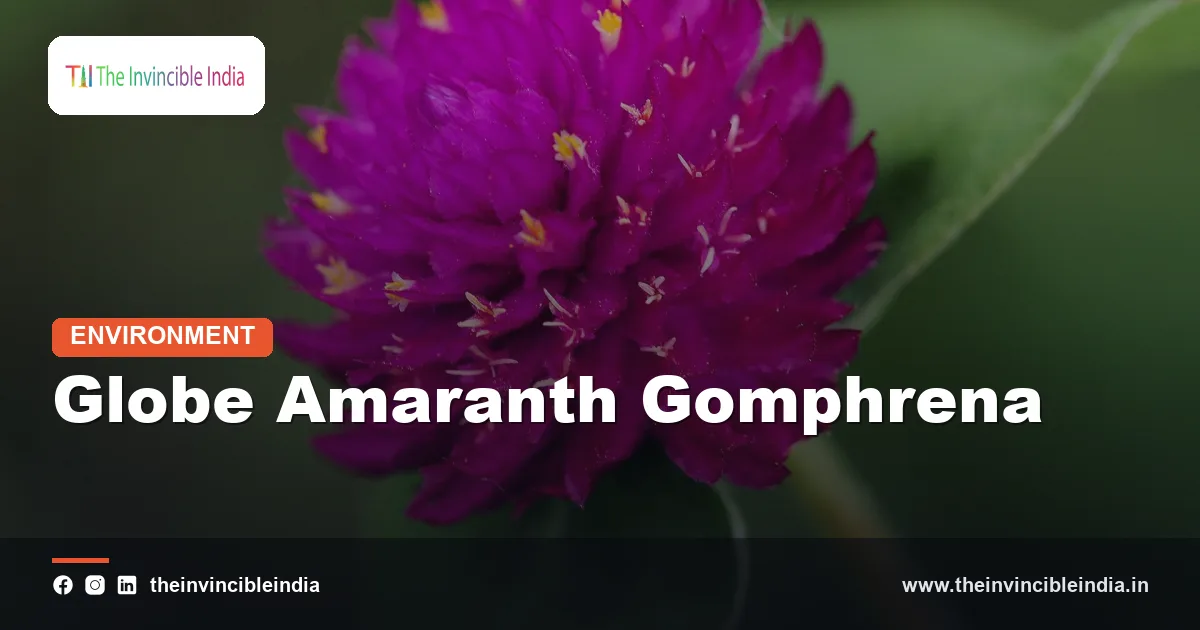
The globe amaranth (Gomphrena globosa), known in South India as vadamalli and widely called gomphrena, is a hardy annual plant of the amaranth family whose round, papery, clover-like flower heads keep their colour for months after being cut and dried. Native to Central America, the globe amaranth has become a common sight in Indian gardens, roadside plantings and flower markets, where its magenta, purple, pink and white heads are strung into garlands.
This guide explains what the globe amaranth is, why it is called an everlasting flower, how it is grown and dried, how it is used in garlands and crafts, and how it differs from related plants such as the cockscomb. It sticks to stable botanical facts. Last updated: 30 October 2026.
| Attribute | Details |
|---|---|
| Common names | Globe amaranth, gomphrena, bachelor’s button, everlasting flower, vadamalli (Tamil) |
| Scientific name | Gomphrena globosa |
| Family | Amaranthaceae |
| Origin | Central America (the region around Panama and Guatemala), now naturalised and cultivated in the tropics worldwide |
| Where grown in India | Gardens, farms and roadsides across the country; especially common in Tamil Nadu, Kerala, Karnataka and other southern states |
| Flowering season | Mainly the rainy season and after, though it can flower for much of the year in warm climates |
| Main uses | Garland and loose flower, dried flower, ornamental bedding, butterfly plant |
| Notable facts | The coloured part is made of papery bracts, not petals; the pigment gomphrenin is named after the genus |
Key Takeaways
- The globe amaranth (Gomphrena globosa) is an annual plant in the family Amaranthaceae that is native to Central America.
- The globe amaranth is called vadamalli in Tamil, and its round flower heads are widely used in South Indian garlands.
- The colourful part of a globe amaranth flower head consists of papery bracts, which is why the flower retains its colour when dried.
- The globe amaranth tolerates heat, drought and poor soil, and it blooms through the rains and into winter.
- The globe amaranth is a different plant from the grain and leaf amaranths, although all of them belong to the same family, Amaranthaceae.
- The globe amaranth attracts butterflies and bees and is a popular choice for dried flower arrangements and crafts.
What Is the Globe Amaranth?
The globe amaranth is a bushy, branching annual herb about 30 to 60 cm tall that bears round, clover-shaped flower heads about 2 to 4 cm across in shades of magenta, purple, pink, red-orange and white. The plant has opposite oval leaves, slightly hairy stems and flower heads held singly or in small groups at the tips of branches.
The scientific name Gomphrena globosa is derived from an old Latin plant name, gromphaena, used by the Roman naturalist Pliny for a kind of amaranth, while the species name globosa means globe-like and refers to the round flower heads. The plant is grown as an annual in most climates, but in the tropics it can live longer.
The globe amaranth belongs to the family Amaranthaceae, which also contains spinach, beet, quinoa, cockscomb and the grain amaranths. The family is notable for plants that produce betalain pigments, a distinctive group of red and yellow colours.
Why Is the Globe Amaranth Called Vadamalli and Gomphrena?
The globe amaranth is called vadamalli in Tamil, a name usually explained as the never-fading jasmine, because malli means jasmine and the flower heads do not wither quickly, and the name gomphrena is the genus name used in scientific and horticultural writing. Other English names include bachelor’s button, everlasting flower and, in some books, immortelle.
- Vadamalli: the common name in Tamil Nadu and Kerala, used in markets and gardens.
- Gomphrena: the genus name, commonly used by gardeners and nurseries.
- Bachelor’s button: an English name shared with several other round-headed flowers, such as the cornflower.
- Everlasting flower: a description of how the flower heads stay fresh-looking when dried.
Because common names overlap, scientists use the botanical name Gomphrena globosa to identify the plant without confusion.
Why Is the Globe Amaranth Called an Everlasting Flower?
The globe amaranth is called an everlasting flower because its colourful bracts are dry and papery, so the flower head keeps its shape and colour for months after being picked and dried. The true flowers of the plant are tiny and hidden among the bracts, and it is the bracts that give each head its colour.
Plants with this quality are sometimes called straw flowers or immortelles. Others in the group include strawflower (Xerochrysum), statice and some everlasting daisies. Everlasting flowers are valued for dry bouquets, wreaths and craft work, because they do not need water to stay attractive.
The pigments in the globe amaranth belong to the betalain group, and one of them, gomphrenin, is named after the genus Gomphrena. These pigments are responsible for the magenta and purple tones of the common form.
Where Does the Globe Amaranth Grow in India?
The globe amaranth grows in gardens, farms, roadsides and wasteland across India, and it is particularly common in southern states such as Tamil Nadu, Kerala and Karnataka, where it is grown for garlands and decoration. It is tolerant of heat and sun and does well in tropical and subtropical regions.
In many parts of the country the plant has become naturalised, meaning that it grows and self-seeds without deliberate planting. It is not considered a serious invasive weed, though it does spread from seed in warm, open ground. The globe amaranth is rarely a plant of dense forest and is found mainly in cultivated or disturbed land.
In cooler hill regions the plant is grown as a summer annual because frost kills it. In the plains it flowers through the monsoon and the post-monsoon months, and in warm southern districts it can produce blooms for much of the year.
How Is the Globe Amaranth Grown?
The globe amaranth is grown from seed sown in a sunny spot in warm weather, and it needs little water or fertiliser once established. It grows well in ordinary garden soil, including sandy and poor soils, as long as the drainage is good.
Growing guide
- Sowing time: sow at the start of the rains or in spring, when temperatures are consistently warm.
- Seed treatment: the seeds are covered with fluffy hairs, so soaking them for a few hours or rubbing off the fluff helps germination.
- Light: choose a position with full sun for at least six hours a day.
- Soil: well-drained soil of moderate fertility; rich soils give leafy plants with fewer flowers.
- Spacing: about 25 to 30 cm between plants.
- Watering: moderate in the early stages; established plants tolerate dry spells.
- Pinching: pinching the tips of young plants encourages bushy growth and more flower heads.
Seeds germinate in about one to two weeks in warm conditions, and plants start to flower roughly two to three months after sowing. The plant is easy to grow in pots and large containers, which makes it suitable for balconies and terraces.
Care and common problems
The globe amaranth needs very little care once it is established, and regular picking of flowers encourages the plant to produce more. Overwatering and heavy shade are the main causes of poor flowering and leaf spots. Aphids and leaf-eating caterpillars occasionally attack young plants, and they can usually be controlled by hand-picking, a jet of water or a mild soap spray. Because the plant sets seed freely, gardeners who do not want it to spread should remove the oldest heads before the seeds ripen. Seed saved from healthy plants can be sown the next season, although colours may vary in the offspring.
What Are the Varieties and Related Species?
The globe amaranth has tall and dwarf varieties in several colours, and the genus Gomphrena contains about a hundred species, some of which are also grown as ornamentals. The standard colours of Gomphrena globosa are purple-magenta, pink and white, and breeders have added deeper reds and bicolour forms.
| Plant | Scientific name | Distinguishing feature |
|---|---|---|
| Globe amaranth | Gomphrena globosa | Round, clover-like heads in magenta, pink or white |
| Strawberry fields gomphrena | Gomphrena haageana | Smaller, red-orange conical heads on wiry stems |
| Cockscomb | Celosia argentea | Crested or plumed flower heads in the same family |
| Grain amaranth | Amaranthus species | Tall plants grown for leaves and seeds |
| Strawflower | Xerochrysum bracteatum | Another everlasting flower, but in the daisy family |
Gomphrena haageana, a Mexican species, is grown as an ornamental in some Indian gardens and can be crossed with the globe amaranth to produce hybrids. The cockscomb is a closer relative and is also used in Indian garlands and as a dried flower.
How Is the Globe Amaranth Used in Garlands and Crafts?
The globe amaranth is used in India as a loose flower for garlands, hair adornments and temple and wedding decorations, and as a dried flower in bouquets, wreaths and handmade crafts. The round heads are tough, so they can be strung easily and stay fresh for longer than many softer flowers.
- Garlands: vadamalli heads are often strung with jasmine, marigold, crossandra or other flowers to add colour and bulk.
- Decoration: the flowers are used in festival and wedding decor, stage settings and offerings.
- Dried arrangements: the heads are dried upside down and used in bouquets and wreaths.
- Crafts: pressed or dried heads are used in cards, candles, resin work and potpourri.
- Natural colour: the pigment-rich bracts have been used experimentally as a source of natural dye.
Flower sellers value the globe amaranth because it is long-lasting and cheap to produce. A small plot can supply a steady stream of flowers over several months.
How Do You Dry Globe Amaranth Flowers?
To dry globe amaranth flowers, cut the stems when the heads are fully coloured but before they start to fade, strip the lower leaves, tie the stems in small bunches and hang them upside down in a dry, airy, shaded place for one to two weeks. Drying in the shade preserves the colour better than direct sun.
Flowers should be picked on a dry day, after the morning dew has evaporated. Once the stems are stiff and the heads feel papery, they can be stored in a dry box or arranged in a vase without water. Silica gel can be used to dry individual heads for crafts. Dried heads keep their colour for many months if kept away from damp and strong light.
Is the Globe Amaranth Useful to Wildlife and Is It Safe?
The globe amaranth is a useful nectar plant for butterflies, bees and other small insects, and it is generally regarded as a safe, non-toxic ornamental. The flower heads provide a steady supply of nectar over many weeks, which is useful for garden pollinators during the rainy season.
In some parts of the world the flowers have been used in traditional herbal teas and folk medicines, but these uses are not well documented by modern science, and the plant is mainly grown for decoration. Anyone considering a medicinal or edible use should check with a qualified practitioner. Diseases are few, though the plant can suffer from leaf spots in wet weather and from aphids or caterpillars occasionally.
Bottom Line
The globe amaranth, or vadamalli, is a tough, cheerful everlasting flower that thrives in Indian heat, supports pollinators and gives garlands and dried bouquets their lasting colour. It is easy to grow from seed and rewards even a beginner with months of round, jewel-like flower heads.
Frequently Asked Questions
What is the globe amaranth called in Tamil?
The globe amaranth is called vadamalli in Tamil. The same plant is widely known as gomphrena, and its botanical name is Gomphrena globosa.
Where is the globe amaranth originally from?
The globe amaranth is originally from Central America. It has been spread by gardeners across the tropics and is now naturalised and widely grown in India.
Why does the globe amaranth keep its colour when dried?
The globe amaranth keeps its colour when dried because the coloured part is made of dry, papery bracts rather than soft petals. These bracts contain stable pigments and contain little moisture, so the flower head holds its shape and colour for months.
When does the globe amaranth bloom in India?
The globe amaranth blooms mainly during the rainy season and the months that follow it. In warm southern regions the plant can flower for much of the year if it gets sun and moderate watering.
Is the globe amaranth the same as the cockscomb?
No, the globe amaranth and the cockscomb are different plants, although both belong to the family Amaranthaceae. The globe amaranth has round clover-like heads, while the cockscomb has crested or feathery plumes.
How do you grow the globe amaranth at home?
The globe amaranth is grown at home by sowing seeds in a sunny spot with well-drained soil during warm weather. Water moderately, pinch young tips for bushier plants and pick the flowers regularly to encourage more blooms.
{“@context”:”https://schema.org”,”@graph”:[{“@type”:”FAQPage”,”mainEntity”:[{“@type”:”Question”,”name”:”What is the globe amaranth called in Tamil?”,”acceptedAnswer”:{“@type”:”Answer”,”text”:”The globe amaranth is called vadamalli in Tamil. The same plant is widely known as gomphrena, and its botanical name is Gomphrena globosa.”}},{“@type”:”Question”,”name”:”Where is the globe amaranth originally from?”,”acceptedAnswer”:{“@type”:”Answer”,”text”:”The globe amaranth is originally from Central America. It has been spread by gardeners across the tropics and is now naturalised and widely grown in India.”}},{“@type”:”Question”,”name”:”Why does the globe amaranth keep its colour when dried?”,”acceptedAnswer”:{“@type”:”Answer”,”text”:”The globe amaranth keeps its colour when dried because the coloured part is made of dry, papery bracts rather than soft petals. These bracts contain stable pigments and contain little moisture, so the flower head holds its shape and colour for months.”}},{“@type”:”Question”,”name”:”When does the globe amaranth bloom in India?”,”acceptedAnswer”:{“@type”:”Answer”,”text”:”The globe amaranth blooms mainly during the rainy season and the months that follow it. In warm southern regions the plant can flower for much of the year if it gets sun and moderate watering.”}},{“@type”:”Question”,”name”:”Is the globe amaranth the same as the cockscomb?”,”acceptedAnswer”:{“@type”:”Answer”,”text”:”No, the globe amaranth and the cockscomb are different plants, although both belong to the family Amaranthaceae. The globe amaranth has round clover-like heads, while the cockscomb has crested or feathery plumes.”}},{“@type”:”Question”,”name”:”How do you grow the globe amaranth at home?”,”acceptedAnswer”:{“@type”:”Answer”,”text”:”The globe amaranth is grown at home by sowing seeds in a sunny spot with well-drained soil during warm weather. Water moderately, pinch young tips for bushier plants and pick the flowers regularly to encourage more blooms.”}}]}]}


