

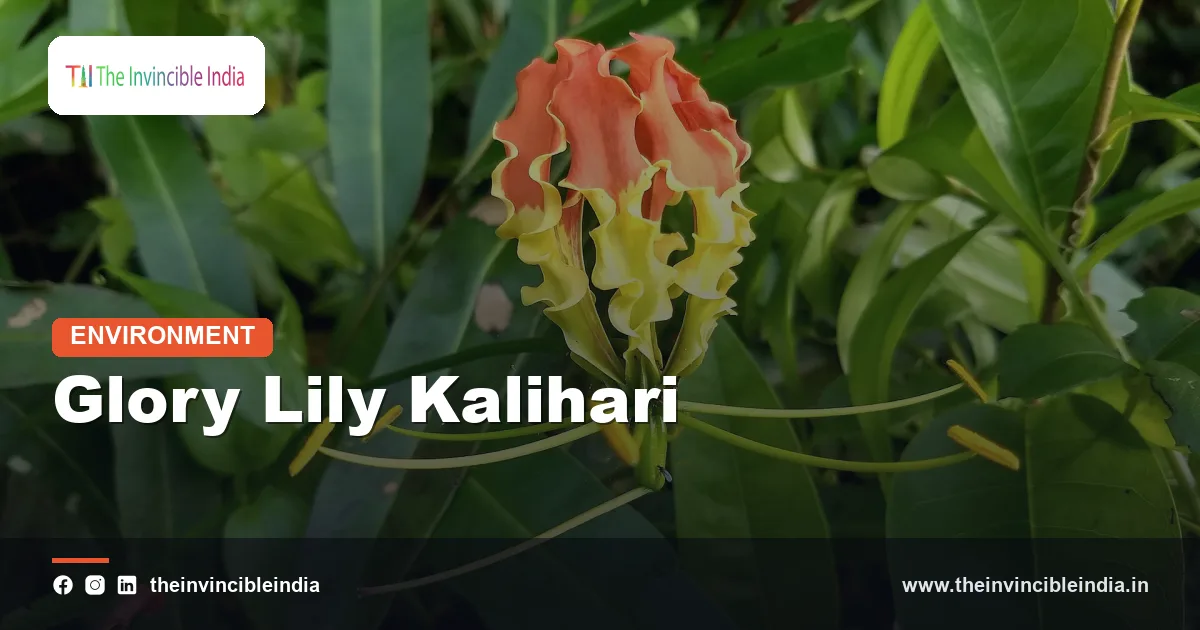
The glory lily (Gloriosa superba), known in Hindi as kalihari, is a tuberous climbing plant of the colchicum family that produces striking flame-coloured flowers with swept-back, wavy petals, and it is the state flower of Tamil Nadu. The plant grows wild in the scrub, hedgerows and forest edges of peninsular India, and it is also cultivated commercially because its tubers and seeds are a source of the alkaloid colchicine. Every part of the glory lily is highly poisonous, which makes it one of the most beautiful and most dangerous flowers in the Indian landscape.
This guide explains what the glory lily is, how it got the names kalihari and agnishikha, where it grows, why it matters in Tamil Nadu, how it is used in medicine and farming, and how to handle it safely. The article is evergreen and describes well-established botanical and cultural facts rather than volatile figures. Last updated: 30 October 2026.
| Attribute | Details |
|---|---|
| Common names | Glory lily, flame lily, climbing lily, tiger claw, kalihari (Hindi), agnishikha (Sanskrit, Kannada), kandhal or senkandhal (Tamil) |
| Scientific name | Gloriosa superba |
| Family | Colchicaceae (earlier placed in Liliaceae) |
| Origin | Tropical Africa and tropical Asia, including the Indian subcontinent |
| Where found in India | Western Ghats, Eastern Ghats, peninsular scrub, the plains of South India, parts of central and eastern India and the lower Himalayan foothills |
| Flowering season | Mainly the monsoon months, roughly June to September |
| Main uses | Ornamental climber, cut flower, source of colchicine for pharmaceuticals, traditional medicine after processing |
| Notable facts | State flower of Tamil Nadu; national flower of Zimbabwe; all parts are toxic |
Key Takeaways
- The glory lily (Gloriosa superba) is a perennial, tuber-bearing climber that holds on to supports with curling leaf tips.
- The glory lily is the state flower of Tamil Nadu, where it is known as kandhal or senkandhal.
- The glory lily is not a true lily; it belongs to the family Colchicaceae, whose members share the alkaloid colchicine.
- Every part of the glory lily, especially the tuber, is poisonous to humans and livestock, and ingestion can be fatal.
- The glory lily is grown commercially in parts of South India for its tubers and seeds, which are used to extract colchicine.
- The glory lily flowers mostly during the monsoon, and each bloom changes colour from green-yellow to orange and deep red as it ages.
What Is the Glory Lily?
The glory lily is a herbaceous perennial climber, scientifically named Gloriosa superba, that grows from an underground tuber and scrambles over shrubs and fences using tendrils formed at the tips of its leaves. The species name superba means superb or magnificent, and the genus name Gloriosa means glorious, which reflects how showy the flowers appear to botanists.
The glory lily is a monocot, so it is related to onions, lilies and tulips in the broad sense, but it sits in its own family, Colchicaceae. Older books still list it under Liliaceae, which is why the common name still says lily. The plant dies back to the tuber when the dry season arrives and sprouts again after the first good rains, a habit that suits the seasonal climate of the Indian peninsula.
Botanists recognise the glory lily as one species with considerable variation in flower colour and shape across Africa and Asia. Some authors treat several regional forms as separate species, but the Indian plant is generally referred to as Gloriosa superba.
Why Is the Glory Lily Called Kalihari and What Are Its Other Names?
The glory lily is called kalihari in Hindi, a name used across much of northern and central India, while the Sanskrit and Kannada name agnishikha means flame-tipped or tongue of fire and describes the flaming colour of the petals. Different Indian languages have their own local names, and many of them describe either fire or the plough.
- Hindi: kalihari.
- Sanskrit: agnishikha, langali, agnimukhi and halini, with langali and halini referring to the plough-like shape of the tuber.
- Tamil: kandhal and senkandhal.
- Malayalam: menthonni.
- Marathi: kalalavi.
- English: glory lily, flame lily, climbing lily, fire lily and tiger claw.
The English name flame lily and the Sanskrit agnishikha reach the same image independently: the petals look like tongues of fire rising from the stem. The name tiger claw refers to the curved, pointed shape of the sharp-tipped petals.
What Does the Glory Lily Look Like?
The glory lily has slender, branching stems that can climb several metres, lance-shaped leaves with tendril-like tips, and nodding flowers whose six wavy petals bend sharply backwards. The six long stamens spread outward like the spokes of a wheel, and the style bends to one side, giving the flower an unmistakable shape.
Flower
The flower of the glory lily opens green or yellow near the base and develops red or orange tones as it matures, so one plant often carries blooms in several shades at once. The petals are typically 5 to 8 cm long, with crinkled edges. In Indian forms the tips are often red and the lower part yellow, though pure yellow and deep red variants occur.
Leaves and stem
The leaves of the glory lily are glossy, lance-shaped and arranged alternately or in opposite pairs, and each ends in a curling tip that hooks around a support. The stem is smooth and thin, which is why the plant relies entirely on neighbouring vegetation or a trellis.
Tuber and fruit
The tuber of the glory lily is a fleshy, cylindrical or V-shaped underground rhizome that can resemble a small yam or a bent finger. This resemblance has caused accidental poisonings in the past, because the tuber can be mistaken for an edible root. The fruit is a three-chambered capsule that splits open to release round, red seeds.
Where Does the Glory Lily Grow in India?
The glory lily grows wild across peninsular India, particularly in the scrub forests, thickets and hedgerows of the Western Ghats, the Eastern Ghats and the Deccan plateau, and it extends into parts of central and eastern India and the lower foothills of the Himalaya. It prefers light, well-drained soil and a distinct wet season followed by a dry period.
In the wild the glory lily climbs through shrubs at forest edges, where it gets sun on its flowers and partial shade on its roots. It is common along field boundaries in South India, and the tubers survive the dry months underground. The plant is native to the Indian subcontinent as well as to tropical Africa, which is why it appears in the floras of both regions.
Tamil Nadu is the best-known centre for cultivation, with farms in several southern districts growing the plant for the pharmaceutical trade. Cultivation is also reported in neighbouring southern states. Because the plant is cultivated on a farm scale, tubers and dried seeds are bought by processors that extract colchicine for the pharmaceutical industry.
Why Is the Glory Lily the State Flower of Tamil Nadu?
The glory lily is the state flower of Tamil Nadu because the plant is native to the region, appears in classical Tamil literature and its bright red and yellow blooms are closely linked with the monsoon landscape of the state. In Tamil the flower is called kandhal, and ancient Sangam poetry mentions kandhal flowers in descriptions of hill and forest scenery.
Many Indian states and countries choose a state or national flower to represent identity and landscape. The glory lily shares this honour in another country as well, since it is the national flower of Zimbabwe, where it is called the flame lily. The same plant therefore represents an Indian state and an African nation, which shows how widely the species is spread.
The state symbol does not mean that the flower is safe to handle or eat. The state choice recognises its beauty and cultural presence, not any edible quality, and the plant remains classed as poisonous in every region where it grows.
Is the Glory Lily Poisonous?
Yes, the glory lily is highly poisonous, and every part of the plant, particularly the tuber and the seeds, contains the toxic alkaloids colchicine and gloriosine. Eating even a small piece of the tuber can cause severe illness, and fatal poisoning has been recorded in people and animals.
Colchicine interferes with cell division, so the poison acts most quickly on tissues that renew rapidly, such as the lining of the gut and the bone marrow. The first signs of poisoning from the glory lily usually appear within hours and can include burning in the mouth and throat, vomiting, abdominal pain and diarrhoea. Later signs can include weakness, low blood pressure, hair loss and failure of several organs, and there is no simple home remedy.
Safety guidelines
- Never eat any part of the glory lily, and never use the tuber as a food or home remedy.
- Keep children and pets away from the plant, the dried pods and the red seeds.
- Wear gloves when digging or handling the tubers, and wash hands thoroughly afterwards.
- Label the plant clearly in gardens and farms so that the tuber is not mistaken for a root vegetable.
- Seek immediate medical help if any part of the plant has been swallowed, and tell the doctor the plant name.
Farm workers who harvest the tubers are advised to protect their skin and to avoid touching the eyes or mouth during work. Livestock normally avoid the plant but can be poisoned when dried material gets mixed with fodder.
What Is the Glory Lily Used For?
The glory lily is used mainly as a source of colchicine for the pharmaceutical industry, as an ornamental climber and cut flower, and, after traditional processing, in some Ayurvedic and folk preparations. Its medicinal importance comes entirely from the alkaloids that also make it poisonous.
Pharmaceutical use
Colchicine extracted from the glory lily is used in modern medicine to treat gout and familial Mediterranean fever, and it has long been used in plant breeding. In plant genetics, colchicine is used to double the chromosome number of crop plants and so create polyploid varieties. These uses explain why a poisonous plant has real commercial value.
Traditional use
Traditional Indian medicine has long used the tuber of the glory lily, under the names langali and kalihari, but only after a detoxifying process called shodhana and only under the supervision of trained practitioners. Classical texts describe uses for joint pain, skin conditions and wounds, and for hastening childbirth, but these uses carry real danger and should not be tried at home.
Ornamental and cut-flower use
Gardeners grow the glory lily on fences, arches and pergolas for its dramatic flowers, and florists in some countries sell it as a cut flower because the blooms last well in a vase. The plant is not used in temple garlands in the way jasmine or marigold is, partly because of its toxicity and partly because the flowers are delicate.
How Is the Glory Lily Grown?
The glory lily is grown from tubers or seeds planted in light, well-drained soil in a warm, sunny spot with something to climb on, and tubers are usually planted at the start of the monsoon. Tubers are the preferred planting material because seeds germinate slowly and take longer to produce flowers.
- Climate: warm and frost-free conditions with distinct wet and dry seasons suit the plant best.
- Soil: sandy loam or red soil with good drainage works well, because waterlogged tubers rot.
- Planting: whole, healthy tubers are planted horizontally a few centimetres deep, with the growing tip pointing upward.
- Support: a trellis, wire or hedge is needed because the stems cannot stand without help.
- Watering: regular watering during growth and flowering, and a dry rest after the leaves die back.
- Harvest: seeds are collected from ripe, split capsules, and tubers are dug after the vines dry.
Commercial growers in South India typically plant the tubers at the start of the rainy season and harvest seeds a few months later. Fertile tubers produce new growing points, and a single tuber can multiply into several in successive seasons. Gardeners who plant the glory lily in containers should choose a deep pot and keep it out of reach of children.
Is the Glory Lily a True Lily?
No, the glory lily is not a true lily, because true lilies belong to the genus Lilium in the family Liliaceae, while the glory lily is placed in the separate family Colchicaceae. The two groups look similar in some respects because both are monocots with showy six-part flowers, but they differ in structure and in chemistry.
| Feature | Glory lily (Gloriosa superba) | True lily (Lilium) |
|---|---|---|
| Family | Colchicaceae | Liliaceae |
| Growth habit | Climbing vine with leaf-tip tendrils | Upright stem without tendrils |
| Underground part | Tuber or rhizome | Scaly bulb |
| Petal shape | Narrow, wavy, swept back | Broad, usually trumpet or bowl shaped |
| Key chemical | Colchicine and related alkaloids | Varies; some are toxic to cats |
| Safety | Highly poisonous in all parts | Generally low risk to humans |
The difference matters in practice. A person who knows that the glory lily is not an ordinary lily is less likely to treat its tuber as a harmless garden bulb.
What Role Does the Glory Lily Play in the Environment?
The glory lily provides nectar and pollen for insects and sunbirds and cover for small animals, and it is a characteristic part of scrub and forest-edge ecosystems in India. The long, projecting stamens and the nectar-bearing flower attract pollinators such as bees, butterflies and sunbirds, which carry pollen between plants.
The plant has also suffered from over-collection. Because wild tubers have been dug up for sale, populations of the glory lily have declined in some regions, and conservation organisations have encouraged cultivation so that wild stocks are not depleted. Farm-grown supply is now the main source for the pharmaceutical trade, which reduces pressure on natural populations.
Growing the glory lily on field boundaries can also be a practical choice for farmers, because livestock avoid the plant and it needs little attention once established.
Bottom Line
The glory lily is both a symbol and a hazard: a state flower of Tamil Nadu with fiery, curled petals, and a plant whose tubers hold a dangerous poison. Admire it in the garden or the wild, grow it with care, and never eat or medicate with it without expert supervision.
Frequently Asked Questions
What is the glory lily called in Hindi?
The glory lily is called kalihari in Hindi. It is also known by the Sanskrit name agnishikha, which means flame-tipped, and by the Tamil name kandhal.
Is the glory lily the state flower of Tamil Nadu?
Yes, the glory lily is the state flower of Tamil Nadu, where it is known as kandhal or senkandhal. It is also the national flower of Zimbabwe, where it is called the flame lily.
Is the glory lily poisonous to touch or eat?
The glory lily is highly poisonous if eaten, and the tuber and seeds are the most dangerous parts. Handling the plant is generally safe if hands are washed afterwards, but gloves are advised when digging the tubers because the sap may irritate the skin.
What is colchicine, and why is it linked to the glory lily?
Colchicine is a plant alkaloid that stops cells from dividing normally, and the glory lily is one of its natural sources. It is used in medicine to treat gout and in plant breeding to double chromosome numbers, but it is toxic in overdose.
When does the glory lily bloom in India?
The glory lily blooms mainly during the monsoon, from about June to September. The exact timing varies with local rainfall, altitude and the date when the tubers sprout.
Can the glory lily be grown at home?
Yes, the glory lily can be grown at home from tubers in a sunny spot with a trellis and well-drained soil. It should be kept away from children and pets, and the plant should be labelled so that the tuber is never mistaken for a food root.
{“@context”:”https://schema.org”,”@graph”:[{“@type”:”FAQPage”,”mainEntity”:[{“@type”:”Question”,”name”:”What is the glory lily called in Hindi?”,”acceptedAnswer”:{“@type”:”Answer”,”text”:”The glory lily is called kalihari in Hindi. It is also known by the Sanskrit name agnishikha, which means flame-tipped, and by the Tamil name kandhal.”}},{“@type”:”Question”,”name”:”Is the glory lily the state flower of Tamil Nadu?”,”acceptedAnswer”:{“@type”:”Answer”,”text”:”Yes, the glory lily is the state flower of Tamil Nadu, where it is known as kandhal or senkandhal. It is also the national flower of Zimbabwe, where it is called the flame lily.”}},{“@type”:”Question”,”name”:”Is the glory lily poisonous to touch or eat?”,”acceptedAnswer”:{“@type”:”Answer”,”text”:”The glory lily is highly poisonous if eaten, and the tuber and seeds are the most dangerous parts. Handling the plant is generally safe if hands are washed afterwards, but gloves are advised when digging the tubers because the sap may irritate the skin.”}},{“@type”:”Question”,”name”:”What is colchicine, and why is it linked to the glory lily?”,”acceptedAnswer”:{“@type”:”Answer”,”text”:”Colchicine is a plant alkaloid that stops cells from dividing normally, and the glory lily is one of its natural sources. It is used in medicine to treat gout and in plant breeding to double chromosome numbers, but it is toxic in overdose.”}},{“@type”:”Question”,”name”:”When does the glory lily bloom in India?”,”acceptedAnswer”:{“@type”:”Answer”,”text”:”The glory lily blooms mainly during the monsoon, from about June to September. The exact timing varies with local rainfall, altitude and the date when the tubers sprout.”}},{“@type”:”Question”,”name”:”Can the glory lily be grown at home?”,”acceptedAnswer”:{“@type”:”Answer”,”text”:”Yes, the glory lily can be grown at home from tubers in a sunny spot with a trellis and well-drained soil. It should be kept away from children and pets, and the plant should be labelled so that the tuber is never mistaken for a food root.”}}]}]}


