

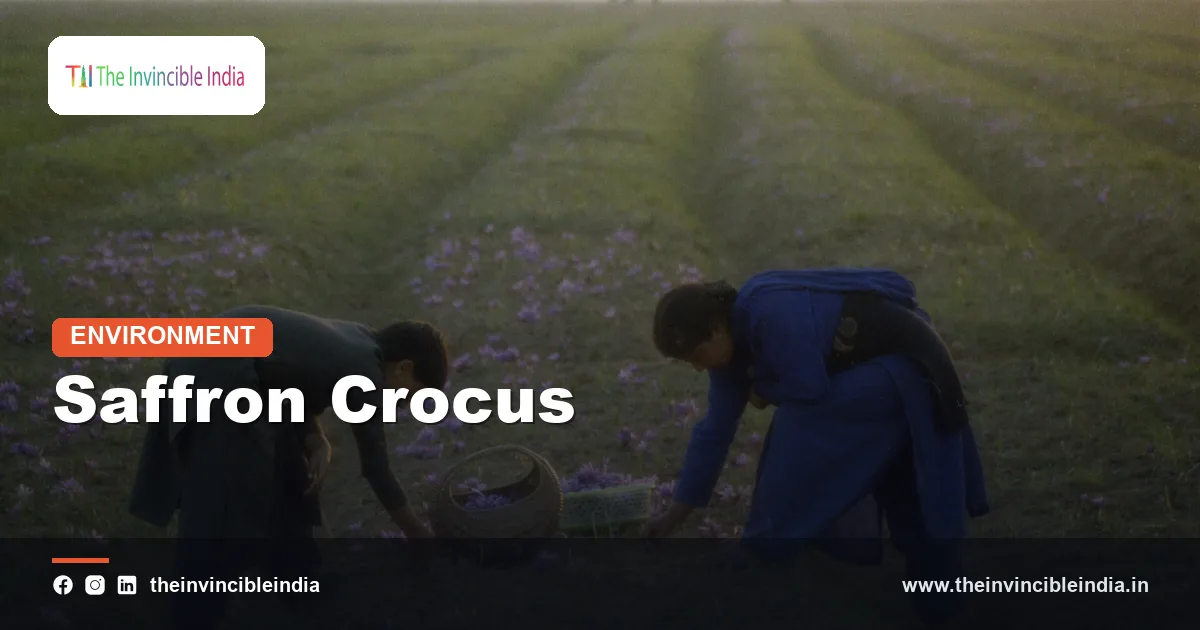
Saffron is the dried, deep-red stigma of the autumn-flowering purple crocus (Crocus sativus), grown in India mainly around Pampore in Kashmir, and it is the costliest spice in the world by weight. Each flower produces only three slender red threads, all of which must be picked by hand, which is why a few grams of genuine saffron carry a high price.
In India, saffron cultivation is concentrated on the high, flat-topped plateaus of the Kashmir Valley, where cool autumn mornings and well-drained soil suit the crop. This explainer covers what the plant is, where and how it grows, how the spice is harvested and graded, what it is used for, and how to tell real saffron from imitations.
| Attribute | Details |
|---|---|
| Common name | Saffron, Kesar (Hindi), Zafran (Kashmiri and Urdu) |
| Scientific name | Crocus sativus |
| Family | Iridaceae (the iris family) |
| Where grown in India | Pampore, Budgam and other parts of the Kashmir Valley; a smaller area in Kishtwar, Jammu and Kashmir |
| Part used | The dried stigmas (style branches) of the flower |
| Season | Corms planted in July-August; flowers bloom in October-November |
| Propagation | Corms only, because the plant is sterile and does not set viable seed |
| Main uses | Food colouring and flavouring, tea, sweets, perfumery, dye, traditional medicine, ritual |
| Recognition | Kashmir saffron holds a Geographical Indication (GI) tag, granted in 2020 |
Key Takeaways
- Saffron is made from the dried red stigmas of Crocus sativus, a purple crocus of the iris family that flowers in autumn.
- Kashmir’s Pampore plateau is India’s best-known saffron-growing area, and Kashmir saffron received a Geographical Indication (GI) tag in 2020.
- Saffron is propagated only through underground corms, because Crocus sativus is a sterile triploid that cannot produce fertile seed.
- A commonly cited figure is that roughly 150,000 or more flowers are needed to yield one kilogram of dried saffron, and all picking and stigma separation is done by hand.
- Saffron’s colour comes mainly from crocin, its bitter taste from picrocrocin, and its aroma from safranal, and the ISO 3632 standard grades the spice by these compounds.
- Genuine saffron is used in tiny quantities in biryani, kheer, kahwa tea and sweets, while unusually cheap “saffron” is often adulterated or is another plant altogether.
What is saffron and which plant does it come from?
Saffron is a spice obtained from the dried stigmas of Crocus sativus, a low-growing bulb-like plant of the iris family (Iridaceae). The plant grows from a corm, a short, swollen underground stem that looks like a small bulb, and sends up narrow, grass-like leaves along with lilac to purple flowers.
Each flower has six petals and three bright orange-red stigmas, which are the tips of the female part of the flower. Together with a short portion of the style, these threads are the saffron of commerce. The yellow stamens and the petals are not the spice, although they are sometimes used separately for dyes or in traditional preparations.
Crocus sativus is a triploid, which means that each cell carries three sets of chromosomes instead of two. A triploid plant cannot form viable seed, so every saffron plant in the world is essentially a vegetative copy grown from corms. This is why saffron fields show little genetic variety and why the crop is so dependent on the health of the planting material.
The word “saffron” is often confused with “kesari” or “bhagwa” shades, which refer to a deep orange colour, and with the unrelated “meadow saffron” (Colchicum), which is poisonous. The spice discussed here is only the true Crocus sativus.
Where is saffron grown in India?
Saffron in India is grown mainly in the Kashmir Valley of Jammu and Kashmir, with Pampore in Pulwama district being the best-known centre. The fields around Pampore lie on a raised plateau known locally as a karewa, a type of lake-deposit terrace formed over geological time.
Besides Pampore, saffron is also grown in parts of Budgam and Srinagar districts, and in Kishtwar in the Jammu division. Fields in these areas sit at roughly 1,600 to 1,800 metres above sea level, though exact elevations differ from plot to plot. Karewa soils are light, calcareous and well drained, which suits the crocus because its corms rot quickly in waterlogged ground.
The climate matters as much as the soil. Saffron needs a warm, dry summer when the corms rest, followed by a cool, clear autumn when the flowers open. Kashmir offers this pattern, with dry late summers and flowering weather in October and November. Scattered experimental plantings have been tried in other Himalayan and hill regions of India, but the Kashmir Valley remains the only major commercial source.
India is a small producer of saffron compared with Iran, which supplies the large majority of the world’s saffron. Kashmir saffron is valued in the domestic market as a distinct regional product, and it is traditionally known for its deep colour and strong aroma.
How is saffron cultivated?
Saffron is cultivated by planting corms in summer and harvesting the flowers in autumn, and a single planting can keep producing for several years. Farmers in Kashmir typically plant corms in July and August, burying them a few centimetres to around fifteen centimetres deep in carefully prepared, weed-free plots.
Preparing the land and corms
The soil is ploughed and levelled, and farmyard manure is traditionally added before planting. Healthy corms of good size are selected, because larger corms produce more flowers. After a few years the corms multiply underground and the bed becomes crowded, so growers lift and replant them, often in a fresh plot, to restore vigour.
The growing cycle
The plant has an unusual life cycle that runs against the normal seasons. Leaves and flowers appear in autumn, the plant grows through the cold months, and the foliage dies back in spring and early summer. The corm then rests underground through the warm months before beginning the cycle again.
- July to August: corms are planted or replanted.
- October to November: flowers emerge for about two to three weeks, and are harvested daily.
- Winter and spring: grass-like leaves feed the corm and form new daughter corms.
- Late spring and summer: leaves wither and the corm rests.
Saffron depends heavily on the timing of rain. Light rain in late summer helps the corms prepare to flower, but heavy or untimely rain during flowering can ruin the crop. Because the corms are usually not irrigated by modern systems in many traditional fields, a dry or erratic season can reduce the yield sharply.
How is saffron harvested and processed?
Saffron is harvested entirely by hand in the early morning, because the flowers must be picked soon after they open and before the sun wilts them. The flowering window is short, so families and hired workers pick the fields every day during the two to three weeks of bloom.
The picked flowers are brought indoors the same day. The red stigmas are then separated from the petals, a delicate and time-consuming task usually done by hand in a cool room. The stigmas are dried soon afterwards, either in gentle warmth or in the shade, so that the moisture falls and the colour and aroma are locked in. Careless drying can weaken the flavour, and over-drying can make the threads brittle.
Once dried, saffron weighs only a small fraction of what was picked. A commonly cited figure is that about 150,000 flowers or more are needed to produce one kilogram of dried saffron, though the exact number varies with flower size and the method of trimming the stigmas. The finished threads are graded, packed in airtight containers and protected from light and moisture, because saffron loses strength when exposed to air and sunlight.
Why is saffron so expensive?
Saffron is expensive because its yield per flower is tiny, the harvest is entirely manual and the picking season lasts only a few weeks. A single flower gives just three stigmas, and the crop cannot be harvested by machine without damaging the delicate threads.
Several factors push the price up further.
- Labour: Picking, separating and drying all depend on skilled hands, and the work must be finished within hours of flowering.
- Low yield per hectare: The crop produces only a small weight of dried spice from each unit of land.
- Climate risk: A shift in rain or temperature at the wrong time can lower the harvest in a particular year.
- Quality control: Genuine, well-graded saffron must be carefully tested, and adulteration is common in the wider market.
Because of its price, saffron is sold in very small packs, often in fractions of a gram, and recipes call for only a few threads at a time.
What gives saffron its colour, taste and aroma?
Saffron’s colour, taste and aroma come from three main chemical compounds: crocin, picrocrocin and safranal. Each plays a different role, and together they define the quality of the spice.
| Compound | What it gives saffron |
|---|---|
| Crocin | The golden-yellow to orange colouring power, which dissolves readily in water |
| Picrocrocin | The slightly bitter taste, which also gives rise to safranal as the spice dries and ages |
| Safranal | The distinctive hay-like, honeyed aroma |
Laboratories use these compounds to measure quality. The international standard ISO 3632 classifies saffron into categories, with Category I as the highest, using tests for colouring strength, bitterness and aroma. A higher colouring value generally indicates a richer, more potent spice.
Because crocin dissolves in warm water or milk, a small pinch of saffron can tint an entire dish. Cooks usually soak the threads in a spoonful of warm milk or water for several minutes before adding them, which releases colour and flavour more evenly than adding dry threads directly.
What are the grades of Kashmir saffron?
Kashmir saffron is traditionally sold in grades that depend on how much of the stigma, and how much of the pale style, is included in the threads. The grade names used in the trade vary by seller, but the commonly used terms are listed below.
| Trade grade | Description |
|---|---|
| Mongra | Only the deep-red stigma tips, with no style attached; the strongest and costliest grade |
| Lacha | Stigma with a short part of the pale-yellow style still attached; milder and cheaper |
| Guchhi | A lower grade made of mixed or leftover pieces |
Buyers are advised to rely on lab-tested, sealed packs from reputed sellers rather than on the grade name alone, since labels differ and the same word can describe different quality levels in different shops.
How is saffron used in Indian life?
Saffron is used in India mainly as a flavouring and natural colour in rich foods, as a drink ingredient and in ritual and traditional medicine. Its use in the kitchen is lavish in royal and festive dishes and sparing in everyday meals.
- Food: Saffron colours and perfumes biryani, pulao, kheer, phirni, shrikhand, kulfi and sweets such as kesar peda and jalebi. In Kashmiri cooking it appears in certain meat dishes and in rice preparations.
- Drinks: Kashmiri kahwa, a green tea with spices and almonds, is traditionally finished with a few strands of saffron. Saffron milk is also a common warm drink.
- Religion and culture: Saffron paste is used for tilak marks and in some ritual offerings, and the word “kesari” for the orange colour has strong cultural associations across the subcontinent.
- Traditional medicine: Ayurveda and Unani systems describe saffron as a tonic and a digestive aid, and it is added to many herbal formulations.
- Cosmetics and perfumery: Saffron appears in some fragrances and face-care preparations, usually as a minor ingredient.
Scientific interest in saffron’s compounds is ongoing, and some small studies have examined effects on mood and eyesight. The evidence is still preliminary, and saffron should not be treated as a substitute for medical treatment.
How can you tell real saffron from fake?
Real saffron can be recognised by its long, trumpet-shaped dark-red threads, its slow release of golden-yellow colour in water and its distinctive aroma. Fake or adulterated saffron often releases colour instantly or leaves threads that turn pale.
Some simple observations may help, although none is a laboratory test.
- Genuine threads are dark red with a slightly lighter orange tip, and they are trumpet-shaped at one end.
- When dropped in warm water, real saffron colours the water yellow gradually, while the threads themselves keep their red colour for some time.
- Cheap imitations may use dyed corn silk, safflower petals or other plant fibres, which bleed red colour into the water straight away.
- A very low price is usually a warning sign, because genuine saffron cannot be produced cheaply.
The most reliable protection is to buy from sellers who provide batch details and, where possible, a GI-tag certification or a laboratory test report. Home tests cannot detect all forms of adulteration.
What threatens Kashmir saffron and how is it being protected?
Kashmir saffron is threatened by irregular rainfall, declining area, ageing corm stocks, urban expansion on farmland and competition from cheaper imported saffron. Over several decades, the area under saffron and the yield per hectare in the valley have fallen compared with earlier periods.
Several measures have been introduced to support the crop.
- National Saffron Mission: Launched around 2010 under the broader horticulture programme, it was meant to rejuvenate saffron fields through better corms, irrigation and sprinklers, and farmer training.
- GI tag: Kashmir saffron received Geographical Indication status in 2020, helping protect the name from imitation and supporting market recognition.
- Testing and trading facilities: A saffron park and a testing laboratory at Pampore have been set up to grade and certify the spice.
- Research: Agricultural universities in Kashmir study better planting material, flowering management and drip irrigation to cut the dependence on rainfall.
Long-term success depends on keeping farmers in the business through fair prices, protecting the karewa lands from conversion to housing, and reducing adulteration so that genuine producers earn their due.
Bottom Line
Saffron is the hand-harvested stigma of Crocus sativus, and Kashmir’s Pampore plateau remains India’s iconic source. Its value lies in its colour, aroma and the labour behind each thread, and its future depends on climate, protection of farmland and honest trade. Information on this page was last reviewed on 23 October 2026.
Frequently Asked Questions
What is saffron made from?
Saffron is made from the dried red stigmas of the Crocus sativus flower. Each flower has only three stigmas, which are picked by hand, separated from the petals and then dried. The finished threads are used in tiny amounts for colour, flavour and aroma.
Where is saffron grown in India?
Saffron is grown mainly in the Kashmir Valley, with Pampore in Pulwama district being the best-known centre. Smaller areas in Budgam, Srinagar and Kishtwar also grow it. The crop prefers the well-drained karewa plateau soils and the cool autumn climate of the region.
Why is saffron the most expensive spice?
Saffron is the most expensive spice because each flower yields only three stigmas and all of the work is done by hand. A commonly cited estimate is that well over 100,000 flowers are needed for one kilogram of dried spice. The short harvest season and sensitivity to weather add to the cost.
When does saffron bloom in Kashmir?
Saffron blooms in Kashmir in October and November, usually for two to three weeks. The corms are planted earlier, in July and August, and the flowers must be picked in the early morning soon after they open. Timing varies slightly with the weather each year.
How do you use saffron in cooking?
Saffron is used by soaking a few threads in warm milk or water for several minutes and then adding the liquid to the dish. This releases the colour and flavour evenly. It is common in biryani, kheer, sweets and Kashmiri kahwa tea, and only a pinch is needed per serving.
How can you check whether saffron is genuine?
Genuine saffron releases a golden-yellow colour slowly in warm water and its threads stay red for some time. Instant red bleeding, a very low price or a missing aroma suggest adulteration. Buying certified, lab-tested saffron from a trusted seller is more reliable than any home test.
{“@context”:”https://schema.org”,”@graph”:[{“@type”:”FAQPage”,”mainEntity”:[{“@type”:”Question”,”name”:”What is saffron made from?”,”acceptedAnswer”:{“@type”:”Answer”,”text”:”Saffron is made from the dried red stigmas of the Crocus sativus flower. Each flower has only three stigmas, which are picked by hand, separated from the petals and then dried. The finished threads are used in tiny amounts for colour, flavour and aroma.”}},{“@type”:”Question”,”name”:”Where is saffron grown in India?”,”acceptedAnswer”:{“@type”:”Answer”,”text”:”Saffron is grown mainly in the Kashmir Valley, with Pampore in Pulwama district being the best-known centre. Smaller areas in Budgam, Srinagar and Kishtwar also grow it. The crop prefers the well-drained karewa plateau soils and the cool autumn climate of the region.”}},{“@type”:”Question”,”name”:”Why is saffron the most expensive spice?”,”acceptedAnswer”:{“@type”:”Answer”,”text”:”Saffron is the most expensive spice because each flower yields only three stigmas and all of the work is done by hand. A commonly cited estimate is that well over 100,000 flowers are needed for one kilogram of dried spice. The short harvest season and sensitivity to weather add to the cost.”}},{“@type”:”Question”,”name”:”When does saffron bloom in Kashmir?”,”acceptedAnswer”:{“@type”:”Answer”,”text”:”Saffron blooms in Kashmir in October and November, usually for two to three weeks. The corms are planted earlier, in July and August, and the flowers must be picked in the early morning soon after they open. Timing varies slightly with the weather each year.”}},{“@type”:”Question”,”name”:”How do you use saffron in cooking?”,”acceptedAnswer”:{“@type”:”Answer”,”text”:”Saffron is used by soaking a few threads in warm milk or water for several minutes and then adding the liquid to the dish. This releases the colour and flavour evenly. It is common in biryani, kheer, sweets and Kashmiri kahwa tea, and only a pinch is needed per serving.”}},{“@type”:”Question”,”name”:”How can you check whether saffron is genuine?”,”acceptedAnswer”:{“@type”:”Answer”,”text”:”Genuine saffron releases a golden-yellow colour slowly in warm water and its threads stay red for some time. Instant red bleeding, a very low price or a missing aroma suggest adulteration. Buying certified, lab-tested saffron from a trusted seller is more reliable than any home test.”}}]}]}


