

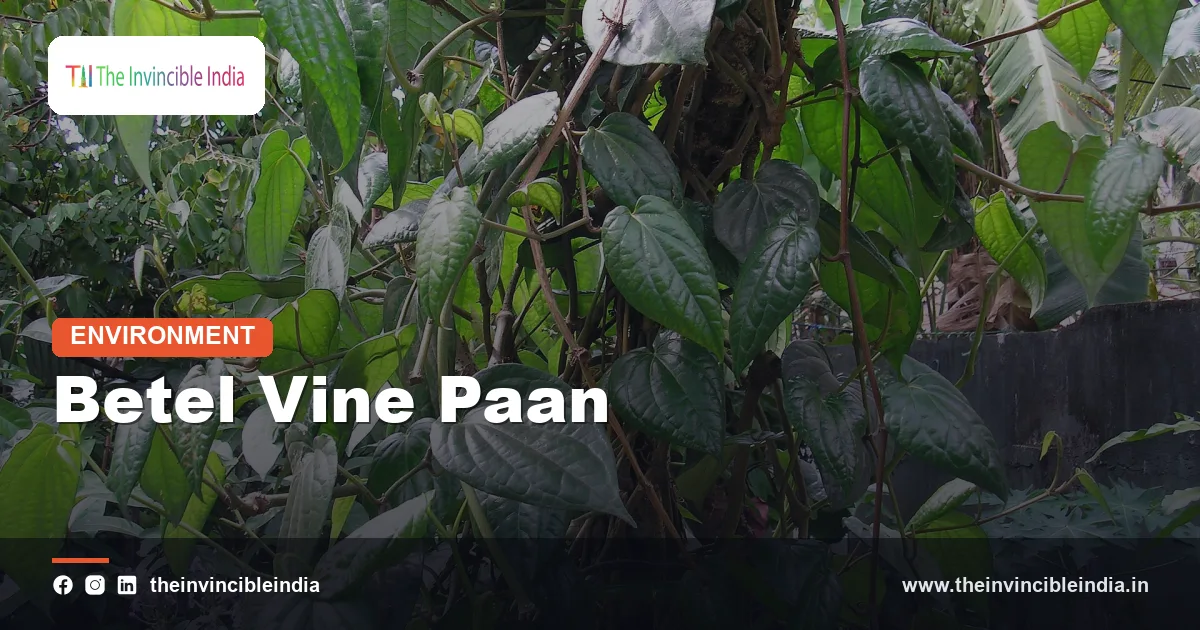
The betel vine (Piper betle) is a perennial, glossy-leaved climbing plant of the pepper family whose heart-shaped leaf, called paan in Hindi, is chewed, offered and exchanged across India. Grown in humid, shaded gardens from West Bengal and Odisha to Kerala and Uttar Pradesh, it is one of the country’s oldest cultivated leaf crops and a source of livelihood for lakhs of small farming families.
The leaf is valued as a mouth freshener, a ceremonial offering and a traditional digestive, but the way it is usually consumed, wrapped with areca nut, lime and sometimes tobacco, carries well-documented health risks. This explainer covers the plant, its cultivation, varieties, cultural role and the health cautions, in a balanced way.
| Attribute | Details |
|---|---|
| Common names | Betel vine, paan, nagavalli, tambula (Sanskrit), vetrilai (Tamil), tamalapaku (Telugu) |
| Scientific name | Piper betle |
| Family | Piperaceae (the pepper family, which also includes black pepper) |
| Where grown in India | West Bengal, Odisha, Bihar, Uttar Pradesh, Assam, Maharashtra, Karnataka, Tamil Nadu, Kerala, Andhra Pradesh and other humid regions |
| Part used | The fresh, heart-shaped leaf |
| Growth habit | Evergreen climbing vine; separate male and female plants (dioecious) |
| Season | Planted mainly in the warm, early monsoon period; leaves are harvested through much of the year |
| Propagation | Stem cuttings (vine cuttings), not seed |
| Uses | Chewing as paan, ritual offerings, hospitality, traditional medicine, essential oil |
Key Takeaways
- The betel vine, Piper betle, is a climbing evergreen of the pepper family, and its heart-shaped leaf is known in India as paan.
- Betel vine is grown in shaded, humid, specially built gardens, and it is propagated by stem cuttings because cultivated plants rarely give useful seed.
- Paan leaf is central to Indian hospitality and ritual, appearing in weddings, pujas and traditional offerings of respect.
- The leaf itself contains aromatic oils such as eugenol and chavicol, but paan is usually chewed with areca nut and slaked lime, a combination linked to oral disease.
- The International Agency for Research on Cancer (IARC) classifies areca nut and betel quid, especially with tobacco, as carcinogenic to humans.
- Betel vine cultivation is labour-intensive and supports many small farming households, particularly in eastern and southern India.
What is the betel vine?
The betel vine is a creeping, evergreen climber, Piper betle, grown for its smooth, dark-green, heart-shaped leaves. It belongs to the same family as black pepper (Piperaceae) and has a similar jointed stem that climbs by putting out small roots at the nodes.
The plant is believed to have originated in Southeast Asia and has been used in the Indian subcontinent for thousands of years. Ancient Sanskrit and Pali writings mention tambula, the betel leaf offered with areca nut, as part of daily life, courtly etiquette and ritual. Today the plant is cultivated across South and Southeast Asia.
Betel vine is dioecious, meaning separate plants carry male and female catkins. In commercial gardens the plant is nearly always grown from cuttings, and flowers are rarely a concern. The leaves are thin, glossy and aromatic, with a mildly peppery, sweetish and slightly pungent flavour that varies with the variety.
It is important not to confuse betel leaf with the betel nut. The “betel nut” is actually the seed of the areca palm (Areca catechu), a different plant entirely. The two are chewed together, which is the source of the confusion.
Where is the betel vine grown in India?
The betel vine is grown in many warm and humid parts of India, with major cultivation in West Bengal, Odisha, Bihar, Uttar Pradesh, Assam, Karnataka, Tamil Nadu, Kerala, Andhra Pradesh and Maharashtra. India is among the largest producers and certainly the largest consumers of betel leaf in the world.
The crop is grown in specific local clusters, each with its own tradition and variety.
- Eastern India: West Bengal and Odisha have extensive paan gardens, often in coastal districts where humidity is high and the soil is fertile.
- Bihar and the Gangetic plain: The Magahi (Maghai) paan of Bihar is a well-known regional variety, and the Magahi paan has a Geographical Indication (GI) tag.
- Uttar Pradesh and Madhya Pradesh: Mahoba, Varanasi and nearby areas are famous for paan growing and trade, with Banarasi paan a household name in north India.
- South India: Karnataka, Tamil Nadu, Kerala and Andhra Pradesh grow betel leaf for local markets and for movement to northern states.
Betel vine needs a warm, moist climate with little frost, so the northern plains protect the crop in winter and the southern states grow it year-round. Where winters are cold, growers cover the gardens with straw and shade structures to hold in warmth.
How is the betel vine cultivated?
The betel vine is cultivated in covered, humid garden enclosures where the climbing stems are trained up supports and harvested leaf by leaf. These gardens are known by regional names such as baroj or boroj in Bengal and Odisha, and the structure is carefully built to control light, wind and humidity.
The garden structure
A typical garden is a tall enclosure with a roof and walls of bamboo, straw, reeds and cloth or other cheap shading materials. The covering keeps strong sun and drying winds out and traps humidity, protecting the delicate leaves. Inside, growers set up rows of supports so the vines can climb, often using bamboo poles or living trees such as agathi (Sesbania grandiflora) or other quick-growing species.
Planting and care
The crop is planted using cuttings that have two to three nodes, and these are planted in rows in well-drained, fertile soil. Frequent light watering is essential, since waterlogging will kill the plant while dryness lowers leaf quality. Farmers use farmyard manure, oilcakes and other organic inputs, and they must keep a watch on soil moisture all through the year.
- Soil must drain well, since standing water encourages root and foot rot.
- Vines are tied to supports regularly, so that leaves hang cleanly and can be plucked easily.
- Shade is adjusted by season: more in summer, less in winter.
- Gardens may be productive for several years before the old vines are replaced.
The crop is vulnerable to fungal and bacterial diseases, particularly foot rot caused by Phytophthora, along with leaf spots and root-knot nematodes. Disease management relies on clean planting material, good drainage, crop rotation of the garden plot and, where required, carefully used protective sprays.
What are the main varieties of paan leaf?
Paan leaf varieties in India differ in leaf size, thickness, pungency, aroma and shelf life, and they are usually named for the place of origin or the taste. Buyers in different regions prefer different types.
| Variety or group | Typical association |
|---|---|
| Magahi (Maghai) | Bihar; soft, thin, mild-tasting leaf with a GI tag |
| Banarasi | Varanasi and eastern Uttar Pradesh; widely traded and used in the famous Banarasi paan |
| Desawari | Mahoba and Bundelkhand region; a popular and aromatic type |
| Bangla | West Bengal and Odisha; large, thick, pungent leaf |
| Mitha (sweet) | Widely grown; mild, sweetish taste favoured for sweet paan |
| Kapoori | South India; strongly aromatic leaf |
Names and exact characteristics vary somewhat by region, but the common idea is that thin, soft, mild leaves are preferred for sweet paan, while thicker and more pungent leaves are favoured by those who like a sharper bite.
How is paan used in Indian culture?
Paan is used in India as a sign of hospitality, a ritual offering and a social habit, with the leaf typically folded around a filling and eaten after meals. Its cultural role is older than most Indian cuisines, and it appears in literature, music, cinema and daily customs.
- Hospitality: Offering paan to guests is a traditional gesture of respect in many households, especially in north India.
- Ritual: Betel leaves are placed in puja plates, offered to deities and used in weddings, housewarmings and other ceremonies. Leaves are often placed with coconuts and fruits as part of auspicious offerings.
- After-meal custom: A fresh paan with fennel, cardamom and sweet fillings is widely eaten as a digestive and mouth freshener after a heavy meal.
- Arts and literature: Paan features in classical poetry, in the Urdu and Hindi film songs of earlier decades and in Lucknow and Banaras tehzeeb (etiquette).
In South Indian traditions, betel leaves and areca nuts are given together as tambulam to guests at weddings and festivals, symbolising goodwill and prosperity. Customs differ by community, but the leaf as a symbol of welcome is nearly universal.
What goes into a paan?
A paan is made by smearing a betel leaf with slaked lime and sometimes katha, then adding areca nut and flavourings and folding it into a small parcel. The exact filling differs enormously by region and by the preference of the person eating.
- Betel leaf: The base and wrapper.
- Slaked lime (chuna): A white paste of calcium hydroxide that helps release alkaloids from the areca nut and gives the characteristic red colour.
- Katha (catechu): A brown extract from the heartwood of the khair tree (Acacia catechu), adding astringency.
- Areca nut (supari): Sliced or crushed seed of the areca palm.
- Flavourings: Cardamom, fennel seeds (saunf), coconut, gulkand (rose petal preserve), cloves, candied fruits and sweet syrups.
- Tobacco (optional): Added in some preparations, such as zarda or khaini, and this is the part that raises the most serious health concerns.
A “meetha paan” typically contains sweet ingredients like gulkand and coconut and does not include tobacco, whereas tobacco-containing varieties are sold separately and carry statutory warnings in India.
Does betel leaf have medicinal uses?
Betel leaf has a long place in traditional Ayurvedic and folk medicine, where it is described as a digestive, a mouth freshener and a mild stimulant, but modern clinical evidence is limited. The leaf contains essential oils, including phenolic compounds such as eugenol and chavicol, which have shown antimicrobial and antioxidant activity in laboratory studies.
Traditional uses mentioned include chewing the leaf after meals to help digestion, applying warm leaves to the chest or skin as a home remedy, and using leaf juice in cough and cold preparations. Betel leaf oil is also used in small amounts in some perfumes and flavourings.
These traditional uses should not be read as proven treatments. Laboratory findings do not necessarily translate into human benefit, and there are few large controlled trials. Anyone considering regular use for health reasons should speak to a qualified doctor.
What are the health risks of chewing paan?
The main health risks from chewing paan come from areca nut, slaked lime and especially tobacco, which are associated with oral cancers, oral submucous fibrosis and dental problems, rather than from the betel leaf alone. This distinction is important, since many people use the word “paan” for the entire mixture.
The International Agency for Research on Cancer (IARC), part of the World Health Organization, has classified areca nut and betel quid with tobacco as carcinogenic to humans. Studies from India and other South Asian countries link habitual chewing to cancers of the mouth and throat, gum disease and a condition called oral submucous fibrosis, in which the mouth gradually loses its ability to open fully.
- Tobacco-containing paan carries the highest risk, because tobacco adds nicotine and cancer-causing compounds.
- Areca nut itself is addictive for many users and has been linked to oral disease even without tobacco.
- Frequent chewing stains teeth, irritates the gums and can cause mouth ulcers.
- Pregnant women, people with diabetes or heart conditions and anyone with mouth sores are generally advised to avoid areca nut products.
A plain betel leaf eaten occasionally, or a sweet paan without areca nut and tobacco, is generally considered much less harmful, but research on betel leaf alone is limited and people differ in how they react. Public-health agencies in India discourage chewing tobacco and areca nut products, and tobacco-containing paan is regulated under Indian tobacco-control laws. Public spitting of paan is also a sanitation concern in cities.
How is betel leaf harvested and marketed?
Betel leaf is harvested by hand, a few leaves at a time, once the vines have grown to a suitable stage, and the picked leaves are graded, bundled and sent to market quickly. Because the leaf is perishable, it must reach consumers within days, so a strong network of traders connects growing clusters to cities.
Pluckers select mature but tender leaves and take them from the lower and middle portions of the vine, leaving the growing tip. Leaves are sorted by size, colour and quality, and packed in bundles or baskets, often lined with moist cloth, straw or banana leaf to prevent drying. Large markets such as those in Varanasi, Kolkata, Mumbai and Chennai handle large volumes every day.
Paan growing is labour-intensive and relatively steady. Many farms are small, family-run gardens of a fraction of an acre, and the work gives employment to growers, pluckers, transporters and paan sellers. Risks include disease, cold waves, cyclones that destroy garden structures and price swings. Some producers have sought better prices through cold storage, grading and export of leaves to the Middle East, Europe and North America, mainly for communities of Indian origin.
How has the paan trade changed in recent years?
The paan trade has changed through new ways of selling, packaging and flavouring, but its growers still face old problems of weather, disease and price swings. Packaged mouth fresheners, ready-made paan shots and “fusion” paan flavoured with chocolate or fruit have widened the market among younger customers, while many paan shops now offer tobacco-free options.
At the same time, many gardens have shrunk because of labour shortages, rising input costs and storm damage to the shade structures. Farmer groups and agricultural institutions have encouraged improved shade-net structures, drip irrigation, disease-free planting material and cold-chain handling to cut losses. Better grading and branding, along with Geographical Indication recognition for some local varieties, are meant to bring higher and steadier returns to growers.
Bottom Line
The betel vine is a graceful, shade-loving climber whose leaf sits at the heart of Indian hospitality and ritual. The leaf itself has a long traditional history, but the common habit of chewing it with areca nut, lime and tobacco carries serious, well-documented health risks. Information on this page was last reviewed on 23 October 2026.
Frequently Asked Questions
What is the betel vine?
The betel vine is a climbing evergreen plant, Piper betle, grown for its heart-shaped leaf known as paan. It belongs to the pepper family and is cultivated in humid regions across India. The leaf is used for chewing, in rituals and in traditional medicine.
Is betel leaf the same as betel nut?
No, betel leaf and betel nut are two different plant products. The leaf comes from the betel vine, Piper betle, while the so-called betel nut is the seed of the areca palm. They are commonly chewed together in paan, which causes the confusion.
Where is paan grown in India?
Paan is grown mainly in West Bengal, Odisha, Bihar, Uttar Pradesh, Assam, Karnataka, Tamil Nadu, Kerala, Andhra Pradesh and Maharashtra. It needs a warm, humid climate with shade and good drainage. Regional varieties such as Magahi, Banarasi and Desawari are known by their place of origin.
How is the betel vine propagated?
The betel vine is propagated by stem cuttings, usually pieces with two to three nodes. Seed is not used in commercial gardens. The cuttings are planted in well-drained soil inside shaded, humid enclosures and tied to supports as they grow.
Is chewing paan bad for health?
Chewing paan with areca nut and especially tobacco is harmful and is linked to oral cancers and oral submucous fibrosis. The International Agency for Research on Cancer classifies areca nut and betel quid with tobacco as carcinogenic to humans. The betel leaf alone is considered less risky, but evidence is limited and medical advice is sensible.
Why is paan important in Indian culture?
Paan is important because it stands for hospitality, auspiciousness and social custom. Betel leaves are offered to guests, used in pujas and weddings and given with areca nut as tambulam in many traditions. The practice has been recorded in Indian literature for many centuries.
{“@context”:”https://schema.org”,”@graph”:[{“@type”:”FAQPage”,”mainEntity”:[{“@type”:”Question”,”name”:”What is the betel vine?”,”acceptedAnswer”:{“@type”:”Answer”,”text”:”The betel vine is a climbing evergreen plant, Piper betle, grown for its heart-shaped leaf known as paan. It belongs to the pepper family and is cultivated in humid regions across India. The leaf is used for chewing, in rituals and in traditional medicine.”}},{“@type”:”Question”,”name”:”Is betel leaf the same as betel nut?”,”acceptedAnswer”:{“@type”:”Answer”,”text”:”No, betel leaf and betel nut are two different plant products. The leaf comes from the betel vine, Piper betle, while the so-called betel nut is the seed of the areca palm. They are commonly chewed together in paan, which causes the confusion.”}},{“@type”:”Question”,”name”:”Where is paan grown in India?”,”acceptedAnswer”:{“@type”:”Answer”,”text”:”Paan is grown mainly in West Bengal, Odisha, Bihar, Uttar Pradesh, Assam, Karnataka, Tamil Nadu, Kerala, Andhra Pradesh and Maharashtra. It needs a warm, humid climate with shade and good drainage. Regional varieties such as Magahi, Banarasi and Desawari are known by their place of origin.”}},{“@type”:”Question”,”name”:”How is the betel vine propagated?”,”acceptedAnswer”:{“@type”:”Answer”,”text”:”The betel vine is propagated by stem cuttings, usually pieces with two to three nodes. Seed is not used in commercial gardens. The cuttings are planted in well-drained soil inside shaded, humid enclosures and tied to supports as they grow.”}},{“@type”:”Question”,”name”:”Is chewing paan bad for health?”,”acceptedAnswer”:{“@type”:”Answer”,”text”:”Chewing paan with areca nut and especially tobacco is harmful and is linked to oral cancers and oral submucous fibrosis. The International Agency for Research on Cancer classifies areca nut and betel quid with tobacco as carcinogenic to humans. The betel leaf alone is considered less risky, but evidence is limited and medical advice is sensible.”}},{“@type”:”Question”,”name”:”Why is paan important in Indian culture?”,”acceptedAnswer”:{“@type”:”Answer”,”text”:”Paan is important because it stands for hospitality, auspiciousness and social custom. Betel leaves are offered to guests, used in pujas and weddings and given with areca nut as tambulam in many traditions. The practice has been recorded in Indian literature for many centuries.”}}]}]}


