

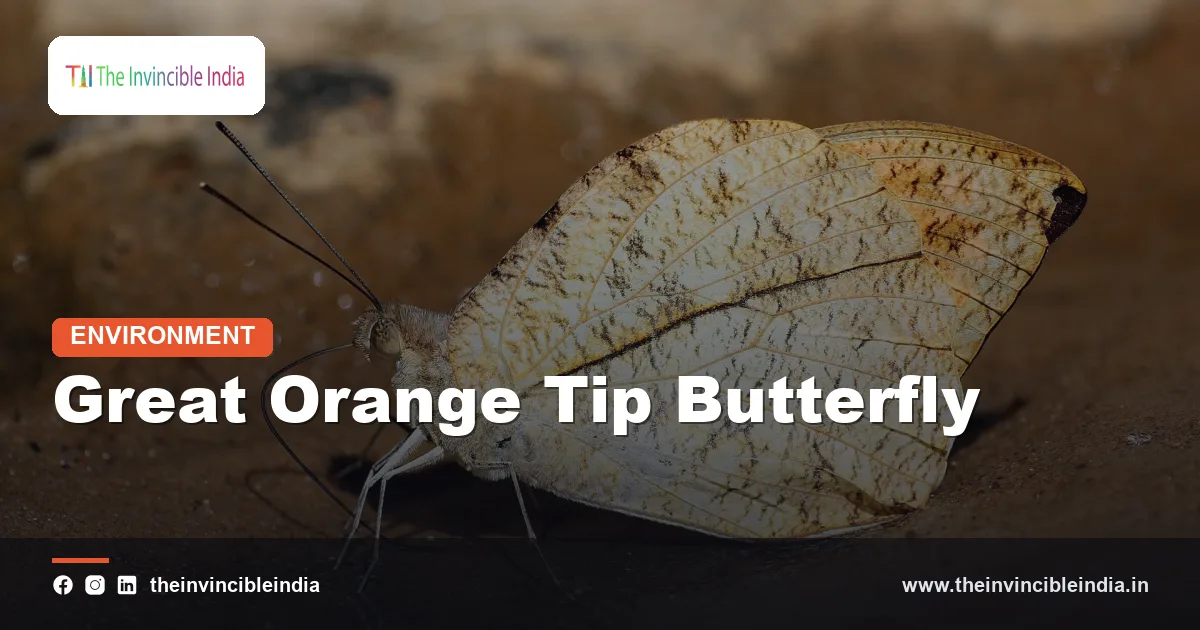
The great orange tip (Hebomoia glaucippe) is a large white butterfly of the family Pieridae, recognised by the vivid orange patches at the tips of its forewings and by its dead-leaf-like underside. It is a strong, fast flier of moist forests and forest edges across peninsular India, the Himalayan foothills and the north-east, and it is one of the most eye-catching butterflies a visitor can see in the Indian countryside.
The great orange tip is the largest and boldest of the orange-tipped butterflies found in India. When its wings are open, it shows white with a bright orange apex bordered in black; when closed, it vanishes into the leaf litter as a brownish, leaf-shaped shape. This striking contrast between display and disguise makes it a favourite with butterfly watchers and photographers.
| Quick Facts | Details |
|---|---|
| Common name | Great orange tip |
| Scientific name | Hebomoia glaucippe (Linnaeus, 1758) |
| Family | Pieridae (whites and yellows), subfamily Pierinae |
| Wingspan | Large for a pierid, roughly 8 to 10 cm |
| Host plants | Members of the caper family (Capparaceae), including Capparis species and Crateva (varuna) |
| Range and habitat in India | Moist and evergreen forest, forest edges and wooded clearings; Western Ghats, north-east, Himalayan foothills, Eastern Ghats and islands |
| Flight season and broods | On the wing for much of the year, with peaks in and after the monsoon; several broods a year |
| Notable features | White wings with bold orange tips, fast flight, dead-leaf underside, males that gather at damp ground |
Key Takeaways
- The great orange tip (Hebomoia glaucippe) is a large Pierid butterfly with white wings and vivid orange forewing tips.
- The great orange tip rests with closed wings that look like a dead leaf, which gives it excellent camouflage in forest litter.
- Great orange tip caterpillars feed on caper-family plants such as Capparis and Crateva.
- Male great orange tips gather on damp ground, a behaviour called mud-puddling, to take up water and minerals.
- The great orange tip prefers moist and evergreen forests, forest edges and wooded clearings across India.
- The great orange tip depends on forest cover, so loss of woodland and caper-family host plants is its main threat.
What is the great orange tip butterfly?
The great orange tip butterfly is a large white-and-orange member of the whites and yellows family, Pieridae, scientifically named Hebomoia glaucippe. It is the best-known species of the genus Hebomoia, and it is the largest of the orange-tip group found in India, which also includes smaller orange tips of the genus Colotis.
Linnaeus described the species in 1758. The butterfly ranges widely through South Asia, South-East Asia and parts of East Asia, with several local subspecies. In India, the great orange tip is considered a species of well-wooded hills and humid lowlands rather than dry plains.
Unlike many of its relatives, which are small and delicate, the great orange tip has a strong, robust build, a rapid flight and a bold look. Its size and its tendency to fly with great speed along forest trails give it a presence that is hard to miss.
How do you identify a great orange tip?
A great orange tip is identified by its large size, white wings, bright orange forewing tips bordered with black, and a brown underside that looks like a dead leaf. The orange tips are usually the first feature noticed in flight, as they flash against the dark forest background.
The upperside
On the upperside, the wings are largely white, sometimes with a faint bluish or greenish tinge in the male. The tip of each forewing is a vivid orange patch, edged and veined with black and sometimes marked with a violet sheen. In males, the orange patch is broad and bright. Females often show more black markings and a less pure orange area, and their white may be slightly duller.
The underside
The underside is quite different. When the butterfly closes its wings, the underside is pale brown to buff and patterned with fine streaks and veins, imitating a dead leaf with its mid-rib and veins. The forewing tip is pointed and the hindwing is shaped like a leaf with a small stalk-like projection. At rest on a branch or among litter the butterfly is almost invisible.
Size and shape
The wingspan is large for a pierid, and the wings are elongated and slightly pointed. This build supports a strong flight. Compared with the common emigrant or the common gull, both of which are also white or yellow, the great orange tip is much bigger and moves more forcefully.
Where does the great orange tip live in India?
The great orange tip lives in moist deciduous and evergreen forests, forest edges and wooded clearings across the Western Ghats, the north-east, the Himalayan foothills, the Eastern Ghats and island groups, and it is rarely seen in dry, treeless plains. Its distribution closely follows the availability of its caper-family host plants and humid forest conditions.
In the Western Ghats, it is seen along forest roads, stream banks and the edges of evergreen forest. In the north-east, it can be common in lowland and foothill forests. It also occurs in the Andaman and Nicobar Islands, where a local subspecies is found. Outside India, the species extends through Sri Lanka, Nepal, Myanmar and Southeast and East Asia.
The butterfly is a good flier and may wander into gardens, plantations and the edges of villages near forests. However, it does not usually form stable populations away from woodland where host plants are present. It is therefore a reasonable indicator of forest quality.
What does the great orange tip eat?
Great orange tip caterpillars eat the leaves of caper-family plants such as Capparis species and Crateva (varuna), while adults sip nectar from forest flowers and take minerals from damp soil. These host plants are scattered shrubs and small trees of forest edges, riverbanks and scrub forest.
Caterpillar food plants
Capparis species are thorny climbing shrubs found in many Indian forests, and Crateva is a tree often growing near water. The female lays eggs on tender leaves of these plants. The caterpillars hatch, feed on the foliage and grow through several moults. Because host plants are not abundant everywhere, the butterfly is less widespread than some of its relatives.
Adult food
Adults feed on nectar from many flowers, especially those of forest shrubs and garden plants such as Lantana and Ixora. Males also come to wet sand, mud and animal droppings in forest clearings. This puddling provides sodium and other minerals that are scarce in the diet of nectar-feeding adults.
How does the great orange tip behave?
The great orange tip is a powerful, fast flier that patrols forest trails and clearings, and males frequently gather on damp ground to drink. The flight is strong, direct and often high, making it difficult to follow with the eye, especially in dappled forest light.
When it settles, the butterfly folds its wings and turns into a dead leaf. This sudden change from a bright flash to an invisible shape is a clever defence. A bird scanning the forest floor for movement sees only a leaf. When disturbed, the butterfly takes off again with a burst of speed and a flash of orange.
Males are often seen in small groups at damp patches, sometimes alongside other butterflies such as swallowtails and other whites. They are alert and take off quickly if approached from above. Patient observers who move slowly and keep a low profile can sometimes approach quite close. Females are seen less often, since they spend more time in the forest canopy and near host plants.
What is the life cycle of the great orange tip?
The great orange tip goes through complete metamorphosis in four stages: egg, caterpillar, chrysalis and adult. A generation takes several weeks in warm humid conditions, and the butterfly breeds in several broods across the year, with higher numbers during and after the monsoon.
| Stage | What happens |
|---|---|
| Egg | Laid singly on young leaves of a caper-family host plant; small, pale and upright |
| Caterpillar | Green, smooth-bodied larva that feeds on host leaves and rests along a leaf or stem |
| Chrysalis | Angular, leaf-like pupa held upright by a silk girdle and a tail pad, usually green or brownish |
| Adult | Emerges, dries its wings, feeds on nectar and moisture, and mates |
Like other pierids, the great orange tip pupa is supported by a silken girdle around the middle and a silk pad at the tail, instead of hanging freely like those of nymphalids. The green colour of the caterpillar and pupa helps them blend with host-plant leaves. The adult emerges after one to two weeks.
Each stage faces predators and parasites, and many do not survive. A healthy population therefore needs a good number of host plants spread across the forest, so that eggs are laid widely.
Why does the great orange tip look like a dead leaf?
The great orange tip looks like a dead leaf when its wings are closed because the underside has leaf-like colour, veins and outline, which hides the butterfly from birds and lizards. The disguise is called crypsis, and it is the main defence of the species while it rests.
The upperside offers a different kind of protection. The flash of orange and white when the butterfly takes off may startle a predator and give the butterfly a split second to escape. Such flash colours are common in insects that rely on rapid, erratic flight. Once the butterfly lands and closes its wings, the bright colours disappear, and the predator loses the target.
This combination of a bold display and a perfect disguise is typical of forest butterflies, and the great orange tip is among the best examples in India.
How does the great orange tip compare with other Indian orange tips and whites?
The great orange tip is much larger than other Indian orange-tipped butterflies, and unlike smaller relatives it combines a leaf-like underside with bold orange tips. Comparing it with similar butterflies helps with quick identification in the field.
| Butterfly | Size | Key feature | Typical habitat |
|---|---|---|---|
| Great orange tip (Hebomoia glaucippe) | Large | White with large orange forewing tips; leaf-like underside | Moist forests and forest edges |
| Small orange tip (Colotis etrida) | Small | Small orange tips on pale wings | Dry scrub and open country |
| Plain orange tip (Colotis aurora) | Small to medium | Orange-red forewing patch, slender build | Dry open country |
| Common gull (Cepora nerissa) | Medium | White with black borders; lacks orange tips | Scrub, gardens and light woodland |
The great orange tip is the only one of these with a broad orange patch together with a large wingspan and a leaf-like underside. Its preference for forest also separates it from the orange tips of dry country.
Why does the great orange tip matter, and how can it be protected?
The great orange tip matters because it is a forest pollinator, a prey species and an indicator of habitat quality, and it is protected mainly by conserving forest cover and caper-family host plants. Where forest edges are cleared or planted with unsuitable crops, the butterfly disappears.
The species is not generally listed as globally threatened, but local populations depend on intact woodland. Fragmentation, clearing for plantations and widespread spraying of pesticides at forest margins can reduce numbers. Maintaining native shrubs such as Capparis along roadsides and field edges is a practical step.
- Retain native caper-family shrubs and Crateva trees at forest margins.
- Avoid insecticide use near forest edges and along trails.
- Protect damp clearings and stream banks where males gather.
- Support community butterfly counts that record seasonal patterns.
Responsible butterfly watching also helps, since it builds local awareness and supports nature-based livelihoods. Watchers should avoid trampling vegetation, collecting specimens or disturbing males at puddling sites.
How can you watch and photograph the great orange tip?
The best way to watch a great orange tip is to visit a forest trail or stream bank on a warm, sunny morning, look for damp patches where males gather, and approach slowly and quietly. Patience is essential, because the butterfly is alert and flies off quickly if startled.
Photographing the open wings requires luck and timing, as the butterfly rarely opens its wings for long. A common approach is to wait at a puddling site, where males settle and sometimes open their wings to warm up. Photographing the closed underside is also rewarding, since it shows the leaf-like pattern. Using a modest zoom and avoiding sudden movement gives the best chance of a good image.
Recording the date, location and behaviour of each sighting adds to community records. For a large and showy butterfly like the great orange tip, even simple observations are valuable in tracking forest health and seasonal trends.
Bottom Line
The great orange tip is a large, fast Indian forest butterfly that flashes white and orange in flight and vanishes as a dead leaf at rest. It breeds on caper-family plants, depends on healthy woodland and is a rewarding species for anyone who walks quietly on a forest trail.
Frequently Asked Questions
What is a great orange tip butterfly?
A great orange tip is a large white butterfly, Hebomoia glaucippe, of the family Pieridae. It has bright orange forewing tips and a dead-leaf-like underside. It lives in moist forests and forest edges across India.
What do great orange tip caterpillars eat?
Great orange tip caterpillars eat the leaves of caper-family plants, mainly Capparis species and Crateva (varuna). These shrubs and trees grow in forests, along streams and at scrub edges. The female lays her eggs singly on young leaves.
Where can you see the great orange tip in India?
You can see the great orange tip in moist forests and forest edges of the Western Ghats, the north-east, the Himalayan foothills and the Eastern Ghats. It is often found along forest roads, stream banks and clearings. It is rare in dry, treeless plains.
Why does the great orange tip look like a dead leaf?
The great orange tip looks like a dead leaf because its closed wings are brown, veined and shaped like a leaf. This camouflage hides the butterfly from birds and lizards while it rests. The bright orange and white appear only when the wings are open in flight.
Why do great orange tips gather on wet ground?
Great orange tips, mostly males, gather on wet ground to drink water and take up minerals such as sodium. This behaviour is called mud-puddling. The minerals are scarce in nectar and are important for the butterflies’ activity and reproduction.
Is the great orange tip butterfly endangered?
No, the great orange tip is not generally listed as an endangered butterfly. However, it depends on forest and caper-family host plants, so loss of woodland can reduce local numbers. Protecting forest edges and avoiding pesticide spraying helps the species.
{“@context”:”https://schema.org”,”@graph”:[{“@type”:”FAQPage”,”mainEntity”:[{“@type”:”Question”,”name”:”What is a great orange tip butterfly?”,”acceptedAnswer”:{“@type”:”Answer”,”text”:”A great orange tip is a large white butterfly, Hebomoia glaucippe, of the family Pieridae. It has bright orange forewing tips and a dead-leaf-like underside. It lives in moist forests and forest edges across India.”}},{“@type”:”Question”,”name”:”What do great orange tip caterpillars eat?”,”acceptedAnswer”:{“@type”:”Answer”,”text”:”Great orange tip caterpillars eat the leaves of caper-family plants, mainly Capparis species and Crateva (varuna). These shrubs and trees grow in forests, along streams and at scrub edges. The female lays her eggs singly on young leaves.”}},{“@type”:”Question”,”name”:”Where can you see the great orange tip in India?”,”acceptedAnswer”:{“@type”:”Answer”,”text”:”You can see the great orange tip in moist forests and forest edges of the Western Ghats, the north-east, the Himalayan foothills and the Eastern Ghats. It is often found along forest roads, stream banks and clearings. It is rare in dry, treeless plains.”}},{“@type”:”Question”,”name”:”Why does the great orange tip look like a dead leaf?”,”acceptedAnswer”:{“@type”:”Answer”,”text”:”The great orange tip looks like a dead leaf because its closed wings are brown, veined and shaped like a leaf. This camouflage hides the butterfly from birds and lizards while it rests. The bright orange and white appear only when the wings are open in flight.”}},{“@type”:”Question”,”name”:”Why do great orange tips gather on wet ground?”,”acceptedAnswer”:{“@type”:”Answer”,”text”:”Great orange tips, mostly males, gather on wet ground to drink water and take up minerals such as sodium. This behaviour is called mud-puddling. The minerals are scarce in nectar and are important for the butterflies’ activity and reproduction.”}},{“@type”:”Question”,”name”:”Is the great orange tip butterfly endangered?”,”acceptedAnswer”:{“@type”:”Answer”,”text”:”No, the great orange tip is not generally listed as an endangered butterfly. However, it depends on forest and caper-family host plants, so loss of woodland can reduce local numbers. Protecting forest edges and avoiding pesticide spraying helps the species.”}}]}]}


