

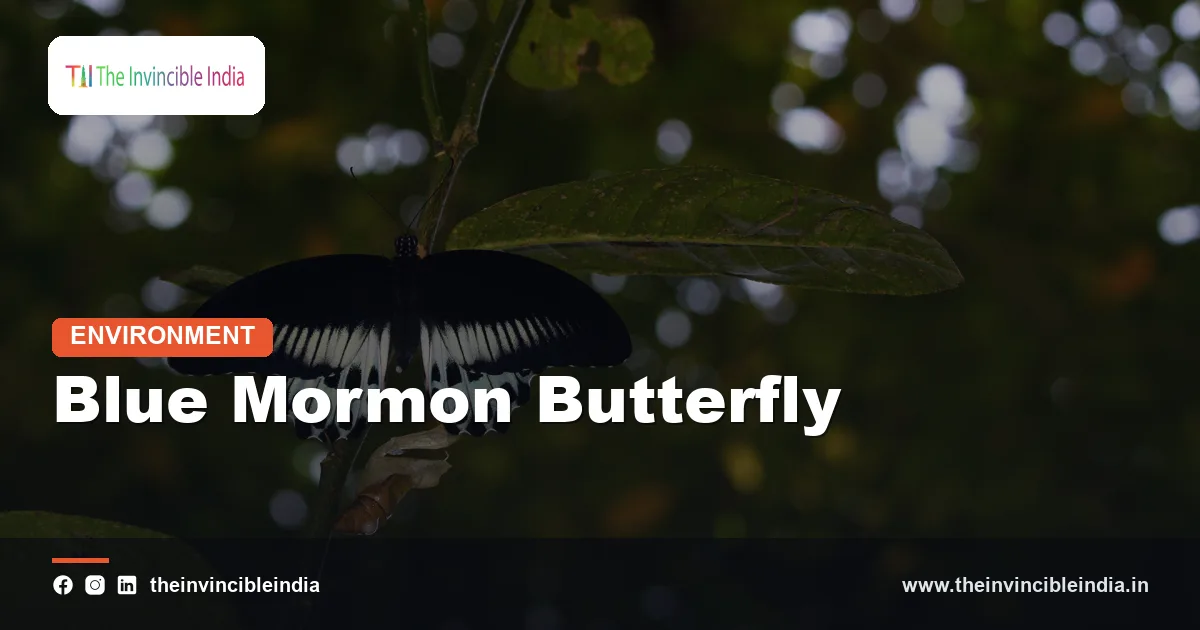
The blue Mormon (Papilio polymnestor) is a large velvety-black swallowtail butterfly with a broad band of shimmering sky-blue across its wings, found in the Western Ghats and other parts of peninsular India, and it was declared the state butterfly of Maharashtra in 2015. With a wingspan that often exceeds 12 cm, it is one of the biggest butterflies in India and a common sight in the forests, gardens and hill slopes of western and southern India.
The blue Mormon is widely admired for its size, its strong gliding flight and its use of citrus trees as food for its caterpillars. This guide explains how to identify the blue Mormon, where it lives, what it eats, how its life cycle works, why Maharashtra chose it as a state symbol and how to watch it responsibly.
Blue Mormon Quick Facts
| Common name | Blue Mormon |
|---|---|
| Scientific name | Papilio polymnestor (Cramer, 1775) |
| Family | Papilionidae (swallowtails) |
| Wingspan | Roughly 12 to 15 cm, making it one of the largest butterflies in India |
| Caterpillar host plants | Members of the rue and citrus family (Rutaceae), including cultivated Citrus species such as lime, lemon and orange, and wild relatives |
| Range and habitat in India | Western Ghats and peninsular India, including the Konkan coast and the southern states; forests, forest edges, plantations, gardens and hill slopes; also found in Sri Lanka |
| Flight season | Seen through much of the year with several broods; often most conspicuous in and after the monsoon |
| Notable features | Maharashtra state butterfly (2015); velvety black wings with a blue band; short hindwing tail; strong, gliding flight |
Key Takeaways
- The blue Mormon (Papilio polymnestor) is a large swallowtail butterfly with a wingspan of roughly 12 to 15 cm.
- The blue Mormon was declared the state butterfly of Maharashtra in 2015, and it is widely associated with the Western Ghats.
- Blue Mormon caterpillars feed mainly on Citrus and other plants of the rue family (Rutaceae), so the butterfly is often seen around lime and lemon trees.
- The wings of the blue Mormon are velvety black with a broad band of pale, shimmering blue across the hindwing and part of the forewing.
- Young blue Mormon caterpillars look like bird droppings, a camouflage that protects them from predators.
- The blue Mormon is not regarded as globally threatened, but it depends on healthy Western Ghats forest and on host plants in gardens and orchards.
What Is the Blue Mormon Butterfly?
The blue Mormon is a large swallowtail butterfly, Papilio polymnestor, native to India and Sri Lanka and best known from the forests and hills of the Western Ghats. It was described by the Dutch naturalist Pieter Cramer in 1775 and belongs to the family Papilionidae, the swallowtails.
The group called “Mormons” in India includes several swallowtails in the genus Papilio, such as the common Mormon and the blue Mormon. Despite the shared name, the blue Mormon is a separate species with a distinctive blue band and a much larger size. The name has nothing to do with any religion; it is an old naturalists’ label for a group of related butterflies.
Swallowtails get their name from the tail-like projections on the hindwings of many species. In the blue Mormon the tail is short and relatively inconspicuous, but the sheer size and colour of the butterfly make it stand out in any garden or forest clearing.
How Can You Identify the Blue Mormon?
You can identify the blue Mormon by its large size, its velvety black wings, the broad band of pale shimmering blue on both wings and the short tail on the hindwing. When the butterfly flies, it often appears as a dark shape with a bright blue stripe, and in sunlight the blue appears to glow.
Upperside
The upperside is deep black with a broad, pale sky-blue to blue-green band. The band is strongest on the hindwing and extends partly onto the forewing. The blue is formed by the microscopic structure of the wing scales rather than by pigment, and so its brightness shifts with the angle of light.
Underside
The underside is duller than the upperside, with brown or blackish tones and a hint of red near the bases of the wings. The pale band is usually visible but less brilliant. Small touches of red can also be seen on the body and near the tornus of the hindwing.
Males and females
The two sexes look broadly similar, and the female is usually a little larger and may have slightly broader wings. Sex is hard to determine in the field, so the key identification features are the large size and the blue band.
Where Is the Blue Mormon Found in India?
The blue Mormon is found mainly in the Western Ghats and in peninsular India, including the Konkan coast, Goa, Karnataka, Kerala and Tamil Nadu, with records from parts of the central peninsula as well. It is also found in Sri Lanka, and it is considered a butterfly of the Indian peninsula and nearby island.
Within these regions, the species uses a wide variety of habitats:
- Evergreen and semi-evergreen forest and forest edges in the Western Ghats.
- Moist deciduous forest, ravines and hill slopes with scattered trees.
- Gardens, orchards and plantations where citrus trees are grown.
- Parks and wooded campuses in and around cities such as Mumbai and Pune, which lie close to forested hills.
Because the blue Mormon can fly strongly and cover a large area, it sometimes appears in places far from the forest. However, regular breeding occurs only where suitable host plants are available.
Why Is the Blue Mormon the State Butterfly of Maharashtra?
The blue Mormon was declared the state butterfly of Maharashtra in 2015 because it is a striking, widespread and recognisable butterfly of the Western Ghats, which run through the state. The decision aimed to raise public interest in butterflies and in the protection of forests and their pollinators.
State symbols such as animals, birds, trees and butterflies are chosen to connect people with local biodiversity. A butterfly is useful for this purpose because it is easily seen, attractive and sensitive to habitat change, so its presence or absence says something about the health of a landscape. Several other Indian states have also adopted state butterflies, as the table below shows.
| State | State butterfly |
|---|---|
| Maharashtra | Blue Mormon (Papilio polymnestor) |
| Karnataka | Southern Birdwing (Troides minos) |
| Uttarakhand | Common Peacock (Papilio bianor) |
| Kerala | Malabar Banded Peacock (Papilio buddha) |
| Tamil Nadu | Tamil Yeoman (Cirrochroa thais) |
What Does the Blue Mormon Eat?
Blue Mormon caterpillars eat the leaves of plants in the rue and citrus family (Rutaceae), and adult blue Mormons drink nectar from flowers and minerals from wet ground. The female lays her eggs singly on tender young leaves so that the caterpillars find fresh food at hatching.
Host plants
The main host plants are cultivated and wild species of Citrus, including lime, lemon and orange, and other Rutaceae such as wild citrus relatives of forest edges. This is why the blue Mormon is a regular visitor to home gardens that grow lemon or lime trees. Caterpillars rarely cause serious harm to mature trees, though heavy infestations in small nursery plants can strip the foliage.
Adult food
Adult blue Mormons visit flowers such as lantana, ixora, jasmine and various forest shrubs, hovering with their wings in constant motion. They are also attracted to damp ground, where males gather to take in salts. The large size and quivering wings make them easy to notice when they feed.
What Is the Life Cycle of the Blue Mormon?
The blue Mormon passes through egg, caterpillar, pupa and adult stages, and in warm regions there are several broods a year. The cycle from egg to adult takes several weeks, depending on weather and food.
- Egg: The female lays small, round, pale eggs, one at a time, on young citrus or other host leaves.
- Caterpillar: The young larva is brown and white and looks like a bird dropping, which discourages predators. The older caterpillar is bright green with a swollen front part and a pair of false eye-like marks. When alarmed it can extend a soft, forked, foul-smelling gland called the osmeterium.
- Pupa: The caterpillar attaches itself to a twig or leaf stem with a silk pad and a silk girdle. The chrysalis is green or brown and resembles a broken twig or a curled leaf.
- Adult: The butterfly emerges, expands its wings and, after a few hours, begins to fly and feed.
Because the caterpillar and chrysalis are well camouflaged, many gardeners never notice them. People who grow lime or lemon trees can often find the green caterpillars by looking at the newest leaves.
How Does the Blue Mormon Fly and Behave?
The blue Mormon flies with powerful, gliding wingbeats and often travels high above the ground, and it is a restless butterfly that rarely settles for long. It is easier to see when it descends to feed, drink or lay eggs.
Flower visits
At flowers, the butterfly keeps its wings fluttering and hovers rather than perching, which is typical of swallowtails. This behaviour supports the pollination of many garden and forest plants, because the large body picks up and carries pollen between flowers.
Mud-puddling
Males, and sometimes females, gather at damp sand and stream edges. They are often seen with other swallowtails such as the common Mormon, the tailed jay and the common bluebottle. Large mixed gatherings are most likely in the monsoon and post-monsoon months.
Defence
The blue Mormon relies on strong flight to avoid predators as an adult. In the early stages, camouflage and the osmeterium protect the caterpillar. The bright blue band may also confuse a predator by flashing and then vanishing as the butterfly dives into the shade.
How Is the Blue Mormon Different from Similar Butterflies?
The blue Mormon differs from similar swallowtails mainly in its much larger size, its continuous blue band and its short hindwing tail. Several large dark butterflies share its habitat, so a quick comparison helps in the field.
| Butterfly | How it differs from the blue Mormon |
|---|---|
| Common Mormon (Papilio polytes) | Smaller, with a white patch on the hindwing in males and several different forms among females. |
| Southern Birdwing (Troides minos) | Even larger, with a bold yellow and black pattern rather than a blue band. |
| Common Bluebottle (Graphium sarpedon) | Smaller with a clear blue band, but narrower wings, no tail and a much faster, darting flight. |
| Blue Tiger (Tirumala limniace) | Orange-brown to bluish with white or blue streaks; it belongs to a different family, the brush-footed butterflies. |
| Malabar Banded Peacock (Papilio buddha) | Shows a green and blue sheen and a band of pale bars; found mainly in the Western Ghats and rarely in gardens. |
A very large, velvety-black butterfly with a broad blue band, gliding over a lime tree or a forest clearing in the Western Ghats, is almost certainly a blue Mormon.
Is the Blue Mormon Threatened?
The blue Mormon is not regarded as a globally threatened butterfly, and it remains fairly common across much of the Western Ghats. However, its long-term survival depends on the protection of forest, hill slopes and host plants.
The main pressures include:
- Loss and fragmentation of forests through roads, mining, quarrying and development.
- Pesticide use in orchards and nurseries, which can kill caterpillars.
- Removal of wild host plants and weedy trees from field edges.
- Illegal collection of showy butterflies for decoration or trade.
Collecting butterflies in protected areas is prohibited in India, and several butterfly species are listed in the schedules of the Wildlife (Protection) Act, 1972. Being a state butterfly can raise awareness, but protection of forests is the real foundation of conservation.
How Can You See and Photograph the Blue Mormon?
You can see the blue Mormon most easily by visiting forest edges, hill slopes and gardens with citrus trees in the Western Ghats during warm, bright weather, especially in the morning. During the monsoon and the weeks after it, numbers often rise and the butterflies are more active.
Practical tips
- Look near flowering shrubs such as lantana and ixora, where the butterfly pauses to feed.
- Watch damp sand and stream banks for mud-puddling groups.
- Check the newest leaves of lime and lemon trees for eggs and caterpillars.
- Use a fast shutter speed because the wings quiver at flowers.
- Avoid handling caterpillars and chrysalises, and do not spray pesticides on citrus plants that host them.
Home gardeners can help by growing a lime or lemon tree and a few nectar shrubs. Sharing sightings through community-science platforms also helps researchers track how butterflies respond to climate and land use.
Bottom Line
The blue Mormon is a large, shimmering swallowtail that has become a symbol of Maharashtra and of the butterfly life of the Western Ghats. Protecting forests, avoiding pesticides on citrus plants and watching butterflies without disturbing them are the best ways to keep the blue Mormon flying in Indian skies.
Frequently Asked Questions
What is the scientific name of the blue Mormon butterfly?
The scientific name of the blue Mormon butterfly is Papilio polymnestor. It was described by Pieter Cramer in 1775 and belongs to the swallowtail family Papilionidae.
Which state has the blue Mormon as its state butterfly?
Maharashtra has the blue Mormon as its state butterfly. The state declared it in 2015, partly to raise interest in butterflies and in the Western Ghats.
How big is the blue Mormon butterfly?
The blue Mormon has a wingspan of roughly 12 to 15 cm, which makes it one of the largest butterflies in India. Females are usually a little larger than males.
What do blue Mormon caterpillars eat?
Blue Mormon caterpillars eat the leaves of Citrus and other plants of the rue family (Rutaceae). That is why the butterfly is often found around lime and lemon trees in gardens and orchards.
Where can I see the blue Mormon in India?
The blue Mormon can be seen in the Western Ghats and in peninsular India, including Maharashtra, Goa, Karnataka, Kerala and Tamil Nadu. Look for it in forest edges, hill slopes, gardens and orchards, especially around flowering shrubs and citrus trees.
How is the blue Mormon different from the common Mormon?
The blue Mormon is larger than the common Mormon and has a broad shimmering blue band on velvety black wings. The common Mormon (Papilio polytes) is smaller and often has white patches on the hindwing, and its females occur in several forms.
{“@context”:”https://schema.org”,”@graph”:[{“@type”:”FAQPage”,”mainEntity”:[{“@type”:”Question”,”name”:”What is the scientific name of the blue Mormon butterfly?”,”acceptedAnswer”:{“@type”:”Answer”,”text”:”The scientific name of the blue Mormon butterfly is Papilio polymnestor. It was described by Pieter Cramer in 1775 and belongs to the swallowtail family Papilionidae.”}},{“@type”:”Question”,”name”:”Which state has the blue Mormon as its state butterfly?”,”acceptedAnswer”:{“@type”:”Answer”,”text”:”Maharashtra has the blue Mormon as its state butterfly. The state declared it in 2015, partly to raise interest in butterflies and in the Western Ghats.”}},{“@type”:”Question”,”name”:”How big is the blue Mormon butterfly?”,”acceptedAnswer”:{“@type”:”Answer”,”text”:”The blue Mormon has a wingspan of roughly 12 to 15 cm, which makes it one of the largest butterflies in India. Females are usually a little larger than males.”}},{“@type”:”Question”,”name”:”What do blue Mormon caterpillars eat?”,”acceptedAnswer”:{“@type”:”Answer”,”text”:”Blue Mormon caterpillars eat the leaves of Citrus and other plants of the rue family (Rutaceae). That is why the butterfly is often found around lime and lemon trees in gardens and orchards.”}},{“@type”:”Question”,”name”:”Where can I see the blue Mormon in India?”,”acceptedAnswer”:{“@type”:”Answer”,”text”:”The blue Mormon can be seen in the Western Ghats and in peninsular India, including Maharashtra, Goa, Karnataka, Kerala and Tamil Nadu. Look for it in forest edges, hill slopes, gardens and orchards, especially around flowering shrubs and citrus trees.”}},{“@type”:”Question”,”name”:”How is the blue Mormon different from the common Mormon?”,”acceptedAnswer”:{“@type”:”Answer”,”text”:”The blue Mormon is larger than the common Mormon and has a broad shimmering blue band on velvety black wings. The common Mormon (Papilio polytes) is smaller and often has white patches on the hindwing, and its females occur in several forms.”}}]}]}


