

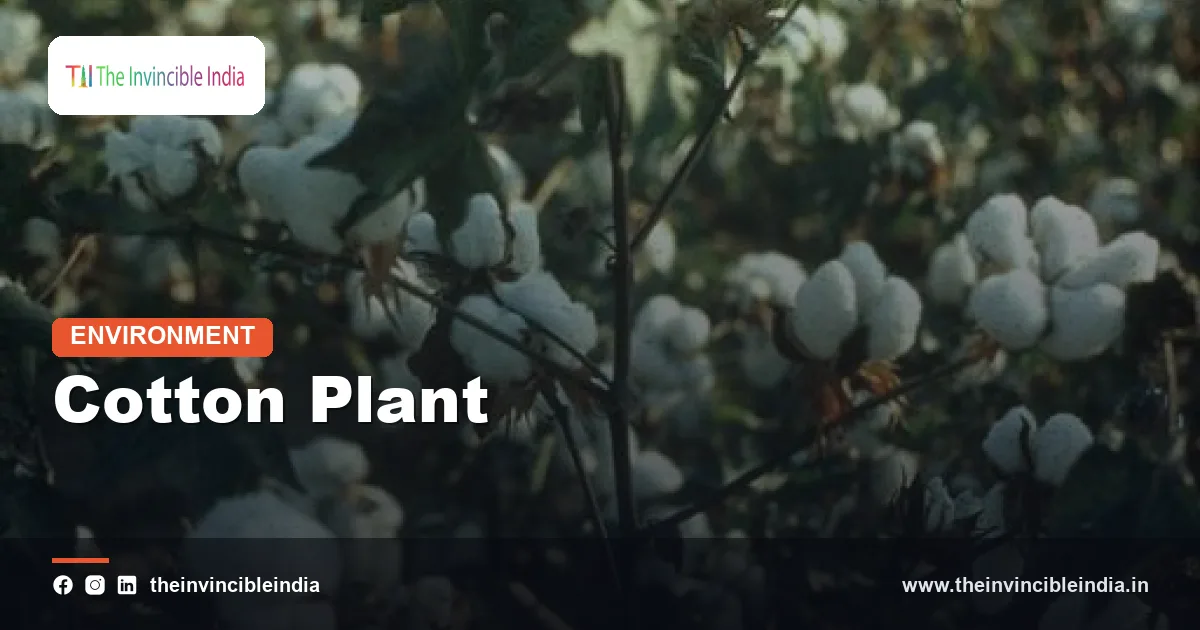
The cotton plant is a warm-climate shrub of the genus Gossypium whose seed pods, called bolls, split open to reveal soft white fibres that are spun into yarn and woven into cloth. In India, the cotton plant is grown as a major kharif (monsoon-season) crop and sits at the start of one of the country’s longest manufacturing chains, running from the farm through ginning, spinning, weaving and garment-making.
India has grown and woven cotton for thousands of years, and it is unusual in cultivating all four cultivated cotton species. This article explains what the cotton plant is, how it grows, where it is farmed in India, what the Bt cotton debate is about, and how a field of bolls becomes a bale, a bolt of fabric and a finished shirt.
| Attribute | Detail |
|---|---|
| Scientific name | Gossypium species (mainly G. hirsutum, G. arboreum, G. herbaceum and G. barbadense) |
| Family | Malvaceae (the mallow family, which also includes okra and hibiscus) |
| Where grown in India | Gujarat, Maharashtra, Telangana, Andhra Pradesh, Karnataka, Madhya Pradesh, Haryana, Punjab, Rajasthan and Tamil Nadu, among others |
| Season | Mainly kharif: sown with the monsoon or pre-monsoon irrigation, picked from roughly October to January |
| Part used | The fibre (lint) on the seed; the seed itself is used for oil and cattle feed |
| Main products | Yarn, fabric, cottonseed oil, cottonseed cake, cotton waste and linters |
| Importance | One of India’s key cash crops and the raw material base of its textile industry |
| Species grown in India | All four cultivated species, plus hybrids, a distinction few countries share |
Key Takeaways
- The cotton plant belongs to the genus Gossypium in the mallow family, Malvaceae, and its commercial product is the white fibre that grows on its seeds inside a boll.
- India cultivates all four cultivated cotton species, Gossypium hirsutum, G. barbadense, G. arboreum and G. herbaceum, along with hybrids between them.
- Bt cotton, a genetically modified variety carrying a gene from the soil bacterium Bacillus thuringiensis, was approved for commercial cultivation in India in 2002 and is the only genetically modified crop grown on a large scale in the country.
- Raw harvested cotton is called kapas; ginning separates it into lint, which goes to spinning mills, and cottonseed, which is crushed for oil and cattle feed.
- Cotton farming in India is largely rain-fed and concentrated on the black cotton soils of the Deccan and western India, which hold moisture well.
- Cotton cloth from the Indian subcontinent has an ancient history, with cotton remains found at Indus Valley sites and fine muslins that were famous across the ancient and medieval world.
What is the cotton plant and how does it grow?
The cotton plant is a perennial shrub that is grown as an annual crop, reaching roughly one to two metres in height, with broad lobed leaves, cream or pale yellow flowers and a rounded green capsule called a boll. Inside the boll, each seed is wrapped in fine hairs. When the boll ripens it splits along its seams and the hairs fluff out into the white mass that people recognise as cotton.
A cotton flower lasts only a day or two. It opens cream-white or yellow, turns pink or reddish after pollination and then falls, leaving a small green boll behind. The boll takes about six to eight weeks to mature. The fibres inside are single elongated plant cells, each a hair that grows out from the seed coat and is made almost entirely of cellulose.
Because the plant is naturally perennial, it will keep flowering and fruiting if left alone. Farmers treat it as an annual because a fresh crop each year gives better control over pests and a more uniform harvest. The plant is also indeterminate, meaning it flowers over a long period, which is why bolls on the same plant open at different times and cotton is picked in several rounds.
Which cotton species are grown in India?
India grows four cultivated species of cotton, and it is often described as the only major producer that cultivates all four together with hybrids. The species differ in fibre length, fineness and region of origin, which is why they suit different soils, spinning needs and traditions.
| Species | Common name | Origin | Fibre character |
|---|---|---|---|
| Gossypium hirsutum | Upland cotton | Central America and Mexico | Medium staple; the most widely grown cotton in India and the world |
| Gossypium barbadense | Egyptian, Pima or Sea Island type | South America | Long and extra-long staple; fine, strong fibre for premium fabrics |
| Gossypium arboreum | Tree cotton, often called desi cotton | Indian subcontinent | Short staple; hardy and drought tolerant |
| Gossypium herbaceum | Levant cotton, also a desi type | Africa and Arabia | Short staple; suited to dry conditions |
The two Old World species, G. arboreum and G. herbaceum, were the cottons of India for most of its history. They are tough and tolerate poor rainfall, but their short fibre suits coarse cloth and certain blended or absorbent uses better than fine yarn. Upland cotton, introduced and bred later, now dominates, and most of India’s modern hybrids are crosses within the upland group or between upland and long-staple cottons.
Where is cotton grown in India?
Cotton is grown across three broad zones in India: the north (Punjab, Haryana and Rajasthan), the central zone (Gujarat, Maharashtra and Madhya Pradesh) and the south (Telangana, Andhra Pradesh, Karnataka and Tamil Nadu). Gujarat and Maharashtra are generally recognised as among the leading cotton states by area and output, with Telangana and others following, although the exact ranking changes from season to season.
- North zone: Largely irrigated cotton, sown in April to May and picked in the autumn. Fields here are often fed by canal water and the crop sits between wheat seasons.
- Central zone: Mostly rain-fed cotton on deep black soil, sown with the monsoon in June to July. This belt accounts for a very large share of the national cotton area.
- South zone: A mix of rain-fed and irrigated cotton, with a longer growing window and some rabi-season cotton in places.
India has one of the largest areas under cotton of any country in the world, though its yield per hectare has historically been lower than that of several other major producers because so much of the crop is rain-fed and grown by small farmers. These are broad, long-standing patterns; the exact area and production figures vary each year and are published by government and trade bodies.
What soil and climate does the cotton plant need?
The cotton plant needs a long, warm, frost-free growing season, plenty of sunshine, moderate rain during growth and dry weather during boll opening and picking. It does best on deep, well-drained soils that retain moisture, which is why the black cotton soil, also called regur, of the Deccan plateau is so closely associated with the crop.
Regur is rich in clay that swells when wet and cracks when dry. It holds water through the dry weeks of the monsoon and supplies moisture to the deep taproot of the plant. Cotton also grows on alluvial soils in the north when irrigation is available, and on red soils in parts of the south with careful management.
Temperatures of roughly 21 to 30 degrees Celsius suit the plant during growth. Frost kills it, and prolonged waterlogging damages the roots. Heavy rain at picking time stains the lint and reduces quality, which is why a dry, sunny autumn is the farmer’s wish.
How is cotton farmed from sowing to picking?
Cotton is farmed through a seasonal cycle that starts with land preparation and sowing and ends, roughly six months later, with several rounds of hand picking. Each stage determines the quality of the final fibre, so timing and care matter throughout.
Sowing and early care
Farmers plough the land, add farmyard manure and sow seeds in rows, usually with wide spacing so the spreading plants get light and air. Seeds are placed at a depth of a few centimetres. Early weeding is critical because young cotton competes poorly with weeds. Thinning and gap-filling make sure each row has an even stand.
Growth, nutrition and water
Cotton responds to nitrogen, phosphorus and potash, and the growing plant needs water most during flowering and boll formation. In irrigated areas, drip irrigation has been promoted to save water and fertiliser, since cotton is a fairly thirsty crop overall. In rain-fed areas, farmers depend on the monsoon and on moisture stored in the soil.
Picking
Most cotton in India is picked by hand, often by women labourers, in several passes as bolls open over weeks. Hand picking allows workers to avoid leaf trash and select clean fibre, which helps quality, but it is labour intensive. The picked material, still holding its seeds, is called kapas or seed cotton.
What are the main pests and problems of cotton?
The main pests of the cotton plant are bollworms, sucking insects such as aphids, whitefly, jassids and mealybugs, and diseases such as cotton leaf curl virus. Among them, the bollworm complex has historically caused the most damage because the caterpillars bore into flower buds and bolls and destroy the developing fibre.
- American bollworm (Helicoverpa armigera): a caterpillar that feeds on squares and bolls; long a leading cause of cotton loss in India.
- Pink bollworm (Pectinophora gossypiella): a small larva that feeds inside the boll and damages seed and lint; it has become a serious concern in recent years in several regions.
- Whitefly and other sucking pests: they weaken the plant, excrete sticky honeydew and can carry viral disease.
- Cotton leaf curl virus: spread by whitefly, it curls leaves and reduces yield, especially in northern India.
Managing these problems depends on a mix of resistant varieties, crop rotation, timely sowing, monitoring with traps and, where needed, targeted insecticide sprays. Integrated pest management is promoted by agricultural universities and extension services to reduce spraying.
What is Bt cotton and why is it debated?
Bt cotton is a genetically modified cotton carrying a gene from the soil bacterium Bacillus thuringiensis that produces a protein toxic to certain bollworm caterpillars. It was approved for commercial cultivation in India in 2002, and it remains the only genetically modified crop grown commercially at scale in the country.
The first Bt hybrids, based on the Cry1Ac gene, targeted the American bollworm. A second generation with two toxin genes followed later, aimed at wider protection. The technology spread quickly, and Bt hybrids came to occupy the vast majority of India’s cotton area in the years that followed.
The debate around Bt cotton is real and has several sides. A fair summary lays them out together.
Arguments commonly made in favour
- Bt cotton reduced losses to American bollworm and cut insecticide sprays aimed at that pest, especially in the early years.
- Cotton output and exports rose sharply in the years after adoption, and many farmers reported higher yields and incomes.
- The technology fitted easily into existing farming because the farmer simply buys a different seed.
Concerns commonly raised
- Seeds are costly and cannot be saved and replanted in the same way as traditional varieties, so farmers depend on seed companies each year.
- Pests can evolve resistance to the toxin, and pink bollworm resistance to Bt cotton has been reported in parts of India, leading to renewed pest pressure.
- Gains in yield have been uneven over time, and researchers disagree about how much of the output rise is due to Bt itself and how much to other factors such as hybrids, irrigation and fertiliser use.
- Critics have raised concerns about the impact on farmer debt, biodiversity, and the loss of desi cotton seed diversity.
- Unapproved herbicide-tolerant seed has been found circulating among farmers, which regulators have flagged as a compliance problem.
Government agencies, scientists, farmer groups and civil society continue to debate regulation, seed pricing and the next generation of cotton traits. Studies reach differing conclusions depending on the period and region examined, so the most reliable statement is that Bt cotton delivered clear early gains against bollworm while raising long-term questions about resistance management, costs and diversity.
How does raw cotton become cloth?
Raw cotton becomes cloth through a sequence of steps: ginning to separate fibre from seed, baling, spinning into yarn, weaving or knitting into fabric, and finally dyeing, finishing and stitching into garments. Each stage adds value, and India has a presence at nearly every stage of this chain.
- Ginning: a gin machine removes the seeds from the kapas. The lint that results is cleaned and compressed into bales. In India, a standard bale is about 170 kilograms.
- Spinning: the lint is carded, combed and drawn out into rovings, then twisted into yarn. Finer, longer-staple cotton produces stronger and smoother yarn.
- Weaving or knitting: yarn is woven on looms into cloth or knitted into jersey and hosiery fabrics.
- Processing: the fabric is bleached, dyed, printed and finished.
- Making up: the finished fabric is cut and stitched into garments, home textiles and other goods.
Cotton fibre is graded by staple length, fineness and strength. In rough terms, short staple is under about 20 millimetres, medium staple runs from the low twenties up to the mid-twenties, long staple runs longer and extra-long staple longer still. Longer fibre makes finer yarn, which is why extra-long staple cottons are used for high-end shirting and sheets.
What else does the cotton plant give besides fibre?
Besides fibre, the cotton plant gives cottonseed, which is crushed to make edible cottonseed oil and a protein-rich cake used as cattle feed. Seed cotton is typically about one-third fibre and two-thirds seed by weight, so a large share of every harvest is not lint at all.
- Cottonseed oil: used for cooking and in some processed foods after refining.
- Cottonseed cake or meal: a protein feed for cattle, widely used in dairy farming.
- Linters: very short fibres left clinging to the seed after ginning, used in paper, cellulose products and cushioning.
- Cotton stalks: sometimes used as fuel, for making briquettes or as raw material for particle board, although many are burned or left in fields.
- Cotton waste: short fibre recovered during spinning and used in coarse yarn, wipes and padding.
These by-products matter economically because they spread income across the chain and keep oil and feed industries tied to the cotton belt.
Why does cotton matter to India?
Cotton matters to India because it supports the livelihoods of millions of farmers and workers and supplies raw material to one of the country’s largest manufacturing sectors, textiles and apparel. It is both a farm crop and an industrial input, and its fortunes affect rural incomes, mill operations and exports.
The crop also has deep cultural and historical weight. Archaeologists have found evidence of cotton use in the Indus Valley civilisation, and cotton cloth from the subcontinent reached distant markets in ancient times. Fine muslins, such as those from the Bengal region, were famous for their delicacy. During the freedom movement, the spinning wheel (charkha) and handspun cotton khadi became symbols of self-reliance, and the cotton plant became tied to the story of the nation.
The government supports the sector through minimum support prices for kapas, which are announced for each season, and through procurement by agencies such as the Cotton Corporation of India. Cotton is also traded on domestic markets and internationally, so global prices, import duties and export policy affect what farmers earn. Debates about prices, quality, water use and fibre standards remain a regular part of agricultural policy.
Is cotton farming sustainable?
Cotton farming can be made more sustainable, but conventional cotton is a resource-intensive crop that raises real concerns about water, pesticides and farmer risk. Because so much Indian cotton is rain-fed, harvests swing with the monsoon, and drought or untimely rain can cause heavy losses for small growers.
- Water: irrigated cotton uses a lot of water, so drip systems and better scheduling are promoted.
- Pesticides: bollworm control has changed with Bt, but sucking pests and resistance still call for careful management.
- Organic and regenerative cotton: organic cotton is grown without synthetic pesticides and fertilisers, and India is generally counted among the largest organic cotton producers in the world, although it makes up a small share of total output.
- Better Cotton and similar programmes: voluntary schemes train farmers in more efficient practices and sell to brands that want responsibly grown fibre.
- Desi cotton revival: some farmers and groups are reviving native short-staple cotton for its hardiness and low input needs.
Bottom Line
The cotton plant gives India its most important natural textile fibre, along with oil and feed from its seed, and it links millions of farmers to mills, markets and exports. Its future depends on managing pests and resistance, saving water, strengthening seed diversity and keeping farm incomes stable.
Frequently Asked Questions
What is the cotton plant used for?
The cotton plant is used mainly for its fibre, which is spun into yarn and woven into cloth. Its seeds are also crushed for cottonseed oil and a protein-rich cattle feed, and its short linters go into paper and cellulose products. Cotton therefore supplies textile, food-oil and animal-feed industries at once.
Which state grows the most cotton in India?
Gujarat and Maharashtra are generally counted among the leading cotton-growing states in India, with Telangana, Andhra Pradesh, Karnataka and others also growing large amounts. The exact ranking by area and production changes from year to year with rainfall and prices, so current figures should be checked with government or trade sources.
What is Bt cotton?
Bt cotton is a genetically modified cotton that carries a gene from the bacterium Bacillus thuringiensis, which makes a protein that kills certain bollworm caterpillars. It was approved for commercial planting in India in 2002 and is the only genetically modified crop grown commercially at scale in the country. It has also drawn debate over seed cost, pest resistance and farmer dependence on seed companies.
When is cotton sown and harvested in India?
Cotton is mainly a kharif crop in India, sown between about April and July depending on the region and picked from roughly October to January. Irrigated fields in the north are sown earlier, while rain-fed fields in central and southern India are sown with the monsoon. Because bolls open gradually, picking takes place in several rounds.
What is the difference between kapas and cotton lint?
Kapas is raw seed cotton straight from the field, with the fibre still attached to its seeds, while lint is the clean fibre left after ginning has removed the seeds. Lint is baled and sent to spinning mills. The separated seeds are crushed for oil and feed.
Which cotton species are grown in India?
India grows all four cultivated cotton species: Gossypium hirsutum (upland), G. barbadense (long staple), G. arboreum and G. herbaceum (the Asiatic or desi cottons). Upland cotton and hybrids dominate present-day cultivation. The desi types are hardier and better suited to dry conditions but have shorter fibre.
{“@context”:”https://schema.org”,”@graph”:[{“@type”:”FAQPage”,”mainEntity”:[{“@type”:”Question”,”name”:”What is the cotton plant used for?”,”acceptedAnswer”:{“@type”:”Answer”,”text”:”The cotton plant is used mainly for its fibre, which is spun into yarn and woven into cloth. Its seeds are also crushed for cottonseed oil and a protein-rich cattle feed, and its short linters go into paper and cellulose products. Cotton therefore supplies textile, food-oil and animal-feed industries at once.”}},{“@type”:”Question”,”name”:”Which state grows the most cotton in India?”,”acceptedAnswer”:{“@type”:”Answer”,”text”:”Gujarat and Maharashtra are generally counted among the leading cotton-growing states in India, with Telangana, Andhra Pradesh, Karnataka and others also growing large amounts. The exact ranking by area and production changes from year to year with rainfall and prices, so current figures should be checked with government or trade sources.”}},{“@type”:”Question”,”name”:”What is Bt cotton?”,”acceptedAnswer”:{“@type”:”Answer”,”text”:”Bt cotton is a genetically modified cotton that carries a gene from the bacterium Bacillus thuringiensis, which makes a protein that kills certain bollworm caterpillars. It was approved for commercial planting in India in 2002 and is the only genetically modified crop grown commercially at scale in the country. It has also drawn debate over seed cost, pest resistance and farmer dependence on seed companies.”}},{“@type”:”Question”,”name”:”When is cotton sown and harvested in India?”,”acceptedAnswer”:{“@type”:”Answer”,”text”:”Cotton is mainly a kharif crop in India, sown between about April and July depending on the region and picked from roughly October to January. Irrigated fields in the north are sown earlier, while rain-fed fields in central and southern India are sown with the monsoon. Because bolls open gradually, picking takes place in several rounds.”}},{“@type”:”Question”,”name”:”What is the difference between kapas and cotton lint?”,”acceptedAnswer”:{“@type”:”Answer”,”text”:”Kapas is raw seed cotton straight from the field, with the fibre still attached to its seeds, while lint is the clean fibre left after ginning has removed the seeds. Lint is baled and sent to spinning mills. The separated seeds are crushed for oil and feed.”}},{“@type”:”Question”,”name”:”Which cotton species are grown in India?”,”acceptedAnswer”:{“@type”:”Answer”,”text”:”India grows all four cultivated cotton species: Gossypium hirsutum (upland), G. barbadense (long staple), G. arboreum and G. herbaceum (the Asiatic or desi cottons). Upland cotton and hybrids dominate present-day cultivation. The desi types are hardier and better suited to dry conditions but have shorter fibre.”}}]}]}


