

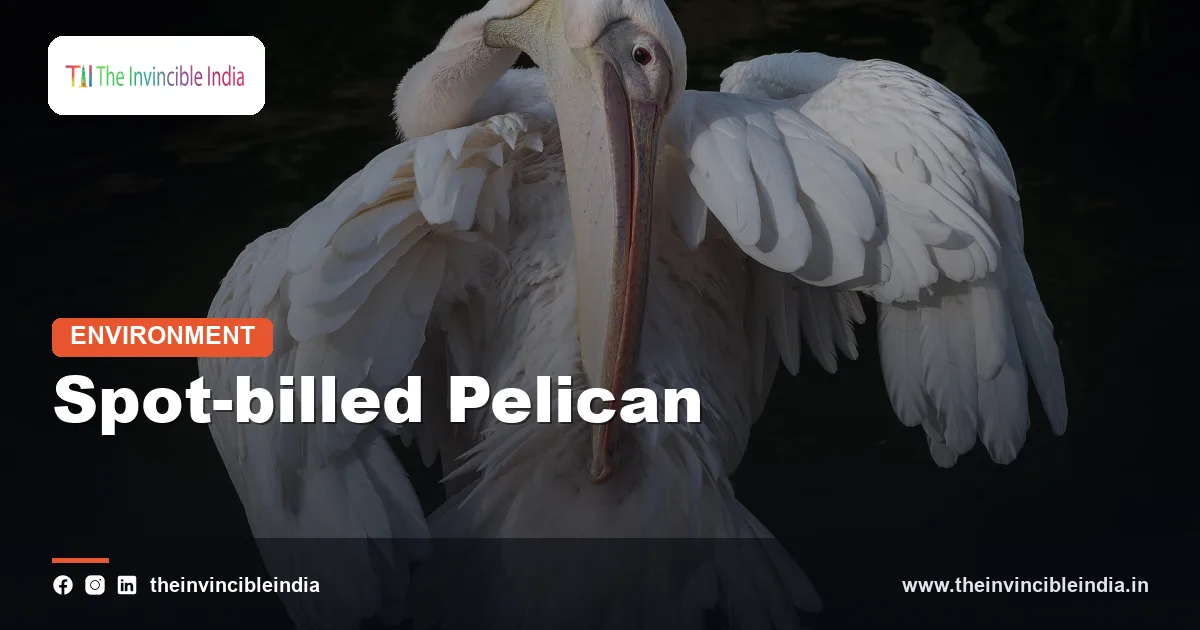
The spot-billed pelican (Pelecanus philippensis), also known as the grey pelican, is a large, greyish-white waterbird of South Asia that catches fish in a stretchy throat pouch and breeds in noisy colonies in trees beside lakes, tanks and village wetlands. India holds the largest share of the world’s remaining spot-billed pelicans, which are listed as Near Threatened because of wetland loss and disturbance at their nesting sites.
The bird is easy to recognise by the rows of bluish-black spots along the upper edge of its pinkish bill and by its habit of fishing together in groups. This explainer covers how to identify the spot-billed pelican, where it lives in India, how it feeds and breeds, which colonies are best known and what threatens its survival.
Quick Facts: Spot-billed Pelican
| Common names | Spot-billed pelican, grey pelican |
|---|---|
| Scientific name | Pelecanus philippensis |
| Family | Pelecanidae (pelicans) |
| Size | About 125 to 150 cm long; wingspan roughly 2.5 m; weight several kilograms |
| India range and habitat | Large lakes, reservoirs, village tanks, estuaries and coastal wetlands, mainly in peninsular India and Assam |
| Diet | Mainly fish, taken by scooping with the bill pouch; also some crustaceans and frogs |
| Breeding | Colonial tree nesting; breeding mostly from October to March in southern India |
| Movement | Resident with local and seasonal movements to follow water and food |
| Conservation status | Near Threatened on the IUCN Red List; protected under Indian wildlife law |
Key Takeaways
- The spot-billed pelican is a large grey-and-white pelican of South Asia, identified by the dark spots on its pinkish upper bill.
- The spot-billed pelican catches fish by scooping them into an expandable throat pouch while swimming, not by diving from the air.
- The spot-billed pelican nests in colonies in tall trees beside or within wetlands and villages, often alongside storks, cormorants and egrets.
- Kokkare Bellur in Karnataka, Koonthankulam in Tamil Nadu and Uppalapadu in Andhra Pradesh are well-known Indian breeding colonies of the spot-billed pelican.
- The spot-billed pelican is listed as Near Threatened by the International Union for Conservation of Nature, and India is its main stronghold.
- The main threats to the spot-billed pelican are the loss and pollution of wetlands, felling of nesting trees and disturbance at breeding colonies.
What is the spot-billed pelican?
The spot-billed pelican is a species of pelican in the family Pelecanidae, native to South Asia and parts of Southeast Asia, and it is the only pelican that breeds regularly in India. Pelicans are among the heaviest flying birds, and the spot-billed is a medium-sized member of the group, smaller than the Dalmatian pelican and the great white pelican.
The scientific name Pelecanus philippensis gives a misleading clue about its home. The species was named from a specimen associated with the Philippines, but the bird is now rare there. Its real stronghold is the Indian subcontinent, with a smaller number in Sri Lanka and Cambodia. Historically, the range was much wider across Southeast Asia, but wetland loss, hunting and egg collection have removed it from many areas.
In English, the bird is also called the grey pelican, a name that fits its overall dull grey-white colour. In Indian field guides it is usually listed under the first name, because the spots on the bill are the most dependable feature for telling it apart from other pelicans.
How can you identify a spot-billed pelican?
The spot-billed pelican can be identified by its greyish-white body, its long pinkish bill with bluish-black spots along the upper edge, and its pink or yellowish throat pouch. At 125 to 150 cm in length with a wingspan of about 2.5 metres, it is a large and unmistakable waterbird.
Adult plumage is mostly grey-white, with darker grey on the flight feathers and a short, ragged crest of brownish feathers on the nape. In the breeding season, adults develop a pinkish flush on the lower back and rump, and the pouch becomes more brightly coloured. Juveniles are browner and duller and do not show the clear bill spots. The legs and feet are dark, the toes are fully webbed and the eye is surrounded by dull skin.
| Feature | Spot-billed pelican | Great white pelican |
|---|---|---|
| Overall colour | Grey-white, dull | Bright white with a pink tinge |
| Bill | Pinkish with dark spots on the upper edge | Yellow-pink without spots |
| Size | Slightly smaller | Larger and heavier |
| Status in India | Breeding resident | Mainly a winter visitor |
| Nape | Short brownish crest | Small crest, pale |
In flight, the spot-billed pelican holds its neck folded back against its shoulders and its heavy bill resting on the chest, which is a posture shared by all pelicans and distinguishes them from storks and cranes. It flies in long lines or V-formations, flapping slowly and then gliding, and it uses rising warm air to soar for long distances.
Where does the spot-billed pelican live in India?
The spot-billed pelican lives on large inland lakes, reservoirs, irrigation tanks, estuaries and coastal lagoons, mainly in peninsular India and in parts of Assam and the eastern states. It prefers shallow, fish-rich water that is large enough to fish in groups and that has tall trees nearby for nesting.
In southern India the species is found in Karnataka, Tamil Nadu, Andhra Pradesh and Kerala, and sometimes in Odisha, with the largest breeding colonies recorded in the south. Birds also occur in Assam, where they use wetlands of the Brahmaputra floodplain, and wander widely outside the breeding season. In earlier centuries the bird was reported from a larger area of the subcontinent, including parts of the Gangetic plains, but its presence there is now irregular.
Because pelicans fish in open water, they favour large lakes such as Kolleru in Andhra Pradesh, Pulicat on the border of Andhra Pradesh and Tamil Nadu, and reservoirs of the Cauvery basin. They also use fishponds and tanks outside protected areas, so they often live close to people.
How does the spot-billed pelican catch fish?
The spot-billed pelican catches fish by swimming on the surface and scooping its prey into a large, stretchable pouch of skin under the lower bill, then draining the water and swallowing the fish whole. It does not plunge-dive from the air like the brown pelican of the Americas.
Feeding is often a group activity. A line or crescent of pelicans swims together, beating their wings and driving shoals of fish toward shallow water. The birds then dip their bills in unison, trapping fish in their pouches. After each scoop the pelican lifts its bill slightly to drain water, tilts its head back and swallows the catch. A single adult needs a substantial amount of fish each day, and a breeding pair must feed growing chicks as well.
- Main prey: small to medium freshwater and estuarine fish, including carps, catfish and tilapia.
- Other prey: crustaceans and, occasionally, frogs and other small animals.
- Feeding style: cooperative herding of fish in shallow water; solitary fishing is also common.
- Time of day: mostly morning and afternoon, with long periods of rest and preening in between.
The pouch is not used to store fish for later. It acts as a net, and its large size can hold several litres of water along with the fish. The skin is elastic and the lower bill bones are flexible, allowing the pouch to expand widely.
How does the spot-billed pelican breed?
The spot-billed pelican breeds in dense colonies, building stick nests in the crowns of tall trees, and in southern India the nesting season usually runs from around October to March, after the monsoon has filled the tanks. The birds return to the same colonies year after year when conditions are favourable.
Males gather material and females arrange it into a bulky platform of sticks and twigs lined with leaves. The female typically lays a small clutch of three to five whitish eggs, and both parents share incubation, which lasts about a month. The chicks are born naked and helpless and are fed on regurgitated fish by both adults, who open their bills so the young can reach into the throat. As they grow, the chicks form noisy groups on the branches and begin to fly after a couple of months.
Colonies are often shared with other large waterbirds. At several Indian sites, painted storks, openbill storks, little cormorants, night herons and egrets nest in the same trees. This mixed arrangement offers protection through numbers, and the droppings of the birds enrich the water and soil below.
Which are the best-known spot-billed pelican colonies in India?
The best-known spot-billed pelican colonies in India are at Kokkare Bellur in Karnataka, Koonthankulam in Tamil Nadu and Uppalapadu in Andhra Pradesh, with other sites at Nelapattu and the Pulicat lagoon area. Many of these colonies are in or beside villages, where local residents have a long tradition of tolerating the birds.
| Site | State | Notes |
|---|---|---|
| Kokkare Bellur | Karnataka | Village in Mandya district where pelicans and painted storks nest in trees within the settlement |
| Koonthankulam Bird Sanctuary | Tamil Nadu | Tank-based sanctuary in Tirunelveli district with large breeding colonies of water birds |
| Uppalapadu | Andhra Pradesh | Village tank near Guntur, a notable pelican and stork site |
| Nelapattu and Pulicat area | Andhra Pradesh | Coastal wetlands and sanctuary region with breeding and feeding birds |
| Kolleru Lake | Andhra Pradesh | Large freshwater lake that supports feeding pelicans |
Kokkare Bellur is especially well known because the villagers have protected the nesting birds for generations. Many residents regard the pelicans as guests and have traditionally refrained from harming them or the trees they use. Visitors are encouraged to keep their distance and to avoid noise.
Does the spot-billed pelican migrate?
The spot-billed pelican does not undertake long migrations; it is a resident bird in India that moves locally as water levels, fish supplies and breeding seasons change. Individuals may travel hundreds of kilometres between wetlands, but they do not make the regular cross-continental journeys of species such as the bar-headed goose.
After breeding, young birds and some adults disperse widely in search of food. Sightings of lone pelicans on lakes far from known colonies are common. Those movements make it difficult to count the population from a single site, and conservationists rely on coordinated waterbird surveys, such as the Asian Waterbird Census, to estimate numbers.
Is the spot-billed pelican endangered?
The spot-billed pelican is not classified as Endangered but as Near Threatened by the International Union for Conservation of Nature (IUCN), which reflects a population that has declined over time and remains small. Its numbers have fallen across Southeast Asia, and India is now the most important refuge.
Past assessments gave the species a higher level of concern, and it has since been placed in the Near Threatened category, partly because Indian colonies have been better protected and partly because new survey data suggested a larger population than earlier estimates. Even so, the bird remains dependent on a limited number of colonies.
What are the main threats?
- Drainage, encroachment and pollution of lakes and tanks, which reduce fish stocks.
- Felling or lopping of nesting trees, and disturbance at colonies.
- Entanglement in fishing nets and lines, and drowning in fishing gear.
- Historical hunting and collection of eggs and chicks, which still occurs in some regions.
- Pesticides and industrial pollution that build up in fish and harm breeding success.
How is it protected?
In India the spot-billed pelican is protected under the Wild Life (Protection) Act, 1972, and several of its nesting sites are bird sanctuaries, conservation reserves or community-protected areas. Community stewardship, as seen at Kokkare Bellur, has proved as important as legal protection.
Why does the spot-billed pelican matter?
The spot-billed pelican matters because it is a top predator of fish in shallow wetlands and an indicator of healthy, productive freshwater systems. A thriving colony suggests that a lake has enough fish, clean water and undisturbed trees.
Pelican colonies also bring practical benefits to nearby villages. Bird droppings, known as guano, enrich the soil and have been used as natural fertiliser in some places. Birdwatching and nature tourism provide local income, and the presence of such a conspicuous bird has encouraged community conservation. Protecting the pelican therefore also protects the lakes, tanks and trees that support many other species, from cormorants and storks to fish and invertebrates.
How can you watch spot-billed pelicans responsibly?
The best way to watch spot-billed pelicans responsibly is to visit a recognised colony during the breeding season, stay at a distance and use binoculars or a spotting scope rather than approaching the nests. Early morning and late afternoon give the best views of feeding and flight.
- Season: roughly November to February in southern India, when nests are active.
- Distance: keep away from nest trees; noise and movement can cause adults to abandon eggs or chicks.
- Behaviour: do not throw objects, use drones or feed the birds.
- Local rules: follow instructions from forest officials and village committees, who manage access to many sites.
Bottom Line
The spot-billed pelican is a large, social fish-eating bird whose future in the world depends heavily on India. Protecting its lakes, tanks and nesting trees, with the cooperation of local communities, is the most effective way to keep its colonies alive.
Frequently Asked Questions
Why is it called the spot-billed pelican?
The spot-billed pelican is named for the rows of bluish-black spots along the upper edge of its pinkish bill. These spots are the clearest feature for separating it from other pelicans. The bird is also called the grey pelican because of its dull grey-white plumage.
How big is the spot-billed pelican?
The spot-billed pelican is about 125 to 150 cm long, with a wingspan of roughly 2.5 metres. It weighs several kilograms, which makes it one of the heavier flying birds in India. It is smaller than the great white pelican and the Dalmatian pelican.
Where can I see spot-billed pelicans in India?
Spot-billed pelicans can be seen at Kokkare Bellur in Karnataka, Koonthankulam Bird Sanctuary in Tamil Nadu, Uppalapadu and the Pulicat and Nelapattu area in Andhra Pradesh, and on large lakes such as Kolleru. The best time is usually from November to February, during the nesting season in the south.
What does the spot-billed pelican eat?
The spot-billed pelican eats mainly fish, which it scoops into its throat pouch while swimming. It also takes crustaceans and occasionally frogs. Birds often fish together in groups, herding fish into shallow water before scooping them up.
Is the spot-billed pelican a migratory bird?
The spot-billed pelican is mainly a resident bird in India and does not migrate over long distances. It does move locally, sometimes for hundreds of kilometres, to follow water, fish and breeding opportunities. Its movements are far less regular than those of true migrants.
Is the spot-billed pelican endangered?
The spot-billed pelican is listed as Near Threatened by the IUCN, not Endangered. Its population has declined over time, and India holds the main breeding colonies. The bird is protected under the Wild Life (Protection) Act, 1972, but still faces wetland loss, tree felling and disturbance.
{“@context”:”https://schema.org”,”@graph”:[{“@type”:”FAQPage”,”mainEntity”:[{“@type”:”Question”,”name”:”Why is it called the spot-billed pelican?”,”acceptedAnswer”:{“@type”:”Answer”,”text”:”The spot-billed pelican is named for the rows of bluish-black spots along the upper edge of its pinkish bill. These spots are the clearest feature for separating it from other pelicans. The bird is also called the grey pelican because of its dull grey-white plumage.”}},{“@type”:”Question”,”name”:”How big is the spot-billed pelican?”,”acceptedAnswer”:{“@type”:”Answer”,”text”:”The spot-billed pelican is about 125 to 150 cm long, with a wingspan of roughly 2.5 metres. It weighs several kilograms, which makes it one of the heavier flying birds in India. It is smaller than the great white pelican and the Dalmatian pelican.”}},{“@type”:”Question”,”name”:”Where can I see spot-billed pelicans in India?”,”acceptedAnswer”:{“@type”:”Answer”,”text”:”Spot-billed pelicans can be seen at Kokkare Bellur in Karnataka, Koonthankulam Bird Sanctuary in Tamil Nadu, Uppalapadu and the Pulicat and Nelapattu area in Andhra Pradesh, and on large lakes such as Kolleru. The best time is usually from November to February, during the nesting season in the south.”}},{“@type”:”Question”,”name”:”What does the spot-billed pelican eat?”,”acceptedAnswer”:{“@type”:”Answer”,”text”:”The spot-billed pelican eats mainly fish, which it scoops into its throat pouch while swimming. It also takes crustaceans and occasionally frogs. Birds often fish together in groups, herding fish into shallow water before scooping them up.”}},{“@type”:”Question”,”name”:”Is the spot-billed pelican a migratory bird?”,”acceptedAnswer”:{“@type”:”Answer”,”text”:”The spot-billed pelican is mainly a resident bird in India and does not migrate over long distances. It does move locally, sometimes for hundreds of kilometres, to follow water, fish and breeding opportunities. Its movements are far less regular than those of true migrants.”}},{“@type”:”Question”,”name”:”Is the spot-billed pelican endangered?”,”acceptedAnswer”:{“@type”:”Answer”,”text”:”The spot-billed pelican is listed as Near Threatened by the IUCN, not Endangered. Its population has declined over time, and India holds the main breeding colonies. The bird is protected under the Wild Life (Protection) Act, 1972, but still faces wetland loss, tree felling and disturbance.”}}]}]}


