

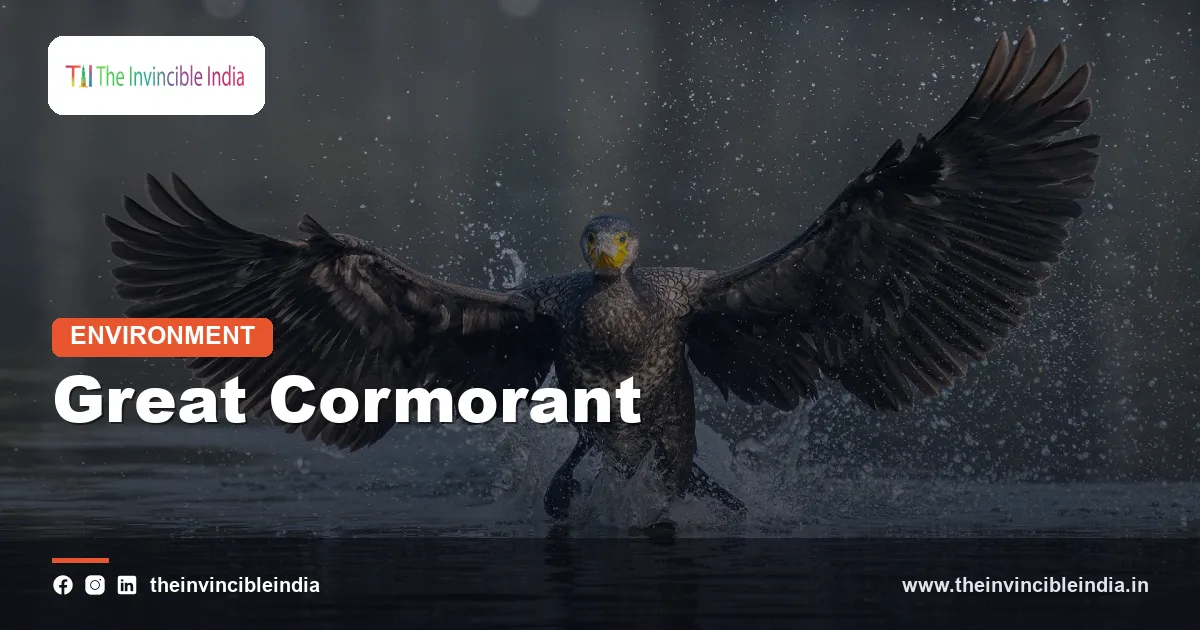
The great cormorant (Phalacrocorax carbo) is a large, black, long-bodied waterbird of the family Phalacrocoracidae that dives underwater to catch fish and is the biggest cormorant found in India, living on lakes, reservoirs, rivers, estuaries and coasts. With its hooked bill, glossy bronze-black plumage and habit of perching with wings spread open to dry, the great cormorant is one of the most familiar large waterbirds of Indian wetlands.
The great cormorant is also one of the most widespread birds in the world, found on several continents, and in India it occurs both as a resident and as a winter visitor. This explainer describes how the great cormorant looks, where it lives, how it hunts, how it differs from the smaller Indian cormorants and how it breeds and is perceived by people.
| Common name | Great cormorant (also called black cormorant or large cormorant) |
|---|---|
| Scientific name | Phalacrocorax carbo |
| Family and order | Phalacrocoracidae (cormorants and shags), order Suliformes |
| Size | About 80 to 100 cm long, with a wingspan of roughly 130 to 160 cm |
| Range in India | Widespread across the country on suitable waters, as a resident in some regions and a winter visitor in others |
| Habitat | Lakes, reservoirs, rivers, estuaries, lagoons, coastal waters and large village tanks |
| Diet | Fish, caught by pursuit diving; also occasional crustaceans and amphibians |
| Breeding | Colonial nester in trees or on islets; usually three to four pale blue-green eggs |
| IUCN status | Least Concern |
Key Takeaways
- The great cormorant (Phalacrocorax carbo) is the largest cormorant in India, measuring about 80 to 100 cm in length with a hooked bill and glossy black plumage.
- The great cormorant catches fish by diving and swimming underwater, using its webbed feet to propel itself and its hooked bill to grasp prey.
- The great cormorant perches with its wings held open after swimming because its feathers absorb water and need to dry before flight.
- The great cormorant can be told from the smaller Indian cormorant and little cormorant by its larger size, heavy bill, yellow throat skin and white chin patch.
- The great cormorant breeds in colonies, building stick nests in trees or on islets and raising chicks that are fed by regurgitation.
- The great cormorant is listed as Least Concern by the IUCN, though it is sometimes persecuted by fishers who see it as a competitor.
What Does the Great Cormorant Look Like?
The great cormorant is a large, heavy-bodied waterbird with a long neck, a thick, hooked bill and dark plumage that shines with a bronze or greenish-purple gloss. It is considerably bigger than the other cormorants of India and sits low in the water when it swims, often with its bill tilted slightly upward.
The adult has a bare patch of yellow skin on the face and throat, edged with a pale or white chin patch, and its eyes are green. The wing coverts and back feathers have dark edges that produce a scaled pattern. In breeding season the bird grows fine white thread-like feathers on the head and neck and shows a conspicuous white patch on each thigh, which makes it much easier to identify.
Young birds are browner and paler, with whitish underparts that become darker over several years. The long, stiff tail helps the bird to steer underwater and to prop itself while perched on a post or branch. The feet are fully webbed across all four toes, a trait shared with pelicans and related waterbirds.
Where Does the Great Cormorant Live in India?
The great cormorant lives in almost every part of India that has large, open water holding fish, from the plains to the foothills, and along much of the coast. It is found on big lakes, reservoirs, wide rivers, canals, estuaries, lagoons and sheltered coastal bays, and it is especially common in the cooler months when winter visitors join the resident birds.
The bird needs two things: water that is clear enough to see fish and a safe perch near the water to rest and dry its feathers. Dead trees standing in reservoirs, rocky islets, electric poles, bridges and jetties all serve well. Because of this flexibility, the great cormorant is often seen close to towns, harbours and fishing villages.
Across the world the species ranges through Europe, Asia, Africa, Australasia and the Atlantic coast of North America. The Asian birds are a distinct population, often placed in a separate subspecies, and they are the ones that occur in India. In the Asian Waterbird Census, the great cormorant is among the regularly counted species at Indian wetlands.
How Does the Great Cormorant Hunt Underwater?
The great cormorant hunts by diving from the surface, swimming underwater with powerful strokes of its webbed feet, and seizing fish in its hooked bill. This method is called pursuit diving, and it allows the bird to chase fish rather than wait for them.
A typical dive lasts roughly half a minute, though the bird can stay under for longer, and it usually dives to a few metres in depth. The bird often arches forward and springs from the surface in a low jump before diving, which is a good clue for observers. After surfacing it manoeuvres the fish so that it is swallowed head first, which keeps the spines flat. Large fish are first brought to the surface and then tossed and turned.
Cormorants are efficient hunters because their body is streamlined and their bones are heavier than those of many birds, which reduces buoyancy. The wing feathers also trap less air, allowing the bird to sink easily. This is the very feature that forces it to dry its wings afterwards.
Do cormorants hunt alone or in groups?
Great cormorants hunt both alone and in groups. Single birds often fish in shallow bays, while flocks may drive shoals of fish toward the shore by diving together in a line. In rich waters a group can strip a patch of fish quickly, and other waterbirds such as egrets and gulls often gather nearby to pick up the leftovers.
What Does the Great Cormorant Eat?
The great cormorant eats fish almost exclusively, taking whatever species and sizes are abundant, and it may also eat crustaceans, frogs and other small aquatic animals on occasion. Studies of cormorants elsewhere show that they often catch slow, bottom-dwelling or schooling fish that are easy to pursue.
An adult may need a few hundred grams of fish each day, and a hungry bird will eat more. The species does not specialise in prized fish, and it frequently takes small, bony or cheap fish that are of little commercial value. In heavily stocked tanks and fish farms, however, a flock can take a noticeable share of the stock.
- Typical prey includes carps, catfish, tilapia, perch-like fish and eels.
- Fish are swallowed head first to avoid spines catching in the throat.
- Indigestible parts, such as bones and scales, are coughed up as pellets.
- Coastal birds take mullet, gobies and small marine fish.
Why Does the Great Cormorant Spread Its Wings?
The great cormorant spreads its wings after swimming because its feathers are partly wettable and need to dry before the bird can fly well. The plumage lacks the heavy waterproofing found in ducks, so water soaks into the feathers and reduces buoyancy, which helps the bird dive but leaves it heavy and cold afterwards.
Perched cormorants stand upright with wings held out, often facing the sun or wind, and stay in this pose for many minutes. Some scientists also think that the posture helps with digestion and with warming the body after cold dives. Whatever the exact balance of reasons, the wing-drying stance is the best-known cormorant behaviour and a reliable field mark for spotting the group at a distance.
How Does the Great Cormorant Differ from Other Indian Cormorants?
The great cormorant is larger and heavier than the Indian cormorant and the little cormorant, with a thicker bill and a conspicuous yellow throat patch bordered in white. India has three common cormorants, and size is the quickest way to tell them apart.
| Feature | Great cormorant | Indian cormorant | Little cormorant |
|---|---|---|---|
| Scientific name | Phalacrocorax carbo | Phalacrocorax fuscicollis | Microcarbo niger |
| Size | Largest, about 80-100 cm | Medium, about 60-65 cm | Smallest, about 50 cm |
| Bill | Heavy, hooked, with yellow skin at base | Long and slender, hooked at tip | Short and rather stubby |
| Throat | Yellow patch edged with white | Dark, with a pale throat in some plumages | Small pale throat |
| Typical habit | Big lakes, rivers and coasts | Large water bodies, often in flocks | Small ponds and tanks, in any wetland |
All three species may appear together in a single wetland, perched side by side on dead trees or rocks, and the size difference then becomes obvious. The great cormorant is often the highest or most prominent bird on the perch.
How Does the Great Cormorant Breed?
The great cormorant breeds in colonies, building a bulky platform of sticks and other material in a tree or on an islet or cliff, and laying usually three to four pale blue-green eggs coated with a chalky white layer. The nests are often grouped closely and can share a heronry with egrets, herons, storks and ibises.
Both parents incubate the eggs for about four weeks and take turns bringing fish. The chicks are naked at first and then grow a dark down, and they are fed by regurgitation, reaching deep into the parent’s throat to take partly digested fish. They leave the nest after several weeks, though they continue to rely on the adults for food for some time.
In India, the timing of breeding varies by region and is generally linked to water levels and food supply. Colonies are noisy, smelly places because of the droppings, which are rich in nutrients but can scorch the leaves and kill the nest trees over many seasons.
Does the Great Cormorant Migrate?
The great cormorant migrates in part: some Indian birds are residents that stay in one region, while others arrive in winter from northern and central Asia. Numbers on lakes and rivers therefore often rise in the cooler months, when large flocks may gather at rich fishing grounds.
Movements are generally short and flexible. Birds shift between water bodies as food and water levels change, and they roost together in large numbers in tall trees near lakes. In the evening, lines and V-shaped flocks of cormorants flying to their roosts are a familiar sight at many Indian reservoirs.
Is the Great Cormorant a Threat to Fisheries?
The great cormorant is not a threatened species, but it is often seen as a competitor by fishers because it eats fish. The IUCN lists it as Least Concern, with a large and widespread population, and in some countries its numbers have increased greatly after being protected.
The reality of its impact on fisheries is complex. In open, natural waters the bird mainly takes abundant, small fish and has little effect on catches. In small, densely stocked ponds and hatcheries, flocks can cause real losses, and netting or other deterrents are sometimes used. Cormorants can also be caught accidentally in fishing nets and may be harmed by pollution and by the disturbance of colonies.
Have people used cormorants for fishing?
Yes, in parts of East Asia people have traditionally trained cormorants to catch fish for them, a practice most famous in China and Japan. A ring or cord around the neck prevents the bird from swallowing large fish, which the fisher then retrieves. The tradition shows how skilled the birds are at underwater hunting, though it is now rare and mostly practised for tourism or heritage.
Why Does the Great Cormorant Matter to Wetlands?
The great cormorant matters to wetlands because it is a major fish predator and a sign of waters that still hold fish, and because its colonies move nutrients from the water to the land. Healthy wetlands in India often support all three cormorants together with herons, storks and pelicans.
Waterbird counts that include the great cormorant help conservationists track wetland health, and the bird’s roosts and colonies are monitored in several protected areas. Because the species is large, visible and easy to recognise, it also gives many people an easy introduction to wetland birdwatching.
- Best viewing: dead trees, rocky islets and jetties where birds perch and dry their wings
- Best time: early morning and late afternoon, when birds fish and fly to roosts
- Useful clue: a dark bird that dives, surfaces and swims with the bill tilted upward
- Courtesy: keep away from nesting colonies, especially in the breeding season
Bottom Line
The great cormorant is a large, dark, wing-drying diving bird that dominates the perches of many Indian lakes and rivers. It is common and secure globally, yet it relies on clean, fish-rich waters and quiet trees for nesting, which makes it a useful indicator of the health of India’s wetlands.
Frequently Asked Questions
What is a great cormorant?
A great cormorant is a large black waterbird of the species Phalacrocorax carbo that dives to catch fish. It measures about 80 to 100 cm long, has a hooked bill, a yellow throat patch and glossy bronze-black feathers. It is found on lakes, rivers and coasts across India.
Why does the great cormorant spread its wings?
The great cormorant spreads its wings to dry them because its feathers absorb water and become heavy. This partial lack of waterproofing helps the bird dive but means it must dry out afterwards. Sunning may also help it warm up and digest food.
How deep can a great cormorant dive?
A great cormorant usually dives to a few metres, though it can go deeper in some waters. Most dives last about half a minute. The bird propels itself with its webbed feet and uses its hooked bill to seize fish.
How can I tell a great cormorant from a little cormorant?
The great cormorant is much larger than the little cormorant, with a heavy hooked bill and a yellow throat patch edged in white. The little cormorant is the smallest Indian cormorant, with a short bill and a compact body. The two can be seen together on the same perch.
Is the great cormorant a migratory bird in India?
The great cormorant is partly migratory in India, because some birds are residents while others arrive in winter from northern and central Asia. Numbers on lakes and rivers often rise in the cooler months. The birds move locally depending on water levels and food.
Is the great cormorant endangered?
No, the great cormorant is not endangered and is classed as Least Concern by the IUCN. It has a very large range and a large, stable global population. Local problems include conflict with fishers, disturbance of colonies and pollution of wetlands.
{“@context”:”https://schema.org”,”@graph”:[{“@type”:”FAQPage”,”mainEntity”:[{“@type”:”Question”,”name”:”What is a great cormorant?”,”acceptedAnswer”:{“@type”:”Answer”,”text”:”A great cormorant is a large black waterbird of the species Phalacrocorax carbo that dives to catch fish. It measures about 80 to 100 cm long, has a hooked bill, a yellow throat patch and glossy bronze-black feathers. It is found on lakes, rivers and coasts across India.”}},{“@type”:”Question”,”name”:”Why does the great cormorant spread its wings?”,”acceptedAnswer”:{“@type”:”Answer”,”text”:”The great cormorant spreads its wings to dry them because its feathers absorb water and become heavy. This partial lack of waterproofing helps the bird dive but means it must dry out afterwards. Sunning may also help it warm up and digest food.”}},{“@type”:”Question”,”name”:”How deep can a great cormorant dive?”,”acceptedAnswer”:{“@type”:”Answer”,”text”:”A great cormorant usually dives to a few metres, though it can go deeper in some waters. Most dives last about half a minute. The bird propels itself with its webbed feet and uses its hooked bill to seize fish.”}},{“@type”:”Question”,”name”:”How can I tell a great cormorant from a little cormorant?”,”acceptedAnswer”:{“@type”:”Answer”,”text”:”The great cormorant is much larger than the little cormorant, with a heavy hooked bill and a yellow throat patch edged in white. The little cormorant is the smallest Indian cormorant, with a short bill and a compact body. The two can be seen together on the same perch.”}},{“@type”:”Question”,”name”:”Is the great cormorant a migratory bird in India?”,”acceptedAnswer”:{“@type”:”Answer”,”text”:”The great cormorant is partly migratory in India, because some birds are residents while others arrive in winter from northern and central Asia. Numbers on lakes and rivers often rise in the cooler months. The birds move locally depending on water levels and food.”}},{“@type”:”Question”,”name”:”Is the great cormorant endangered?”,”acceptedAnswer”:{“@type”:”Answer”,”text”:”No, the great cormorant is not endangered and is classed as Least Concern by the IUCN. It has a very large range and a large, stable global population. Local problems include conflict with fishers, disturbance of colonies and pollution of wetlands.”}}]}]}


