

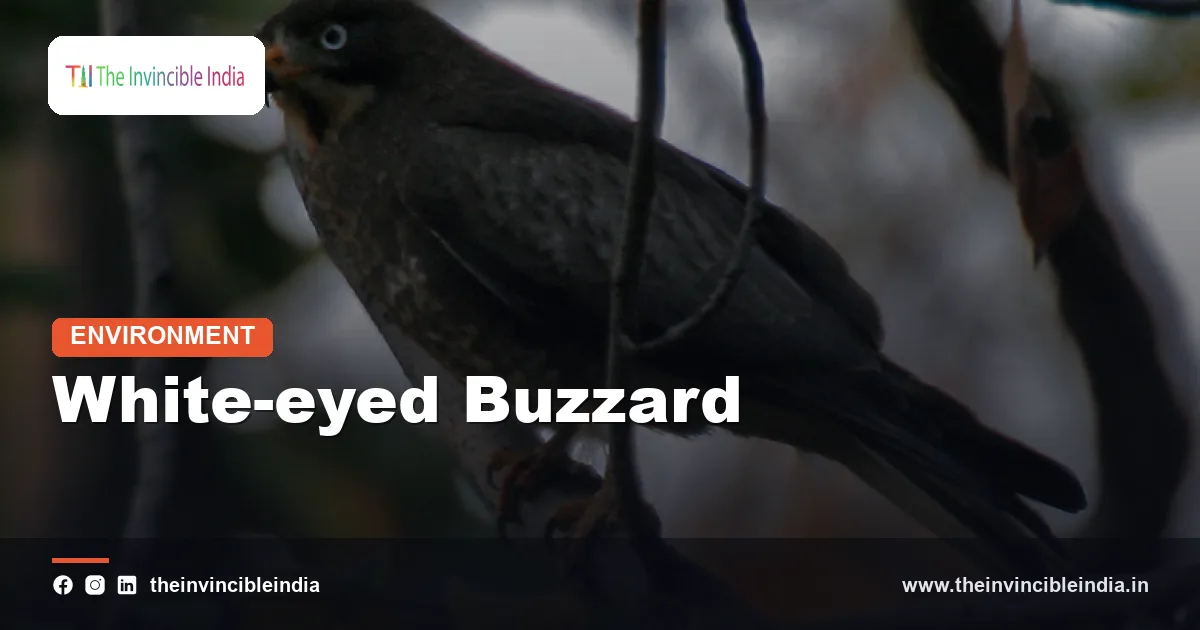
The white-eyed buzzard (Butastur teesa) is a small, slim, brown bird of prey of the family Accipitridae that lives in the dry, open country of the Indian subcontinent, where it hunts insects, lizards, rodents and frogs by swooping down from a perch. Named for the pale yellowish-white eye of the adult, the white-eyed buzzard is a common resident of farmland, scrub and light woodland across much of northern and central India.
The white-eyed buzzard is often overlooked because it sits quietly on poles, dead branches and wires, but its plaintive, mewing call and its habit of soaring over fields in the hot months make it easy to notice once its features are known. This explainer describes its appearance, range, food, hunting method, calls, nesting and conservation status.
| Common name | White-eyed buzzard (Indian name: teesa) |
|---|---|
| Scientific name | Butastur teesa |
| Family and order | Accipitridae (hawks, eagles and kites), order Accipitriformes |
| Size | About 35 to 43 cm long, with a wingspan of roughly a metre |
| Range in India | Widespread across the plains and drier regions of the north, centre and peninsula; absent from dense humid forest and high mountains |
| Habitat | Open scrub, dry grassland, farmland, light deciduous woodland and semi-desert edges |
| Diet | Grasshoppers and other large insects, lizards, small snakes, frogs, rodents and crabs |
| Breeding | Stick nest in a tree, mainly in the hot, dry months; usually two to four eggs |
| IUCN status | Least Concern |
Key Takeaways
- The white-eyed buzzard (Butastur teesa) is a small bird of prey of the family Accipitridae that is a resident of dry, open country across the Indian subcontinent.
- The adult white-eyed buzzard has a pale, whitish-yellow eye, brown upperparts, a white throat with a dark central stripe and a rufous tail with a dark band.
- The white-eyed buzzard feeds largely on grasshoppers, lizards, rodents and frogs, and it hunts by watching from a perch and then dropping onto prey.
- The white-eyed buzzard has a distinctive, plaintive, nasal mewing call, often given while the bird circles over open ground.
- The white-eyed buzzard builds a small stick nest in a tree and lays usually two to four eggs, with nesting concentrated in the hot, dry months.
- The white-eyed buzzard is listed as Least Concern by the IUCN and is helpful to farmers because it eats crop-eating insects and rodents.
What Does the White-eyed Buzzard Look Like?
The white-eyed buzzard is a slender, medium-sized hawk with brown upperparts, a pale throat marked by a dark stripe, a barred reddish-brown breast and an unmistakable pale yellowish-white iris in the adult. The cere at the base of the bill and the legs are yellow, and the hooked bill is dark.
The back and wings are brownish-grey, with a rufous or reddish patch on the upper wing that is more visible in flight. The tail is chestnut-coloured with a dark band near the tip, which is a useful clue when the bird is soaring. A white patch on the nape, which may show when the feathers are ruffled, adds to the identification. In the air, the bird shows long, narrow wings and a rather long tail, giving it a leaner outline than most buzzards.
The sexes look alike, though females are slightly larger. Young birds are duller, with a brown eye that only gradually turns pale, a more streaked body and a less distinct throat stripe. Because the white eye is so noticeable in adults, it gives the species its common name and makes a good field mark in good light.
Why does the eye look white?
The adult iris is a pale straw or whitish-yellow colour, which contrasts with the dark face and gives the bird a cold, staring expression. The pale iris develops with age, and juveniles have darker brown eyes. Several other raptors also show pale irises, but the white-eyed buzzard’s combination of pale eye and white throat is distinctive.
Where Does the White-eyed Buzzard Live in India?
The white-eyed buzzard lives throughout much of India’s plains and peninsula, in dry, open habitats such as scrub, farmland and thin woodland, and it is one of the commoner small raptors in the north and centre of the country. Outside India, its range covers the wider Indian subcontinent, including Pakistan, Nepal and Bangladesh.
It is a resident bird, though it may make local movements with the seasons and in response to food. The species keeps mainly to lowlands and low hills and avoids dense evergreen forest, very wet regions and the high Himalaya. It is often seen along roadsides and canals, on irrigated fields, in orchards and on the edges of villages.
The bird prefers places with open ground for hunting and scattered trees or poles for perching. Heavily cultivated landscapes can suit it well if tall trees remain. In the deserts of the west, it keeps to the thorn scrub and the irrigated edges, while in central India it often frequents open deciduous woodland.
Why Is It Called a Buzzard?
The white-eyed buzzard is called a buzzard because it resembles the true buzzards of the genus Buteo in size and build, although it belongs to a separate genus, Butastur, whose name blends the Latin words for buzzard and hawk. Such birds are sometimes known as buzzard-eagles, and the group contains four species in Asia and Africa.
The species name teesa is believed to come from an Indian vernacular name for the bird. In Europe, the word buzzard refers to a Buteo, while in North America it often means a vulture, which can cause confusion. The white-eyed buzzard is neither a vulture nor a true Buteo, but it hunts in a similar patient manner.
What Does the White-eyed Buzzard Eat?
The white-eyed buzzard eats mainly large insects such as grasshoppers and locusts, along with lizards, small snakes, frogs, rodents, crabs and sometimes small birds. Its diet is dominated by small animals that are abundant in dry, open habitats, which makes the bird a useful natural pest controller.
During the hot season, when grasshoppers and other insects are plentiful, the bird may eat large numbers of them. After the monsoon, frogs and rodents become more important. The bird may also gather at grass fires and ploughed fields, where prey is exposed and easy to snatch.
- Insects: grasshoppers, locusts, crickets, beetles and winged termites
- Reptiles: garden lizards, skinks and small snakes
- Amphibians: frogs and toads, especially after rain
- Mammals: mice, rats, and sometimes young squirrels
- Others: crabs from paddy fields and occasional small birds
How Does the White-eyed Buzzard Hunt?
The white-eyed buzzard hunts by sitting still on an exposed perch such as a pole, wire or bare branch, scanning the ground, and then gliding down to seize prey in its talons. This method is called perch-and-pounce hunting, and it saves energy compared with hovering or long flights.
The bird often returns to the same favourite perch, and it may take the catch to a branch to eat. When prey is scarce, the buzzard may soar or glide low over fields, quartering the ground, and it can walk on the ground for insects. It is an unhurried hunter, and a motionless buzzard on a roadside pole is usually watching for movement in the grass below.
Its relatively broad wings and rounded tail allow the bird to manoeuvre in a short space, and its sharp eyesight picks out the smallest movement. The talons are short and strong, adapted for gripping slippery lizards and frogs rather than killing large prey.
What Does the White-eyed Buzzard Sound Like?
The white-eyed buzzard has a plaintive, nasal, whining mew, often written as “pit-weer”, which it gives mainly while soaring in pairs during the breeding season. The call carries a long way across open country and is one of the first clues that a buzzard is overhead.
Outside the breeding season the bird is much quieter and may be silent for long periods. During courtship, the pair circles together high above the nest area, calling repeatedly, and the male may perform short, undulating display flights. Recognising the call is useful, because the white-eyed buzzard often calls from a distance before it is seen.
How Does the White-eyed Buzzard Breed?
The white-eyed buzzard breeds by building a small, untidy nest of sticks lined with leaves and grass in a tree, laying usually two to four eggs, and raising the young during the hot, dry months. In India, nesting is generally concentrated in the period from about February to May, though this varies by region.
The nest is often placed in a mango, neem or acacia tree, at moderate height, and may be reused or repaired in later years. The eggs are pale, bluish-white, sometimes with faint markings. The female does most of the incubation, while the male brings her food. Both parents feed the chicks, which are fed at the nest with insects, lizards and small rodents torn into pieces.
The young leave the nest after several weeks but stay near the nest area while they learn to hunt. Because the nests are small and well hidden among leaves, they are easy to miss, and the best sign of breeding is a pair calling and circling above a tree.
| Stage | What happens |
|---|---|
| Courtship | Pair soars and calls over the territory |
| Nest | Small stick platform lined with leaves in a tree |
| Eggs | Usually two to four pale bluish-white eggs |
| Incubation | Mainly by the female, with food brought by the male |
| Chicks | Fed insects, lizards and rodents by both parents |
| Season | Mostly the hot, dry months before the monsoon |
How Is the White-eyed Buzzard Different from Other Raptors?
The white-eyed buzzard differs from other common Indian raptors in its slim build, pale eye, white throat with a dark stripe, rufous tail and perch-and-pounce hunting style. Comparing it with look-alikes makes identification easier.
| Bird | Key features |
|---|---|
| White-eyed buzzard | Slim, brown, pale eye, white throat with dark stripe, rufous tail with dark band |
| Black kite | Larger, dark brown, forked tail, scavenges widely around towns |
| Shikra | Small, slate-grey above, barred below, short rounded wings, dashes through trees |
| Common buzzard | Larger and heavier, a winter visitor, broad rounded wings, variable plumage |
The black kite is the raptor most often confused with it by beginners, but the black kite has a forked tail and a very different, scavenging lifestyle. The white-eyed buzzard keeps to quieter open country and rarely mixes with the crowds of kites that gather at rubbish heaps.
Is the White-eyed Buzzard Threatened?
The white-eyed buzzard is not threatened and is listed as Least Concern by the IUCN, because it has a large range and a population that remains widespread and fairly common. However, like many farmland birds, it faces pressures that can reduce local numbers.
The main threats include loss of nesting trees, conversion of scrub and grassland into intensive agriculture or housing, heavy use of pesticides that reduce prey and may poison the birds, and occasional persecution. Because the bird accepts farmland, hedgerows and scattered trees, it often survives where habitat is only lightly managed.
Why Does the White-eyed Buzzard Matter to Farmland?
The white-eyed buzzard matters to farmland because it eats grasshoppers, locusts, rats and other animals that damage crops, providing free pest control. A healthy population of the bird indicates that fields still hold a balanced mix of insects, reptiles and small mammals.
Keeping a few tall trees, bare perches such as poles and field margins with long grass helps the bird to hunt and nest. Reducing broad-spectrum pesticide use also protects the food chain, and the same measures help owls, kestrels, shrikes and other farmland predators.
How can the white-eyed buzzard be spotted?
The simplest way to spot the white-eyed buzzard is to scan roadside poles, wires and dead branches in open country in the early morning and late afternoon. A slim brown hawk sitting upright and staring at the ground is a good candidate, and the pale eye, white throat and rufous tail can be checked with binoculars. In the hot months, listen for the whining mew of birds soaring overhead.
Bottom Line
The white-eyed buzzard is a slim, pale-eyed raptor of dry, open country that patiently hunts insects, lizards and rodents from a perch. It remains common across India, and its presence on farmland shows that field edges, scattered trees and a varied prey base are still intact.
Frequently Asked Questions
What is a white-eyed buzzard?
A white-eyed buzzard is a small bird of prey of the species Butastur teesa found in open country across the Indian subcontinent. The adult has a pale, whitish-yellow eye, brown upperparts and a white throat with a dark central stripe. It hunts insects, lizards and rodents.
Why is it called the white-eyed buzzard?
It is called the white-eyed buzzard because the adult has a pale, whitish-yellow iris that stands out against the dark face. Young birds have brown eyes that lighten with age. The word buzzard refers to its buzzard-like build, although it belongs to the genus Butastur.
What does the white-eyed buzzard eat?
The white-eyed buzzard eats mainly grasshoppers and other large insects, lizards, small snakes, frogs, rodents and crabs. It watches from a perch and drops onto prey in the open. Its diet makes it a useful controller of crop pests.
Where can I see a white-eyed buzzard in India?
The white-eyed buzzard can be seen across the plains and dry regions of India, particularly in open scrub, farmland and light woodland. It often perches on roadside poles, wires and dead branches. It avoids dense humid forest and high mountains.
What does the white-eyed buzzard sound like?
The white-eyed buzzard gives a plaintive, nasal, whining mew, often written as “pit-weer”. It calls mostly while soaring in the breeding season and is quieter at other times. The call carries over open country and helps locate the bird.
Is the white-eyed buzzard endangered?
No, the white-eyed buzzard is not endangered and is listed as Least Concern by the IUCN. It has a wide range and is fairly common in India. Local threats include loss of nest trees, pesticide use and habitat conversion.
{“@context”:”https://schema.org”,”@graph”:[{“@type”:”FAQPage”,”mainEntity”:[{“@type”:”Question”,”name”:”What is a white-eyed buzzard?”,”acceptedAnswer”:{“@type”:”Answer”,”text”:”A white-eyed buzzard is a small bird of prey of the species Butastur teesa found in open country across the Indian subcontinent. The adult has a pale, whitish-yellow eye, brown upperparts and a white throat with a dark central stripe. It hunts insects, lizards and rodents.”}},{“@type”:”Question”,”name”:”Why is it called the white-eyed buzzard?”,”acceptedAnswer”:{“@type”:”Answer”,”text”:”It is called the white-eyed buzzard because the adult has a pale, whitish-yellow iris that stands out against the dark face. Young birds have brown eyes that lighten with age. The word buzzard refers to its buzzard-like build, although it belongs to the genus Butastur.”}},{“@type”:”Question”,”name”:”What does the white-eyed buzzard eat?”,”acceptedAnswer”:{“@type”:”Answer”,”text”:”The white-eyed buzzard eats mainly grasshoppers and other large insects, lizards, small snakes, frogs, rodents and crabs. It watches from a perch and drops onto prey in the open. Its diet makes it a useful controller of crop pests.”}},{“@type”:”Question”,”name”:”Where can I see a white-eyed buzzard in India?”,”acceptedAnswer”:{“@type”:”Answer”,”text”:”The white-eyed buzzard can be seen across the plains and dry regions of India, particularly in open scrub, farmland and light woodland. It often perches on roadside poles, wires and dead branches. It avoids dense humid forest and high mountains.”}},{“@type”:”Question”,”name”:”What does the white-eyed buzzard sound like?”,”acceptedAnswer”:{“@type”:”Answer”,”text”:”The white-eyed buzzard gives a plaintive, nasal, whining mew, often written as “pit-weer”. It calls mostly while soaring in the breeding season and is quieter at other times. The call carries over open country and helps locate the bird.”}},{“@type”:”Question”,”name”:”Is the white-eyed buzzard endangered?”,”acceptedAnswer”:{“@type”:”Answer”,”text”:”No, the white-eyed buzzard is not endangered and is listed as Least Concern by the IUCN. It has a wide range and is fairly common in India. Local threats include loss of nest trees, pesticide use and habitat conversion.”}}]}]}


