

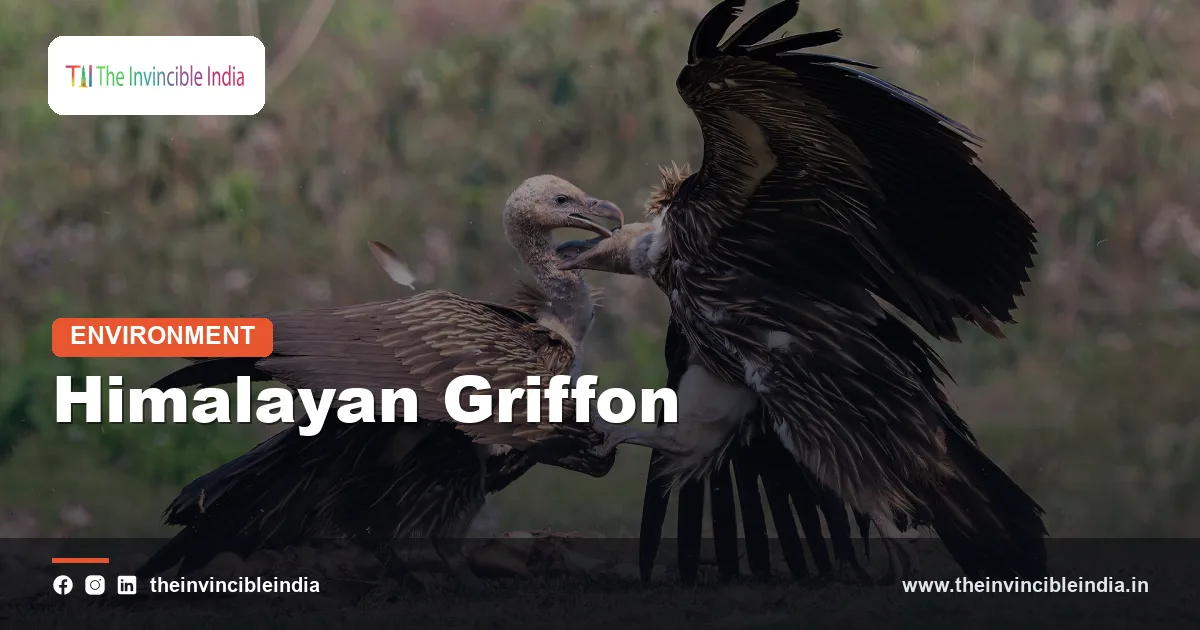
The Himalayan griffon is a very large, pale, broad-winged vulture (Gyps himalayensis) that soars over the high mountains of northern India and the Tibetan plateau, living almost entirely on the carcasses of dead animals. It is one of the biggest flying birds of the Indian Himalaya, with a wingspan that can pass two and a half metres, and it is a familiar silhouette above the cold, dry valleys of Ladakh, Lahaul-Spiti and the high Uttarakhand ranges.
Because it cleans up dead livestock and wild animals in places where few other scavengers can survive, the Himalayan griffon performs a quiet but essential ecological service. This guide explains how to recognise the bird, where it lives, what it eats, how it breeds and why vultures of every kind matter to India’s mountains and villages.
| Common name | Himalayan griffon (also called Himalayan vulture) |
|---|---|
| Scientific name | Gyps himalayensis |
| Family | Accipitridae (hawks, eagles, kites and Old World vultures) |
| Size | Roughly 100 to 120 cm long; wingspan about 2.5 to 3 metres |
| Range in India | High Himalaya from Ladakh and Himachal Pradesh to Uttarakhand, Sikkim and Arunachal Pradesh; descends to the foothills in winter |
| Habitat | Alpine meadows, cold deserts, rocky gorges and cliffs, mostly well above 2,000 metres |
| Diet | Carrion, mainly the carcasses of yaks, sheep, goats, horses and wild ungulates |
| Breeding | Nests on cliff ledges; usually a single white egg laid in late winter or early spring |
| Conservation status | Near Threatened (IUCN); protected under the Wildlife (Protection) Act, 1972 |
Key Takeaways
- The Himalayan griffon (Gyps himalayensis) is one of the largest vultures in the world, with a wingspan of roughly 2.5 to 3 metres.
- The Himalayan griffon is a true scavenger that feeds on carrion and almost never kills live prey.
- The Himalayan griffon breeds on high cliff ledges and normally raises just one chick a year.
- The Himalayan griffon is classed as Near Threatened by the IUCN and is legally protected in India.
- Many Himalayan griffons move down to lower slopes and foothills in winter, a pattern known as altitudinal migration.
- Veterinary drugs such as diclofenac, which poisoned other Indian vultures, are a continuing danger to the Himalayan griffon when residues are present in livestock carcasses.
What is the Himalayan griffon?
The Himalayan griffon is an Old World vulture belonging to the genus Gyps, the group of big, long-necked, bare-headed griffon vultures found across Africa, Europe and Asia. It is the Himalayan representative of that group and is closely related to the Eurasian griffon of the Mediterranean and West Asia, though noticeably larger and paler.
Like all Old World vultures, the Himalayan griffon is not related to the New World vultures of the Americas. The similarity of appearance comes from convergent evolution, in which unrelated birds develop alike because they follow the same way of life. The Himalayan griffon is a member of the same family as eagles, kites and hawks, which is why its bill and talons look like a raptor’s even though it rarely uses its feet to kill.
The bird is sometimes simply called the Himalayan vulture. In English the word griffon refers to the mythical creature with an eagle’s head and a lion’s body, and was applied to the big vultures because of their large size and hooked bill.
How big is the Himalayan griffon and how can it be identified?
An adult Himalayan griffon measures about 100 to 120 centimetres from bill to tail and weighs roughly 8 to 12 kilograms, which makes it one of the heaviest flying birds in India. Its wings are very broad with long “fingered” tips, and its tail is short and slightly wedge-shaped.
Several features help separate the Himalayan griffon from other vultures seen in the region:
- Pale plumage: The body and wing coverts are creamy, sandy or whitish, often with fine dark streaking on the back and chest.
- Dark flight feathers: The large flight feathers and the tail are blackish-brown, producing a strong contrast with the pale body when the bird is seen from below.
- White ruff: A collar of long, narrow, pale feathers surrounds the base of the neck, and the head and neck carry only a covering of whitish down.
- Yellowish bill: The strong, hooked bill is pale yellow to horn-coloured with a darker tip.
- Juveniles: Young birds are darker and more heavily streaked, with a brownish ruff and a darker bill, and they gradually become paler over several years.
In flight the Himalayan griffon holds its wings in a shallow “V” and rocks gently from side to side while soaring. Its shape and size make it easy to pick out against the sky, though it can be confused at a distance with other large vultures or with the golden eagle and bearded vulture, which have much narrower wings.
Where does the Himalayan griffon live in India?
The Himalayan griffon lives across the high Himalaya of northern India, in states and union territories including Ladakh, Jammu and Kashmir, Himachal Pradesh, Uttarakhand, Sikkim and Arunachal Pradesh. Its wider range stretches along the Himalayan arc and the Tibetan plateau into Central Asia, including Nepal, Bhutan, Tibet and the Pamir and Tian Shan ranges.
The bird prefers open country with cliffs, ridges and wide valleys, where it can use rising air to travel long distances. Typical habitats include:
- Cold, arid high-altitude valleys such as those of Ladakh and Spiti, where livestock herding provides regular carrion.
- Steep rocky gorges and crags with sheltered ledges for roosting and nesting.
- Alpine meadows and grazing grounds above the tree line, where yaks, sheep and goats graze in summer.
- Foothill valleys and river plains, which many birds visit in winter when the high ground is snowbound and food is scarce.
Most Himalayan griffons are residents of the mountains, though they move seasonally. In winter, individuals, especially young birds, descend to lower elevations and some wander well out onto the northern plains. Records from distant parts of the country are occasionally reported and are usually of wandering immature birds.
What does the Himalayan griffon eat?
The Himalayan griffon eats carrion, meaning the flesh of animals that have already died from disease, accident, weather or predation. In the Indian Himalaya this is mostly the carcasses of domestic animals such as yaks, sheep, goats, ponies and cattle, together with the remains of wild ungulates such as blue sheep (bharal) and ibex.
The griffon seldom kills animals itself. It may occasionally take weak or injured young animals or small creatures, but its structure is built for feeding on large carcasses:
- A long, bare neck lets it reach deep into a body cavity without soiling its feathers.
- A strong, hooked bill tears through skin and muscle once the hide has been opened by other animals or by decay.
- A very acidic stomach neutralises bacteria and toxins that would sicken most other animals.
At a large carcass, dozens of Himalayan griffons may gather, jostling for position and feeding quickly. A single bird can eat a kilogram or more in a sitting and can store food in an expandable crop, which allows it to go several days without another meal. Because carcasses appear unpredictably, this ability to feast and then fast is a significant advantage in high, thinly populated country.
How does the Himalayan griffon find food and fly at altitude?
The Himalayan griffon finds food mostly by sight, watching the ground from great height and following the behaviour of other birds. It also relies on thermals and mountain updrafts, which carry its heavy body upward with minimal effort so it can cover many kilometres a day while spending very little energy.
Several habits explain how a bird this large manages in thin mountain air:
- Soaring on air currents: The broad wings give a large surface for the weight, so the bird can ride rising warm air and ridge lift for hours without flapping.
- Watching neighbours: When one vulture descends toward a carcass, others see it and follow, so a kill that was invisible from afar draws a crowd quickly.
- Sharp eyesight: Vultures have excellent distance vision and can pick out a motionless carcass on a hillside from a great height.
- Efficient lungs: Like other high-flying birds, the Himalayan griffon has a respiratory system adapted to using oxygen efficiently in thin air.
Griffons usually start the day late, waiting until the sun has warmed the slopes enough to produce thermals. They spend the early hours perched on cliffs, spreading their wings to catch the morning sun and warm up after cold nights.
How does the Himalayan griffon breed?
The Himalayan griffon breeds on cliff ledges and in rock crevices, building a large untidy nest of sticks and twigs lined with grass and fur. A pair normally lays a single white egg, usually in late winter or early spring, and the parents take turns incubating it for around two months.
Nesting often takes place in loose colonies, with several pairs using the same cliff face. Key points about the breeding cycle include:
- One egg per year: A single egg is typical, so a population cannot recover quickly from losses.
- Shared parental care: Both parents incubate the egg and feed the chick by regurgitating food from the crop.
- Slow growth: The chick stays in the nest for several months before it is ready to fledge, and it may depend on its parents for food for some time afterwards.
- Late maturity: Himalayan griffons reach breeding age after several years and can live for decades.
This slow rate of reproduction is one reason vultures are so vulnerable to human threats. Where adult birds die faster than they can be replaced, populations decline for many years before any recovery can show.
Why are vultures like the Himalayan griffon important?
Vultures such as the Himalayan griffon matter because they remove dead animals quickly and safely, which stops carcasses from becoming sources of disease. A flock of griffons can strip a large carcass to bone within hours, long before bacteria and flies multiply.
Their ecological and cultural roles include:
- Natural sanitation: Fast removal of carcasses reduces the spread of diseases such as anthrax and botulism to livestock and people.
- Nutrient recycling: Feeding vultures return the nutrients of dead animals to the ecosystem without the need for burial or burning.
- Support for herding communities: In the high Himalaya, where digging graves is hard and fuel is scarce, vultures offer a practical way of disposing of dead livestock.
- Cultural links: In Tibetan Buddhist regions, vultures are traditionally associated with the “sky burial” custom, in which a body is offered to the birds.
The collapse of India’s lowland vulture populations in the 1990s showed what happens when scavengers disappear. Carcasses lay uneaten, feral dog numbers rose and public-health concerns increased. The Himalayan griffon is a reminder of the value of keeping the remaining populations healthy.
What threats does the Himalayan griffon face?
The main threats to the Himalayan griffon are poisoning from veterinary drugs and pesticides, loss of food supply, disturbance at nesting sites and collisions with man-made structures. The IUCN lists the species as Near Threatened, which means it is not yet in immediate danger of extinction but could become so without careful monitoring.
The key issues are:
- Diclofenac and similar drugs: This anti-inflammatory painkiller, once widely used on cattle, causes kidney failure in vultures that feed on treated carcasses. It was the main cause of the collapse of India’s resident Gyps vultures, and India banned its veterinary use in 2006. Other drugs can pose similar risks, so carcass safety remains a concern.
- Poisoned carcasses: Baits laid out to kill predators such as wolves and stray dogs can also kill vultures that feed on them.
- Changing herding practices: A decline in traditional grazing or in the number of livestock left in the open could reduce food in some areas.
- Disturbance and development: Roads, construction and tourism near cliffs can disturb nesting colonies.
- Infrastructure hazards: Wind turbines and power lines can injure large soaring birds.
Conservation efforts in India include legal protection under the Wildlife (Protection) Act, 1972, restrictions on harmful veterinary drugs, vulture-safe zones and public awareness programmes. These measures have been aimed mainly at the lowland species, but the same safe-carcass principles help the Himalayan griffon.
How does the Himalayan griffon compare with other Indian vultures?
The Himalayan griffon is larger and paler than most other vultures found in India, and it is the dominant griffon of the high mountains, while the smaller species mainly live in the plains and foothills. The table below compares it with some other well-known Indian vultures.
| Vulture | Typical habitat in India | Notable feature |
|---|---|---|
| Himalayan griffon | High Himalaya, descends in winter | Very large and pale with a white ruff |
| Bearded vulture (lammergeier) | High Himalaya cliffs | Feeds mainly on bones; narrow wings and wedge-shaped tail |
| Cinereous vulture | Winter visitor to the north | Dark, heavy vulture with a massive bill |
| Egyptian vulture | Plains, towns and hills | Small, white with a yellow face and a slender bill |
| Indian and white-rumped vultures | Plains and plateaus | Critically endangered after the diclofenac crash |
Within the Himalaya, the Himalayan griffon often shares carcasses with golden eagles, ravens, choughs and bearded vultures. The griffons usually dominate by sheer size and numbers, while the bearded vulture arrives later to take bones that remain.
Where can you see the Himalayan griffon?
The Himalayan griffon is best seen in the high, open landscapes of Ladakh, Spiti, Kinnaur and the upper valleys of Uttarakhand and Sikkim, where it soars above passes and cliffs. In winter, sightings become more likely in foothill areas and at lower altitudes.
Some practical tips for watching them include:
- Look skyward in late morning when thermals start to rise and birds leave their roosts.
- Scan cliff faces for perched birds and white streaks of droppings that show regular roosts.
- Watch the behaviour of ravens and eagles, since a gathering of scavengers can show the location of a carcass.
- Keep a respectful distance from nesting cliffs, especially in late winter and spring when pairs are breeding and disturbance can cause nest failure.
- Avoid approaching feeding flocks closely, as stressed birds may abandon a meal.
A pair of binoculars is a great help, since the bird often looks like a dark speck when high in the sky. Patience and a good view of a ridge line will usually be rewarded, particularly in places where local herding keeps carcasses available.
Bottom Line
The Himalayan griffon is a giant, pale scavenger that depends on high-altitude carrion, slow breeding and safe food. It is Near Threatened, and its future depends on keeping the Himalayan food chain free of toxic veterinary drugs and poisons, so it can go on cleaning India’s mountains for decades to come.
Frequently Asked Questions
What is the Himalayan griffon?
The Himalayan griffon is a very large vulture of the high Himalaya and the Tibetan plateau, known by the scientific name Gyps himalayensis. It feeds on carrion, has a wingspan of roughly 2.5 to 3 metres and is found across northern India from Ladakh to Arunachal Pradesh.
How big is a Himalayan griffon?
An adult Himalayan griffon is roughly 100 to 120 centimetres long and weighs about 8 to 12 kilograms. Its wingspan reaches around 2.5 to 3 metres, which makes it one of the largest flying birds in India.
What does the Himalayan griffon eat?
The Himalayan griffon eats the carcasses of dead animals, mainly yaks, sheep, goats and wild ungulates such as bharal. It almost never hunts live prey, and its bare neck and acidic stomach are adapted for feeding on decaying flesh.
Is the Himalayan griffon endangered?
The Himalayan griffon is classed as Near Threatened by the IUCN, which is less severe than endangered but signals concern. It is protected in India under the Wildlife (Protection) Act, 1972, and threatened mainly by poisoned carcasses and veterinary drugs.
How is the Himalayan griffon different from the bearded vulture?
The Himalayan griffon is a broad-winged, pale griffon that eats meat from carcasses, whereas the bearded vulture is a narrow-winged bird with a wedge-shaped tail that feeds mostly on bones. The two often share the same Himalayan cliffs and carcasses.
Does the Himalayan griffon migrate?
The Himalayan griffon is mainly a resident of the mountains but makes seasonal altitudinal movements. Many birds, especially young ones, descend to lower slopes and the foothills in winter when snow covers the high ground and food is harder to find.
{“@context”:”https://schema.org”,”@graph”:[{“@type”:”FAQPage”,”mainEntity”:[{“@type”:”Question”,”name”:”What is the Himalayan griffon?”,”acceptedAnswer”:{“@type”:”Answer”,”text”:”The Himalayan griffon is a very large vulture of the high Himalaya and the Tibetan plateau, known by the scientific name Gyps himalayensis. It feeds on carrion, has a wingspan of roughly 2.5 to 3 metres and is found across northern India from Ladakh to Arunachal Pradesh.”}},{“@type”:”Question”,”name”:”How big is a Himalayan griffon?”,”acceptedAnswer”:{“@type”:”Answer”,”text”:”An adult Himalayan griffon is roughly 100 to 120 centimetres long and weighs about 8 to 12 kilograms. Its wingspan reaches around 2.5 to 3 metres, which makes it one of the largest flying birds in India.”}},{“@type”:”Question”,”name”:”What does the Himalayan griffon eat?”,”acceptedAnswer”:{“@type”:”Answer”,”text”:”The Himalayan griffon eats the carcasses of dead animals, mainly yaks, sheep, goats and wild ungulates such as bharal. It almost never hunts live prey, and its bare neck and acidic stomach are adapted for feeding on decaying flesh.”}},{“@type”:”Question”,”name”:”Is the Himalayan griffon endangered?”,”acceptedAnswer”:{“@type”:”Answer”,”text”:”The Himalayan griffon is classed as Near Threatened by the IUCN, which is less severe than endangered but signals concern. It is protected in India under the Wildlife (Protection) Act, 1972, and threatened mainly by poisoned carcasses and veterinary drugs.”}},{“@type”:”Question”,”name”:”How is the Himalayan griffon different from the bearded vulture?”,”acceptedAnswer”:{“@type”:”Answer”,”text”:”The Himalayan griffon is a broad-winged, pale griffon that eats meat from carcasses, whereas the bearded vulture is a narrow-winged bird with a wedge-shaped tail that feeds mostly on bones. The two often share the same Himalayan cliffs and carcasses.”}},{“@type”:”Question”,”name”:”Does the Himalayan griffon migrate?”,”acceptedAnswer”:{“@type”:”Answer”,”text”:”The Himalayan griffon is mainly a resident of the mountains but makes seasonal altitudinal movements. Many birds, especially young ones, descend to lower slopes and the foothills in winter when snow covers the high ground and food is harder to find.”}}]}]}


