

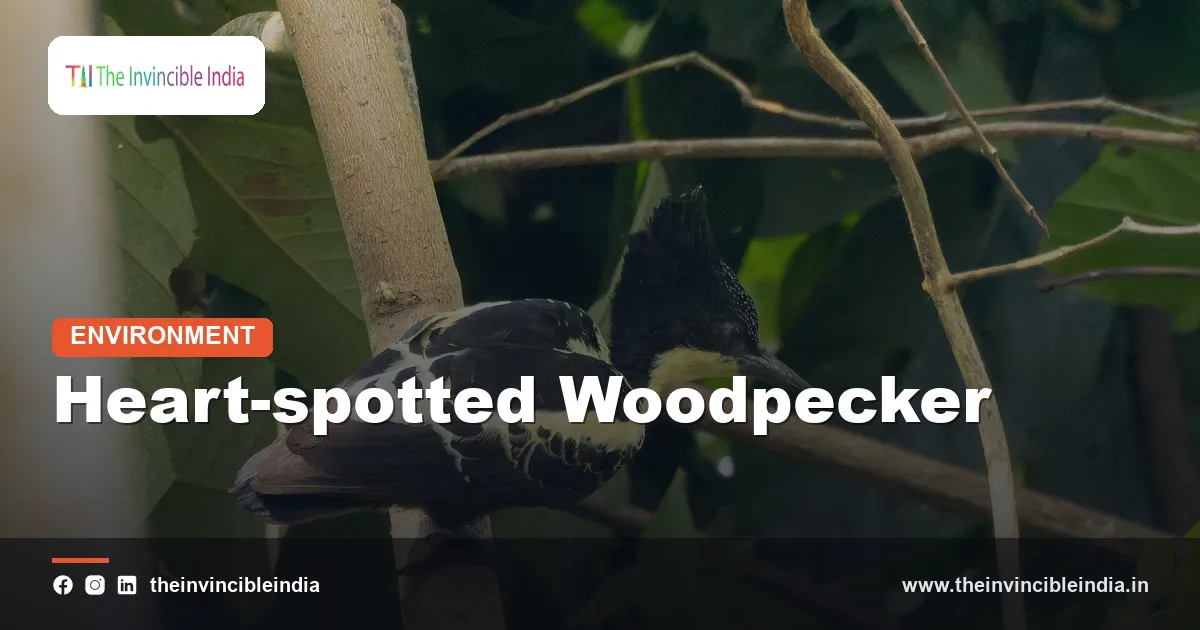
The heart-spotted woodpecker (Hemicircus canente) is a small, short-tailed, black-and-buff woodpecker of Indian forests, named for the heart-shaped white spots on its folded wings. It is one of the most distinctive woodpeckers of the subcontinent, with a tall pointed crest, a large head and a habit of sitting crosswise on branches like a perching songbird rather than clinging upright to trunks.
The heart-spotted woodpecker is found in the Western Ghats, the eastern peninsular hills, the Himalayan foothills and much of northeast India, where it lives in moist deciduous forest, evergreen forest and bamboo. It often moves in noisy little groups, mixes with other forest birds, and feeds on insects, fruit and flower nectar.
| Attribute | Detail |
|---|---|
| Common name | Heart-spotted woodpecker |
| Scientific name | Hemicircus canente |
| Family | Picidae (woodpeckers, piculets and wrynecks) |
| Size | About 15 to 17 cm long, with a very short tail |
| India range and habitat | Western Ghats, eastern hills, Himalayan foothills and northeast India; moist deciduous and evergreen forest, bamboo and old plantations |
| Diet | Insects, larvae, ants, fruit and flower nectar |
| Breeding | Nests in a hole excavated in a dead or dying tree, mostly in the dry season before the monsoon; a small clutch of white eggs |
| Conservation status | Least Concern on the IUCN Red List, though dependent on mature forest |
Key Takeaways
- The heart-spotted woodpecker (Hemicircus canente) is a sparrow-to-bulbul-sized woodpecker named for the white heart-shaped spots on its inner flight feathers.
- The heart-spotted woodpecker has an unusually short tail and a pointed crest, and it often perches crosswise on a branch like a songbird.
- Heart-spotted woodpeckers live in forest across the Western Ghats, the eastern hills, the Himalayan foothills and northeast India, usually in small flocks.
- The diet of the heart-spotted woodpecker includes ants, beetle larvae, other insects, fruit and nectar from flowering trees such as the silk-cotton.
- Heart-spotted woodpeckers breed in holes dug in dead trees, so standing dead wood in a forest directly supports their nesting.
- The heart-spotted woodpecker is assessed as Least Concern globally, but it declines where mature forest is cleared.
What is the heart-spotted woodpecker?
The heart-spotted woodpecker is a small forest woodpecker belonging to the genus Hemicircus in the family Picidae, the same family that includes the flamebacks, pied woodpeckers and piculets. Its scientific name is Hemicircus canente, and the species was described in the early nineteenth century by the French naturalist René Lesson.
Among Indian woodpeckers, the heart-spotted woodpecker is easily recognised by its compact build. It looks almost top-heavy, with a large head, a pointed crest that is often raised, and a tail so short that it barely extends beyond the folded wings. This body plan is quite different from the long, wedge-shaped, stiff tail of a typical woodpecker.
The bird is mostly black above and pale below, with a buff or whitish face and neck. The feature that gives it its name is a set of white, roughly heart-shaped marks on the inner flight feathers, called the tertials, which show clearly on the folded wing. Because the species is small and moves quickly through the canopy, these spots are often the clearest feature when the bird is seen from below or from the side.
How do you identify a heart-spotted woodpecker?
A heart-spotted woodpecker can be identified by its small size, black upperparts, pale head and underparts, tall crest, very short tail and white heart-shaped spots on the wings. If you see a small, crested woodpecker with a stubby tail sitting along a thin branch, it is almost certainly this species.
Plumage and size
The heart-spotted woodpecker measures roughly 15 to 17 cm from bill tip to tail tip, making it considerably smaller than the common flameback or the white-naped woodpecker. The back, wings and tail are black. The underparts and the sides of the face are buffy to creamy white, and the throat is pale. The black breast and flank markings seen in some other woodpeckers are mostly absent, so the bird looks cleanly two-toned.
Males and females differ in the colour of the crest and head. The male carries a bolder dark crest, while the female is paler about the head. Observers usually separate the sexes by comparing the crest and forehead pattern in good light.
Posture and movement
The posture of the heart-spotted woodpecker is a useful field mark. Most woodpeckers cling vertically to trunks and prop themselves on a stiff tail. The heart-spotted woodpecker often sits across a horizontal branch, and it moves along limbs and twigs in short hops, searching the bark and leaf clusters. It also sallies out briefly to catch a flying insect, and it is more agile in thin branches than many of its relatives.
Voice
The call of the heart-spotted woodpecker is a shrill, squeaky and slightly nasal note, often repeated and given in flight or when a group is moving through trees. Many birdwatchers locate the species by sound before sight, because the call carries well through forest. The bird drums much less than larger woodpeckers.
Where does the heart-spotted woodpecker live in India?
The heart-spotted woodpecker lives in forested hills of peninsular India, the Himalayan foothills and northeast India, and it also extends into neighbouring countries of South and Southeast Asia. It is a resident bird, meaning it does not undertake long seasonal migrations, although it may move locally in search of flowering and fruiting trees.
In the Western Ghats, the species occurs in moist deciduous and semi-evergreen forests, and it is also recorded in tall secondary growth, old plantations and well-wooded estates. In the eastern hills and central India it favours sal and mixed deciduous forest with large old trees. Across the Himalayan foothills and northeast India it occurs in lowland and foothill forest and in bamboo-rich patches.
The species is more tied to tall trees than many garden birds. It does best where there are mature trees with a mix of live and dead limbs, and it is generally absent from open scrub, farmland and treeless urban areas. The table below summarises typical habitat use.
| Region of India | Typical habitat |
|---|---|
| Western Ghats | Moist deciduous, semi-evergreen forest and old plantations |
| Eastern hills and central India | Sal and mixed deciduous forest |
| Himalayan foothills | Foothill forest and bamboo |
| Northeast India | Lowland and hill evergreen forest, bamboo and secondary growth |
What does the heart-spotted woodpecker eat?
The heart-spotted woodpecker eats mainly insects, especially ants, beetle larvae and other small arthropods, along with some fruit and the nectar of flowering trees. It is more varied in diet than the stereotype of a woodpecker that only chisels into wood for grubs.
Much of its foraging is done on thin branches, twigs, leaf clusters and the bark of living trees rather than by deep excavation. The bird gleans small prey from crevices and from the surfaces of leaves and branches, and it may probe cracks in bark with its straight, pointed bill. It will also take insects in short aerial sallies, much like a flycatcher.
Fruit and nectar
Heart-spotted woodpeckers are regularly seen visiting flowering trees, where they lap nectar and also catch the insects drawn to the blossoms. The silk-cotton tree (Bombax ceiba), the coral tree (Erythrina) and some other tropical trees that flower while leafless are well-known feeding stops for forest birds in the dry season. By visiting these flowers, the woodpecker may carry pollen from one tree to another, though birds like bulbuls, mynas and sunbirds are usually more important pollinators.
Why diet matters for forests
A bird that eats ants, larvae and other insects helps keep insect populations in balance within a forest, and a bird that eats fruit may drop or defecate seeds away from the parent tree. The heart-spotted woodpecker therefore contributes in small ways to forest health, even though it is not a dominant seed disperser or predator.
How does the heart-spotted woodpecker behave in groups?
The heart-spotted woodpecker is usually seen in pairs or small parties of up to a handful of birds, and it frequently joins mixed-species hunting flocks that move together through the canopy. This social habit is unusual among woodpeckers, many of which are solitary or defend territories alone.
Mixed-species flocks are a common feature of Indian forests. Drongos, babblers, minivets, warblers, nuthatches and woodpeckers travel through the trees together, and each species benefits in different ways: more eyes watch for predators, and the movement of the group flushes insects. The heart-spotted woodpecker often forms part of such a flock, announcing itself with its squeaky calls as the group moves.
Within a small party, birds keep in contact by calling, and they move quickly from tree to tree. The flight is undulating and rather weak for a bird of its size, with rapid wingbeats followed by short glides. When a group lands, birds scatter along different branches and begin working through them at once, so a flock can seem to appear and vanish within a few minutes.
When and how does the heart-spotted woodpecker breed?
The heart-spotted woodpecker breeds mainly in the dry season, from roughly the end of winter into early summer in most of India, laying a small clutch of white eggs in a hole it excavates in a tree. Exact timing varies with region and local weather, and the pair generally finishes breeding before the heaviest monsoon rain.
Like other woodpeckers, the heart-spotted woodpecker nests in a cavity. The pair chisels a hole into a dead or partly dead trunk or branch, often at a considerable height, and the entrance is small and round. Both parents are thought to share the work of digging, incubating the eggs and feeding the young. The nestlings are fed insects at first and are not independent until some time after fledging.
The role of dead trees
Nest holes need soft or decaying wood, so the survival of the heart-spotted woodpecker depends on standing dead trees and snags. When a forest is managed only for timber or cleaned of dead wood, cavity-nesting birds lose their nest sites. Old woodpecker holes are also valuable to other animals, since barbets, parakeets, owls, flying squirrels and bees often reuse cavities that woodpeckers have dug.
How is the heart-spotted woodpecker different from other Indian woodpeckers?
The heart-spotted woodpecker differs from most other Indian woodpeckers in being smaller, shorter-tailed, crested and more likely to perch crosswise on branches. The comparison below shows the main points of contrast with a few familiar species.
| Feature | Heart-spotted woodpecker | Typical larger Indian woodpecker |
|---|---|---|
| Size | About 15 to 17 cm | Often 25 to 30 cm or more |
| Tail | Very short, not used as a prop | Long and stiff, used as a prop on trunks |
| Crest | Tall and pointed | Small or absent |
| Perching | Often crosswise on branches | Usually vertical on trunks |
| Group life | Small parties and mixed flocks | Often solitary or in pairs |
| Drumming | Infrequent | Loud and frequent |
The heart-spotted woodpecker also differs from the piculets, which are tiny woodpeckers with soft tails and no crest. Piculets are smaller still and generally brownish or olive, while the heart-spotted woodpecker is black-and-pale with a striking crest.
Is the heart-spotted woodpecker threatened?
The heart-spotted woodpecker is not globally threatened: it is classified as Least Concern on the IUCN Red List because it has a wide range and no evidence of a rapid overall decline. This status describes the species as a whole, and local populations can still be affected where forest is lost or heavily degraded.
The bird is protected, like other wild Indian birds, under the Wildlife (Protection) Act, 1972. Its main risks are habitat loss from logging and conversion of forest, fragmentation that isolates populations, and the removal of dead and old trees. Birds that nest in tree cavities are especially sensitive to the loss of mature trees.
How can people help?
- Protect old forest patches, wooded estates and sacred groves, which keep mature trees standing.
- Leave dead trees and large dead branches in place where they pose no safety risk, since they provide nest holes.
- Avoid disturbing nesting birds in the dry season, and keep dogs and cats away from forest edges where possible.
- Record sightings on community platforms so that scientists can follow trends in the bird’s range.
Where can you see a heart-spotted woodpecker?
The best way to see a heart-spotted woodpecker is to visit a protected forest in the Western Ghats, the eastern hills or northeast India and look in the canopy early in the morning. Because the bird is small and often high up, listening for its squeaky call is usually more productive than scanning the trees blindly.
A few practical tips help. Binoculars are essential for spotting the heart-shaped wing markings. Mornings and late afternoons are the most active periods. Flowering trees in the dry season attract many birds, and a mixed flock passing through is a good sign that a heart-spotted woodpecker may be among them. Slow, quiet walking along forest roads and trails gives better results than rushing through.
Bottom Line
The heart-spotted woodpecker is a small, crested, short-tailed woodpecker of Indian forests, easily recognised by the heart-shaped white spots on its wings and by its habit of perching crosswise on branches. It is secure as a species but depends on mature forest and dead trees for nesting, so protecting old woodland also protects this bird.
Frequently Asked Questions
Why is it called the heart-spotted woodpecker?
The heart-spotted woodpecker is named for the white, heart-shaped spots on its inner flight feathers, which are visible on the folded wing. These marks stand out against the black upperparts and are one of the quickest ways to identify the species.
How big is a heart-spotted woodpecker?
A heart-spotted woodpecker is about 15 to 17 cm long, which makes it one of the smaller woodpeckers found in India. Its very short tail and large head make it look even more compact than its length suggests.
Where is the heart-spotted woodpecker found in India?
The heart-spotted woodpecker is found in the Western Ghats, the eastern peninsular hills, the Himalayan foothills and northeast India. It lives mainly in moist deciduous and evergreen forest, bamboo and old, well-wooded plantations.
What does the heart-spotted woodpecker eat?
The heart-spotted woodpecker eats mainly insects such as ants and beetle larvae, along with some fruit and nectar from flowering trees. It gleans prey from branches and leaves rather than only drilling into trunks.
Does the heart-spotted woodpecker drum like other woodpeckers?
The heart-spotted woodpecker drums much less than larger woodpeckers and is usually located by its shrill, squeaky calls. It has a short tail and often perches crosswise on branches, so it behaves more like a songbird than a typical trunk-climbing woodpecker.
Is the heart-spotted woodpecker endangered?
The heart-spotted woodpecker is not endangered and is classified as Least Concern on the IUCN Red List. It still depends on mature forest and standing dead trees for nesting, so it can decline locally where forests are cleared or heavily thinned.
{“@context”:”https://schema.org”,”@graph”:[{“@type”:”FAQPage”,”mainEntity”:[{“@type”:”Question”,”name”:”Why is it called the heart-spotted woodpecker?”,”acceptedAnswer”:{“@type”:”Answer”,”text”:”The heart-spotted woodpecker is named for the white, heart-shaped spots on its inner flight feathers, which are visible on the folded wing. These marks stand out against the black upperparts and are one of the quickest ways to identify the species.”}},{“@type”:”Question”,”name”:”How big is a heart-spotted woodpecker?”,”acceptedAnswer”:{“@type”:”Answer”,”text”:”A heart-spotted woodpecker is about 15 to 17 cm long, which makes it one of the smaller woodpeckers found in India. Its very short tail and large head make it look even more compact than its length suggests.”}},{“@type”:”Question”,”name”:”Where is the heart-spotted woodpecker found in India?”,”acceptedAnswer”:{“@type”:”Answer”,”text”:”The heart-spotted woodpecker is found in the Western Ghats, the eastern peninsular hills, the Himalayan foothills and northeast India. It lives mainly in moist deciduous and evergreen forest, bamboo and old, well-wooded plantations.”}},{“@type”:”Question”,”name”:”What does the heart-spotted woodpecker eat?”,”acceptedAnswer”:{“@type”:”Answer”,”text”:”The heart-spotted woodpecker eats mainly insects such as ants and beetle larvae, along with some fruit and nectar from flowering trees. It gleans prey from branches and leaves rather than only drilling into trunks.”}},{“@type”:”Question”,”name”:”Does the heart-spotted woodpecker drum like other woodpeckers?”,”acceptedAnswer”:{“@type”:”Answer”,”text”:”The heart-spotted woodpecker drums much less than larger woodpeckers and is usually located by its shrill, squeaky calls. It has a short tail and often perches crosswise on branches, so it behaves more like a songbird than a typical trunk-climbing woodpecker.”}},{“@type”:”Question”,”name”:”Is the heart-spotted woodpecker endangered?”,”acceptedAnswer”:{“@type”:”Answer”,”text”:”The heart-spotted woodpecker is not endangered and is classified as Least Concern on the IUCN Red List. It still depends on mature forest and standing dead trees for nesting, so it can decline locally where forests are cleared or heavily thinned.”}}]}]}


