

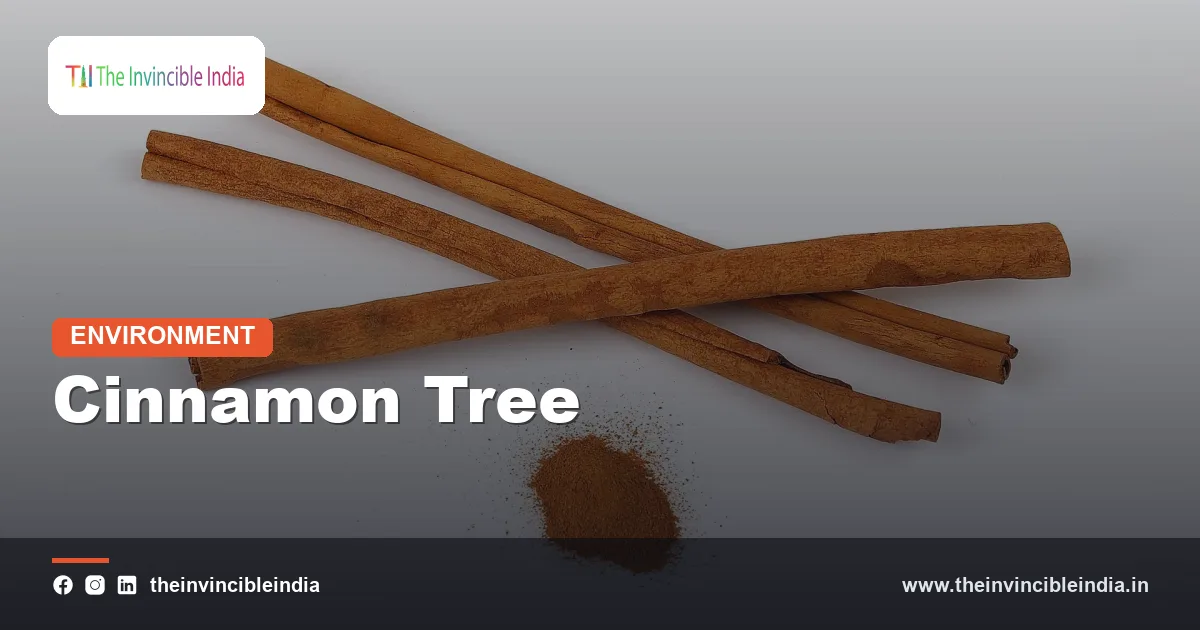
The cinnamon tree is a tropical evergreen of the genus Cinnamomum whose dried inner bark is the sweet, warm spice known as cinnamon, and the true cinnamon tree, Cinnamomum verum, is native to Sri Lanka and the Western Ghats of southern India. The spice is sold as rolled quills, broken pieces (quillings) or powder, and it is also distilled into aromatic oils.
In India, the cinnamon tree is grown mostly in Kerala and in smaller pockets of Karnataka and Tamil Nadu, usually as a small plantation or homestead crop. This explainer describes the tree, the way its bark is harvested, how true cinnamon differs from cassia, and how the spice is used in Indian kitchens and households.
Quick Facts
| Attribute | Detail |
|---|---|
| Common names | Cinnamon, true cinnamon, Ceylon cinnamon; dalchini (Hindi), karuvapatta (Malayalam), lavanga pattai (Tamil) |
| Scientific name | Cinnamomum verum (also written Cinnamomum zeylanicum) |
| Family | Lauraceae, the laurel family |
| Origin | Sri Lanka and the Western Ghats region of southern India |
| Where grown in India | Kerala mainly, with smaller plantings in Karnataka, Tamil Nadu and the Andaman and Nicobar Islands |
| Part used | Inner bark of young stems; the leaves and bark are also distilled for oil |
| Harvest season | Mainly the rainy months, when the bark separates easily from the wood |
| Main products | Quills, quillings, bark powder, bark oil, leaf oil |
| Notable fact | Cinnamon is one of the oldest spices in world trade, and its main flavour compound is cinnamaldehyde |
Key Takeaways
- Cinnamon is the dried inner bark of trees in the genus Cinnamomum, and true cinnamon comes from Cinnamomum verum.
- The cinnamon tree belongs to the laurel family, Lauraceae, the same family as the Indian bay leaf (tejpatta), camphor and avocado.
- Cinnamon bark is harvested from coppiced shoots, peeled in thin layers and rolled into quills that dry in the shade.
- True cinnamon has a thin, pale, many-layered quill and a mild, sweet flavour, while cassia has a thick, hard, dark bark and a stronger, sharper taste.
- Cinnamaldehyde is the main flavour compound of cinnamon bark, while the oil of the leaf is rich in eugenol instead.
- Indian kitchens use cinnamon, called dalchini, in whole-spice tempering, rice dishes, garam masala and sweet preparations.
What is the cinnamon tree and where does it grow?
The cinnamon tree is a bushy, evergreen tree of the laurel family that grows in warm, humid, tropical lowlands and foothills and is cultivated for the aromatic bark of its young shoots. Left alone, a Cinnamomum verum tree can reach roughly 10 to 15 metres, but on plantations it is deliberately kept as a low, many-stemmed bush so that it produces slender, straight shoots.
The wild home of the species is Sri Lanka and the wet forests of the Western Ghats. The tree prefers a warm climate with well-distributed rainfall, a sandy or lateritic soil that drains well, and low to moderate elevation. In India, these conditions are met along the coastal and foothill belt of Kerala, which is why the state is the centre of cultivation. Smaller plantings exist in parts of Karnataka and Tamil Nadu and in the humid island climate of the Andaman and Nicobar group.
Several other trees of the same genus are also called cinnamon in everyday speech, which sometimes causes confusion. They include the Chinese cassia (Cinnamomum cassia), the Indonesian cassia (Cinnamomum burmannii) and the Indian cassia, Cinnamomum tamala, whose leaves are sold as tejpatta.
What does a cinnamon tree look like?
A cinnamon tree has glossy, leathery, oval leaves with three to five prominent veins, small greenish-yellow flowers in loose clusters, and dark purple, olive-shaped fruits. The young leaves are often a coppery pink or red and turn deep green as they mature, which makes a cinnamon plantation easy to recognise in the new-growth season.
The leaves release a sharp, spicy smell when crushed, and this is because the leaf holds oil in which eugenol is the main component. The bark of the trunk is rough and brownish, but the valued inner bark, from young stems, is thin and pale and carries the sweet scent of the spice.
How is the tree propagated?
Cinnamon is usually grown from seed or from stem cuttings and layered shoots, and seedlings are raised in a nursery before being planted out. Seeds lose their ability to germinate quickly, so they are sown soon after the ripe fruits are collected. Farmers plant the seedlings in clumps and, after the plant is established, cut it back close to the ground so that it sends up several straight shoots.
How is cinnamon harvested and turned into quills?
Cinnamon is harvested by cutting mature shoots, scraping off the outer bark, peeling the inner bark in strips and rolling the strips into quills that are dried in the shade. The work is highly skilled and is still done largely by hand, which is a major reason that true cinnamon costs more than the common cassia.
The process runs in a fixed sequence, and each step affects the quality of the final quill.
- Coppicing: After a few years of growth, the stems are cut at the base. The stump then produces fresh shoots, so one plant can be harvested repeatedly for many years.
- Selecting shoots: Shoots that are about a finger or two in thickness, with brown colour and a straight form, are chosen. The bark of these shoots peels easily during the damp season.
- Scraping: The outer, rough bark is scraped off with a curved knife, leaving the inner bark that holds the oil.
- Peeling: A long slit is cut along the stem and the inner bark is lifted off in strips. The strips curl naturally as they dry.
- Quill making: Thin strips are nested inside one another to build a long, compact quill. The skilled worker trims and fits them so the quill is even.
- Drying: The quills are dried in a shaded, ventilated place, never in strong sun, which would dull the colour and weaken the aroma. They turn from pale cream to a light golden brown.
- Grading and cutting: The quills are sorted by thickness, colour and length, and broken pieces and trimmings are sold separately as quillings or chips.
What is the difference between true cinnamon and cassia?
True cinnamon, Cinnamomum verum, is a thin, light-brown, soft and brittle bark with a delicate sweet flavour, while cassia is a thicker, darker, harder bark from related species with a sharper and more pungent taste. Both are sold as cinnamon in many markets, and most of the cinnamon found in supermarkets in several countries is in fact cassia.
| Feature | True cinnamon (Cinnamomum verum) | Cassia (for example Cinnamomum cassia) |
|---|---|---|
| Appearance | Thin, pale tan, many layers rolled like a cigar | Thick, dark reddish-brown, a single curled layer |
| Texture | Brittle and easy to crumble | Hard and woody |
| Flavour | Mild, sweet, delicately floral | Strong, spicy, slightly bitter |
| Coumarin content | Very low | Considerably higher |
| Typical price | Higher | Lower |
| Main source | Sri Lanka, with some from south India | China, Indonesia, Vietnam |
Coumarin is a naturally occurring compound that, in large and regular intakes, can be a concern for the liver in sensitive people. Because cassia contains a good deal more of it than true cinnamon, food-safety agencies in several countries advise moderation in the regular use of cassia powder. A normal culinary amount in Indian cooking is far lower than the levels that attract such advice.
Where is cinnamon grown in India?
Cinnamon in India is grown mainly in Kerala, which has the climate and the long agricultural tradition needed for the crop, and in smaller areas of Karnataka, Tamil Nadu and the Andaman and Nicobar Islands. The scale of Indian production is modest compared with the leading world producers, and a large part of the cinnamon used in Indian kitchens is either cassia grown in India or cinnamon imported from other countries.
Most Indian cinnamon is cultivated by small farmers who grow it alongside coconut, arecanut, pepper and other spice and plantation crops. This mixed cropping is typical of the Western Ghats region, where homestead gardens combine several perennial species on a single plot.
What is Indian cassia?
Indian cassia is the name for Cinnamomum tamala, a different species whose leaves are the tejpatta used in Indian cooking and whose bark is sometimes sold as an inferior cinnamon. It grows in the Himalayan foothills and the north-east rather than in the southern coastal belt, so it should not be confused with the southern cinnamon tree.
How is cinnamon used in Indian kitchens?
Cinnamon is used in Indian cooking as a whole-spice flavouring added to hot oil or ghee at the start of a dish, as one of the core ingredients of garam masala, and as a fragrance in sweets, beverages and rice preparations. In north Indian cooking, a small stick of dalchini is a regular companion of cloves, green cardamom and bay leaf in pulao and biryani.
- Tempering and tadka: A small piece is fried briefly in hot fat to release its scent into curries, dals and vegetable dishes.
- Rice dishes: Pulao, biryani and the spiced rice of coastal regions use whole bark pieces for their sweet fragrance.
- Garam masala: Ground cinnamon is a classical part of the blended spice mixes of north and central India.
- Meat and Mughlai dishes: Kormas, nihari and kebab marinades often include cinnamon alongside clove and mace.
- Sweets and drinks: Masala chai, kheer, halwa and festive bakes use cinnamon for warmth.
- Kerala and coastal cooking: Stews, roast spice pastes and coconut-based curries draw on cinnamon along with pepper and cardamom.
Whole bark is generally preferred in Indian cooking because it can be removed after cooking, and because it keeps its aroma far longer than powder.
Which chemicals give cinnamon its flavour?
Cinnamaldehyde is the main compound that gives cinnamon bark its characteristic sweet, warm aroma and flavour, and it makes up the greater part of the bark oil. The oil from the leaf of the tree has a different profile, with eugenol as the dominant compound, which gives it a clove-like smell.
Besides cinnamaldehyde, cinnamon bark contains small quantities of eugenol, linalool, caryophyllene and other aromatic molecules, together with tannins and mucilage. This is why cinnamon bark oil, leaf oil and root oil smell noticeably different from each other. The bark oil is used mainly in flavouring and perfumery, and the leaf oil in soaps, mouthwashes and other products.
The spice is also a good illustration of how a plant can hold different chemical signatures in different organs. The cinnamon leaf, bark and root are all fragrant, yet each is distilled for a different commercial purpose.
Why does cinnamon matter in history and trade?
Cinnamon matters in history because it was one of the first spices to be traded over long distances, and it was valued by ancient Mediterranean, Arab and later European merchants as a luxury good. For many centuries, the source of the spice was kept obscure by traders who wanted to protect their profit.
The Portuguese took control of the cinnamon trade of Sri Lanka in the sixteenth century, and the Dutch and later the British succeeded them. These shifts of control were part of the wider competition among European powers for the spice trade of the Indian Ocean. Southern India, with its ports on the Malabar coast, was a long-established node in this network, alongside pepper, cardamom and ginger.
The story of cinnamon therefore connects botany, geography and economics, and it helps explain why the Malabar coast attracted so many traders over the centuries.
How should cinnamon be bought and stored?
Cinnamon is best bought as whole quills or sticks and stored in an airtight container away from heat, light and moisture, because the aroma fades quickly once the bark is ground. Whole quills can stay fragrant for a year or more, while powder loses much of its character in a shorter time.
- Look for pale tan, thin, many-layered quills if true cinnamon is wanted.
- Choose a thick, dark and hard stick if a strong cassia flavour is preferred.
- Grind small amounts at a time in a clean, dry mill for the freshest taste.
- Keep the container tightly closed and out of the steam of the kitchen.
What are the traditional uses of cinnamon?
Cinnamon has been used in traditional Indian medicine and home remedies as a warming, digestive and aromatic herb, known in Ayurveda as twak. It is a regular ingredient of kadha and herbal tea preparations that are taken in the cold season, and its oil is used in some balms and dental products.
Modern scientific studies of cinnamon continue, and claims about its effect on blood sugar or other conditions remain under investigation rather than settled. Anyone with a medical condition, or anyone taking regular medication, should treat cinnamon as a food and consult a doctor before using concentrated extracts or large amounts as a supplement.
Bottom Line
The cinnamon tree turns a thin layer of inner bark into one of the best-known spices in the world, and India, particularly Kerala, remains a small but meaningful part of the story. Knowing the difference between true cinnamon and cassia helps cooks and buyers choose the right product. Cinnamon is best treated as a fragrant culinary ingredient with a long history, not as a cure.
Frequently Asked Questions
What is cinnamon made from?
Cinnamon is made from the dried inner bark of trees in the genus Cinnamomum. True cinnamon comes from Cinnamomum verum, and the bark is peeled from young shoots, rolled into quills and dried in the shade. The quills are sold whole, broken into pieces or ground into powder.
Is cinnamon grown in India?
Yes, cinnamon is grown in India, mainly in Kerala and in smaller areas of Karnataka, Tamil Nadu and the Andaman and Nicobar Islands. It is usually a small-farm crop, often planted with coconut or other plantation crops. India also grows and uses cassia, and a share of the cinnamon sold in the country is imported.
What is the difference between cinnamon and cassia?
True cinnamon is a thin, pale, brittle bark with a mild and sweet flavour, while cassia is a thicker, darker and harder bark with a stronger taste. Cassia also contains considerably more coumarin than true cinnamon. Both are sold as cinnamon, so it is worth checking the label or the appearance of the stick.
How long does a cinnamon tree take to give bark?
A cinnamon tree is generally ready for its first bark harvest after about two to three years of growth, once the shoots are of the right thickness. The plant is then cut back, and it sends up new shoots that can be harvested again. A well-managed plantation can keep producing bark for many years.
Why is cinnamon peeled in the rainy season?
Cinnamon is peeled mainly in the rainy season because the sap is flowing and the bark separates easily from the wood at that time. Peeling in dry conditions is much harder and can damage the bark. The damp weather also helps the strips curl into neat quills.
Is cinnamon the same as tejpatta?
No, cinnamon is the bark of Cinnamomum verum, while tejpatta is the leaf of a related tree, Cinnamomum tamala. Both belong to the laurel family and share a warm, sweet fragrance. In cooking, tejpatta is used as a leaf and cinnamon as a bark stick or powder.
{“@context”:”https://schema.org”,”@graph”:[{“@type”:”FAQPage”,”mainEntity”:[{“@type”:”Question”,”name”:”What is cinnamon made from?”,”acceptedAnswer”:{“@type”:”Answer”,”text”:”Cinnamon is made from the dried inner bark of trees in the genus Cinnamomum. True cinnamon comes from Cinnamomum verum, and the bark is peeled from young shoots, rolled into quills and dried in the shade. The quills are sold whole, broken into pieces or ground into powder.”}},{“@type”:”Question”,”name”:”Is cinnamon grown in India?”,”acceptedAnswer”:{“@type”:”Answer”,”text”:”Yes, cinnamon is grown in India, mainly in Kerala and in smaller areas of Karnataka, Tamil Nadu and the Andaman and Nicobar Islands. It is usually a small-farm crop, often planted with coconut or other plantation crops. India also grows and uses cassia, and a share of the cinnamon sold in the country is imported.”}},{“@type”:”Question”,”name”:”What is the difference between cinnamon and cassia?”,”acceptedAnswer”:{“@type”:”Answer”,”text”:”True cinnamon is a thin, pale, brittle bark with a mild and sweet flavour, while cassia is a thicker, darker and harder bark with a stronger taste. Cassia also contains considerably more coumarin than true cinnamon. Both are sold as cinnamon, so it is worth checking the label or the appearance of the stick.”}},{“@type”:”Question”,”name”:”How long does a cinnamon tree take to give bark?”,”acceptedAnswer”:{“@type”:”Answer”,”text”:”A cinnamon tree is generally ready for its first bark harvest after about two to three years of growth, once the shoots are of the right thickness. The plant is then cut back, and it sends up new shoots that can be harvested again. A well-managed plantation can keep producing bark for many years.”}},{“@type”:”Question”,”name”:”Why is cinnamon peeled in the rainy season?”,”acceptedAnswer”:{“@type”:”Answer”,”text”:”Cinnamon is peeled mainly in the rainy season because the sap is flowing and the bark separates easily from the wood at that time. Peeling in dry conditions is much harder and can damage the bark. The damp weather also helps the strips curl into neat quills.”}},{“@type”:”Question”,”name”:”Is cinnamon the same as tejpatta?”,”acceptedAnswer”:{“@type”:”Answer”,”text”:”No, cinnamon is the bark of Cinnamomum verum, while tejpatta is the leaf of a related tree, Cinnamomum tamala. Both belong to the laurel family and share a warm, sweet fragrance. In cooking, tejpatta is used as a leaf and cinnamon as a bark stick or powder.”}}]}]}


