

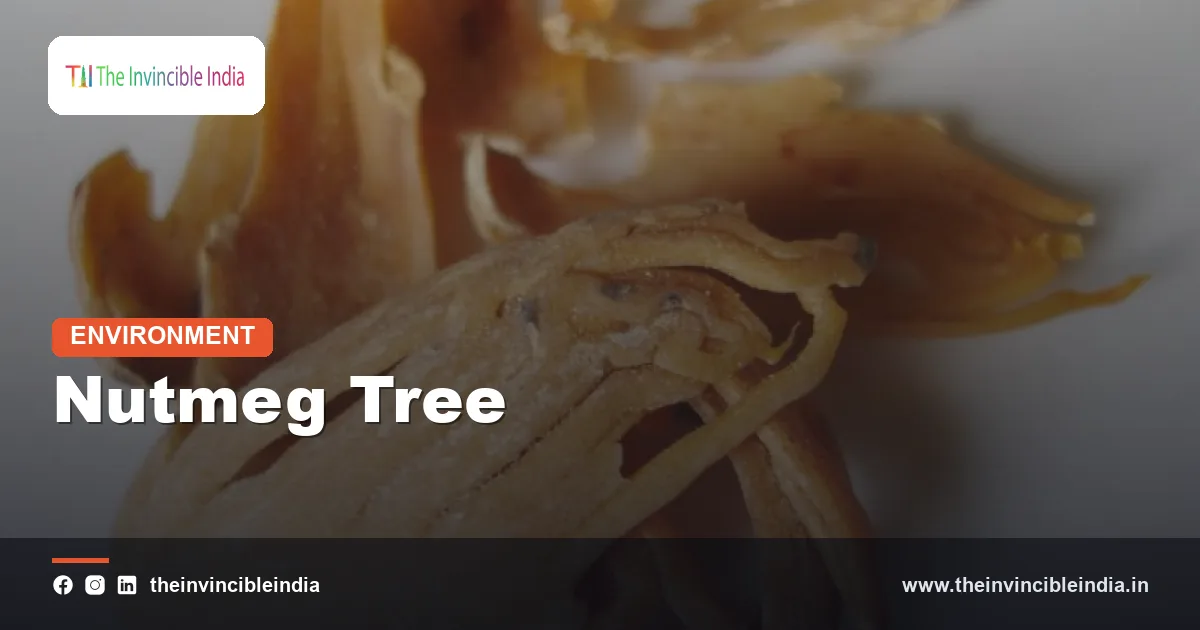
The nutmeg tree is a tropical evergreen whose fruit yields two different spices, the hard brown seed known as nutmeg and the lacy red covering around it known as mace, and the tree, Myristica fragrans, is native to the Banda Islands of Indonesia and is grown in India mainly in Kerala. Nutmeg is a warm, sweet and slightly woody spice, while mace has a similar but more delicate and citrus-tinged flavour.
In India, nutmeg is called jaiphal and mace is called javitri, and both are used in garam masala, rich gravies, sweets and traditional remedies. This explainer describes how the nutmeg tree grows, how the fruit is split into two spices, how they are dried and graded, where the tree is cultivated in India, and how to use nutmeg safely.
Quick Facts
| Attribute | Detail |
|---|---|
| Common names | Nutmeg (seed) and mace (aril); jaiphal and javitri (Hindi); jathikka and jathipathri (Malayalam) |
| Scientific name | Myristica fragrans |
| Family | Myristicaceae, the nutmeg family |
| Origin | Banda Islands, part of the Maluku (Moluccas) region of Indonesia |
| Where grown in India | Kerala mainly, with smaller areas in Tamil Nadu, Karnataka and the Andaman and Nicobar Islands |
| Part used | The seed kernel (nutmeg) and the aril around the seed (mace); the fleshy fruit wall is also used locally |
| Harvest season | Fruits ripen and split open mainly in the monsoon and post-monsoon months, with some picking at other times |
| Main products | Whole nutmeg, ground nutmeg, mace blades, nutmeg butter, nutmeg oil, pickles and candied fruit |
| Notable fact | The nutmeg tree is dioecious, with separate male and female trees, and a single fruit gives two distinct spices |
Key Takeaways
- Nutmeg is the dried seed kernel of Myristica fragrans, and mace is the dried red aril that surrounds that same seed.
- The nutmeg tree is native to the Banda Islands of Indonesia and is cultivated in India mainly in Kerala, often inside coconut and arecanut gardens.
- Nutmeg trees are usually male or female, so only female trees bear fruit, and a planting needs a few male trees for pollination.
- A nutmeg tree normally begins to bear fruit about seven to nine years after planting and can remain productive for several decades.
- Nutmeg contains myristicin and related compounds, and eating large amounts of the spice can cause nausea, confusion and other serious effects.
- In Indian cooking, jaiphal and javitri are used in small quantities in garam masala, Mughlai dishes, milk drinks and sweets.
What is the nutmeg tree and what does it look like?
The nutmeg tree is a dense, evergreen tree of the nutmeg family that commonly grows 10 to 20 metres tall, with a rounded crown, dark glossy leaves and a smooth, grey-brown bark that exudes a reddish sap when cut. The tree is a member of Myristicaceae, a family of tropical forest trees, and it is quite different from the cinnamon, clove and bay trees that are often grouped with it as “spice trees”.
The leaves are oval, pointed at the tip and arranged alternately along the branches, and they are aromatic when crushed. The small flowers are pale yellow and bell-shaped and hang in small clusters in the leaf axils. Male flowers are carried in groups, while female flowers are usually single or in twos. The fruit is a fleshy, yellow, pear-like or apricot-like drupe about the size of a small plum.
How does one fruit give both nutmeg and mace?
One nutmeg fruit gives both spices because its seed is wrapped in a bright red, net-like covering called the aril, and the dried seed becomes nutmeg while the dried aril becomes mace. When the ripe fruit splits open along a seam, it reveals the glossy dark brown seed encased in the scarlet aril, a striking sight inside the yellow husk.
The three parts of the fruit can be described as follows.
- Fruit wall (pericarp): The thick, fleshy outer part. It is sour and slightly astringent, and in Kerala it is used to make pickles, jams, candied pieces and a refreshing juice.
- Aril: The red lace around the seed. When separated and dried, it becomes mace, which turns from red to a pale orange or yellowish-brown.
- Seed: A hard shell encloses the kernel, which is the nutmeg, an oval brown seed with a marbled interior.
Where does the nutmeg tree grow, and where is it grown in India?
The nutmeg tree grows in warm, humid tropical lowlands with heavy, well-distributed rainfall, and in India it is grown mainly in Kerala, with smaller plantings in Tamil Nadu, Karnataka and the Andaman and Nicobar Islands. The tree prefers deep, fertile, well-drained loamy soil and partial shade, especially when young, and it does not tolerate prolonged dryness or waterlogging.
In Kerala, nutmeg is often grown as an intercrop in the shade of coconut and arecanut palms, which makes use of the space and gives the young trees protection from strong sun. In Tamil Nadu, plantings are found in places such as the Nilgiri and Kanyakumari areas. Most Indian nutmeg is produced by small farmers on mixed homestead plots, and the crop is part of the broader spice economy of the Western Ghats. Indonesia and Grenada are among the best-known international producers.
How is a nutmeg tree grown and when does it bear fruit?
A nutmeg tree is grown from seed or from grafted and budded plants, and it usually begins to bear fruit about seven to nine years after planting, reaching full yield after around fifteen to twenty years. The tree is long-lived and can remain productive for several decades, which makes it a patient investment for a farming family.
Why is the sex of the tree important?
The sex of the nutmeg tree is important because the species is dioecious, which means that a given tree produces either male or female flowers, and only female trees bear fruit. A seedling cannot be identified as male or female until it flowers, which may take several years. Farmers therefore prefer vegetative methods, such as grafting from known female trees, and retain a small proportion of male trees, usually about one in every ten or so, for pollination.
Which pests and diseases matter?
Nutmeg is troubled by fruit rot, die-back, leaf spot and a few insect pests, and the fruit is especially prone to damage during heavy rain. Good drainage, clean gardens and timely harvesting help reduce losses. Stored nutmeg is also subject to insects and moulds if it is not dried properly.
How are nutmeg and mace harvested and processed?
Nutmeg and mace are harvested by collecting the ripe fruits that split open on the tree or fall to the ground, separating the seed and aril, and drying each part separately. The work is done by hand and needs care because the aril is delicate and the value of mace depends on its colour and shape.
- Collecting: Ripe fruits are picked with a long pole with a basket or gathered from the ground soon after they fall.
- Husking: The fleshy outer wall is split and removed, leaving the seed wrapped in its aril.
- Separating mace: The aril is peeled off carefully in one piece, flattened and dried in the shade or in gentle sun for several days until it hardens and changes colour.
- Drying the seed: The seed, still in its hard shell, is dried slowly, often for several weeks, until the kernel shrinks and rattles inside the shell.
- Cracking: The brittle shell is broken and the nutmeg kernel is taken out.
- Grading and storing: Nutmegs are sorted by size and appearance, and sound kernels are kept dry. In some regions, kernels have traditionally been dipped in lime to deter insects.
What is the difference between nutmeg and mace?
Nutmeg is the hard seed kernel, while mace is the soft red aril around it, and the two differ in texture, colour and flavour even though they come from the same fruit. Nutmeg tastes warm, sweet and slightly bitter, whereas mace tastes lighter, more floral and a little peppery.
| Feature | Nutmeg (jaiphal) | Mace (javitri) |
|---|---|---|
| Part of fruit | Seed kernel | Aril around the seed |
| Fresh colour | Brown seed in a hard shell | Bright scarlet |
| Dried form | Hard oval nut, usually grated | Thin, flat orange-brown blades |
| Flavour | Warm, sweet, woody | Delicate, floral, slightly citrus |
| Common use | Garam masala, sweets, milk, gravies | Biryani, kormas, light-coloured dishes |
| Typical price | Lower | Higher, since each fruit gives little mace |
How is nutmeg used in Indian food?
Nutmeg is used in Indian food in very small quantities as a grated or powdered spice that adds warmth and depth to savoury gravies, sweets and milk-based drinks. A pinch is usually enough, because the flavour is powerful and can become bitter when used in excess.
- Garam masala and spice blends: Jaiphal and javitri are included in several north Indian and Mughlai masala mixes.
- Rich gravies: Kormas, nihari and some biryani preparations use mace or nutmeg for aroma.
- Sweets and desserts: A little grated nutmeg flavours kheer, halwa, rasmalai and festive puddings.
- Milk drinks: A pinch in warm milk is a traditional home practice, particularly in the cold season.
- Kerala preparations: The fruit wall is made into pickles, jams and a drink, and the spice appears in some meat and bakery recipes.
Freshly grated nutmeg has a much better aroma than pre-ground powder, and a small grater kept for the purpose is a familiar tool in many kitchens.
Is nutmeg safe to eat?
Nutmeg is safe in the small amounts used in cooking, but eating large quantities, such as a teaspoon or more at a time or a whole nut, can cause serious poisoning. The compounds myristicin and elemicin in nutmeg act on the nervous system when taken in excess and can cause nausea, dizziness, a racing heartbeat, confusion and hallucinations.
The practice of taking large doses for such effects is dangerous and not recommended. Pregnant women are generally advised to avoid more than culinary amounts, and nutmeg oil should not be swallowed. People with health conditions or those who use nutmeg as a home remedy should seek medical advice.
What are the traditional uses of nutmeg?
Nutmeg has been used in traditional Indian medicine as jatiphala, a warming and digestive spice often given in tiny amounts, and it features in some Ayurvedic and Unani preparations. Home remedies commonly include a small pinch in warm milk or honey to help with digestion or restless sleep, though these uses rest on tradition and are not established medical treatments.
Nutmeg butter, a fat pressed from the kernels, and nutmeg essential oil are used in perfumery, balms, soaps and as flavourings in the food and drink industries. The oil is strong and should be used only as directed for external or industrial use.
What products come from the nutmeg tree?
The nutmeg tree gives a range of products beyond the two spices, including nutmeg butter, essential oil, oleoresin and fruit preparations made from the fleshy pericarp. Almost every part of the fruit finds a use, so a well-run plantation can earn income from more than one product.
- Whole nutmeg and ground nutmeg: The main culinary product, sold in shells or as kernels.
- Mace blades and powder: The premium by-product, valued for baking and light-coloured gravies.
- Nutmeg butter: A reddish, aromatic fat pressed from the kernels and used in soaps and balms.
- Essential oil and oleoresin: Concentrated flavours for food, drinks and perfumery.
- Fruit pericarp products: Pickles, jams, squash and candied slices, widely made in Kerala.
How can good nutmeg and mace be recognised?
Good nutmeg is heavy, firm and oily, with a strong sweet smell and a marbled pattern when cut, while good mace is flexible, bright orange-brown and fragrant. Both lose quality when they are stored badly, so the look and smell of the spice are the most useful guides at the point of purchase.
- Whole nutmegs should be free of small holes, which indicate insect damage.
- A light, dry and dusty nutmeg is probably old, and a very pale and brittle mace has probably lost much of its oil.
- Whole nutmeg is always preferable to powder, because powder is easier to adulterate and fades quickly.
- Blades of mace are best kept in a closed tin or jar, away from damp.
What is the history of the nutmeg trade?
The history of the nutmeg trade is that of a spice that, for centuries, grew only on the small Banda Islands and was carried by Arab, Indian and later European traders to distant markets. In the seventeenth century, the Dutch East India Company seized control of the Banda Islands and enforced a monopoly, and in 1667 the Treaty of Breda saw the Dutch keep the nutmeg island of Run while the English received New Amsterdam, later New York.
The monopoly ended when seedlings were carried to other tropical colonies in the late eighteenth and nineteenth centuries. The tree was planted in places such as Grenada, Sri Lanka and the Malabar region of India. Today, nutmeg and mace are grown in many tropical countries.
Bottom Line
The nutmeg tree is unusual among the spice trees because a single fruit gives two spices, nutmeg and mace, and Kerala is its main home in India. Both spices are valuable in small quantities and risky in large ones. Choosing whole nutmeg, grating it fresh and using only a pinch is the simplest way to enjoy it well.
Frequently Asked Questions
What is the difference between nutmeg and mace?
Nutmeg is the hard seed kernel of the fruit, while mace is the red, lace-like aril that covers the seed. Both come from the same tree, Myristica fragrans. Nutmeg tastes warm and sweet, and mace is lighter, more floral and usually costs more.
Where is nutmeg grown in India?
Nutmeg is grown in India mainly in Kerala, often as an intercrop in coconut and arecanut gardens. Smaller plantings are found in Tamil Nadu, Karnataka and the Andaman and Nicobar Islands. The tree needs a warm, humid climate and well-drained soil.
How long does a nutmeg tree take to bear fruit?
A nutmeg tree usually begins to bear fruit about seven to nine years after planting and reaches full yield after around fifteen to twenty years. Only female trees bear fruit. The tree can stay productive for several decades.
Is nutmeg called jaiphal in Hindi?
Yes, jaiphal is the Hindi name for nutmeg, and javitri is the Hindi name for mace. In Malayalam the names are jathikka and jathipathri. These words are used in recipes and spice shops across India.
Can nutmeg be harmful?
Yes, nutmeg can be harmful when eaten in large amounts, though it is safe in the small pinch used in cooking. Excess nutmeg can cause nausea, dizziness, confusion and hallucinations because of compounds such as myristicin. Anyone who has taken a large amount should seek medical help promptly.
How should nutmeg be stored?
Nutmeg is best stored whole in an airtight container in a cool, dry place away from sunlight. Whole nutmeg keeps its aroma for a long time, and it can be grated fresh when needed. Ground nutmeg and mace lose their flavour faster and should be used within a few months.
{“@context”:”https://schema.org”,”@graph”:[{“@type”:”FAQPage”,”mainEntity”:[{“@type”:”Question”,”name”:”What is the difference between nutmeg and mace?”,”acceptedAnswer”:{“@type”:”Answer”,”text”:”Nutmeg is the hard seed kernel of the fruit, while mace is the red, lace-like aril that covers the seed. Both come from the same tree, Myristica fragrans. Nutmeg tastes warm and sweet, and mace is lighter, more floral and usually costs more.”}},{“@type”:”Question”,”name”:”Where is nutmeg grown in India?”,”acceptedAnswer”:{“@type”:”Answer”,”text”:”Nutmeg is grown in India mainly in Kerala, often as an intercrop in coconut and arecanut gardens. Smaller plantings are found in Tamil Nadu, Karnataka and the Andaman and Nicobar Islands. The tree needs a warm, humid climate and well-drained soil.”}},{“@type”:”Question”,”name”:”How long does a nutmeg tree take to bear fruit?”,”acceptedAnswer”:{“@type”:”Answer”,”text”:”A nutmeg tree usually begins to bear fruit about seven to nine years after planting and reaches full yield after around fifteen to twenty years. Only female trees bear fruit. The tree can stay productive for several decades.”}},{“@type”:”Question”,”name”:”Is nutmeg called jaiphal in Hindi?”,”acceptedAnswer”:{“@type”:”Answer”,”text”:”Yes, jaiphal is the Hindi name for nutmeg, and javitri is the Hindi name for mace. In Malayalam the names are jathikka and jathipathri. These words are used in recipes and spice shops across India.”}},{“@type”:”Question”,”name”:”Can nutmeg be harmful?”,”acceptedAnswer”:{“@type”:”Answer”,”text”:”Yes, nutmeg can be harmful when eaten in large amounts, though it is safe in the small pinch used in cooking. Excess nutmeg can cause nausea, dizziness, confusion and hallucinations because of compounds such as myristicin. Anyone who has taken a large amount should seek medical help promptly.”}},{“@type”:”Question”,”name”:”How should nutmeg be stored?”,”acceptedAnswer”:{“@type”:”Answer”,”text”:”Nutmeg is best stored whole in an airtight container in a cool, dry place away from sunlight. Whole nutmeg keeps its aroma for a long time, and it can be grated fresh when needed. Ground nutmeg and mace lose their flavour faster and should be used within a few months.”}}]}]}


