

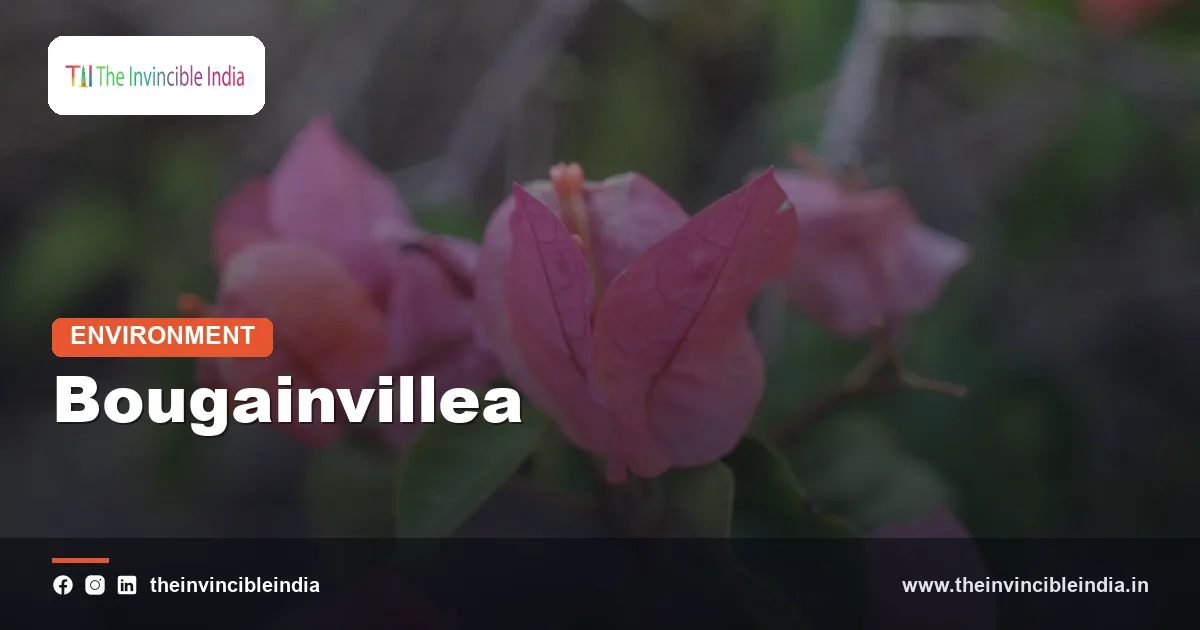
In India, bougainvillea is a thorny, woody climbing plant from South America whose brilliantly coloured, paper-thin bracts cover walls, gates, balconies and highway dividers for much of the year. Although it is grown everywhere in the country as an ornamental, bougainvillea is not native to India; it arrived through European botanical and garden exchange and has since become one of the most familiar sights of Indian towns and cities.
What most people call the “flower” of bougainvillea is actually a set of modified leaves, while the true flowers are small, pale and easy to overlook. This article explains the plant’s botany, its main species and varieties, its flowering pattern in Indian conditions, how it is grown and pruned, and why it suits Indian landscapes so well.
Quick Facts
| Scientific name | Bougainvillea spp. (mainly B. glabra, B. spectabilis, B. peruviana and their hybrids) |
|---|---|
| Family | Nyctaginaceae (the four-o’clock or bougainvillea family) |
| Origin | South America, including Brazil, Peru, Bolivia and Paraguay |
| Named after | Louis Antoine de Bougainville, the French navigator who led a circumnavigation in 1766-69 |
| Where grown in India | Almost all states, from the plains and coasts to hill towns that stay frost-free; especially common in cities |
| Main flowering season in India | Winter to late spring, with heavy bursts after a dry spell; some varieties bloom in repeated flushes through the year |
| Colourful parts | Three large bracts around three small tubular flowers |
| Main uses | Ornamental climber, hedge, screen, potted plant, standard tree form and bonsai |
| Notable facts | Thorny, drought tolerant, thrives in full sun, and flowers best when slightly stressed |
Key Takeaways
- Bougainvillea is a South American climbing shrub that belongs to the Nyctaginaceae family and is not native to India.
- The vivid pink, magenta, red, orange, yellow and white colour of bougainvillea comes from bracts, which are modified leaves, and not from true petals.
- Each bougainvillea bract cluster surrounds three small tubular flowers that are usually cream or white and last only a short time.
- Bougainvillea blooms most heavily in Indian conditions when it receives full sun, restrained watering and a mild dry or cool spell before flowering.
- Bougainvillea is propagated mainly from semi-hardwood cuttings and tolerates heat, poor soil, air pollution and long dry periods once established.
- The thorns of bougainvillea make it a useful barrier hedge but also mean it needs careful handling during pruning.
What is bougainvillea and where does it come from?
Bougainvillea is a small genus of about a dozen species of thorny, vine-like shrubs native to the warm parts of South America, mainly Brazil, Peru, Bolivia, Paraguay and Argentina. In the wild the plants scramble over other vegetation, climbing with the help of their hooked thorns, and they grow best in places with a distinct dry season.
The plant takes its name from Louis Antoine de Bougainville, a French admiral and explorer who commanded a voyage around the world between 1766 and 1769. Philibert Commerson, the naturalist travelling with that expedition, collected the plant in Brazil, and it was later described and named in the genus Bougainvillea. From Europe it spread through botanical gardens, plant collectors and colonial gardens to tropical and subtropical regions around the world.
In India the plant became popular in the nineteenth and twentieth centuries as a garden ornamental and has since naturalised in many gardens, abandoned plots and roadsides. It sits in the same family as the four-o’clock flower (Mirabilis jalapa), another garden plant that many Indians know as gulabbas or gul-e-abbas.
What are the colourful parts of bougainvillea if they are not flowers?
The colourful parts of bougainvillea are bracts, which are modified leaves that grow just beneath the true flowers and take over the showy role normally played by petals. Each cluster has three bracts, and in the middle of each bract sits one small, tubular flower, so a single cluster carries three true flowers.
The true flowers are usually white, cream or pale yellow and are only about two to three centimetres long. They open and fade within a day or two, while the bracts remain bright and papery for weeks. This is why a bougainvillea in full display can look covered in colour for a long time, even though the actual flowering is brief.
Why the bracts last so long
The bracts of bougainvillea have a thin, dry, paper-like texture and contain pigments called betalains, which are also found in beetroot and in some cacti. Plants that produce betalains do not produce the anthocyanin pigments that colour most other flowers, which is a distinctive feature of the order to which the family belongs. Because the bracts are tough and dry, they resist heat and wind and fall slowly, which is why bougainvillea holds its colour through summers that would wither ordinary petals.
What the fruit looks like
The fruit of bougainvillea is a small, dry, ribbed capsule-like structure called an achene, enclosed within the remains of the flower tube. Many ornamental cultivars set seed rarely or not at all, so gardeners almost never grow them from seed.
Why is bougainvillea so common in India?
Bougainvillea is so common in India because its natural needs match Indian conditions: strong sunlight, warm temperatures, a clear dry season and the ability to survive on little water. The plant needs no special soil, tolerates dust and pollution, and recovers quickly from hard pruning, which makes it a low-cost choice for homes, municipalities and housing societies.
Several features explain its popularity across very different parts of the country.
- Drought tolerance: Established plants survive long gaps between waterings, which suits the dry season in much of peninsular and western India.
- Heat tolerance: Bougainvillea keeps blooming in summer heat that stops many other ornamentals.
- Pollution tolerance: Its leathery leaves cope with dust and traffic fumes, so it is widely planted on flyovers, medians and boundary walls.
- Fast growth: A cutting can grow into a covering for a gate or terrace within a few seasons.
- Wide colour range: Gardeners can choose from magenta, purple, red, orange, pink, yellow and white, as well as variegated types.
- Security value: Thorny growth along a compound wall discourages casual intrusion.
The plant is less suited to places with hard frost. In northern India, a severe winter cold wave can burn the young growth, although established plants frequently resprout from the base once temperatures rise.
What are the main species and varieties of bougainvillea?
The main parent species of garden bougainvillea are Bougainvillea glabra, Bougainvillea spectabilis and Bougainvillea peruviana, and most modern cultivars are hybrids or selections derived from them. Hundreds of named cultivars exist worldwide, differing in colour, bract size, growth habit, thorniness and whether they carry double or variegated bracts.
| Group | Typical features | Common garden use |
|---|---|---|
| Bougainvillea glabra | Smooth, nearly hairless leaves; bracts mostly magenta, purple or white; blooms heavily and reliably | Pots, trellises, hedges and compound walls |
| Bougainvillea spectabilis | Hairy leaves and stems; vigorous, strongly thorny; large clusters of bracts that flower in flushes | Large walls, pergolas and big landscape spaces |
| Bougainvillea peruviana | Less hairy; bracts usually reddish pink or purple; fewer thorns than some relatives | Breeding parent; also used in warm gardens |
| Hybrid cultivars | Include dwarf, double-bract, variegated and orange or gold types such as those sold under names like Barbara Karst, Jamaica White and Mary Palmer | Pots, bonsai, standards and specimen planting |
Gardeners choose between climbing types, compact bushy types for pots and low hedges, and dwarf forms that stay small. Double-bract and variegated varieties tend to cost more and often grow more slowly, so they are best suited to containers and focal points rather than large spaces.
When does bougainvillea flower in India?
Bougainvillea flowers in India mainly from winter through late spring, with the heaviest displays typically appearing between roughly November and April in most regions. Many plants also bloom again in smaller flushes after pruning, and in warm coastal or southern locations they can show colour almost all year.
The plant tends to bloom best after a short period of mild stress. A spell of dry weather, cooler nights or reduced watering signals the plant to stop making leaves and shift energy into producing bracts. Overwatering and heavy nitrogen fertiliser have the opposite effect, producing lush green growth with few bracts, which is the most common complaint among gardeners.
Factors that influence flowering
- Light: Bougainvillea needs several hours of direct sunlight each day; plants in shade grow leaves but bloom poorly.
- Water: Allowing the soil to dry between waterings encourages bract production.
- Fertiliser: Balanced or flowering-oriented feeds help more than nitrogen-rich ones.
- Pruning: Bracts form on new growth, so correct pruning timing leads to more flowers.
- Root space: Slightly root-bound plants in pots often flower more freely.
How do you grow and care for bougainvillea?
Bougainvillea is grown best in a sunny spot with well-drained soil, modest watering and light feeding, and it needs far less attention than most flowering climbers. The plant dislikes waterlogged roots, so good drainage matters more than rich soil.
Soil, sun and water
A sandy loam or a mix of garden soil, sand and compost suits bougainvillea well. In pots, gardeners use a coarse, gritty mix and a container with large drainage holes. Water deeply but infrequently once the plant is established, and reduce watering further in the cooler months. During the first few months after planting, young plants need steadier moisture until their roots settle.
Feeding
Light feeding every few weeks during the growing season is usually enough. A fertiliser lower in nitrogen and higher in phosphorus and potassium encourages flowering. Excess fertiliser, particularly nitrogen, results in dense foliage and few bracts.
Handling the roots
Bougainvillea resents root disturbance. When moving a plant from a nursery bag, gardeners usually keep the root ball intact and avoid breaking it apart, because damaged roots can set the plant back for months.
Common pests and problems
- Caterpillars: Leaf-eating caterpillars sometimes strip foliage, especially in the monsoon and post-monsoon period.
- Aphids and mealybugs: These sap-feeding insects can weaken new growth and are usually controlled with a water spray or mild soap solution.
- Leaf drop: Sudden leaf fall often follows a change of location, a cold spell or overwatering.
- Yellowing leaves: Poor drainage or nutrient imbalance is the usual cause.
How is bougainvillea pruned and propagated?
Bougainvillea is pruned by cutting back long, leggy stems after a flowering flush and is propagated mainly from semi-hardwood stem cuttings, which root more reliably when kept warm and humid. Because bracts form on new growth, regular pruning promotes more flowers rather than fewer.
Pruning
Gardeners generally prune lightly after each flush of colour to keep the shape and encourage fresh shoots, and prune harder at the end of the main flowering season to control size. Thick gloves and long sleeves are essential because the thorns are sharp and curved. Training stems horizontally along a wall or wire, rather than letting them grow vertically, often leads to more flowering shoots along the length of the stem.
Propagation
Cuttings of about 15 to 25 centimetres taken from semi-hardwood stems are the standard method. Many cultivars root slowly, so growers use rooting hormone, a gritty medium and warmth. Air layering and grafting are also used, particularly for cultivars that are difficult to root. Since most ornamental types rarely produce viable seed, plants raised from seed are uncommon and often differ from the parent.
Training into special forms
Bougainvillea can be shaped as a standard, a miniature tree with a single trunk and rounded crown, as a hedge, as an espalier on a wall, or as a bonsai. Its woody stems and tolerance for pruning make it one of the more popular flowering subjects for bonsai in India.
How is bougainvillea used in Indian landscaping?
Bougainvillea is used in Indian landscaping as a climber on walls and pergolas, a thorny boundary hedge, a potted terrace plant, a shaped standard and a cascading cover for slopes and flyovers. Its toughness and low maintenance have made it a standard choice for municipal planting, schools, offices and residential colonies.
- Compound walls and gates: Trained on wire or a trellis, bougainvillea covers walls with colour and adds a layer of natural security.
- Hedges and screens: Shrubby types are clipped into dense flowering hedges that block views and noise to a degree.
- Roadside and median planting: The plant thrives in dust and reflected heat along highways and urban flyovers.
- Terraces and balconies: Compact cultivars flower well in large pots in apartment settings.
- Pergolas and archways: Vigorous types provide shade and ornamental cover in gardens and courtyards.
- Bonsai and standards: Pruned and trained forms are common at nursery shows and flower exhibitions.
Bougainvillea blooms also feature in flower shows in cities such as Bengaluru, Delhi and Pune, where growers display trained forms and new cultivars. Planners value it as a colour source that needs little water in a country where urban water supply is often stretched.
Is bougainvillea harmful, invasive or difficult to manage?
Bougainvillea is not considered seriously poisonous, but its sharp thorns can cause injury, and in some tropical regions outside India it spreads aggressively and is regarded as a weed. In Indian gardens the main practical issues are thorn injuries during pruning, leaf litter and an ability to overgrow structures if left unchecked.
- Thorns: The curved thorns can cause deep scratches; thick gloves and a long-handled pruner are advisable.
- Sap and skin: Some people report mild skin irritation after handling the plant, so protective clothing helps.
- Pets and children: Thorns are the main hazard rather than poisoning, but young children and pets should be kept away from dense thorny growth.
- Overgrowth: Unpruned plants can climb into roofs, power lines and trees, so periodic trimming is needed.
- Litter: Fallen bracts create a steady cleaning task beneath mature plants.
Planting bougainvillea away from walkways, drains and places where people brush past is a common-sense design choice. In regions where it escapes cultivation, it can compete with native plants, so gardeners in sensitive habitats are generally advised to prefer native climbers.
What does bougainvillea mean in culture and everyday life?
Bougainvillea symbolises warmth, resilience and everyday colour in Indian towns, appearing in photographs, films and descriptions of hill stations, coastal settlements and old bungalows. Because it appears in nearly every Indian city, it has become a visual shorthand for the tropical garden.
The plant has no single religious or traditional ceremonial role comparable to marigold, lotus or jasmine, and its bracts are not generally used in garlands because they are thin and dry out quickly. Its place in Indian life is mainly decorative and environmental. By covering walls and fences, it cools surfaces, adds greenery to dense urban neighbourhoods and offers a habitat for insects and small birds, which nest among its thorny branches.
Some traditional medicine systems in other countries use extracts of bougainvillea leaves and flowers for coughs and other ailments, and laboratory studies have examined its compounds. These uses are not established medical treatments, and bougainvillea should be treated as an ornamental plant rather than a home remedy.
Bottom Line
Bougainvillea is a South American climber whose coloured bracts have become one of the most recognisable features of Indian gardens and streets. It rewards sun, restraint with water and regular pruning, and it is best treated as a tough, low-maintenance ornamental that needs careful handling because of its thorns.
Frequently Asked Questions
Is bougainvillea native to India?
No, bougainvillea is not native to India; it comes from South America, mainly Brazil, Peru, Bolivia and Paraguay. It was brought into India through the botanical and garden exchanges of the colonial period and is now grown in nearly every Indian state as an ornamental plant.
Why is my bougainvillea not flowering?
Bougainvillea usually fails to flower because it gets too little sun, too much water or too much nitrogen fertiliser. Moving the plant to a spot with at least five to six hours of direct sunlight, letting the soil dry between waterings and switching to a low-nitrogen feed generally restores flowering within a season or two.
What are the colourful parts of bougainvillea?
The colourful parts of bougainvillea are bracts, which are modified leaves, rather than petals. Each group of three bracts surrounds three small tubular flowers that are usually white or cream, and the bracts remain bright for weeks after the true flowers have faded.
When should bougainvillea be pruned?
Bougainvillea is best pruned right after a flowering flush, with a harder trim at the end of the main blooming season. Because bracts develop on new growth, timely pruning encourages fresh shoots and more colour, while heavy pruning just before the usual flowering period can delay blooms.
Is bougainvillea poisonous?
Bougainvillea is not regarded as seriously poisonous, but its sharp thorns can cause painful scratches and the sap may mildly irritate sensitive skin. Wearing gloves and long sleeves when pruning is advisable, and the plant is better kept away from places where young children or pets play.
Can bougainvillea grow in pots on a balcony?
Yes, bougainvillea grows well in large pots on sunny balconies and terraces, particularly compact or dwarf cultivars. The pot needs good drainage, a gritty soil mix and sunlight for most of the day, and the plant often flowers better when its roots are slightly crowded.
{“@context”:”https://schema.org”,”@graph”:[{“@type”:”FAQPage”,”mainEntity”:[{“@type”:”Question”,”name”:”Is bougainvillea native to India?”,”acceptedAnswer”:{“@type”:”Answer”,”text”:”No, bougainvillea is not native to India; it comes from South America, mainly Brazil, Peru, Bolivia and Paraguay. It was brought into India through the botanical and garden exchanges of the colonial period and is now grown in nearly every Indian state as an ornamental plant.”}},{“@type”:”Question”,”name”:”Why is my bougainvillea not flowering?”,”acceptedAnswer”:{“@type”:”Answer”,”text”:”Bougainvillea usually fails to flower because it gets too little sun, too much water or too much nitrogen fertiliser. Moving the plant to a spot with at least five to six hours of direct sunlight, letting the soil dry between waterings and switching to a low-nitrogen feed generally restores flowering within a season or two.”}},{“@type”:”Question”,”name”:”What are the colourful parts of bougainvillea?”,”acceptedAnswer”:{“@type”:”Answer”,”text”:”The colourful parts of bougainvillea are bracts, which are modified leaves, rather than petals. Each group of three bracts surrounds three small tubular flowers that are usually white or cream, and the bracts remain bright for weeks after the true flowers have faded.”}},{“@type”:”Question”,”name”:”When should bougainvillea be pruned?”,”acceptedAnswer”:{“@type”:”Answer”,”text”:”Bougainvillea is best pruned right after a flowering flush, with a harder trim at the end of the main blooming season. Because bracts develop on new growth, timely pruning encourages fresh shoots and more colour, while heavy pruning just before the usual flowering period can delay blooms.”}},{“@type”:”Question”,”name”:”Is bougainvillea poisonous?”,”acceptedAnswer”:{“@type”:”Answer”,”text”:”Bougainvillea is not regarded as seriously poisonous, but its sharp thorns can cause painful scratches and the sap may mildly irritate sensitive skin. Wearing gloves and long sleeves when pruning is advisable, and the plant is better kept away from places where young children or pets play.”}},{“@type”:”Question”,”name”:”Can bougainvillea grow in pots on a balcony?”,”acceptedAnswer”:{“@type”:”Answer”,”text”:”Yes, bougainvillea grows well in large pots on sunny balconies and terraces, particularly compact or dwarf cultivars. The pot needs good drainage, a gritty soil mix and sunlight for most of the day, and the plant often flowers better when its roots are slightly crowded.”}}]}]}


