

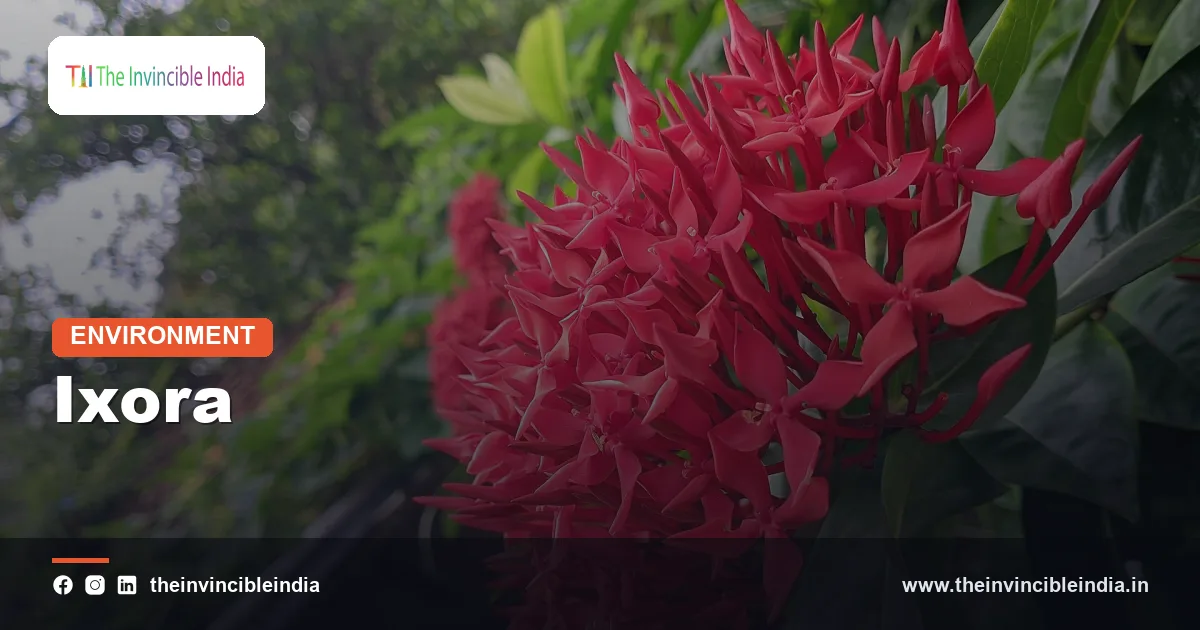
In Indian gardens, ixora is a hardy evergreen shrub of the coffee family, grown for its dense, rounded clusters of small tubular flowers in red, orange, yellow, pink or white. The genus Ixora includes several hundred tropical species, and the most familiar one in India, Ixora coccinea, is native to the Indian subcontinent and Sri Lanka and is also known as the jungle geranium or flame of the woods.
The shrub is popular with landscapers because it flowers for much of the year, tolerates trimming into hedges, and draws butterflies and sunbirds. It also has a place in temple worship and folk medicine. This explainer covers what ixora is, where it grows, how it differs from similar shrubs, how to care for it, and how it is used.
Quick Facts
| Common names | Ixora, jungle geranium, flame of the woods, rangan (Hindi, Bengali), thechi or chethi (Malayalam), vetchi (Tamil), pitkari (Marathi) |
|---|---|
| Scientific name | Ixora coccinea (the most widely grown species in India) |
| Family | Rubiaceae (the coffee or madder family) |
| Native range | Indian subcontinent and Sri Lanka; related species occur across tropical Asia |
| Where grown in India | Gardens, roadsides, parks and hedges across the country, especially in the warm, humid south, east and west coast |
| Growth form | Evergreen shrub, commonly 1 to 2 metres tall, with glossy leaves in opposite pairs |
| Flowers | Four-lobed tubular blossoms in dense round clusters, flowering through much of the year in warm regions |
| Soil preference | Slightly acidic, well-drained, organic-rich soil |
| Main uses | Ornamental hedges and borders, butterfly gardens, worship, floral decoration and traditional medicine |
Key Takeaways
- Ixora is an evergreen shrub of the coffee family (Rubiaceae) whose most common Indian species, Ixora coccinea, is native to India and Sri Lanka.
- Each ixora flower is a small four-lobed tube, and hundreds of them together form the dense, rounded flower heads that give the plant its showy look.
- Ixora prefers slightly acidic, well-drained soil, and leaves turn yellow with green veins when the soil is too alkaline or poor in available iron.
- Ixora flowers attract butterflies, bees and sunbirds, which makes the shrub a popular choice for wildlife-friendly gardens.
- Ixora responds well to pruning and is widely used for hedges, borders and low screens in Indian parks, housing complexes and roadsides.
- Ixora is a regional favourite for temple offerings and garlands, especially in southern and eastern India, where it carries local names such as thechi and rangan.
What is ixora?
Ixora is a genus of flowering shrubs and small trees in the coffee family, Rubiaceae, and the name is most often used for the cultivated red-flowered shrub Ixora coccinea. The genus has several hundred species spread across tropical Asia, Africa and the Pacific, and a few of them have become common garden plants in India.
The coffee family is one of the largest groups of flowering plants and includes coffee, cinchona, the Indian mulberry or noni, and gardenia. Ixora shares with its relatives a typical arrangement of leaves in opposite pairs, with small leaf-like scales called stipules at the base of the stalks, and flowers that are joined into a tube.
Ixora coccinea is a woody, many-branched shrub with leathery, glossy, oval to oblong leaves. In the wild it grows in forest margins and scrub, and in cultivation it is pruned to form tidy mounds and hedges. Dwarf cultivars stay below a metre in height and are favoured for borders, while taller forms are used as screens.
Where does the name ixora come from?
The name ixora is widely believed to come from Ishvara, a Sanskrit name for Shiva or the divine, through the Portuguese transcription of a Malabar word for a deity. The genus was named in the eighteenth century by Linnaeus, who recorded the name of a plant used in worship on the Malabar coast.
This origin reflects a long association of the flower with religious use in India. The species name coccinea simply means scarlet, in reference to the brilliant red of the most common wild form. English names such as flame of the woods and jungle geranium describe the colour and the geranium-like flower heads, although ixora is not related to geraniums.
Regional names
Ixora has many names across India. In Hindi and Bengali it is commonly called rangan, in Malayalam thechi or chethi, in Tamil vetchi, and in Marathi pitkari or pitkuli. In Kerala the flower is also a familiar part of the traditional floral carpet, the pookalam, made during Onam. Local names may vary between districts, so botanical identification is helpful when checking a particular plant.
What does an ixora flower look like?
An ixora flower is a slender tube that opens into four narrow lobes at the top, and hundreds of such flowers are packed into a rounded cluster at the end of a branch. Each flower is only about a centimetre or two long, but the cluster is bold enough to be seen from a distance.
The flowers in a cluster open over several days, which keeps the head colourful for a long time. After flowering, small fleshy berries form, turning from green to dark purple or black when ripe. Birds eat the fruits and spread the seeds.
Flower colour depends on the species and cultivar:
- Red, the classic colour of Ixora coccinea in the wild and in gardens.
- Orange and yellow, seen in selected cultivars and hybrids.
- Pink and salmon, developed for decorative planting.
- White, as in some other species such as the fragrant Ixora finlaysoniana.
Most common garden ixoras have little scent. Fragrant white-flowered species exist, but they are less commonly planted than the red and orange forms.
Which species and types of ixora are grown in India?
The main ixora types grown in India are Ixora coccinea, the common red-flowered shrub, several hybrid cultivars derived from it and related species, and a small number of white-flowered species that are grown for scent or as ornamental trees. Each type has a slightly different size, flower colour and use.
| Type | Key features | Typical use |
|---|---|---|
| Ixora coccinea (common ixora) | Red to orange flower clusters, a hardy shrub of 1 to 2 metres | Hedges, borders, worship |
| Dwarf ixora cultivars | Compact habit, often under a metre, with larger or more colourful heads | Pots, low borders, edging |
| Yellow and pink hybrids | Varied colours produced by selection and crossing | Landscaping and ornamental gardens |
| Ixora finlaysoniana | White, fragrant flowers on a taller shrub | Scented gardens and screens |
| Ixora pavetta (torch tree) | A small tree with white flowers, native to parts of India | Shade and ornamental planting, traditional uses |
Because garden ixoras are crossed and selected freely, many nursery plants carry trade names rather than formal botanical names. When buying a plant, look at the flower colour, plant height and leaf size rather than relying only on a label.
How do you grow and care for ixora?
Ixora grows best in a sunny to lightly shaded spot with acidic to neutral, well-drained soil, regular watering and occasional feeding. In warm parts of India it can be planted in the ground nearly all year, and in cooler regions it is kept in pots and moved to shelter during the cold months.
Light and temperature
Ixora needs at least four to six hours of direct sun for good flowering. In deep shade it grows leggy and produces few flower heads. It is a tropical plant, so cold spells and frost damage the foliage and can kill young plants. In northern plains and hill areas, ixora is usually grown as a protected or container plant.
Soil and feeding
Slightly acidic soil is important. In alkaline soils the leaves can turn pale yellow while the veins remain green, a condition called chlorosis, which arises because iron and some other nutrients become less available. Adding compost, leaf mould or acidic mulch and applying a balanced fertiliser helps, and chelated iron is sometimes used in persistent cases.
Watering
Regular watering keeps the shrub flowering, but the soil should never stay soggy. Mulching around the base helps to hold moisture during summer. Hard, strongly alkaline water used over long periods can raise soil pH and trigger chlorosis, so rainwater or lightly treated water is preferred for potted plants.
Pruning and propagation
Light pruning after a flush of flowers keeps the shrub neat and encourages new flowering shoots. Hedge plants can be trimmed more regularly. Ixora is usually propagated from semi-hardwood stem cuttings, and it can also be raised from seed, although seedlings vary more in flower colour and growth.
Ixora across Indian climates
In the humid coastal belt of Kerala, Karnataka, Goa, Maharashtra and West Bengal, ixora flowers almost continuously and needs little more than periodic pruning. In the hot, dry interior of the peninsula, regular irrigation and mulching keep the shrub in good condition through summer. In the north Indian plains, the plant can survive the heat but is vulnerable to winter frost, so gardeners often plant it in a sheltered corner or against a south-facing wall. In hill stations it is best grown in containers and kept under cover during cold months.
What pests and problems affect ixora?
The most common problems affecting ixora are chlorosis from alkaline soil, sap-sucking insects such as scale and aphids, sooty mould that grows on their sticky deposits, and root rot in waterlogged ground. Most of these issues come from poor soil conditions rather than from the plant itself.
The usual problems and responses are summarised below.
- Yellow leaves with green veins: improve soil acidity, add organic matter and supply micronutrients such as iron.
- Scale insects and mealybugs: remove by hand or wash off, and treat with approved sprays if heavy.
- Black sooty coating on leaves: control the sap-sucking insects that produce honeydew, then wash the leaves.
- Leaf-eating caterpillars or beetles: hand-pick or treat when numbers are high.
- Wilting despite moist soil: check drainage, since root rot is the likely cause.
A healthy, well-fed ixora in good light is usually resistant, so correcting growing conditions is more effective than relying on repeated treatments.
Why is ixora good for butterflies and wildlife?
Ixora is good for butterflies and wildlife because its dense flower heads offer a steady supply of nectar in an easy-to-reach form, and butterflies can feed on many flowers from a single perch. Swallowtails, crows, pierrots and other butterflies are commonly seen visiting ixora in Indian gardens.
Sunbirds, honeybees and other insects also visit the blooms, and the berries are taken by small birds. For this reason ixora is often recommended for butterfly gardens and for habitat-friendly landscaping in housing societies, schools and campuses. Combined with host plants for caterpillars, such as citrus or curry leaf for swallowtails, an ixora planting can support the whole life cycle of local butterflies.
How is ixora used in India?
Ixora is used in India chiefly as an ornamental hedge and garden shrub, as a flower for worship and garlands, and as a plant in traditional folk medicine. Its flowers are among the common offerings in many temples of the south and east, and the plant is also valued in home courtyards.
Worship and decoration
The red flowers are offered in several Hindu traditions and are strung into garlands or used in floral decorations. In Kerala, thechi is a regular ingredient of the pookalam, the floral carpet laid out in front of homes during Onam.
Landscaping
Ixora is used in public parks, hotel grounds, road medians, housing complexes and school campuses. Its compact size and ability to take pruning make it suitable for clipped hedges, low walls of colour and mass planting.
Traditional medicine
In folk and Ayurvedic practice, different parts of ixora, including flowers, roots and leaves, have been used in traditional remedies. These uses are part of cultural practice and are not a substitute for medical advice. Scientific research on its compounds is ongoing, and readers should not treat it as a proven treatment.
Is ixora a native Indian plant?
Ixora coccinea is native to India and Sri Lanka, so it counts as a native species in most of the country, although many garden cultivars are hybrids introduced from other tropical regions. The plant has been cultivated in India for a very long time and is now found in gardens from Kerala to West Bengal and from Maharashtra to the north-eastern states.
Other ixora species are native to India’s forests, particularly in the Western Ghats and the north-east, and Ixora is a well-represented genus in Indian botany. Outside Asia, ixora has been introduced to tropical gardens around the world, including the Caribbean, Florida and Hawaii, where it is a common landscaping plant.
Native status matters for gardeners who want to support local wildlife. A native shrub such as Ixora coccinea tends to fit local insects and birds well, whereas some exotic hybrids offer less value to wildlife even if they look striking.
Bottom Line
Ixora is a tough, long-flowering shrub of the coffee family that brings bright colour, butterflies and low maintenance to Indian gardens. It needs sun, acidic soil and good drainage, and it rewards modest care with flowers through most of the year.
Frequently Asked Questions
What is ixora?
Ixora is an evergreen flowering shrub of the coffee family, grown for its dense clusters of small tubular flowers. The common Indian species, Ixora coccinea, is native to India and Sri Lanka. It is widely used for hedges, borders and temple offerings.
What is ixora called in Hindi and other Indian languages?
Ixora is commonly called rangan in Hindi and Bengali, thechi or chethi in Malayalam, vetchi in Tamil and pitkari in Marathi. Names vary by region and district. In English it is also known as jungle geranium or flame of the woods.
Why are my ixora leaves turning yellow?
Ixora leaves usually turn yellow because the soil is too alkaline or low in available iron, which causes chlorosis with green veins on pale leaves. Poor drainage, overwatering and nutrient shortage can also cause yellowing. Adding compost, using acidic mulch and feeding the plant with a balanced fertiliser often helps.
Does ixora need full sun?
Ixora flowers best in full sun to light shade, with at least four to six hours of direct light each day. In deep shade it produces fewer flower heads and grows leggy. In very hot regions, light afternoon shade can protect the leaves.
Does ixora attract butterflies?
Yes, ixora attracts butterflies because its flower clusters hold abundant, easily reached nectar. Swallowtails and other butterflies, as well as bees and sunbirds, frequently visit the blooms. It is a popular choice for butterfly gardens.
Can ixora be grown in a pot?
Yes, ixora grows well in pots, especially dwarf cultivars, if the container drains freely and the potting mix is slightly acidic and rich in organic matter. The pot should sit in a sunny spot and be watered regularly without becoming soggy. In cold regions the pot can be moved indoors during winter.
{“@context”:”https://schema.org”,”@graph”:[{“@type”:”FAQPage”,”mainEntity”:[{“@type”:”Question”,”name”:”What is ixora?”,”acceptedAnswer”:{“@type”:”Answer”,”text”:”Ixora is an evergreen flowering shrub of the coffee family, grown for its dense clusters of small tubular flowers. The common Indian species, Ixora coccinea, is native to India and Sri Lanka. It is widely used for hedges, borders and temple offerings.”}},{“@type”:”Question”,”name”:”What is ixora called in Hindi and other Indian languages?”,”acceptedAnswer”:{“@type”:”Answer”,”text”:”Ixora is commonly called rangan in Hindi and Bengali, thechi or chethi in Malayalam, vetchi in Tamil and pitkari in Marathi. Names vary by region and district. In English it is also known as jungle geranium or flame of the woods.”}},{“@type”:”Question”,”name”:”Why are my ixora leaves turning yellow?”,”acceptedAnswer”:{“@type”:”Answer”,”text”:”Ixora leaves usually turn yellow because the soil is too alkaline or low in available iron, which causes chlorosis with green veins on pale leaves. Poor drainage, overwatering and nutrient shortage can also cause yellowing. Adding compost, using acidic mulch and feeding the plant with a balanced fertiliser often helps.”}},{“@type”:”Question”,”name”:”Does ixora need full sun?”,”acceptedAnswer”:{“@type”:”Answer”,”text”:”Ixora flowers best in full sun to light shade, with at least four to six hours of direct light each day. In deep shade it produces fewer flower heads and grows leggy. In very hot regions, light afternoon shade can protect the leaves.”}},{“@type”:”Question”,”name”:”Does ixora attract butterflies?”,”acceptedAnswer”:{“@type”:”Answer”,”text”:”Yes, ixora attracts butterflies because its flower clusters hold abundant, easily reached nectar. Swallowtails and other butterflies, as well as bees and sunbirds, frequently visit the blooms. It is a popular choice for butterfly gardens.”}},{“@type”:”Question”,”name”:”Can ixora be grown in a pot?”,”acceptedAnswer”:{“@type”:”Answer”,”text”:”Yes, ixora grows well in pots, especially dwarf cultivars, if the container drains freely and the potting mix is slightly acidic and rich in organic matter. The pot should sit in a sunny spot and be watered regularly without becoming soggy. In cold regions the pot can be moved indoors during winter.”}}]}]}


