

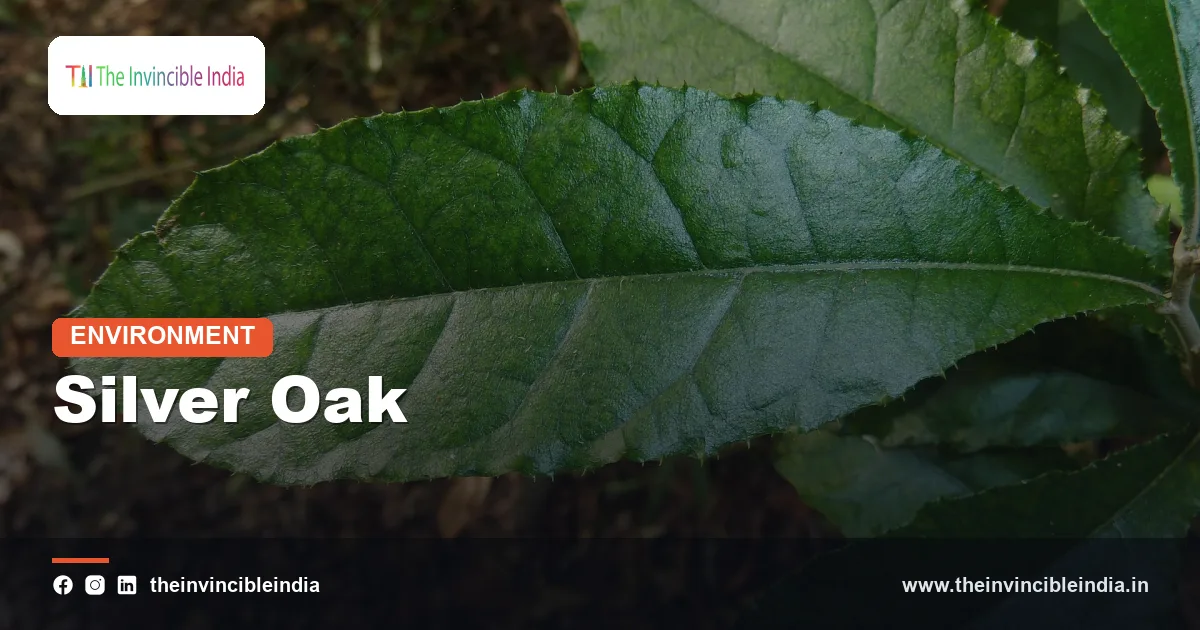
The silver oak (Grevillea robusta) is a tall, fast-growing evergreen tree from eastern Australia that is widely planted in India as a shade tree in coffee and tea estates, as a support for pepper vines and as an avenue and farm-boundary tree. Despite its name, the silver oak is not a true oak at all: it belongs to the Proteaceae family, while real oaks belong to the genus Quercus in the beech family. The tree is recognisable by its fern-like, deeply lobed leaves with silvery undersides and by its showy golden-orange flowers.
Silver oak has been part of the Indian hill landscape for well over a century, particularly in the Western Ghats, the Nilgiris, the hills of Kodagu and Chikmagalur, and the tea gardens of Assam, Darjeeling and the Dooars. This explainer covers what the tree is, how it arrived in India, why planters rely on it, what its timber is used for and what concerns surround it.
Quick Facts
| Common names | Silver oak, silky oak, southern silky oak |
|---|---|
| Scientific name | Grevillea robusta |
| Family | Proteaceae |
| Native range | Coastal eastern Australia (New South Wales and southern Queensland) |
| Where grown in India | Coffee and tea estates of the Western Ghats, Nilgiris, Kodagu, Wayanad, Chikmagalur, Darjeeling, Assam and the Dooars; also avenues and farm boundaries across the southern and eastern hills |
| Height and key features | Typically 20 to 30 metres; straight trunk, fern-like silver-green leaves, golden-orange brush-like flowers |
| Main uses | Shade for coffee, tea and cardamom; live support for pepper vines; timber for furniture, plywood, packing and tea chests; firewood; ornamental avenue tree |
| Notable facts | Not a true oak; introduced to India in the nineteenth century; sheds leaves in the dry season and is valued for its quick growth |
Key Takeaways
- The silver oak is the common name of Grevillea robusta, an Australian tree in the Proteaceae family that is unrelated to the true oaks of the genus Quercus.
- Silver oak is the most widely used shade tree in the coffee estates of Karnataka, Kerala and Tamil Nadu, where its light, filtered canopy protects coffee bushes from harsh sun.
- Silver oak grows quickly and straight, often reaching 20 metres or more within about two decades, which makes it a convenient source of timber and poles.
- Silver oak trunks are widely used as living standards for black pepper vines in the Western Ghats, because the rough bark gives the climbing vines a firm hold.
- Silver oak timber has an attractive lace-like grain and is used for furniture, plywood, packing cases and, historically, tea chests.
- Silver oak is an exotic species in India, and its weak branches, heavy leaf fall and non-native status are the main reasons that some foresters question large-scale planting.
What is the silver oak and is it really an oak?
The silver oak is a large evergreen tree named Grevillea robusta, and it is not a real oak. True oaks are members of the genus Quercus in the Fagaceae family and bear acorns, whereas the silver oak belongs to the Proteaceae family, a southern-hemisphere group that also includes banksias, proteas and macadamia nuts.
The name “silver oak” comes from the silvery, silky underside of the leaves and from the resemblance of the sawn wood to oak, which shows a pronounced ray pattern. In Australia the same tree is called the southern silky oak, and the timber is sometimes sold as lacewood because of the fine lace-like figure that appears on quarter-sawn boards.
The genus Grevillea was named after Charles Francis Greville, an eighteenth-century British horticulturist and a founder of the Royal Horticultural Society. The species name robusta refers to the tree’s sturdy build. Botanists have recorded several hundred Grevillea species, mostly shrubs, but Grevillea robusta is the largest and by far the most widely cultivated across the world.
How did the silver oak reach India?
The silver oak reached India in the nineteenth century, when colonial planters and botanical gardens began experimenting with exotic trees that could shade the new coffee and tea plantations of the hills. Seeds from Australia were raised in botanical gardens and forest nurseries, and the tree quickly proved well suited to the cool, humid, moderately elevated climate of the Western Ghats and the Eastern Himalaya.
Its early adoption followed a clear logic. Coffee and tea planters needed a tree that grew fast, had a thin crown that let dappled light through, and did not compete too aggressively with the crop below. The silver oak met all three needs, and by the twentieth century it had become a standard feature of estates in the Nilgiris, Kodagu, Wayanad, the Palni hills, Munnar and Darjeeling.
From the estates the tree spread to roadsides, village boundaries and small farms. Today silver oak stands are common between roughly 500 and 2,000 metres above sea level in peninsular India, and the tree is also grown in the foothills and middle hills of several northern and north-eastern states.
What does a silver oak tree look like?
A mature silver oak is a tall, straight-trunked tree with a narrow, conical to oval crown, deeply divided leaves and dark, deeply furrowed bark. Under good conditions the tree commonly reaches 20 to 30 metres in height, and trunks of 50 to 90 centimetres in diameter are possible in older stands.
Leaves
The leaves of the silver oak are pinnately lobed, which means they are cut into many narrow segments along a central stalk, giving a fern-like look. The upper surface is dark green and the underside is covered with fine silvery hairs, so the foliage flashes silver when the wind turns the leaves over.
Flowers and fruit
The flowers of the silver oak are golden-yellow to orange and arranged in one-sided, brush-like clusters that resemble toothbrushes. Flowering usually occurs in the spring months and the blossoms are rich in nectar, so they attract bees, sunbirds and other nectar-feeding birds. The fruit is a small, boat-shaped, leathery pod known as a follicle, which splits open to release one or two winged seeds.
Bark and wood
The bark of the silver oak is dark grey to brown and deeply fissured, a feature that helps pepper vines grip the trunk. The wood is reddish-pink to light brown, moderately light and easy to work, with a distinctive silky figure.
Why is the silver oak planted in coffee and tea estates?
The silver oak is planted in coffee and tea estates because its light, open canopy provides the filtered shade that these crops need while growing fast enough to be useful within a few years. Arabica coffee in particular thrives under shade, and a canopy of silver oak moderates temperature, reduces direct sun on the bushes and protects the crop from heavy rain and hail.
Planters in Karnataka, Kerala and Tamil Nadu usually maintain a two-tier shade system in which silver oak forms the upper tier and a mix of other trees forms the lower tier. The regulation of shade is a skilled job: the canopy is lopped or thinned before the monsoon and again in the dry season so that the right amount of light reaches the coffee bushes at each stage of flowering and berry development.
- Microclimate: shade lowers peak leaf temperatures and keeps humidity more even beneath the canopy.
- Soil protection: leaf fall adds organic matter and a mulch layer that slows erosion on slopes.
- Frost and hail cushioning: a canopy over tea and coffee reduces damage during cold snaps and heavy storms.
- Extra income: thinned or felled trees provide timber and poles that estates can sell or use themselves.
In tea gardens the silver oak is used more sparingly, since tea is a sun-tolerant crop, but the tree is still planted in many estates as a windbreak and as a lighter alternative to heavier shade trees such as Albizia species.
How is silver oak used to support pepper vines?
Silver oak trunks serve as living supports for black pepper vines, which are climbers that need a tall, rough-barked standard to grow upward. Farmers in Kerala, Karnataka and Tamil Nadu plant pepper at the base of established silver oak trees, and the vine attaches itself by aerial roots to the bark as it climbs.
The arrangement is common in the Western Ghats because it lets one tree perform three jobs at once: shading coffee or cardamom below, supporting a spice crop on its trunk, and producing timber at the end of its rotation. This multi-layered land use is often described as agroforestry, and it makes the estate more productive per hectare than a single crop would.
Pepper growers also lop the lower branches of silver oak so that the vines receive sunlight on the upper trunk while the roots remain shaded. Other trees used as pepper standards include the Indian coral tree, jackfruit and mango, but silver oak is favoured for its straight bole and quick establishment.
What is silver oak timber used for?
Silver oak timber is used for furniture, plywood, packing cases, panelling and general construction, and the wood was historically a common material for making tea chests. The timber is light to medium in weight, seasons without much difficulty and takes nails, glue and polish well.
The sawn timber displays a handsome lace-like figure when cut along the radius of the log, which makes it attractive for decorative veneers, cabinet work and interior joinery. The heartwood is not strongly resistant to termites and decay, so it is usually treated if it will be used outdoors or in contact with the ground.
| Product | How silver oak is used |
|---|---|
| Furniture and joinery | Sawn boards for tables, cupboards, doors, window frames and decorative panels |
| Plywood and veneer | Peeled or sliced logs used as core or face veneer in plywood factories |
| Packing and crates | Light timber for packing boxes, pallets and, historically, tea chests |
| Poles and posts | Straight stems for scaffolding, rafters and farm structures |
| Fuel | Lopped branches and offcuts used as firewood in estates and villages |
Felling and transport of silver oak are regulated by state forest departments. Because the tree is often grown on private estates and farms, many states allow felling and movement with permission or a transit pass, while rules differ from state to state and have been revised from time to time.
How does silver oak grow and how is it propagated?
Silver oak grows best in cool, moist, well-drained conditions and is normally propagated from seed raised in a nursery. A single mature tree produces large quantities of winged seed, and seedlings are raised in polythene bags before being transplanted into the field at the start of the monsoon.
The tree prefers deep, well-drained, slightly acidic loam and an annual rainfall of roughly 1,000 millimetres or more, although it tolerates moderate dry spells once established. It does poorly in waterlogged soil and in very hot, dry plains, which is why it is concentrated in the hills rather than the lowlands.
Growth pattern
Silver oak is among the faster-growing hardwoods of the Indian hills and may add one to two metres in height per year in favourable sites. It is semi-deciduous in many regions, shedding a good part of its foliage in the dry season and putting out fresh growth as the weather warms.
Management in estates
- Seedlings are planted at wide spacing, often several metres apart, so that adequate light reaches the crop below.
- Lower branches are pruned to produce a clean, straight stem and to prevent shade becoming too dense.
- Trees are lopped before the monsoon in coffee areas to avoid wind damage from heavy crowns.
- Mature trees are harvested after roughly 20 to 30 years and replaced with fresh seedlings.
What are the drawbacks and ecological concerns of the silver oak?
The main drawbacks of the silver oak are that it is a non-native tree with relatively brittle branches, heavy leaf litter and a root system that competes with crops and native plants. Branches can snap in strong wind or heavy rain, and falling limbs are a known hazard in estates and along roads.
Ecologists in the Western Ghats have raised broader questions about replacing native forest canopy with exotic plantation trees. Native shade trees support a wider range of birds, insects and epiphytes than a uniform stand of a single exotic species, and mixed shade systems are often considered better for biodiversity in coffee landscapes.
- Branch breakage: the wood is not very strong, so limbs may fall during storms.
- Leaf litter: the large, slowly decomposing leaves can form a thick mat that suppresses some understorey plants.
- Competition: shallow lateral roots draw water and nutrients near the surface and may compete with nearby crops.
- Exotic status: the tree offers less habitat value than native species, although its flowers do feed birds and bees.
- Invasiveness elsewhere: the species has become invasive in parts of South Africa, Hawaii and other regions, although it has not been widely reported as a serious invader in India.
Some forest authorities in hill regions encourage a gradual shift toward a greater share of native shade trees. Even so, silver oak remains popular because it is cheap to establish and offers a dependable cash return.
How does silver oak compare with other shade trees?
Silver oak compares well with other shade trees on speed of growth and timber value, but native shade trees usually provide better habitat and soil benefits. The table below sets out the main differences between silver oak and several other trees commonly used in Indian plantations.
| Tree | Origin | Typical role | Main strength |
|---|---|---|---|
| Silver oak | Australia | Shade and pepper support in coffee estates | Fast, straight growth and marketable timber |
| Albizia (shade tree species) | Asia | Shade for tea gardens | Fixes nitrogen and tolerates pruning |
| Erythrina (Indian coral tree) | India and tropical Asia | Pepper standard and shade | Easy propagation from cuttings; fixes nitrogen |
| Jackfruit | Western Ghats | Shade, fruit and timber | Food and valuable wood |
| Teak | India and South-East Asia | Plantation timber | High-value, durable timber |
Where is the silver oak found across India?
Silver oak is found mainly in the hill regions of southern India and the tea-growing areas of the north-east, with the densest concentrations in Karnataka, Kerala and Tamil Nadu. It is a familiar sight in Kodagu, Chikmagalur, Wayanad, the Nilgiris, the Anamalai hills, Munnar and the Palni range.
In eastern India the tree is grown in the tea gardens of Darjeeling, Assam and the Dooars, and it also appears in some Himalayan foothill towns as an avenue and ornamental tree. Hill stations such as Ooty, Kodaikanal and Coonoor are known for roads lined with tall silver oaks, and their shimmering leaves are a recognisable part of the scenery.
Bottom Line
The silver oak is a fast-growing Australian tree that has become part of everyday life in India’s coffee, tea and spice country. It offers shade, a living support for pepper, useful timber and a splash of colour when it flowers, but it is an exotic species with some ecological trade-offs. Planters generally manage it alongside native trees so that the benefits are kept and the drawbacks reduced.
Frequently Asked Questions
Is the silver oak a real oak tree?
No, the silver oak is not a real oak. It is Grevillea robusta, a member of the Proteaceae family from Australia, whereas true oaks belong to the genus Quercus. The name comes from the silvery leaf undersides and the oak-like grain of its timber.
Why is silver oak planted in coffee plantations?
Silver oak is planted in coffee plantations because it provides light, filtered shade and grows quickly. The canopy protects coffee bushes from harsh sun and heavy rain, and the trunks can also support black pepper vines. The trees later yield timber, which adds to the estate’s income.
How tall does a silver oak grow?
A silver oak commonly grows to 20 to 30 metres in height. In favourable hill conditions it can add one to two metres a year while young, and it develops a straight trunk with a narrow crown.
What is silver oak wood used for?
Silver oak wood is used for furniture, plywood, panelling, packing cases and poles. The timber is light to medium in weight, easy to work and shows an attractive lace-like grain. It is not very durable outdoors unless treated against termites and decay.
Is the silver oak native to India?
No, the silver oak is native to the coastal forests of eastern Australia, mainly New South Wales and southern Queensland. It was introduced to India in the nineteenth century and is now widely planted in southern hill regions and in the tea gardens of Darjeeling, Assam and the Dooars.
Are there any problems with growing silver oak?
Yes, the silver oak has several drawbacks. Its branches can break in strong winds, its leaf litter is heavy, and its roots compete with nearby crops. Because it is an exotic species, native shade trees generally support more wildlife, so many planters now mix silver oak with native trees.
{“@context”:”https://schema.org”,”@graph”:[{“@type”:”FAQPage”,”mainEntity”:[{“@type”:”Question”,”name”:”Is the silver oak a real oak tree?”,”acceptedAnswer”:{“@type”:”Answer”,”text”:”No, the silver oak is not a real oak. It is Grevillea robusta, a member of the Proteaceae family from Australia, whereas true oaks belong to the genus Quercus. The name comes from the silvery leaf undersides and the oak-like grain of its timber.”}},{“@type”:”Question”,”name”:”Why is silver oak planted in coffee plantations?”,”acceptedAnswer”:{“@type”:”Answer”,”text”:”Silver oak is planted in coffee plantations because it provides light, filtered shade and grows quickly. The canopy protects coffee bushes from harsh sun and heavy rain, and the trunks can also support black pepper vines. The trees later yield timber, which adds to the estate’s income.”}},{“@type”:”Question”,”name”:”How tall does a silver oak grow?”,”acceptedAnswer”:{“@type”:”Answer”,”text”:”A silver oak commonly grows to 20 to 30 metres in height. In favourable hill conditions it can add one to two metres a year while young, and it develops a straight trunk with a narrow crown.”}},{“@type”:”Question”,”name”:”What is silver oak wood used for?”,”acceptedAnswer”:{“@type”:”Answer”,”text”:”Silver oak wood is used for furniture, plywood, panelling, packing cases and poles. The timber is light to medium in weight, easy to work and shows an attractive lace-like grain. It is not very durable outdoors unless treated against termites and decay.”}},{“@type”:”Question”,”name”:”Is the silver oak native to India?”,”acceptedAnswer”:{“@type”:”Answer”,”text”:”No, the silver oak is native to the coastal forests of eastern Australia, mainly New South Wales and southern Queensland. It was introduced to India in the nineteenth century and is now widely planted in southern hill regions and in the tea gardens of Darjeeling, Assam and the Dooars.”}},{“@type”:”Question”,”name”:”Are there any problems with growing silver oak?”,”acceptedAnswer”:{“@type”:”Answer”,”text”:”Yes, the silver oak has several drawbacks. Its branches can break in strong winds, its leaf litter is heavy, and its roots compete with nearby crops. Because it is an exotic species, native shade trees generally support more wildlife, so many planters now mix silver oak with native trees.”}}]}]}


