

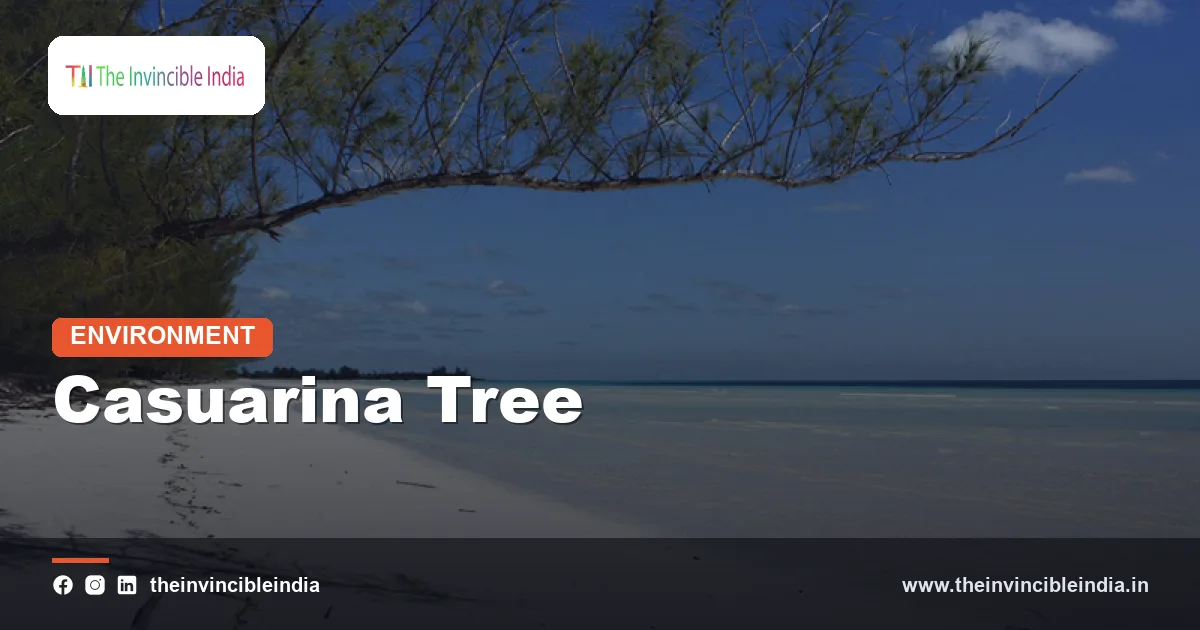
The casuarina (Casuarina equisetifolia) is a fast-growing, needle-like evergreen tree of tropical coasts that is planted along India’s shoreline as a windbreak, a source of firewood and poles, and a pulpwood crop for paper mills. The “needles” of a casuarina are not true leaves but thin, jointed green twigs, and the tree is able to fix atmospheric nitrogen through bacteria in its roots, which lets it grow in poor, sandy coastal soil where most trees fail.
Casuarina plantations are a familiar sight along the east coast of India, especially in Tamil Nadu, Andhra Pradesh and Odisha, where long green belts run behind the beach. This explainer sets out what the casuarina is, why it suits coastal sand, how it is grown and used, and what role it plays in coastal protection.
Quick Facts
| Common names | Casuarina, Australian pine, beefwood, she-oak; jhau (Hindi and Bengali), savukku (Tamil), sarugudu (Telugu) |
|---|---|
| Scientific name | Casuarina equisetifolia |
| Family | Casuarinaceae |
| Native range | Coasts of South-East Asia, northern Australia and Pacific islands |
| Where grown in India | Coastal belts of Tamil Nadu, Andhra Pradesh, Odisha, Puducherry, Kerala, Gujarat and West Bengal, plus inland farm plantations in Andhra Pradesh and Tamil Nadu |
| Height and key features | Commonly 10 to 30 metres; drooping, needle-like green twigs; small woody cone-like fruit; salt-tolerant |
| Main uses | Pulpwood for paper, firewood and charcoal, construction poles and scaffolding, windbreaks and shelterbelts, sand-dune stabilisation |
| Notable facts | Fixes nitrogen through the actinomycete Frankia; short rotations of about three to five years for pulpwood; not related to pines despite the name Australian pine |
Key Takeaways
- The casuarina is the common name of Casuarina equisetifolia, a salt-tolerant evergreen tree of the Casuarinaceae family that grows naturally on tropical shores.
- Casuarina trees fix atmospheric nitrogen through root nodules containing the bacterium Frankia, which allows them to grow in nutrient-poor coastal sand.
- The thin, drooping, needle-like branchlets of casuarina are modified twigs, and the true leaves are reduced to tiny scale-like teeth at the joints.
- Casuarina is a major pulpwood and firewood crop in Andhra Pradesh and Tamil Nadu, where farmers harvest it on short rotations of roughly three to five years.
- Casuarina shelterbelts slow strong coastal winds and stabilise shifting sand dunes, and many coastal plantations were expanded after the 2004 Indian Ocean tsunami.
- Casuarina is not related to pines, and its common name Australian pine refers only to the needle-like appearance of its foliage.
What is a casuarina tree?
A casuarina is a fast-growing evergreen tree with slender, drooping, jointed green branchlets that look like pine needles, and it is the best-known tree of sandy tropical coasts. The scientific name Casuarina equisetifolia means a casuarina with horsetail-like leaves, a reference to the jointed, rush-like twigs that resemble the stems of a horsetail plant.
The name Casuarina comes from the cassowary, a large flightless bird of Australia and New Guinea, because the drooping twigs were said to resemble the bird’s feathers. The family Casuarinaceae contains a small number of genera and a few dozen species, mainly in Australia, South-East Asia and the Pacific.
In India the tree is known by many local names. It is called jhau in Hindi and Bengali, savukku in Tamil and sarugudu in Telugu. Visitors often mistake it for a pine, but the casuarina is a flowering plant and is not related to conifers.
How did the casuarina come to grow along India’s coast?
The casuarina came to India as an introduced tree and was planted widely along the coast from the nineteenth century onwards, after foresters found that it thrived in beach sand. Its natural range stretches from the shores of South-East Asia to northern Australia and the Pacific islands, and the species may have also occurred naturally on some coasts of the Indian Ocean and the Andaman and Nicobar Islands.
Early plantations in Tamil Nadu and Puducherry were set up on sandy stretches near the sea to supply fuel and poles and to hold the sand in place. Over the twentieth century the tree became a commercial crop in the coastal districts of Andhra Pradesh and Tamil Nadu, and farmers began growing it on private land for the paper industry.
Today casuarina is among the most important farm-forestry species of the eastern coastal plains. Its popularity rests on a simple fact: it produces a marketable crop within a few years on soils where food crops perform poorly.
What does a casuarina look like?
A casuarina is a slender tree with a rounded, feathery crown, a straight trunk and drooping green branchlets in place of ordinary leaves. Mature trees often reach 10 to 30 metres, with fissured, greyish-brown bark.
The needles are twigs
The needle-like structures of a casuarina are slender green branchlets, called cladodes, which carry out photosynthesis in place of leaves. Each branchlet is divided into short segments, and at every joint there is a ring of tiny scale-like teeth, which are the real leaves.
Flowers and fruit
Casuarina flowers are small and separate, with male and female flowers usually on different trees or different branches. Male flowers form brownish spikes at the ends of branchlets, and female flowers form small round heads. The fruit is a small, woody, cone-like structure that releases tiny winged seeds called samaras when it matures.
Roots
Casuarina develops a dense network of roots and root nodules in the upper layers of sand. This root system anchors the tree against wind and helps hold sand grains together on dunes.
How does the casuarina fix nitrogen?
The casuarina fixes nitrogen through a partnership with Frankia, a filamentous bacterium that lives in small swellings called nodules on the tree’s roots. Frankia converts nitrogen gas from the air into compounds that the tree can use, and in return the tree supplies the bacterium with sugars made by photosynthesis.
This partnership explains why casuarina can grow in sandy coastal soils that contain little organic matter and few nutrients. The tree also enriches the soil over time through leaf-litter and root turnover, so that crops or other plants can sometimes be grown nearby after the trees are removed.
- Frankia nodules appear as small, lumpy, coral-like clusters on the roots.
- The relationship is a symbiosis, meaning both organisms benefit.
- Nurseries often inoculate seedlings with Frankia to improve early growth in poor soil.
- Nitrogen fixation is also found in other actinorhizal plants such as alder, which are unrelated to casuarina.
Why is the casuarina planted along the coast?
The casuarina is planted along the coast because it tolerates salt spray, sandy soil, strong wind and drought, and few other trees do well in those conditions. A belt of casuarina behind the beach reduces wind speed, protects farmland and villages from salt-laden winds, and helps stop dunes from drifting inland.
Coastal forest departments in Tamil Nadu, Andhra Pradesh, Odisha and other states have established shelterbelts along beaches for decades. The trees are usually planted in several rows, parallel to the shore, so that they act as a barrier against wind and blown sand.
After the 2004 tsunami
After the Indian Ocean tsunami of December 2004, coastal planting received renewed attention, and governments and communities expanded belts of casuarina, mangroves and other coastal trees. Studies have given mixed conclusions on how much a tree belt can reduce the force of a large tsunami, and experts generally describe vegetation as one useful layer of protection rather than a complete defence. Mangroves and dense, wide, multi-species belts are usually considered more effective than narrow rows of a single species.
How is the casuarina grown?
The casuarina is grown from seed or from clonal cuttings raised in a nursery and then transplanted to sandy land at the start of the rainy season. In Andhra Pradesh and Tamil Nadu, farmers increasingly use improved clones selected for fast growth and straight stems.
The tree thrives in well-drained sandy or sandy-loam soil and tolerates moderate salinity. Plantations are dense, with thousands of seedlings per hectare, and the crop is usually harvested after three to five years for pulpwood or after longer periods for poles.
- Soil: well-drained sand or light loam; poor in waterlogged or heavy clay soil.
- Climate: warm coastal and near-coastal regions with moderate to low rainfall.
- Planting: seedlings or clonal plants are placed in pits or furrows at close spacing.
- Irrigation: young trees often need irrigation in dry years, though established trees are drought-tolerant.
- Harvest: clear-felled on short rotations, with new plantations established after harvest.
What are the uses of casuarina?
The main uses of casuarina are pulpwood for paper, firewood and charcoal, and poles for construction and scaffolding. The wood is dense, hard and heavy, with a high calorific value, which makes it an excellent fuel.
| Use | Details |
|---|---|
| Pulpwood | Chipped for paper mills in Andhra Pradesh and Tamil Nadu; a major cash crop for farmers |
| Firewood and charcoal | Dense wood burns hot and produces good charcoal for household and industrial use |
| Poles and scaffolding | Straight stems used in house building, fencing and bamboo-like scaffolding on construction sites |
| Windbreaks | Shelterbelts protecting crops, fish-drying yards and villages along the shore |
| Dune stabilisation | Roots bind loose sand and slow its movement |
| Traditional uses | Bark and other parts are used in some regions in local medicine and tanning |
The wood is heavy and difficult to nail when dry, and untreated timber is moderately susceptible to termites, so casuarina is more widely used for fuel and pulp than for fine furniture. Mining props and rafters are other traditional uses of seasoned poles.
Where is the casuarina grown in India?
Casuarina is grown mainly along the east coast of India, with Andhra Pradesh and Tamil Nadu holding the largest areas under commercial plantations. Districts such as Krishna, Guntur, Prakasam, Nellore and the Godavari region in Andhra Pradesh, and Cuddalore, Nagapattinam, Villupuram and Chengalpattu in Tamil Nadu, are known for casuarina farms.
Coastal belts are also found in Odisha, West Bengal, Puducherry, Kerala, Karnataka, Goa, Maharashtra and Gujarat, as well as on some of the islands. In many places the tree grows in rows along beaches and tidal flats, and forms a recognisable skyline of feathery crowns above the sand.
Are there any drawbacks to casuarina plantations?
Yes, casuarina plantations have several drawbacks, mostly related to water use, soil effects and biodiversity. The tree grows fast and can draw heavily on groundwater, and dense monoculture stands support far fewer species than natural coastal vegetation.
- Water use: fast-growing plantations can lower the water table in dry areas if not managed carefully.
- Monoculture: pure stands provide little habitat compared with mixed coastal forests.
- Leaf-litter effects: the thick layer of fallen twigs can suppress understorey plants and slow decomposition.
- Nesting beaches: in some places, plantations on sandy beaches have raised concern over their effect on turtle nesting, since roots and shade can change the beach.
- Invasiveness: in some regions such as Florida, Casuarina equisetifolia is considered an invasive species, although in India it is mostly planted rather than escaping into the wild.
Coastal managers therefore recommend mixed plantings, leaving open beaches in turtle-nesting zones and retaining native dune plants alongside any casuarina belts.
Casuarina compared with other coastal trees
Casuarina is one of several trees used for coastal protection and fuel, and each has a different role. The table below compares casuarina with other common coastal species of India.
| Tree | Habitat | Main role | Key feature |
|---|---|---|---|
| Casuarina | Sandy beaches and dunes | Windbreak, pulpwood, fuel | Fixes nitrogen, grows quickly |
| Mangroves (such as Rhizophora and Avicennia) | Tidal creeks and estuaries | Shoreline protection and fish nurseries | Tolerate saltwater flooding |
| Coconut palm | Coastal plains | Food, oil, fibre | Salt-tolerant, highly valued crop |
| Cashew | Coastal laterite and sandy soils | Nut crop | Thrives in poor soil |
| Thespesia (portia tree) | Beach edges | Shade, windbreak | Native, salt-tolerant |
Bottom Line
The casuarina is a hardy, nitrogen-fixing coastal tree that has become a staple of Indian shelterbelts and farm forestry. It supplies pulpwood, fuel and poles, and it helps hold sand and slow wind, but it works best as one part of a varied coastal landscape that also includes mangroves and native dune plants.
Frequently Asked Questions
Is casuarina a pine tree?
No, casuarina is not a pine. It is a flowering tree of the family Casuarinaceae, and its needle-like parts are green twigs rather than leaves. The nickname Australian pine arises only from the pine-like appearance of the foliage.
Why is casuarina planted along the coast?
Casuarina is planted along the coast because it tolerates salt spray, sandy soil, strong wind and drought. The trees form a belt that slows coastal winds, shields farmland from salt-laden air and helps stabilise dunes. Its fast growth also provides fuel and pulpwood.
How does casuarina fix nitrogen?
Casuarina fixes nitrogen through root nodules that host the bacterium Frankia. The bacterium converts nitrogen from the air into usable compounds for the tree, and the tree gives it sugars in return. This helps casuarina grow in poor, sandy soils.
What is casuarina wood used for?
Casuarina wood is used mainly for pulpwood, firewood, charcoal and construction poles. The wood is hard, heavy and burns with high heat. It is less commonly used for furniture because it is difficult to work when dry.
Where is casuarina grown in India?
Casuarina is grown mainly along India’s east coast, especially in Andhra Pradesh, Tamil Nadu, Odisha and Puducherry. Large commercial plantations exist in districts such as Krishna, Guntur and Nellore in Andhra Pradesh and Cuddalore and Nagapattinam in Tamil Nadu. Shelterbelts also occur on the west coast and on islands.
Did casuarina trees protect the coast from the 2004 tsunami?
Casuarina belts offered some shelter in places, but research gives mixed results. Experts generally say that coastal vegetation can reduce wave energy somewhat, yet a large tsunami can overwhelm narrow tree belts. Wide, mixed belts that include mangroves are usually seen as more effective than rows of casuarina alone.
{“@context”:”https://schema.org”,”@graph”:[{“@type”:”FAQPage”,”mainEntity”:[{“@type”:”Question”,”name”:”Is casuarina a pine tree?”,”acceptedAnswer”:{“@type”:”Answer”,”text”:”No, casuarina is not a pine. It is a flowering tree of the family Casuarinaceae, and its needle-like parts are green twigs rather than leaves. The nickname Australian pine arises only from the pine-like appearance of the foliage.”}},{“@type”:”Question”,”name”:”Why is casuarina planted along the coast?”,”acceptedAnswer”:{“@type”:”Answer”,”text”:”Casuarina is planted along the coast because it tolerates salt spray, sandy soil, strong wind and drought. The trees form a belt that slows coastal winds, shields farmland from salt-laden air and helps stabilise dunes. Its fast growth also provides fuel and pulpwood.”}},{“@type”:”Question”,”name”:”How does casuarina fix nitrogen?”,”acceptedAnswer”:{“@type”:”Answer”,”text”:”Casuarina fixes nitrogen through root nodules that host the bacterium Frankia. The bacterium converts nitrogen from the air into usable compounds for the tree, and the tree gives it sugars in return. This helps casuarina grow in poor, sandy soils.”}},{“@type”:”Question”,”name”:”What is casuarina wood used for?”,”acceptedAnswer”:{“@type”:”Answer”,”text”:”Casuarina wood is used mainly for pulpwood, firewood, charcoal and construction poles. The wood is hard, heavy and burns with high heat. It is less commonly used for furniture because it is difficult to work when dry.”}},{“@type”:”Question”,”name”:”Where is casuarina grown in India?”,”acceptedAnswer”:{“@type”:”Answer”,”text”:”Casuarina is grown mainly along India’s east coast, especially in Andhra Pradesh, Tamil Nadu, Odisha and Puducherry. Large commercial plantations exist in districts such as Krishna, Guntur and Nellore in Andhra Pradesh and Cuddalore and Nagapattinam in Tamil Nadu. Shelterbelts also occur on the west coast and on islands.”}},{“@type”:”Question”,”name”:”Did casuarina trees protect the coast from the 2004 tsunami?”,”acceptedAnswer”:{“@type”:”Answer”,”text”:”Casuarina belts offered some shelter in places, but research gives mixed results. Experts generally say that coastal vegetation can reduce wave energy somewhat, yet a large tsunami can overwhelm narrow tree belts. Wide, mixed belts that include mangroves are usually seen as more effective than rows of casuarina alone.”}}]}]}


