

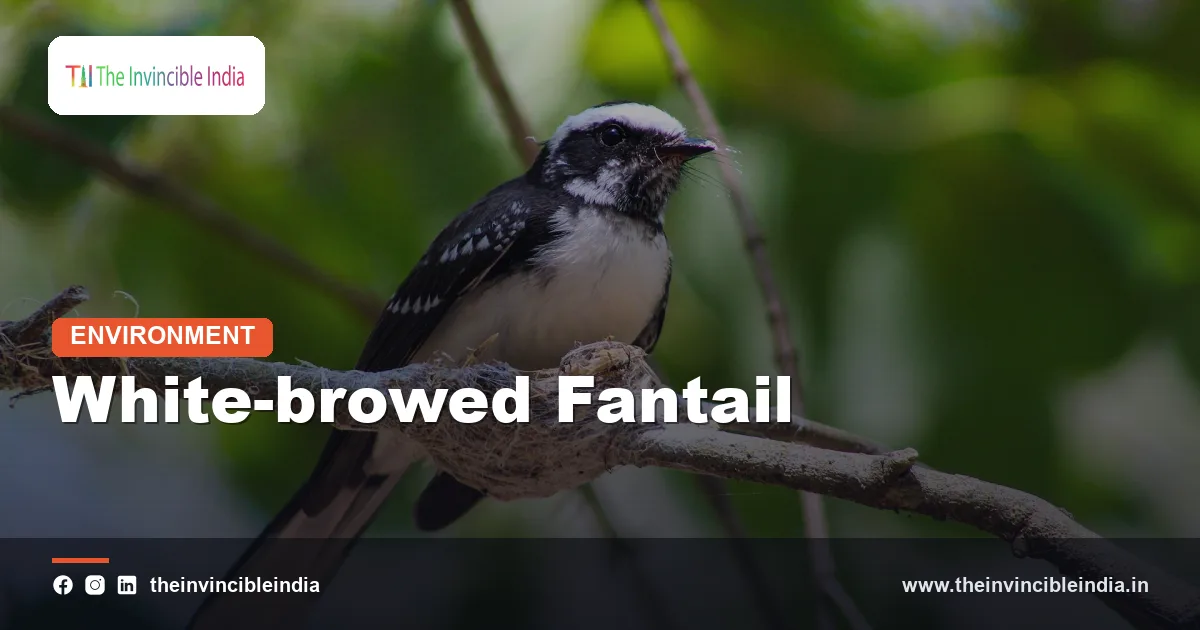
The white-browed fantail (Rhipidura aureola) is a small, restless black-and-white songbird of Indian gardens, scrub and open woodland that fans and swings its tail while it flits after flying insects. Known in older books as the white-browed fantail flycatcher, the species belongs to the fantail family and is one of the most animated small birds a visitor to a South Asian garden is likely to see.
The white-browed fantail is resident across much of India and is recognised by the bold white eyebrow stripe that meets above its bill, its dark upperparts and its broad, white-tipped tail. This explainer covers how to identify the bird, where it lives, what it eats, how it breeds and why its tail display matters.
| Quick Fact | Detail |
|---|---|
| Common name | White-browed fantail |
| Scientific name | Rhipidura aureola |
| Family | Rhipiduridae (fantails) |
| Size | About 17 to 19 cm from bill tip to tail tip |
| India range and habitat | Widespread resident of peninsular and central India and the Himalayan foothills; lives in gardens, scrub, deciduous woodland and plantations |
| Diet | Small flying and foliage-dwelling insects, caught in short aerial sallies |
| Breeding | Builds a tiny cup nest in a tree fork; usually lays 2 to 3 eggs; breeding timing varies with region and rain |
| Migration | Largely resident, with only local movements |
| Conservation status | Least Concern on the IUCN Red List |
Key Takeaways
- The white-browed fantail (Rhipidura aureola) is a small insect-eating songbird of the fantail family, about 17 to 19 cm long.
- A broad white eyebrow stripe that joins over the bill, a dark body and a fanned, white-tipped tail identify the white-browed fantail.
- The white-browed fantail is largely resident in India and lives in gardens, scrub, deciduous forest and tree plantations.
- The white-browed fantail catches insects in the air and among leaves, and its constant tail-fanning is thought to help flush prey into view.
- The white-browed fantail builds a small, neat cup nest of fine fibres and cobweb on a thin fork, and both parents share nest duties.
- The white-browed fantail is listed as Least Concern by the IUCN because its range is wide and it adapts to modified habitats.
What is the white-browed fantail?
The white-browed fantail is a small perching bird in the fantail family, Rhipiduridae, a group of insect-eating songbirds named for their habit of spreading the tail into a fan. The scientific name of the species is Rhipidura aureola. The genus name Rhipidura comes from Greek words that refer to a fan and a tail, which is an accurate description of the bird’s behaviour.
Fantails are found from the Indian subcontinent across Southeast Asia to Australia and the Pacific. The white-browed fantail is the commonest representative of the group in the plains and low hills of India. Older field guides placed fantails among the flycatchers, which is why the bird is sometimes still called the white-browed fantail flycatcher. Modern classification keeps fantails as a separate family within the large group of passerine birds.
The species was described in the early nineteenth century from specimens collected in India. It has several recognised forms across its wide range, with the nominate form occupying most of peninsular India and other populations found in Sri Lanka and Myanmar. The differences between them are slight, mainly in the shade of the plumage and the extent of white markings.
How can you identify a white-browed fantail?
A white-browed fantail is identified by its broad white eyebrow that meets above the bill, its dark brown to blackish upperparts, white spots on the wing and a long, rounded tail with white tips that it often holds fanned. The underparts are mostly white, with a dark throat and breast that carry fine pale streaks or spots in many individuals.
Plumage of males and females
Male and female white-browed fantails look very similar. Both have the white brow, dark ear patch and white tail tips. Females and young birds are usually a little duller and browner, and juveniles show buff or rusty edges on the wing feathers. Because the sexes are so alike, field observers generally tell them apart only by behaviour near the nest.
Size, shape and posture
The white-browed fantail is a slim, small bird with a long tail that makes up a large share of its length. It perches fairly upright, tilts the tail up, spreads it, and sways it from side to side. The bill is short and flattened with bristles at the base, a feature shared by many aerial insect hunters.
Which birds look similar?
| Species | Key difference from the white-browed fantail |
|---|---|
| White-spotted fantail (Rhipidura albogularis) | Has a white throat and a band of white spots across a darker breast; the white eyebrow is narrower and does not form a bold band over the bill |
| White-throated fantail (Rhipidura albicollis) | Mostly dark sooty body with a white throat and white brow; found in hill and Himalayan forest rather than dry plains |
| Black drongo (Dicrurus macrocercus) | Entirely glossy black, larger and with a forked tail; lacks any white brow |
| Asian paradise flycatcher (Terpsiphone paradisi) | Much longer tail in males and a crested head; does not fan the tail in the same way |
Where does the white-browed fantail live in India?
The white-browed fantail lives across most of peninsular and central India, in the Himalayan foothills and in parts of the east, wherever there are trees, shrubs and enough insects. It is a bird of dry and moist deciduous woodland, scrub jungle, bamboo clumps, plantations and well-wooded gardens, and it is largely absent from the driest deserts and from high mountains.
The species avoids deep, dense evergreen interior forest and prefers lighter woodland where there is room to dart and turn. This preference is why the white-browed fantail has done well in towns with mature trees. Campus gardens, avenues, temple groves, farm orchards and city parks all hold resident pairs.
Beyond India, the white-browed fantail occurs in neighbouring Nepal, Bangladesh, Sri Lanka and Myanmar, extending into parts of Southeast Asia. Within the subcontinent, it is regarded as mostly sedentary. Some birds move locally to follow flushes of insects after rain or to shift between plains and lower hills in different seasons, but there is no long-distance migration.
Observers in southern India often meet the species in the understorey and mid-canopy of light forest, while in the north it is more commonly noticed in scrub and gardens at the foot of the hills. In both regions the bird tends to use the lower and middle levels of trees rather than the highest canopy.
Why does the white-browed fantail fan its tail?
The white-browed fantail fans its tail mainly to disturb insects and to make them move, because a hidden insect that flies up becomes easy for the bird to catch. The wide, white-edged tail and the wing movements flash conspicuous patterns that startle small prey out of cover.
Ornithologists also suggest that the tail display can serve as a signal. A fanned tail may communicate alertness or territorial ownership to other fantails, and pairs show synchronised movements during courtship. Scientists do not claim a single proven purpose for every tail flick, and the behaviour probably combines hunting and signalling.
The display is also tied to the bird’s flight style. A fantail’s wing is built for sharp turns, and the large tail acts like a rudder and brake. When the bird lunges at an insect, the tail spreads to change direction quickly, and it often returns to the same perch or to a neighbouring twig afterwards.
- The fan helps flush insects from leaves and bark.
- The wide tail gives extra lift and steering during tight aerial turns.
- The white tips make the tail movement easy for a partner or rival to see.
- The constant motion may confuse predators that rely on a steady target.
What does the white-browed fantail eat?
The white-browed fantail eats small insects, including flies, midges, small beetles, moths, bugs and other tiny arthropods, which it takes mainly on the wing. It hunts in short, darting flights from a perch, snatches prey in the air, and also gleans insects from leaves and twigs.
A feeding fantail rarely stays still. It hops through foliage, spreads and sweeps its tail, and launches itself after anything that moves. The flattened bill with rictal bristles around its base helps the bird to catch and hold small, active prey. Pairs hold territories in which they forage mostly at low to middle heights.
The species sometimes joins mixed hunting parties of small birds that move together through a patch of woodland. In these groups, the white-browed fantail benefits from insects flushed by other birds, and in turn it can cause its own insects to fly. Its hunting makes it a natural controller of small insect numbers in gardens and woodland.
Unlike many Indian birds, the white-browed fantail does not depend on fruit or nectar. It is a specialist insect-eater, and that is why it is easiest to observe in the warmer months, when insects are abundant.
How does the white-browed fantail sing and call?
The white-browed fantail sings a clear, sweet series of whistled notes that rise and fall, often delivered while the bird fans its tail on an exposed twig. The song is short but musical and is repeated through the breeding season, mostly in the early morning and again in the evening.
Observers describe the song as a run of thin, high whistles that descend in pitch, ending in a few softer notes. The bird also gives sharp, squeaky chipping calls when alarmed or when pairs keep contact with each other. Because the bird moves constantly, listeners often hear it before they see it.
Males sing most when defending a territory and when attracting a mate. Singing is often done from a regular perch within the territory, and this makes the white-browed fantail one of the easier garden birds to locate by sound. Song can continue at a low level outside the main breeding season.
How does the white-browed fantail breed?
The white-browed fantail breeds by building a tiny, neat cup nest on a thin horizontal fork and laying a small clutch, usually of two to three eggs. Both parents share the work of nest-building, incubation and feeding the young.
Nest and eggs
The nest is a small, compact cup made of fine grass, plant fibres and other soft material, bound together with cobweb. The outside is often decorated with lichen or bark scraps, which helps it blend with the branch. Nests are usually placed at modest heights on slender twigs in a tree or bush, where an incubating bird’s tail may project over the rim. The eggs are cream or pale with small brown or grey markings, concentrated toward the broader end.
Timing and parental care
The breeding season varies with region and rainfall. In much of India it begins in spring and extends through the monsoon months, with some variation between north and south. Both parents take turns to incubate, and both bring insects to the chicks. The young leave the nest after about two weeks, and the parents continue to feed them for some time afterwards.
Fantails defend the nest actively. They may flutter close to intruders, fan their tails and scold loudly. This behaviour can draw attention to the nest, and it is a reminder to watchers to keep a respectful distance.
Is the white-browed fantail threatened?
The white-browed fantail is not threatened and is classified as Least Concern by the International Union for Conservation of Nature (IUCN), because it has a very large range and a stable population. The bird tolerates gardens, plantations and lightly disturbed woodland.
Even so, the species relies on trees and shrubs, and heavy loss of mature trees reduces suitable nesting and foraging sites. Pesticide use can reduce insect numbers, which affects any insectivore. Roadside tree-felling, clearance of scrub for construction, and the conversion of varied gardens into paved or mono-species landscapes all lower local numbers.
Indian wildlife law, notably the Wild Life (Protection) Act, 1972, protects wild birds in India, and the white-browed fantail benefits from that general protection. Protection of urban green spaces, native tree planting and reduced pesticide use are the practical measures that help common garden insectivores like this one.
How can you watch the white-browed fantail?
The best way to watch a white-browed fantail is to look for restless movement in the lower and middle branches of a tree and to listen for its whistled song. Early morning and late afternoon are the most active periods, and the bird often returns to the same perches.
- Visit well-wooded gardens, campuses, scrub patches and light forest edges.
- Scan the mid-levels of trees for a small bird with a fanned, white-tipped tail.
- Stand still near a favourite perch, because fantails often return after each sally.
- Carry binoculars to see the white brow and the wing spots clearly.
- Avoid approaching a nest, particularly in the breeding season.
Photographers find the species challenging because of its constant motion, and success often depends on patience and on knowing the bird’s usual perches. Keeping a record of sightings in a community platform helps to build knowledge about the distribution and seasonal behaviour of the species.
Why does the white-browed fantail matter?
The white-browed fantail matters because it controls small insects, indicates healthy tree cover and offers an accessible entry point to birdwatching for residents of Indian towns and villages. A single pair can remove a large number of small flying insects over a breeding season.
Common birds such as the white-browed fantail also help scientists track environmental change. Because the bird is widespread and easy to identify, changes in its numbers or timing of breeding can be monitored through citizen-science projects. Records from school groups, amateur birders and wildlife enthusiasts add up to a valuable long-term data set.
Finally, the bird is a cultural and aesthetic pleasure. The cheerful song and the fan of white-edged feathers bring life to gardens and parks, and noticing such small birds is often what encourages people to care for urban trees and green spaces.
Bottom Line
The white-browed fantail is a small, tail-fanning insect-eater that lives in Indian gardens, scrub and light woodland all year round. It is easy to recognise by its bold white brow and white-tipped tail, it is not threatened, and it rewards anyone who stops to watch its energetic hunting and listen to its sweet song.
Frequently Asked Questions
What is the white-browed fantail?
The white-browed fantail is a small black-and-white insect-eating songbird of the fantail family, with the scientific name Rhipidura aureola. It lives in gardens, scrub and open woodland across much of India. It is known for fanning its tail and for its bold white eyebrow stripe.
How big is a white-browed fantail?
A white-browed fantail is about 17 to 19 cm long, including a long tail that forms a large share of that length. It is a slim, light bird that weighs only a few grams. Males and females have nearly the same size and plumage.
Does the white-browed fantail migrate?
The white-browed fantail is largely resident and does not undertake long-distance migration. Some birds make local movements, such as shifting between plains and lower hills or following insect abundance after rain. Most pairs remain in or near the same territory through the year.
What does the white-browed fantail eat?
The white-browed fantail eats small insects such as flies, midges, small beetles and moths. It catches them in short aerial sallies and also picks them from leaves and twigs. It does not depend on fruit, seeds or nectar.
Why does the white-browed fantail spread its tail?
The white-browed fantail spreads its tail mainly to flush insects out of hiding and to help it turn sharply during aerial hunting. The white-tipped fan may also act as a visual signal to a mate or rival. Scientists see the behaviour as a mix of hunting and communication.
Is the white-browed fantail endangered?
No, the white-browed fantail is not endangered and is rated Least Concern by the IUCN. It has a wide range, a stable population and a tolerance of gardens and plantations. Local declines can still occur when mature trees and scrub are cleared or when pesticide use reduces insect prey.
{“@context”:”https://schema.org”,”@graph”:[{“@type”:”FAQPage”,”mainEntity”:[{“@type”:”Question”,”name”:”What is the white-browed fantail?”,”acceptedAnswer”:{“@type”:”Answer”,”text”:”The white-browed fantail is a small black-and-white insect-eating songbird of the fantail family, with the scientific name Rhipidura aureola. It lives in gardens, scrub and open woodland across much of India. It is known for fanning its tail and for its bold white eyebrow stripe.”}},{“@type”:”Question”,”name”:”How big is a white-browed fantail?”,”acceptedAnswer”:{“@type”:”Answer”,”text”:”A white-browed fantail is about 17 to 19 cm long, including a long tail that forms a large share of that length. It is a slim, light bird that weighs only a few grams. Males and females have nearly the same size and plumage.”}},{“@type”:”Question”,”name”:”Does the white-browed fantail migrate?”,”acceptedAnswer”:{“@type”:”Answer”,”text”:”The white-browed fantail is largely resident and does not undertake long-distance migration. Some birds make local movements, such as shifting between plains and lower hills or following insect abundance after rain. Most pairs remain in or near the same territory through the year.”}},{“@type”:”Question”,”name”:”What does the white-browed fantail eat?”,”acceptedAnswer”:{“@type”:”Answer”,”text”:”The white-browed fantail eats small insects such as flies, midges, small beetles and moths. It catches them in short aerial sallies and also picks them from leaves and twigs. It does not depend on fruit, seeds or nectar.”}},{“@type”:”Question”,”name”:”Why does the white-browed fantail spread its tail?”,”acceptedAnswer”:{“@type”:”Answer”,”text”:”The white-browed fantail spreads its tail mainly to flush insects out of hiding and to help it turn sharply during aerial hunting. The white-tipped fan may also act as a visual signal to a mate or rival. Scientists see the behaviour as a mix of hunting and communication.”}},{“@type”:”Question”,”name”:”Is the white-browed fantail endangered?”,”acceptedAnswer”:{“@type”:”Answer”,”text”:”No, the white-browed fantail is not endangered and is rated Least Concern by the IUCN. It has a wide range, a stable population and a tolerance of gardens and plantations. Local declines can still occur when mature trees and scrub are cleared or when pesticide use reduces insect prey.”}}]}]}


