

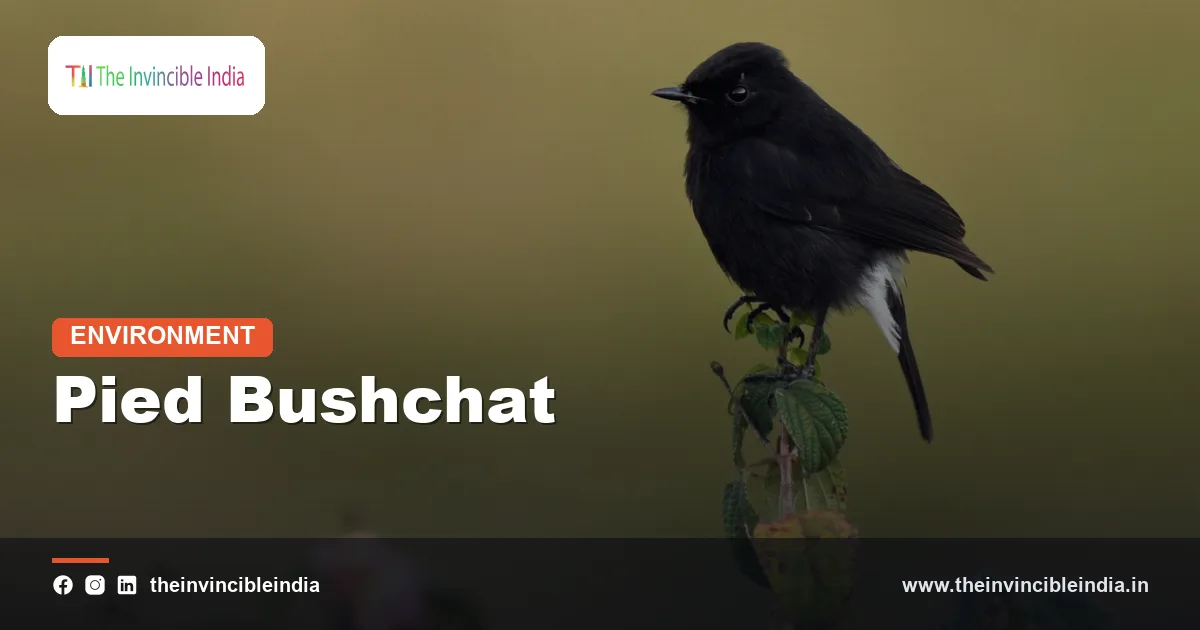
The pied bushchat (Saxicola caprata) is a small, upright perching bird of open country in India, the male of which is glossy black with a white rump and a white patch on the wing, while the female is a plain brown. It is a common sight on low bushes, fence posts, boulders and electric wires, from which it drops to the ground to catch insects.
The pied bushchat belongs to the chat group of the Old World flycatcher family and is found across most of the Indian subcontinent. This explainer describes how to identify the bird, where it lives, what it eats, how it breeds and how it differs from similar chats.
| Quick Fact | Detail |
|---|---|
| Common name | Pied bushchat |
| Scientific name | Saxicola caprata |
| Family | Muscicapidae (Old World flycatchers and chats) |
| Size | About 13 cm long; a compact, round-headed bird |
| India range and habitat | Widespread across the plains, plateaus and lower hills of India; found in open scrub, grassland, farmland, wasteland and village edges |
| Diet | Mainly insects, taken from the ground after a short pounce from a perch |
| Breeding | Nests in a hole or crevice in a bank, wall or rock; usually 3 to 5 eggs; season varies by region |
| Migration | Mostly resident, with some local and altitudinal movement |
| Conservation status | Least Concern on the IUCN Red List |
Key Takeaways
- The pied bushchat (Saxicola caprata) is a small chat of open country, about 13 cm long, in the Old World flycatcher family.
- The male pied bushchat is mostly black with a white rump, white vent and white wing patch, while the female is dull brown with a rusty rump.
- The pied bushchat hunts from a prominent perch, such as a bush top or wire, and pounces on insects on the ground.
- The pied bushchat is widespread and mostly resident across India, in farmland, scrub, grassland and village edges.
- The pied bushchat nests in holes or crevices in banks, walls and rocks, and the female lays about three to five eggs.
- The pied bushchat is rated Least Concern by the IUCN because its range is large and its habitat is common.
What is the pied bushchat?
The pied bushchat is a small insect-eating bird of the chat group, scientifically named Saxicola caprata, that sits upright on exposed perches in open land. The word pied means two-coloured, and the male shows a bold black-and-white pattern that gives the bird its name.
The species belongs to the family Muscicapidae, which contains the Old World flycatchers, chats, robins and thrush-like relatives. Within that family, the genus Saxicola holds the stonechats and bushchats. These are small, round-bodied birds with short legs, short tails and an upright stance, and they are typical of open habitats with scattered perches.
The pied bushchat is found from West and South Asia to parts of Southeast Asia and beyond, and several geographic forms are recognised. Those forms differ in the extent of white on the male and in the shade of the female. In peninsular and eastern India the male is black with white on the rump and vent, and in the north-west the male can show more white on the belly.
How can you identify a pied bushchat?
A pied bushchat is identified by its small size, upright posture and the male’s black plumage with a white rump, white lower belly and white wing patch. The female has brown upperparts, paler underparts and a rufous or reddish-brown rump, and she lacks the male’s strong contrast.
The male
The adult male pied bushchat is glossy black on the head, back, throat and breast. A white patch shows on the wing, the rump is white, and the lower belly and vent are white. In flight, the white rump and wing patch flash against the dark body. The bird flicks its wings and tail often, and it frequently bobs its tail when perched.
The female and the young
The female pied bushchat is brown above and slightly paler below, with a chestnut-tinged rump and tail base. Young birds resemble the female, but they look more spotted and streaked, with pale tips on the feathers. Young males gradually acquire the black plumage over their first year or so.
Which birds look similar?
| Species | Key difference from the pied bushchat |
|---|---|
| Siberian stonechat (Saxicola maurus) | Winter visitor; the male has a black head and a streaked back with a pale neck patch and orange-buff breast, unlike the all-black male pied bushchat |
| Jerdon’s bushchat (Saxicola jerdoni) | Glossy black above with a white belly and no white rump or wing patch; lives mainly in tall grassland in the north and east |
| Grey bushchat (Saxicola ferreus) | Male is grey-backed with a black mask and white eyebrow; found mainly in hills and forest edge |
| Indian robin (Copsychus fulicatus) | Male has black plumage with a white shoulder patch and rufous vent, and often holds its tail upright; usually lower to the ground and in drier scrub |
Where does the pied bushchat live in India?
The pied bushchat lives across most of India in open habitats, including scrub, grassland, farmland, fallow fields, rocky hillsides, roadsides and the edges of villages. It prefers places that have low perches such as bushes, stones, fence posts and wires, along with patches of bare ground or short grass for hunting.
The bird occurs from the plains up to the lower and middle hills, and in the Himalaya it is found up to moderate elevations in the warmer months. It is generally absent from dense forest and from the driest sand deserts. In many parts of India, it is one of the most conspicuous small birds in rural landscapes.
Farmland is especially suitable. Crop margins, field bunds, irrigation channels and hedges offer perches and insects, while stone walls provide nest sites. In towns, the species frequents wasteland, railway embankments, construction sites and open plots. Some birds that breed at higher altitude move down to lower elevations in winter, and such altitudinal movement is one of the only seasonal shifts in the species.
How does the pied bushchat hunt?
The pied bushchat hunts by sitting on an exposed perch, scanning the ground below, dropping to seize an insect and then flying back to the same or a nearby perch. This perch-and-pounce technique is typical of chats and is energy-efficient because the bird only moves when prey is spotted.
The bird’s diet consists mainly of insects, including beetles, grasshoppers, ants, flies, caterpillars and other small invertebrates. It may also hover briefly or flutter low to flush prey, and it occasionally catches insects in a short aerial chase. Spiders and other small arthropods are also eaten.
The strategy requires a good view of the ground, which is why the bird sits on the highest available point in its territory. Each bird defends a hunting area, and males often perch prominently so that they can both watch for food and display to rivals. The pied bushchat is therefore easy to see, even for a beginner.
- The bird picks a high, open perch with a clear view of the ground.
- It watches for movement from insects and other small prey.
- It drops to the ground, seizes the prey and returns to a perch.
- It flicks its wings and tail between hunting attempts.
What does the pied bushchat sound like?
The pied bushchat has a short, pleasant, whistling song made of a few clear notes, delivered by the male from a high perch or sometimes in a brief display flight. The song may include imitations of other birds, and it is often repeated several times in succession.
Alarm calls are harsher. The bird gives sharp, scolding notes, often paired with wing-flicks and tail-bobs, when a predator or a human comes near. Both sexes use contact calls to keep in touch while foraging.
Male song is strongest in the breeding season, particularly at dawn and dusk. A singing male on top of a bush or on a wire is a good way to locate a breeding territory. Territorial males also chase rivals, and brief aerial pursuits are common where territories adjoin.
How does the pied bushchat breed?
The pied bushchat breeds by building a cup nest in a hole or crevice and laying a small clutch of about three to five eggs. The nest is placed in a bank, wall, rock cleft, building ledge or hollow, and is well concealed from view.
Nest and eggs
The nest is a loose cup of grass, rootlets and fibres, often lined with hair, feathers or other soft materials. The eggs are pale bluish or greenish and are usually speckled with reddish or brownish marks. The female does most or all of the incubation, which lasts about two weeks, while the male defends the area and sings nearby.
Season and care of the young
The breeding season varies across India with climate and altitude. In many plains areas it begins in late winter or spring and may include more than one brood in a season, while in the hills it is later. Both parents feed the nestlings with insects, and the young leave the nest after around two weeks. Parents continue to feed the fledglings for a short period while the young learn to hunt.
Is the pied bushchat migratory?
The pied bushchat is mostly a resident bird in India and does not make long-distance migrations. Birds that breed at higher altitudes may move to lower ground in the colder months, and some local wandering follows food and weather, but most individuals stay within a small area.
This sedentary habit explains why the same male is often seen on the same perches over months or years. It also contrasts with the Siberian stonechat, a close relative that breeds far to the north and arrives in India in autumn to spend the winter in grassland and farmland. Telling the two apart is a common challenge for beginners, since both sit on low bushes and flick their tails.
Is the pied bushchat threatened?
The pied bushchat is not threatened and is classified as Least Concern by the International Union for Conservation of Nature (IUCN). It has a very large range, a stable population and the ability to live in modified landscapes such as farmland and village surroundings.
Nevertheless, the bird depends on open ground with perches and on abundant insects. Conversion of scrub and grassland into dense development, heavy use of pesticides and the removal of hedgerows and field edges can lower local numbers. Loss of old walls and banks may also reduce nest sites in some places.
The Wild Life (Protection) Act, 1972, protects wild birds in India. The simplest ways to help the pied bushchat are to retain patches of scrub and hedges, limit pesticide use on farmland and avoid disturbing nests during the breeding season.
How can you watch the pied bushchat?
The best way to watch a pied bushchat is to visit open scrub or farmland in the morning and look at the top of bushes, wires and fence posts for a small, upright bird flicking its tail. Because the bird sits in the open, it is one of the easier chats to observe.
- Scan the highest perches in open fields and along roadsides.
- Look for the male’s white rump and wing patch when it flies.
- Remember that the brown female is easy to overlook, so check nearby bushes.
- Use binoculars to separate the species from stonechats and robins.
- Keep away from nest holes and avoid handling young birds.
Why does the pied bushchat matter?
The pied bushchat matters because it eats large numbers of insects, including crop pests, and because it is a familiar indicator of healthy open habitats. A farm or scrubland with resident bushchats usually has varied insect life and unspoiled hedges and bunds.
The bird also gives many people an easy first lesson in observation. Its distinct sexes, perching habit and predictable territory make it ideal for learning about field marks, sexual dimorphism and territorial behaviour. Records from schools, farmers and birdwatchers add to knowledge of how common open-country birds respond to changes in land use.
Bottom Line
The pied bushchat is a small, upright chat that lives in India’s open country and hunts insects from conspicuous perches. The black-and-white male and brown female are easy to recognise, the species is common and secure, and it is best watched on bush tops and wires in farmland and scrub.
Frequently Asked Questions
What is the pied bushchat?
The pied bushchat is a small chat in the Old World flycatcher family, with the scientific name Saxicola caprata. It lives in open country across India and hunts insects from low perches. The male is black with a white rump and wing patch, and the female is brown.
How can you tell a male pied bushchat from a female?
A male pied bushchat is glossy black with a white rump, white vent and white wing patch, while a female is brown with a rusty rump. The difference is clear at a glance. Young birds look like females but appear more streaked and spotted.
What does the pied bushchat eat?
The pied bushchat eats mainly insects such as beetles, grasshoppers, ants, flies and caterpillars. It watches from a perch and drops to the ground to seize prey. It also takes spiders and other small invertebrates.
Where does the pied bushchat nest?
The pied bushchat nests in holes and crevices, such as those in earth banks, stone walls, rocks and buildings. The nest is a cup of grass, rootlets and fibres, often lined with hair or feathers. The female usually lays about three to five eggs.
Is the pied bushchat found all over India?
The pied bushchat is found across most of India, in the plains, plateaus and lower hills, wherever there is open scrub, grassland or farmland. It is mostly absent from dense forest and from the driest sandy deserts. It is one of the commonest small birds of rural landscapes.
Is the pied bushchat a migratory bird?
The pied bushchat is mostly resident and does not undertake long-distance migration. Some birds from higher altitudes move down to lower ground in cold weather. The Siberian stonechat, a similar winter visitor, is a different species and often causes confusion.
{“@context”:”https://schema.org”,”@graph”:[{“@type”:”FAQPage”,”mainEntity”:[{“@type”:”Question”,”name”:”What is the pied bushchat?”,”acceptedAnswer”:{“@type”:”Answer”,”text”:”The pied bushchat is a small chat in the Old World flycatcher family, with the scientific name Saxicola caprata. It lives in open country across India and hunts insects from low perches. The male is black with a white rump and wing patch, and the female is brown.”}},{“@type”:”Question”,”name”:”How can you tell a male pied bushchat from a female?”,”acceptedAnswer”:{“@type”:”Answer”,”text”:”A male pied bushchat is glossy black with a white rump, white vent and white wing patch, while a female is brown with a rusty rump. The difference is clear at a glance. Young birds look like females but appear more streaked and spotted.”}},{“@type”:”Question”,”name”:”What does the pied bushchat eat?”,”acceptedAnswer”:{“@type”:”Answer”,”text”:”The pied bushchat eats mainly insects such as beetles, grasshoppers, ants, flies and caterpillars. It watches from a perch and drops to the ground to seize prey. It also takes spiders and other small invertebrates.”}},{“@type”:”Question”,”name”:”Where does the pied bushchat nest?”,”acceptedAnswer”:{“@type”:”Answer”,”text”:”The pied bushchat nests in holes and crevices, such as those in earth banks, stone walls, rocks and buildings. The nest is a cup of grass, rootlets and fibres, often lined with hair or feathers. The female usually lays about three to five eggs.”}},{“@type”:”Question”,”name”:”Is the pied bushchat found all over India?”,”acceptedAnswer”:{“@type”:”Answer”,”text”:”The pied bushchat is found across most of India, in the plains, plateaus and lower hills, wherever there is open scrub, grassland or farmland. It is mostly absent from dense forest and from the driest sandy deserts. It is one of the commonest small birds of rural landscapes.”}},{“@type”:”Question”,”name”:”Is the pied bushchat a migratory bird?”,”acceptedAnswer”:{“@type”:”Answer”,”text”:”The pied bushchat is mostly resident and does not undertake long-distance migration. Some birds from higher altitudes move down to lower ground in cold weather. The Siberian stonechat, a similar winter visitor, is a different species and often causes confusion.”}}]}]}


