

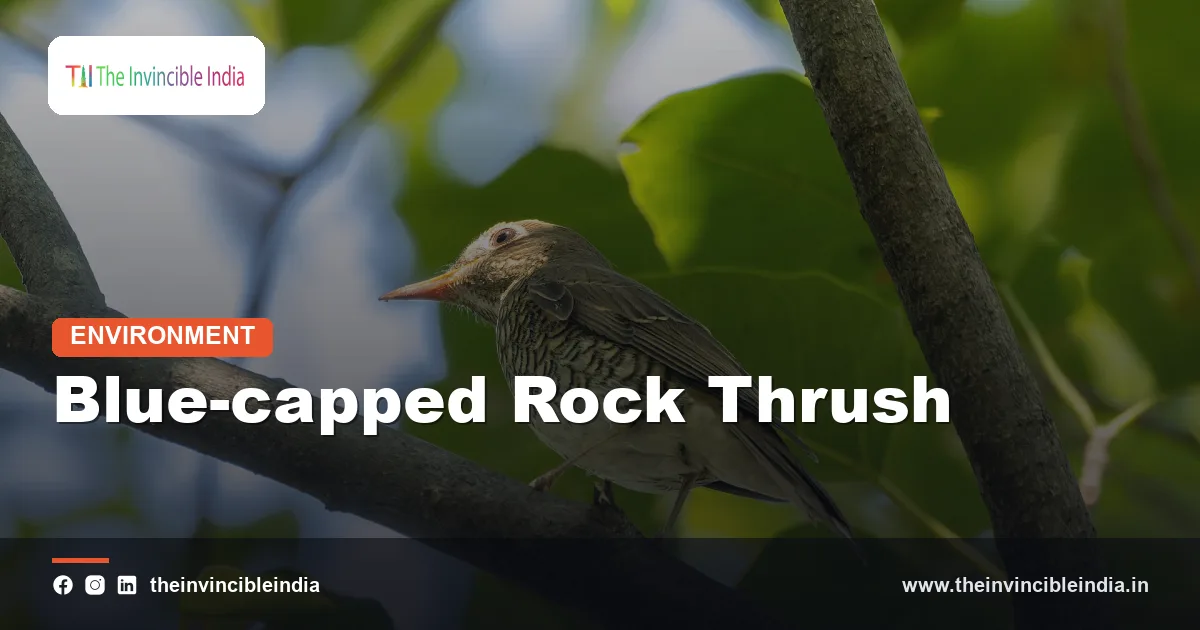
The blue-capped rock thrush (Monticola cinclorhyncha) is a handsome songbird of the Himalayan forests in which the male wears a bright blue crown, a bold white wing patch and chestnut underparts, and which spends the winter in the hill forests of peninsular India. It is a seasonal migrant within the Indian subcontinent, moving between its mountain breeding grounds and its southern wintering areas.
The blue-capped rock thrush belongs to the Old World flycatcher family and is one of several rock thrushes found in India. This explainer describes how to identify the bird, where it breeds and winters, what it eats, how it migrates, and how to separate it from similar species.
| Quick Fact | Detail |
|---|---|
| Common name | Blue-capped rock thrush |
| Scientific name | Monticola cinclorhyncha |
| Family | Muscicapidae (Old World flycatchers and chats) |
| Size | About 17 cm long |
| India range and habitat | Breeds in Himalayan oak, mixed and conifer forest; winters in the Western Ghats and other hill forests, plantations and wooded gardens of peninsular India |
| Diet | Insects and other small invertebrates, plus berries and small fruit |
| Breeding | Nests in summer at mid to high elevations in the Himalaya, in a cavity or crevice; clutch of a few eggs |
| Migration | Altitudinal and long-distance within the subcontinent; moves south after breeding and returns north in spring |
| Conservation status | Least Concern on the IUCN Red List |
Key Takeaways
- The blue-capped rock thrush (Monticola cinclorhyncha) is a thrush-like songbird about 17 cm long, in the Old World flycatcher family.
- The male blue-capped rock thrush has a bright blue crown, a white wing patch and chestnut underparts, while the female is brown and scaly.
- The blue-capped rock thrush breeds in Himalayan forests and winters mainly in the hill forests of peninsular India, including the Western Ghats.
- The blue-capped rock thrush eats insects and other small invertebrates, and in winter it also takes berries and small fruit.
- The blue-capped rock thrush is a seasonal migrant, arriving in its southern wintering areas around autumn and leaving in spring.
- The blue-capped rock thrush is listed as Least Concern by the IUCN because its range is large and its population is stable.
What is the blue-capped rock thrush?
The blue-capped rock thrush is a medium-small songbird of the genus Monticola, the rock thrushes, and it is named for the vivid blue crown of the adult male. The scientific name is Monticola cinclorhyncha, and the species is placed in the family Muscicapidae along with chats, robins and flycatchers.
Rock thrushes were once placed in the thrush family, Turdidae, because of their build and habits. Modern genetic studies moved them into the Old World flycatcher family. The name Monticola means mountain dweller, which suits the group, since most rock thrushes breed in hills and mountains and favour rocky, wooded slopes.
The species is native to southern Asia. It breeds from the western Himalaya eastwards and winters farther south, and its range reaches Southeast Asia. In India it is best known as a winter visitor to the south and as a summer breeder in the north, which makes it a good example of regional bird migration within the country.
How can you identify a blue-capped rock thrush?
A blue-capped rock thrush is identified by the male’s bright blue cap, darker head sides and back, white wing patch and chestnut underparts, or by the female’s brown, finely scaled plumage with a pale throat. The bird is stocky, upright and short-tailed, and it often perches on a bare branch or boulder.
The male
The adult male blue-capped rock thrush is one of the most colourful small birds of the Indian hills. The crown is a vivid blue, in strong contrast with the darker sides of the head and the back. A white patch on the wing is visible at rest and in flight, and the underparts are a rich chestnut. The combination makes the male unmistakable when seen well.
The female and the young
The female blue-capped rock thrush is dull by comparison. She is brown above and paler below with fine scaling or barring on the breast and belly, and she shows a pale throat. Young birds resemble the female, with spots and scales that fade as they mature. Females can be difficult to separate from other female rock thrushes, so observers look at overall shape, face pattern and underpart marks together.
Which birds look similar?
| Species | Key difference from the blue-capped rock thrush |
|---|---|
| Chestnut-bellied rock thrush (Monticola rufiventris) | Male has a blue crown and back with a black face mask and chestnut belly but lacks the strong white wing patch of the blue-capped rock thrush |
| Blue rock thrush (Monticola solitarius) | Male is slaty-blue overall without chestnut underparts; a winter visitor to many parts of India |
| Blue whistling thrush (Myophonus caeruleus) | Larger, dark blue-black with glittering spots; found near streams and rocks in hills |
| Orange-headed thrush (Geokichla citrina) | Orange head and underparts with grey or brownish upperparts; lacks the blue crown and white wing patch |
Where does the blue-capped rock thrush live in India?
The blue-capped rock thrush lives in two main settings in India: Himalayan forest in the breeding season and the hill forests, plantations and wooded gardens of peninsular India in winter. The bird therefore changes habitat with the season, and the same individual can spend part of the year in the north and part in the south.
Breeding grounds
In summer, the blue-capped rock thrush occupies forests of oak, rhododendron, deodar and other mid to high-elevation woodland in the Himalaya, usually on steep, rocky and well-wooded slopes. Males sing from tall perches and claim territories among boulders and cliffs.
Wintering grounds
In winter, the blue-capped rock thrush moves to the evergreen and moist deciduous forests of the Western Ghats and other southern and central hill areas, where it uses forest edges, clearings, shade-grown plantations and wooded gardens. It is often seen in fruiting trees, because winter food includes berries and small fruit.
The species is also recorded on passage in many states, so a visitor may meet it in a hill station or a lowland park during migration. These records help observers to understand the route taken by the birds between north and south.
What does the blue-capped rock thrush eat?
The blue-capped rock thrush eats insects and other small invertebrates, and it supplements this with berries and small fruit, especially outside the breeding season. It forages both on the ground and in the lower and middle levels of trees.
On the ground, the bird hops or runs a short distance, pauses upright, and pounces on beetles, ants, caterpillars and other prey. In trees, it picks insects from leaves and bark or makes short flights to seize them. A fruiting tree can attract rock thrushes, and in the south it joins other birds that feed on small berries.
This mixed diet suits a migrant. Insects supply the protein needed for breeding in the Himalayan summer, while fruit is plentiful in southern forests in winter. The bird’s ability to switch food types helps it use different habitats through the year.
- Breeding season: mostly insects and other invertebrates.
- Winter: insects plus berries and small fruit.
- Feeding sites: forest floor, low branches and fruiting trees.
- Foraging style: upright pauses, short hops and quick pounces.
Does the blue-capped rock thrush migrate?
Yes, the blue-capped rock thrush is a migratory bird, moving each year from its Himalayan breeding areas to winter quarters farther south and returning in spring. Much of the movement happens within the subcontinent, which makes the species an example of short-to-medium distance migration.
After the breeding season, birds leave the mountains in autumn and travel south. Many reach the Western Ghats and other hill ranges by late autumn, remaining until the following spring. The return passage in spring brings them back to the Himalaya in time for the breeding season. Migrants often fly at night, and some stop in gardens, parks and forest patches on their way.
Researchers learn about these routes from sightings submitted by birdwatchers and from ringing records. The pattern is not perfectly fixed, since some birds winter in other regions of South and Southeast Asia, and numbers vary from year to year.
How does the blue-capped rock thrush breed?
The blue-capped rock thrush breeds in the Himalayan summer by building a nest in a hollow or crevice and raising a small brood. Nests are usually placed in cavities among rocks, banks or trees, and are made with moss, grass and other plant material.
The male sings from an exposed perch to attract a female and to warn rivals. The female builds the nest and incubates the eggs, while the male guards the territory. Clutches are small, typically a few eggs, and both parents feed the chicks with insects. Hidden nest sites help protect the eggs and chicks from predators.
Because the breeding grounds are remote and steep, the species is less often studied on its nesting sites than on its wintering grounds. Much of what is known about nesting comes from field naturalists in the Himalayan states.
What does the blue-capped rock thrush sound like?
The blue-capped rock thrush has a clear, melodious, whistled song that carries across hillsides, delivered by the male from a high perch on the breeding grounds. The notes are rich and fluting, and they are repeated in short phrases.
The calls of the species are less distinctive and include sharp, short notes given in alarm. In winter, when the bird is on migration or in its southern quarters, it is usually silent or gives only brief calls, so most watchers find it by sight, not sound.
Song is a useful way to find the bird on its breeding grounds in the Himalaya. Early morning is the best time to hear it, when males sing from the tops of trees and rocks.
Is the blue-capped rock thrush threatened?
The blue-capped rock thrush is not considered threatened and is classified as Least Concern by the International Union for Conservation of Nature (IUCN). It has a large range across southern Asia and a stable population.
Still, the species depends on forest on both ends of its journey. Loss of oak and mixed forest in the Himalaya affects breeding habitat, while clearing of hill forest and plantations in the south affects wintering habitat. Collisions with buildings and glass during night migration are an additional hazard for many songbirds.
Protected areas in the Himalaya and the Western Ghats help to secure habitat. Under the Wild Life (Protection) Act, 1972, wild birds in India are protected from hunting and trade. Maintaining native forest cover and shade-grown plantations is the most useful way to support migratory forest birds such as this one.
How can you watch the blue-capped rock thrush?
The best way to watch a blue-capped rock thrush is to visit hill forests in winter or Himalayan oak forest in summer and to scan fruiting trees and forest edges in the early morning. The male’s blue cap is easy to see when the bird perches in the open.
- In winter, check forest clearings, shaded plantations and fruiting trees in the southern hills.
- In summer, search steep, wooded Himalayan slopes and listen for song at dawn.
- Look for an upright, short-tailed bird perched on a bare branch or rock.
- Use binoculars to confirm the white wing patch on the male and the scaled underparts on the female.
- Keep away from nest sites and avoid playing recorded calls, which can stress territorial birds.
Why does the blue-capped rock thrush matter?
The blue-capped rock thrush matters because it links Himalayan and peninsular forests through its annual movements, helps control insects and spreads seeds when it eats fruit. Its presence shows that both ends of its migration still hold healthy forest.
The bird is also a favourite of birdwatchers because the male is so striking. Interest in such species supports local nature tourism in hill regions and encourages the protection of forest habitat. Records of the first and last dates of the bird in a place also provide long-term information about how seasonal movements respond to climate and land-use change.
Bottom Line
The blue-capped rock thrush is a colourful Old World flycatcher relative that breeds in the Himalaya and winters in the hill forests of peninsular India. The blue-crowned male is unmistakable, the species is secure in numbers, and its survival depends on keeping forests intact at both ends of its seasonal journey.
Frequently Asked Questions
What is the blue-capped rock thrush?
The blue-capped rock thrush is a songbird of the rock thrush genus Monticola, with the scientific name Monticola cinclorhyncha. The male has a bright blue crown, a white wing patch and chestnut underparts. It breeds in the Himalaya and winters in the hill forests of peninsular India.
Where is the blue-capped rock thrush found in India?
The blue-capped rock thrush is found in Himalayan forests in the breeding season and in the hill forests, plantations and wooded gardens of peninsular India in winter. The Western Ghats are an important wintering area. Birds also appear on passage in many other places.
Is the blue-capped rock thrush a migratory bird?
Yes, the blue-capped rock thrush is migratory, moving south from its Himalayan breeding grounds after the summer and returning north in spring. Much of this movement takes place within the Indian subcontinent. Some birds winter in other parts of South and Southeast Asia.
What does the blue-capped rock thrush eat?
The blue-capped rock thrush eats insects and other small invertebrates and, outside the breeding season, also berries and small fruit. It feeds on the ground and in the lower parts of trees. It pounces on prey after short hops or flights.
How can you tell a female blue-capped rock thrush?
A female blue-capped rock thrush is brown above and paler below with fine scaling or barring on the breast and belly and a pale throat. She lacks the male’s blue cap and white wing patch. Because she resembles other female rock thrushes, observers compare her shape, face and underpart marks together.
Is the blue-capped rock thrush endangered?
No, the blue-capped rock thrush is not endangered and is listed as Least Concern by the IUCN. Its range is large and its population is considered stable. Loss of forest in its breeding and wintering areas remains the main long-term risk.
{“@context”:”https://schema.org”,”@graph”:[{“@type”:”FAQPage”,”mainEntity”:[{“@type”:”Question”,”name”:”What is the blue-capped rock thrush?”,”acceptedAnswer”:{“@type”:”Answer”,”text”:”The blue-capped rock thrush is a songbird of the rock thrush genus Monticola, with the scientific name Monticola cinclorhyncha. The male has a bright blue crown, a white wing patch and chestnut underparts. It breeds in the Himalaya and winters in the hill forests of peninsular India.”}},{“@type”:”Question”,”name”:”Where is the blue-capped rock thrush found in India?”,”acceptedAnswer”:{“@type”:”Answer”,”text”:”The blue-capped rock thrush is found in Himalayan forests in the breeding season and in the hill forests, plantations and wooded gardens of peninsular India in winter. The Western Ghats are an important wintering area. Birds also appear on passage in many other places.”}},{“@type”:”Question”,”name”:”Is the blue-capped rock thrush a migratory bird?”,”acceptedAnswer”:{“@type”:”Answer”,”text”:”Yes, the blue-capped rock thrush is migratory, moving south from its Himalayan breeding grounds after the summer and returning north in spring. Much of this movement takes place within the Indian subcontinent. Some birds winter in other parts of South and Southeast Asia.”}},{“@type”:”Question”,”name”:”What does the blue-capped rock thrush eat?”,”acceptedAnswer”:{“@type”:”Answer”,”text”:”The blue-capped rock thrush eats insects and other small invertebrates and, outside the breeding season, also berries and small fruit. It feeds on the ground and in the lower parts of trees. It pounces on prey after short hops or flights.”}},{“@type”:”Question”,”name”:”How can you tell a female blue-capped rock thrush?”,”acceptedAnswer”:{“@type”:”Answer”,”text”:”A female blue-capped rock thrush is brown above and paler below with fine scaling or barring on the breast and belly and a pale throat. She lacks the male’s blue cap and white wing patch. Because she resembles other female rock thrushes, observers compare her shape, face and underpart marks together.”}},{“@type”:”Question”,”name”:”Is the blue-capped rock thrush endangered?”,”acceptedAnswer”:{“@type”:”Answer”,”text”:”No, the blue-capped rock thrush is not endangered and is listed as Least Concern by the IUCN. Its range is large and its population is considered stable. Loss of forest in its breeding and wintering areas remains the main long-term risk.”}}]}]}


