

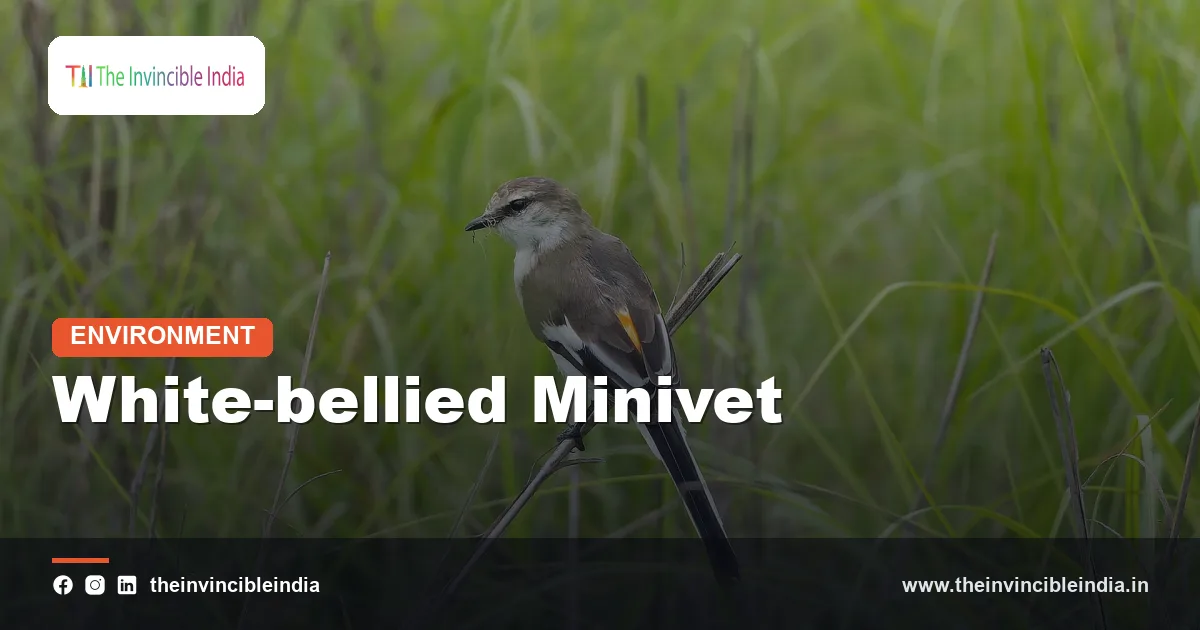
The white-bellied minivet (Pericrocotus erythropygius) is a small, insect-eating songbird of dry Indian scrub and open woodland, in which the male is black above and white below with an orange-red tinge on the breast and rump. Unlike most minivets, which are birds of forest canopy, the white-bellied minivet lives in thorn scrub and open country and is largely confined to the Indian subcontinent.
The white-bellied minivet belongs to the cuckooshrike and minivet family and is usually seen in pairs or small groups moving through the foliage of low trees. This explainer covers how to identify the bird, where it lives, what it eats, how it nests and how it differs from other Indian minivets.
| Quick Fact | Detail |
|---|---|
| Common name | White-bellied minivet |
| Scientific name | Pericrocotus erythropygius |
| Family | Campephagidae (cuckooshrikes and minivets) |
| Size | About 15 cm long |
| India range and habitat | Dry thorn scrub, open deciduous woodland and wooded wasteland across much of peninsular and central India; avoids dense, wet forest |
| Diet | Insects and other small invertebrates, taken from foliage and in short aerial sallies |
| Breeding | Builds a small cobweb-bound cup nest on a branch fork; lays a few eggs; timing varies with region and rain |
| Migration | Mainly resident, with some local movement |
| Conservation status | Least Concern on the IUCN Red List |
Key Takeaways
- The white-bellied minivet (Pericrocotus erythropygius) is a small songbird about 15 cm long, in the family Campephagidae, which includes cuckooshrikes and minivets.
- The male white-bellied minivet has black upperparts, white underparts and an orange-red wash on the breast and rump, while the female is brownish and paler.
- The white-bellied minivet lives in dry thorn scrub and open woodland in India, unlike most minivets, which prefer forest.
- The white-bellied minivet eats insects, which it picks from foliage and catches in brief flights, usually in pairs or small groups.
- The white-bellied minivet builds a small, well-camouflaged cup nest bound with cobweb and decorated with lichen or bark.
- The white-bellied minivet is mostly resident and is rated Least Concern by the IUCN.
What is the white-bellied minivet?
The white-bellied minivet is a small songbird in the genus Pericrocotus, the minivets, which are slender, long-tailed insect-eaters known for the bright red, orange or yellow plumage of the males. The species name erythropygius refers to the reddish rump of the male.
The minivets belong to the family Campephagidae, whose name means caterpillar-eaters, a reference to the family’s fondness for caterpillars and other soft-bodied insects. The family also includes the larger cuckooshrikes. Most minivets live in forests across southern and eastern Asia, and India hosts several species.
The white-bellied minivet is distinctive because of its habitat. While many of its relatives live in the canopy of tall forest, this species is a bird of dry, open country. It is largely restricted to the Indian subcontinent, with most of its range lying within India, and it has adapted well to dry thorn scrub and open deciduous woodland.
How can you identify a white-bellied minivet?
A white-bellied minivet is identified by the male’s black upperparts, white belly, orange-red breast and rump, and white wing bar, and by the female’s brownish upperparts and paler body. The bird is slender, with a fairly long tail, and it moves actively through the foliage.
The male
The adult male white-bellied minivet is black on the head, back and wings, with a white belly and a warm orange to reddish-orange wash on the breast and the rump. A pale wing bar shows in flight. The contrast between the dark upper body and the white underparts is striking, and the orange patches give the bird its splash of colour.
The female and the young
The female white-bellied minivet is much duller than the male. Her upperparts are greyish brown, her underparts are whitish or pale, and any orange or yellow colour on the rump is subdued. Young birds resemble females. Because males are brighter, a mixed pair is easy to spot as the two birds stay close together.
How does it differ from other minivets?
| Species | Key difference from the white-bellied minivet |
|---|---|
| Small minivet (Pericrocotus cinnamomeus) | Male has a grey back and an orange-red breast and belly; also found in open woodland and gardens, so the two can overlap |
| Scarlet minivet (Pericrocotus speciosus) | Larger and brighter; the male is glossy black and scarlet; mainly a forest and wooded country bird |
| Long-tailed minivet (Pericrocotus ethologus) | Mostly a Himalayan bird, with a longer tail and red or yellow patterns on the wing; found in hill forest |
| Ashy minivet (Pericrocotus divaricatus) | Grey and white without red or orange colours; a winter visitor to coastal and forest areas |
Where does the white-bellied minivet live in India?
The white-bellied minivet lives in dry thorn scrub, open deciduous woodland and wooded wasteland across much of peninsular and central India. It is a bird of drier lowlands and low hills and generally avoids dense, wet evergreen forest and high mountains.
The species is typical of areas with acacia, babul and other thorny trees, scattered woodland and scrub. It often occurs in rocky plateaus, dry riverbeds with trees, village outskirts and the edges of deciduous forest. In such habitats it forages among the leaves of low and mid-sized trees.
Because the birds depend on open woodland, they are not usually found in the wettest parts of the Western Ghats or in the heavy forest of the north-east. Within its range the species can be locally common, particularly in protected scrub areas and in parts of the Deccan. Its absence from many moist regions makes it a useful marker of dry-zone habitat.
What does the white-bellied minivet eat?
The white-bellied minivet eats insects and other small invertebrates, including caterpillars, bugs, beetles and spiders, which it finds among foliage. It searches leaves and twigs methodically and makes short flights to seize prey.
Minivets in general are active foragers. They flutter through the tree crown, hover briefly to pick off insects, and sometimes sally into the air after flying prey. The white-bellied minivet follows this pattern in scrub and open woodland, working through acacia and other trees in small parties.
Insect-eating birds help to keep leaf-eating insect numbers in balance. By removing caterpillars and other herbivorous insects, the white-bellied minivet contributes to the health of the trees where it feeds. The bird does not depend on fruit or seeds.
- Caterpillars and other soft-bodied insects form a major part of the diet.
- Prey is gleaned from leaves and twigs or caught in brief flights.
- Foraging takes place in the foliage of low to mid-sized trees.
- Pairs and small groups often forage together and keep in contact with calls.
Why is the white-bellied minivet called a minivet?
The white-bellied minivet is called a minivet because the name is the common label for the small, brightly coloured members of the genus Pericrocotus. The term is used for these slender, long-tailed birds across South and Southeast Asia, and it covers the whole group.
Within the genus, the sexes differ strongly in most species. Males carry red, orange or yellow against black or grey, while females are yellow, buff or brownish. The white-bellied minivet follows this pattern, although its colours are more subdued than those of the scarlet minivet. The common name white-bellied refers to the pale underparts of the male, which stand out against the black back.
The scientific name Pericrocotus erythropygius combines the genus name with a Greek-derived species name meaning red-rumped. Scientific names like this are fixed by the rules of zoological nomenclature, so they remain the most reliable way to refer to the species across languages and regions, while local names in Hindi, Marathi, Telugu, Tamil and other Indian languages vary from place to place.
Understanding the naming helps beginners to place the bird in its wider family. Anyone who recognises the minivet shape, with its slim body, long tail and active feeding, will soon recognise the other Indian minivets, even though the habitats and colours differ.
How does the white-bellied minivet behave?
The white-bellied minivet is a sociable, active bird that usually moves in pairs or small groups, flitting from tree to tree with a light, undulating flight. The birds keep in touch with soft, high-pitched twittering calls as they feed.
Outside the breeding season, small parties may associate with other small insect-eating birds in mixed hunting groups. In such groups, different species search different parts of the tree, and the movement of one bird can flush insects for others. During the breeding season, the birds form pairs and defend a small territory.
The male is often more conspicuous, perching in the open on the upper branches of a tree. When flying, the pale wing bar and the coloured rump are easy to see. Minivets rarely stay still for long, so photographers and watchers need patience.
The calls are weak and musical rather than loud. Birdwatchers often detect the group first by the light trills and twittering notes that carry from the canopy.
How does the white-bellied minivet breed?
The white-bellied minivet breeds by building a small, shallow cup nest on a horizontal branch fork and laying a small clutch of eggs. The nest is bound together with cobweb and camouflaged with lichen or bark, so that it resembles a small knot on the branch.
Nest and eggs
The nest is a compact cup made of fine twigs, grass and fibres, held together with spider silk. The outside is decorated with scraps of bark or lichen, which hides it from predators. Nests are usually placed at a modest height in a thorny or leafy tree. The eggs are pale with brownish or greyish markings, and clutches are small.
Season and care of the young
The breeding season varies with region and local rainfall, and in many parts of India it falls in the warmer months and extends into the early monsoon. Both parents are thought to take part in nest building and feeding the young, and the female does most of the incubation. The nestlings are fed on insects until they fledge, and the family may stay together for a while afterwards.
Is the white-bellied minivet migratory?
The white-bellied minivet is mainly a resident bird and does not undertake long-distance migration. Some birds make local movements in response to rainfall, food supply or seasonal changes, but most pairs remain within their home area through the year.
This residency is typical of birds of dry scrub, where conditions are fairly stable from season to season. Small flocks may wander in the non-breeding season in search of insect-rich trees, and then return to their breeding territories. Compared with some forest minivets, which move seasonally between hills and plains, the white-bellied minivet is quite sedentary.
Is the white-bellied minivet threatened?
The white-bellied minivet is not considered threatened and is classified as Least Concern by the International Union for Conservation of Nature (IUCN). Its range is large, and it can live in thorn scrub and other modified habitats.
Even so, dry scrub is often wrongly treated as wasteland and is cleared for farming, industry or housing. Loss of scrub and open woodland reduces the habitat of this species, and heavy pesticide use can lower insect numbers. Because dry scrub is less often protected than forest, conservationists point out that such ecosystems deserve more attention.
Wild birds are protected in India by the Wild Life (Protection) Act, 1972. Retaining patches of native thorn scrub and open woodland, planting native trees and limiting pesticides are practical ways to help the white-bellied minivet and other dry-zone birds.
How can you watch the white-bellied minivet?
The best way to watch a white-bellied minivet is to visit dry scrub or open deciduous woodland in the morning and look for small parties moving through the tree crowns, with the male’s black, white and orange pattern as the clue. Calm, patient observation from a distance works better than chasing the birds.
- Visit thorn scrub, rocky plateaus and the edges of dry forest.
- Scan acacia and other trees for small birds that flit between branches.
- Listen for light, high twittering calls from the canopy.
- Look for the male’s orange-red rump and white wing bar in flight.
- Use binoculars to separate the species from the small minivet.
Why does the white-bellied minivet matter?
The white-bellied minivet matters because it controls leaf-eating insects, indicates healthy dry-zone vegetation and represents a habitat that is often overlooked. Dry scrub supports a distinct community of birds, and the minivet is one of its most colourful members.
Protecting scrub habitats for birds like the white-bellied minivet also benefits other wildlife and local communities, since dry woodland provides fodder, firewood and grazing land. Recording the species in citizen-science projects helps to show how birds of dry country are faring as land use changes.
Bottom Line
The white-bellied minivet is a small, sociable insect-eater of India’s dry scrub and open woodland, easily recognised by the male’s black, white and orange plumage. It is secure for now, but it depends on thorn scrub and open woodland that should not be dismissed as wasteland.
Frequently Asked Questions
What is the white-bellied minivet?
The white-bellied minivet is a small insect-eating songbird with the scientific name Pericrocotus erythropygius. The male is black above and white below, with an orange-red tinge on the breast and rump. It lives in dry scrub and open woodland in India.
Where is the white-bellied minivet found?
The white-bellied minivet is found mainly in India, in dry thorn scrub, open deciduous woodland and wooded wasteland across much of the peninsular and central parts of the country. It generally avoids dense, wet forest and high mountains. Its range is largely confined to the Indian subcontinent.
What does the white-bellied minivet eat?
The white-bellied minivet eats insects and other small invertebrates, including caterpillars, bugs and beetles. It picks them from leaves and twigs and also catches them in short flights. It does not rely on fruit or seeds.
How is the white-bellied minivet different from other minivets?
The white-bellied minivet differs from most other minivets because it lives in dry open scrub rather than in forest canopy. The male has a black back and white belly with orange-red on the breast and rump. The small minivet has a grey back and an orange-red belly and can overlap in open woodland.
Does the white-bellied minivet migrate?
The white-bellied minivet is mainly resident and does not migrate over long distances. Some birds make local movements in response to rainfall and food supply. Most pairs stay in the same area through the year.
Is the white-bellied minivet endangered?
No, the white-bellied minivet is not endangered and is rated Least Concern by the IUCN. It has a large range and adapts to thorn scrub and open woodland. Clearing of dry scrub and heavy pesticide use are the main local pressures.
{“@context”:”https://schema.org”,”@graph”:[{“@type”:”FAQPage”,”mainEntity”:[{“@type”:”Question”,”name”:”What is the white-bellied minivet?”,”acceptedAnswer”:{“@type”:”Answer”,”text”:”The white-bellied minivet is a small insect-eating songbird with the scientific name Pericrocotus erythropygius. The male is black above and white below, with an orange-red tinge on the breast and rump. It lives in dry scrub and open woodland in India.”}},{“@type”:”Question”,”name”:”Where is the white-bellied minivet found?”,”acceptedAnswer”:{“@type”:”Answer”,”text”:”The white-bellied minivet is found mainly in India, in dry thorn scrub, open deciduous woodland and wooded wasteland across much of the peninsular and central parts of the country. It generally avoids dense, wet forest and high mountains. Its range is largely confined to the Indian subcontinent.”}},{“@type”:”Question”,”name”:”What does the white-bellied minivet eat?”,”acceptedAnswer”:{“@type”:”Answer”,”text”:”The white-bellied minivet eats insects and other small invertebrates, including caterpillars, bugs and beetles. It picks them from leaves and twigs and also catches them in short flights. It does not rely on fruit or seeds.”}},{“@type”:”Question”,”name”:”How is the white-bellied minivet different from other minivets?”,”acceptedAnswer”:{“@type”:”Answer”,”text”:”The white-bellied minivet differs from most other minivets because it lives in dry open scrub rather than in forest canopy. The male has a black back and white belly with orange-red on the breast and rump. The small minivet has a grey back and an orange-red belly and can overlap in open woodland.”}},{“@type”:”Question”,”name”:”Does the white-bellied minivet migrate?”,”acceptedAnswer”:{“@type”:”Answer”,”text”:”The white-bellied minivet is mainly resident and does not migrate over long distances. Some birds make local movements in response to rainfall and food supply. Most pairs stay in the same area through the year.”}},{“@type”:”Question”,”name”:”Is the white-bellied minivet endangered?”,”acceptedAnswer”:{“@type”:”Answer”,”text”:”No, the white-bellied minivet is not endangered and is rated Least Concern by the IUCN. It has a large range and adapts to thorn scrub and open woodland. Clearing of dry scrub and heavy pesticide use are the main local pressures.”}}]}]}


