

The vernal hanging parrot (Loriculus vernalis) is a tiny, bright green parrot of Indian forests, about the size of a sparrow, that is famous for roosting and sometimes feeding while hanging upside down like a bat. It is also known as the Indian hanging parrot or Indian lorikeet, and it is one of the smallest parrots in South Asia. Its short tail, red bill and crimson rump make it unmistakable when it is seen clearly.
This guide explains what the vernal hanging parrot looks like, where it lives in India, what it eats, why it hangs upside down, how it breeds and how it differs from the larger parakeets that are more familiar to most people. It is written for readers who want a clear overview of this small, quick and easily overlooked forest bird.
| Quick Facts | Vernal hanging parrot |
|---|---|
| Scientific name | Loriculus vernalis |
| Other names | Indian hanging parrot, Indian lorikeet |
| Family and order | Psittaculidae (Old World parrots), order Psittaciformes |
| Size | About 14 cm long, with a very short tail |
| Appearance | Overall green plumage, red bill, bright crimson rump, and a small bluish throat patch in the male |
| India range and habitat | Forests and wooded country of the Western Ghats, peninsular and eastern India, the north-east and Himalayan foothills; also parts of South-East Asia |
| Diet | Nectar, flowers, fruits, berries and seeds |
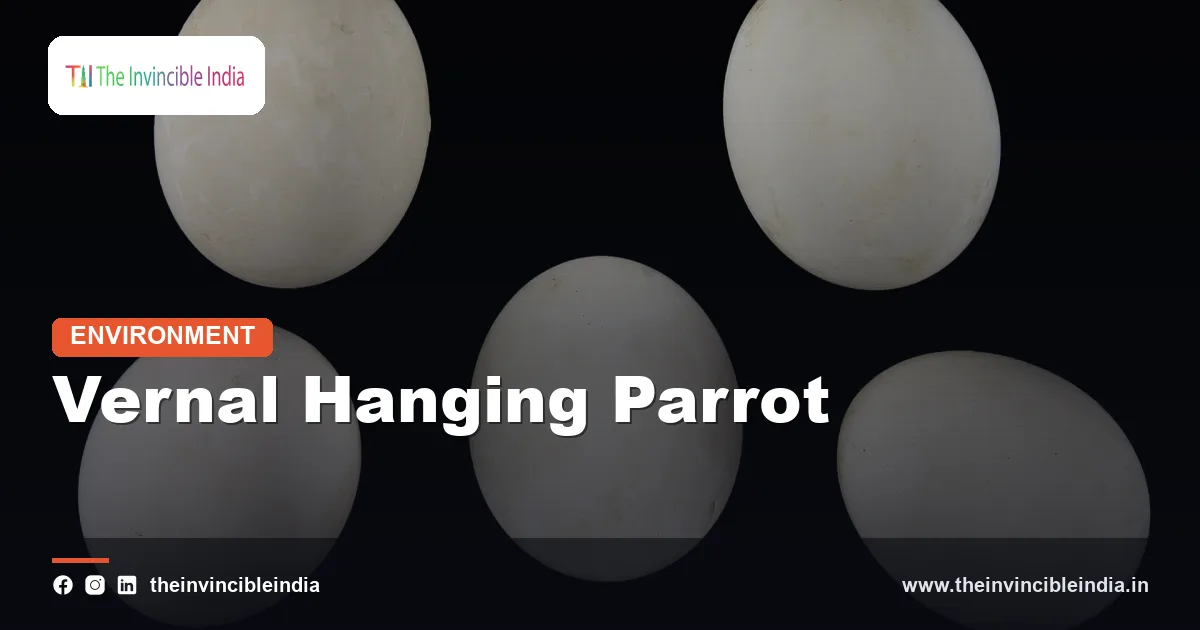
| Breeding | Nests in a hole in a tree trunk or branch; lays a small clutch of white eggs |
| Conservation status | Least Concern on the IUCN Red List; wild parrots are protected in India under the Wildlife (Protection) Act, 1972 |
Key Takeaways
- The vernal hanging parrot (Loriculus vernalis) is a sparrow-sized green parrot of about 14 cm, making it one of the smallest parrots in India.
- The vernal hanging parrot is named for its habit of hanging upside down from branches, both when sleeping and when feeding.
- The vernal hanging parrot can be recognised by its green body, short tail, red bill and bright crimson rump.
- The vernal hanging parrot feeds mainly on nectar, flowers and fruit, and it can act as a pollinator of forest trees.
- The vernal hanging parrot nests in a hole in a tree and lays a small clutch of white eggs.
- The vernal hanging parrot is classed as Least Concern globally, but forest loss and capture for the pet trade remain concerns.
What is the vernal hanging parrot?
The vernal hanging parrot is a very small parrot, belonging to the hanging parrot genus Loriculus, that lives in forests and wooded areas of India and South-East Asia. The word “vernal” means “of spring” and refers to its fresh green colour, while the genus name Loriculus means “little lory”, because the bird resembles a lory in size and diet. Hanging parrots are named for their remarkable resting posture.
The species is one of a small group of hanging parrots found from India to the islands of South-East Asia and New Guinea. In India the vernal hanging parrot is the main representative of the group. Because it is so small and green, it can vanish in the foliage of a flowering tree, and many people know it better by its sharp, metallic calls than by sight.
It is easy to confuse the bird with young parakeets at first glance, but its tiny size, its short, square tail and its upside-down habits set it apart.
What does the vernal hanging parrot look like?
The vernal hanging parrot is a bright green bird with a short, wedge-like tail, a red bill and a vivid crimson patch on the rump and upper tail. The plumage is a paler, yellowish green below and a deeper green above. The eyes are pale, the legs are orange-yellow, and the wings are pointed and narrow, giving a fast, direct flight.
The male has a small bluish patch on the throat, while the female lacks this mark and is slightly duller. Young birds have a duller bill and less red on the rump. In good light, the crimson rump flashes clearly as the bird flies away, which is often the best clue to its identity.
Key identification marks
- Size close to a sparrow, much smaller than any parakeet.
- Bright green plumage with a short, square tail.
- Red bill and crimson rump.
- Blue throat patch in the male.
- High, shrill flight call given again and again.
Where does the vernal hanging parrot live?
The vernal hanging parrot lives in tropical and subtropical forests, forest edges, orchards and tall trees across much of India. It is found in the Western Ghats, in other hill forests of the peninsula, in eastern and north-eastern India, and along the Himalayan foothills. The species also occurs in neighbouring countries such as Bangladesh and Nepal, and in parts of mainland South-East Asia.
The bird prefers evergreen and moist deciduous forest with flowering and fruiting trees. It will also use gardens, plantations and tree-lined avenues if there are suitable food sources and old trees for nesting. It rarely goes into open, treeless country, and it does not usually form the large noisy flocks that larger parakeets do.
Within its range, the vernal hanging parrot is often present at low or moderate densities and can be locally common in good forest. It moves from place to place following flowering and fruiting trees through the year.
Why does the vernal hanging parrot hang upside down?
The vernal hanging parrot hangs upside down to rest and to reach food, and the habit is part of a body plan adapted for life among slender twigs. The bird grips the branch with its feet and lets its body hang below it, which allows it to sleep with little effort and to reach flowers and fruit at the tips of branches that cannot hold a heavier bird. Sleeping in this way may also hide the green bird among the leaves.
It is not a trick performed for show. Hanging is a normal part of the bird’s daily life, and individuals often dangle while feeding on nectar or while clinging to a flower cluster. Birds can remain in this position for a long time without distress, and they can release themselves and fly off at once if a predator comes near.
The same behaviour is seen in related hanging parrots in other parts of Asia, which suggests that it evolved early in the group. It makes the vernal hanging parrot one of the few birds that people compare directly with bats.
What does the vernal hanging parrot eat?
The vernal hanging parrot eats nectar, flower buds, small fruits, berries and seeds, and nectar is especially important in the flowering season. It has a brush-tipped tongue suited to licking nectar and pollen, a feature it shares with lories. The bird also eats figs and other soft fruit, and it may take seeds from certain pods.
It visits flowering trees such as the silk-cotton tree (Bombax ceiba) and the coral tree (Erythrina), where it clambers among the blossoms. As it feeds, its head and breast become dusted with pollen, and it carries the pollen to the next flower. In this way the bird can serve as a pollinator for forest trees, which gives it ecological value beyond its small size.
- Nectar from flowering forest trees.
- Fruits such as figs and small berries.
- Flower buds and soft shoots.
- Seeds from certain trees and shrubs.
How does the vernal hanging parrot breed?
The vernal hanging parrot breeds by nesting in a hole in a tree, which the pair either finds or excavates in a soft or rotting trunk or branch. The female lays a small clutch of white eggs, usually three to five, and she does most of the incubation. The male feeds the female during this time. The young are fed by both parents and leave the nest after several weeks.
Breeding generally takes place in the dry season and in the months leading up to the rains, with timing differing across the range. The nest cavity is often placed high above the ground in a tall tree, which helps protect the eggs from predators.
Hanging parrots have an unusual habit of carrying nest material, such as strips of bark or leaves, tucked into the feathers of the rump, a method also used by some lovebirds. This lets the female transport several pieces in one trip to the nest hole.
What sound does the vernal hanging parrot make?
The vernal hanging parrot makes a thin, shrill, metallic “tsee-tsee” or “pit-pit” call, which it repeats rapidly as it flies. The call is a very useful clue because the bird is hard to see in the canopy. It is often heard overhead as a small group dashes past, and it can be heard during the day as the bird moves from tree to tree.
When feeding, the bird is generally quieter, though it gives soft chattering notes. In the evening, small groups often gather to roost together in a tall tree. In flight the wingbeat is fast and whirring, and the bird often travels in a straight, quick line high above the canopy.
How is the vernal hanging parrot different from other Indian parrots?
The vernal hanging parrot differs from other Indian parrots in being much smaller, having a short tail and hanging upside down. The common Indian parakeets, such as the rose-ringed parakeet and the Alexandrine parakeet, are far larger, have long tails and form noisy flocks in open country and towns. The plum-headed parakeet and the Malabar parakeet are also bigger and have distinctive head colours.
| Feature | Vernal hanging parrot | Rose-ringed parakeet |
|---|---|---|
| Length | About 14 cm | About 40 cm including the tail |
| Tail | Very short | Long and pointed |
| Bill | Red | Red, stout and hooked |
| Habitat | Forest and tall flowering trees | Towns, farmland and open woodland |
| Habit | Hangs upside down | Perches upright |
| Main food | Nectar and fruit | Seeds, grain and fruit |
Is the vernal hanging parrot a good pet?
No, the vernal hanging parrot is not a suitable pet, and it is illegal to capture or trade wild parrots in India. The bird is protected under the Wildlife (Protection) Act, 1972, and international trade in parrots is regulated under CITES, the Convention on International Trade in Endangered Species of Wild Fauna and Flora. Captive hanging parrots have specialised diets and often fail to thrive.
The capture of wild birds for the pet trade has been a problem for many parrot species, and hanging parrots are no exception. Birds taken from the wild may suffer high mortality during capture and transport. Enjoying the bird in its natural habitat, with binoculars and a camera, is a far better way to appreciate it.
Is the vernal hanging parrot threatened?
The vernal hanging parrot is classified as Least Concern by the International Union for Conservation of Nature (IUCN), meaning that it is not currently considered globally threatened. It has a wide range and can live in modified habitats. Even so, the loss of old forest trees with nesting holes, along with the clearing of forest for agriculture and development, can reduce local numbers.
Capture for the pet trade is another pressure in some regions. Protecting large flowering and fruiting trees, retaining mature trees in plantations and gardens, and enforcing laws against bird trapping all help the species. Because the bird depends on flowering trees through the year, it is also affected by the loss of the many native tree species that bloom at different seasons.
Bottom Line
The vernal hanging parrot is a tiny, nectar-loving green parrot of Indian forests, known for sleeping upside down and for its red bill and crimson rump. It is easily missed because of its size and colour, but its shrill flight call and unusual posture reward careful listening and watching.
Frequently Asked Questions
What is a vernal hanging parrot?
A vernal hanging parrot is a tiny green parrot, about 14 cm long, that lives in forests in India and South-East Asia. It has a short tail, a red bill and a crimson rump. It is named for its habit of hanging upside down while resting or feeding.
Why do hanging parrots sleep upside down?
Hanging parrots sleep upside down because their body plan lets them grip a branch securely and hang beneath it with little effort. The posture also lets them reach flowers and fruits on thin twigs. It may help them stay hidden among leaves at night.
What does the vernal hanging parrot eat?
The vernal hanging parrot eats mainly nectar, flowers, soft fruits, berries and some seeds. It has a brush-tipped tongue that helps it lick nectar and pollen. While feeding, it can carry pollen between flowers and act as a pollinator.
How big is the vernal hanging parrot?
The vernal hanging parrot is about 14 cm long, roughly the size of a sparrow. It is among the smallest parrots in India. It is much smaller than common parakeets such as the rose-ringed parakeet.
Where is the vernal hanging parrot found in India?
The vernal hanging parrot is found in forests and wooded areas of the Western Ghats, other peninsular hill forests, eastern India, the north-east and the Himalayan foothills. It prefers moist forests with flowering and fruiting trees. It is also found in neighbouring countries and parts of South-East Asia.
Is it legal to keep a vernal hanging parrot as a pet?
No, it is not legal to capture or keep a wild vernal hanging parrot in India. Wild parrots are protected under the Wildlife (Protection) Act, 1972, and trade in parrots is regulated internationally under CITES. Anyone interested in the bird should watch it in the wild instead.
{“@context”:”https://schema.org”,”@graph”:[{“@type”:”FAQPage”,”mainEntity”:[{“@type”:”Question”,”name”:”What is a vernal hanging parrot?”,”acceptedAnswer”:{“@type”:”Answer”,”text”:”A vernal hanging parrot is a tiny green parrot, about 14 cm long, that lives in forests in India and South-East Asia. It has a short tail, a red bill and a crimson rump. It is named for its habit of hanging upside down while resting or feeding.”}},{“@type”:”Question”,”name”:”Why do hanging parrots sleep upside down?”,”acceptedAnswer”:{“@type”:”Answer”,”text”:”Hanging parrots sleep upside down because their body plan lets them grip a branch securely and hang beneath it with little effort. The posture also lets them reach flowers and fruits on thin twigs. It may help them stay hidden among leaves at night.”}},{“@type”:”Question”,”name”:”What does the vernal hanging parrot eat?”,”acceptedAnswer”:{“@type”:”Answer”,”text”:”The vernal hanging parrot eats mainly nectar, flowers, soft fruits, berries and some seeds. It has a brush-tipped tongue that helps it lick nectar and pollen. While feeding, it can carry pollen between flowers and act as a pollinator.”}},{“@type”:”Question”,”name”:”How big is the vernal hanging parrot?”,”acceptedAnswer”:{“@type”:”Answer”,”text”:”The vernal hanging parrot is about 14 cm long, roughly the size of a sparrow. It is among the smallest parrots in India. It is much smaller than common parakeets such as the rose-ringed parakeet.”}},{“@type”:”Question”,”name”:”Where is the vernal hanging parrot found in India?”,”acceptedAnswer”:{“@type”:”Answer”,”text”:”The vernal hanging parrot is found in forests and wooded areas of the Western Ghats, other peninsular hill forests, eastern India, the north-east and the Himalayan foothills. It prefers moist forests with flowering and fruiting trees. It is also found in neighbouring countries and parts of South-East Asia.”}},{“@type”:”Question”,”name”:”Is it legal to keep a vernal hanging parrot as a pet?”,”acceptedAnswer”:{“@type”:”Answer”,”text”:”No, it is not legal to capture or keep a wild vernal hanging parrot in India. Wild parrots are protected under the Wildlife (Protection) Act, 1972, and trade in parrots is regulated internationally under CITES. Anyone interested in the bird should watch it in the wild instead.”}}]}]}


