

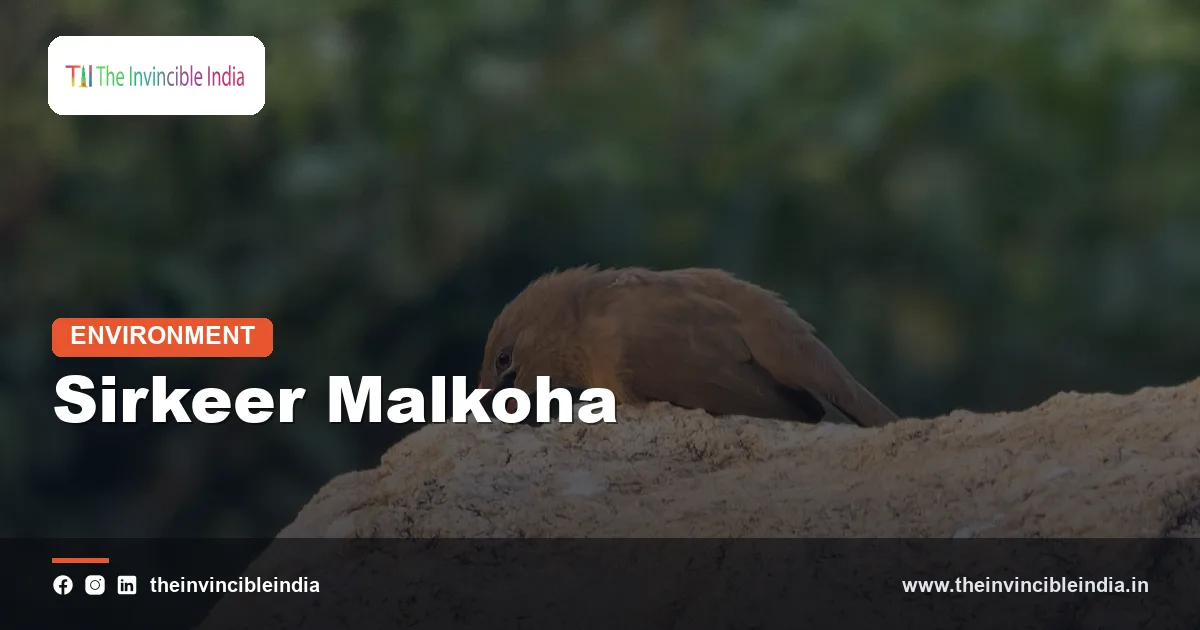
The sirkeer malkoha (Taccocua leschenaultii) is a long-tailed, ground-loving member of the cuckoo family, found in the dry scrub and thorny thickets of India, with a bright cherry-red bill that makes it easy to recognise when it is seen. Unlike many of its cuckoo relatives, it builds its own nest and raises its own chicks. It spends much of its time creeping through bushes and running across open ground rather than flying.
This guide explains what the sirkeer malkoha looks like, where it lives in India, what it eats, how it breeds and how it differs from other cuckoos and malkohas. It is meant for general readers who want a clear and accurate introduction to this unobtrusive scrub bird, which is often described as one of the most elusive of Indian cuckoos.
| Quick Facts | Sirkeer malkoha |
|---|---|
| Scientific name | Taccocua leschenaultii (the only species in its genus) |
| Other names | Sirkeer cuckoo, scrub malkoha |
| Family and order | Cuculidae (cuckoos), order Cuculiformes |
| Size | About 42 cm long, of which the tail forms a large part |
| Appearance | Dull olive-brown upperparts, buff to rufous underparts, long dark tail tipped with white, and a bright red bill with a yellow tip |
| India range and habitat | Dry scrub, thorn forest, bushy hillsides, ravines and overgrown fields across much of peninsular and central India, with related populations in the north and north-east |
| Diet | Insects such as grasshoppers, beetles and caterpillars, plus lizards and other small animals |
| Breeding | Builds its own twig nest in a bush and lays chalky white eggs; not a brood parasite |
| Conservation status | Least Concern on the IUCN Red List |
Key Takeaways
- The sirkeer malkoha (Taccocua leschenaultii) is a long-tailed cuckoo of dry scrub that measures about 42 cm and has a bright cherry-red bill.
- The sirkeer malkoha is not a brood parasite; the pair builds a twig nest and raises its own young.
- The sirkeer malkoha spends much of its time on or close to the ground, running and hopping through bushes in preference to flying.
- The sirkeer malkoha feeds mainly on insects such as grasshoppers and caterpillars, and also catches lizards and other small animals.
- The scientific name Taccocua leschenaultii honours Jean-Baptiste Leschenault de la Tour, a French botanist who collected specimens in India.
- The sirkeer malkoha is classed as Least Concern globally, but it depends on patches of scrub that are often cleared for farming and construction.
What is the sirkeer malkoha?
The sirkeer malkoha is a large, slim cuckoo of the Indian subcontinent that lives in scrub and does not lay its eggs in other birds’ nests. It belongs to the malkohas, a group of non-parasitic cuckoos that are mostly shy, long-tailed and strongly tied to bushy cover. The species is the only member of the genus Taccocua, which makes it a distinctive branch of the cuckoo family.
The common name “sirkeer” is a local-language name that has become the standard English name, and the bird is also called the sirkeer cuckoo or scrub malkoha. The bird is not a migrant. It is a resident that stays in the same patch of country through the year, and individuals are rarely found far from dense cover.
Because the sirkeer malkoha is so secretive, many people who live near it have never noticed it. It tends to be seen by chance, when it crosses a track or climbs to the top of a thorn bush to look around.
What does the sirkeer malkoha look like?
The sirkeer malkoha is a pale, olive-brown bird with a long, graduated tail and a thick, curved, cherry-red bill whose tip is yellowish. The upperparts are a dull olive-brown or greyish-brown, while the underparts are paler and often show a buff or rufous tone, especially on the belly. The tail is dark and glossy, with a broad white tip on each feather that shows clearly when the tail is fanned.
The bill is the most striking feature. It is heavy, slightly decurved and brightly coloured, and it stands out against the dull plumage. There is also a patch of bare skin around the eye that adds to the bird’s rather stern expression. Males and females look alike, and young birds are duller with a less vivid bill.
In size, the bird is roughly as long as a crow’s body, but its slender build and long tail make it look lighter. When it runs along the ground, it holds the tail low or lifts it, and the long tail acts as a balance during sharp turns.
Key identification marks
- A thick, bright red bill with a yellow tip.
- A long, dark graduated tail with white tips on the feathers.
- Dull olive-brown back and paler underparts.
- Bare reddish skin around the eye.
- A habit of running through undergrowth with the tail held out.
Where does the sirkeer malkoha live in India?
The sirkeer malkoha lives in dry scrub, thorn forest, bushy hillsides and ravines across large parts of India, as well as in neighbouring countries including Sri Lanka. Several subspecies are recognised, and they are spread from the north to the peninsula and the north-east. The species is found mostly in drier habitats, though it can occur in thickets at the edges of moister forest.
The bird prefers country with dense low cover such as thorn bushes, lantana, tall grass and dry-deciduous thickets. It also uses overgrown scrub in the foothills and the drier parts of the Deccan plateau. It is much less common in tall, closed forest and in treeless open farmland.
Within its range, the sirkeer malkoha tends to occur at low densities. A pair holds a territory and may be present for years without being noticed, which is one reason the bird is thought to be more common than casual records suggest.
What does the sirkeer malkoha eat?
The sirkeer malkoha eats mostly insects and other small animals that it finds on the ground or in low bushes. Grasshoppers, locusts, beetles, ants and caterpillars make up much of the diet, and the bird also takes spiders, small lizards, and sometimes the eggs or young of other small birds. Some fruit and seeds may be eaten, but animal food dominates.
The bird hunts by stalking. It moves quietly along the ground and through the lower branches, sometimes hopping from branch to branch, then lunges at prey with its strong bill. Prey is often beaten against a branch or the ground before it is swallowed. The strong bill allows it to handle hard-bodied insects and slippery lizards.
This diet means that the sirkeer malkoha helps to control crop-eating insects around scrub and field margins. It is therefore of value to farmers in dry regions, even though most people never see it.
How does the sirkeer malkoha behave?
The sirkeer malkoha is a shy, solitary or paired bird that prefers to run, hop and glide rather than fly long distances. It slips through undergrowth with its tail raised, and it seldom sits still in the open for long. If disturbed, it may run into cover, climb up through the branches and glide down to another bush with outstretched wings and tail.
It is often seen alone or in pairs, and occasionally in small family groups. The bird tends to forage early in the morning and in the late afternoon, resting in the shade during the heat of the day. It may sun itself by spreading its wings in the early morning.
Voice
The voice of the sirkeer malkoha is not loud and is far less familiar than the calls of better-known cuckoos. It makes low, hollow or clucking notes and short harsh calls, and the bill can also produce a clicking or snapping sound. Because the bird is so quiet and so well hidden, sound is not usually the best way to find it.
How does the sirkeer malkoha breed?
The sirkeer malkoha breeds by building its own nest and raising its own chicks, which sets it apart from brood-parasitic cuckoos such as the Asian koel. The pair builds a loose, shallow platform of twigs in a bush or low tree, often lined with leaves. The nest is usually placed a few feet above the ground, inside thick, thorny cover that gives protection from predators.
The female lays a small clutch of chalky white eggs, usually two to three. Both parents are believed to share incubation and feeding of the chicks. The young leave the nest before they can fly well and then scramble about in the branches, which is a trait shared by several non-parasitic cuckoos.
The breeding season varies by region, but it commonly coincides with the monsoon months and the period after the rains, when insect food is plentiful.
Is the sirkeer malkoha a brood parasite?
No, the sirkeer malkoha is not a brood parasite. Although it belongs to the cuckoo family, it incubates its own eggs and feeds its own young. Only a minority of the world’s cuckoo species, roughly four in ten, are brood parasites, and the malkohas, coucals and ground cuckoos are among the groups that raise their own young. The sirkeer malkoha is a good example of the diversity inside the family.
| Group | Example in India | Parental care |
|---|---|---|
| Brood-parasitic cuckoos | Common cuckoo, Asian koel, common hawk-cuckoo | Eggs are laid in other birds’ nests |
| Malkohas | Sirkeer malkoha, green-billed malkoha | Builds its own nest and raises young |
| Coucals | Greater coucal | Builds its own nest, often in dense vegetation |
How is the sirkeer malkoha different from other malkohas?
The sirkeer malkoha differs from other Indian malkohas in its red bill, its drier habitat and its ground-living habits. Malkohas of the genus Phaenicophaeus, such as the green-billed malkoha, are more closely tied to forest canopy and have greener bills. The sirkeer malkoha is a bird of the scrub floor and low bushes.
It is also mistaken for the greater coucal, a larger black and chestnut bird, and for the lesser coucal. The coucals are known as “crow pheasants” because they walk on the ground and have a similar black plumage and reddish eyes. The sirkeer malkoha, by contrast, is brownish with a red bill and white-tipped tail, and it lacks the chestnut wings that identify the coucals.
- Green-billed malkoha: a forest bird with a greenish bill and a long tail with white tips.
- Blue-faced malkoha: a green and grey bird with a bluish face patch, found in the southern forests.
- Greater coucal: a large black bird with chestnut wings and a deep “coop-coop” call.
How can you spot a sirkeer malkoha in the wild?
The best way to spot a sirkeer malkoha is to scan low thorny scrub early in the morning or late in the afternoon, when the bird comes out to feed. Look for a long-tailed bird running through bushes or climbing a thorny branch. A bright red bill can give it away even from a distance.
Patience matters, because the bird often stays in dense tangles. Walking quietly along the edge of dry scrub, listening for rustling in dead leaves and watching for movement at ground level, usually produces better results than playing recordings or crashing through the vegetation. It is best to keep a respectful distance during the breeding season.
- Visit dry scrub and thorn forest rather than dense moist forest.
- Go early in the morning or in the late afternoon.
- Look low, at ground level and in the lower branches.
- Carry binoculars, since the bird rarely allows a close approach.
Is the sirkeer malkoha threatened?
The sirkeer malkoha is classified as Least Concern by the International Union for Conservation of Nature (IUCN), meaning that it is not considered globally threatened. Its range is large and it adapts to disturbed scrub, so it has no sharp decline. Even so, it depends on patches of dense scrub that are cleared when land is converted for agriculture, housing and industry.
Other pressures include the use of pesticides, which reduce insect prey, and the burning of scrub. Because the bird is secretive, population trends are difficult to measure. In India, it is covered by the protection that the Wildlife (Protection) Act, 1972 provides for wild birds in general. Keeping patches of native scrub and thorn forest is the simplest way to support the species.
Bottom Line
The sirkeer malkoha is a long-tailed, red-billed ground cuckoo that lives quietly in Indian scrub, feeding on insects and raising its own young. It is unlike the better-known parasitic cuckoos and is an important reminder that the cuckoo family is more varied than its reputation suggests.
Frequently Asked Questions
What is a sirkeer malkoha?
A sirkeer malkoha is a long-tailed, ground-dwelling cuckoo of dry scrub in India, recognised by its thick red bill with a yellow tip. It belongs to the cuckoo family but builds its own nest. Its scientific name is Taccocua leschenaultii.
Is the sirkeer malkoha a brood parasite like other cuckoos?
No, the sirkeer malkoha is not a brood parasite. The pair builds a twig nest in a bush, incubates the eggs and feeds the chicks. This is typical of malkohas and coucals, which care for their own young.
What does the sirkeer malkoha eat?
The sirkeer malkoha eats mainly insects, including grasshoppers, beetles and caterpillars. It also catches lizards, spiders and other small animals, and it may eat some fruit. It hunts by stalking prey on the ground and in low bushes.
Where can you see a sirkeer malkoha in India?
You can see a sirkeer malkoha in dry scrub, thorn forest, bushy ravines and overgrown fields across much of India. The best time to look is early morning or late afternoon, when the bird is active. It is shy, so quiet, patient observation works best.
Can the sirkeer malkoha fly?
Yes, the sirkeer malkoha can fly, but it prefers to run, hop and glide short distances between bushes. It flies weakly and rarely travels far. This habit is why it is often described as a ground cuckoo.
Is the sirkeer malkoha an endangered bird?
No, the sirkeer malkoha is not endangered. It is listed as Least Concern by the IUCN because of its wide range. Its main risk is the loss of scrub habitat to farming and construction.
{“@context”:”https://schema.org”,”@graph”:[{“@type”:”FAQPage”,”mainEntity”:[{“@type”:”Question”,”name”:”What is a sirkeer malkoha?”,”acceptedAnswer”:{“@type”:”Answer”,”text”:”A sirkeer malkoha is a long-tailed, ground-dwelling cuckoo of dry scrub in India, recognised by its thick red bill with a yellow tip. It belongs to the cuckoo family but builds its own nest. Its scientific name is Taccocua leschenaultii.”}},{“@type”:”Question”,”name”:”Is the sirkeer malkoha a brood parasite like other cuckoos?”,”acceptedAnswer”:{“@type”:”Answer”,”text”:”No, the sirkeer malkoha is not a brood parasite. The pair builds a twig nest in a bush, incubates the eggs and feeds the chicks. This is typical of malkohas and coucals, which care for their own young.”}},{“@type”:”Question”,”name”:”What does the sirkeer malkoha eat?”,”acceptedAnswer”:{“@type”:”Answer”,”text”:”The sirkeer malkoha eats mainly insects, including grasshoppers, beetles and caterpillars. It also catches lizards, spiders and other small animals, and it may eat some fruit. It hunts by stalking prey on the ground and in low bushes.”}},{“@type”:”Question”,”name”:”Where can you see a sirkeer malkoha in India?”,”acceptedAnswer”:{“@type”:”Answer”,”text”:”You can see a sirkeer malkoha in dry scrub, thorn forest, bushy ravines and overgrown fields across much of India. The best time to look is early morning or late afternoon, when the bird is active. It is shy, so quiet, patient observation works best.”}},{“@type”:”Question”,”name”:”Can the sirkeer malkoha fly?”,”acceptedAnswer”:{“@type”:”Answer”,”text”:”Yes, the sirkeer malkoha can fly, but it prefers to run, hop and glide short distances between bushes. It flies weakly and rarely travels far. This habit is why it is often described as a ground cuckoo.”}},{“@type”:”Question”,”name”:”Is the sirkeer malkoha an endangered bird?”,”acceptedAnswer”:{“@type”:”Answer”,”text”:”No, the sirkeer malkoha is not endangered. It is listed as Least Concern by the IUCN because of its wide range. Its main risk is the loss of scrub habitat to farming and construction.”}}]}]}


