

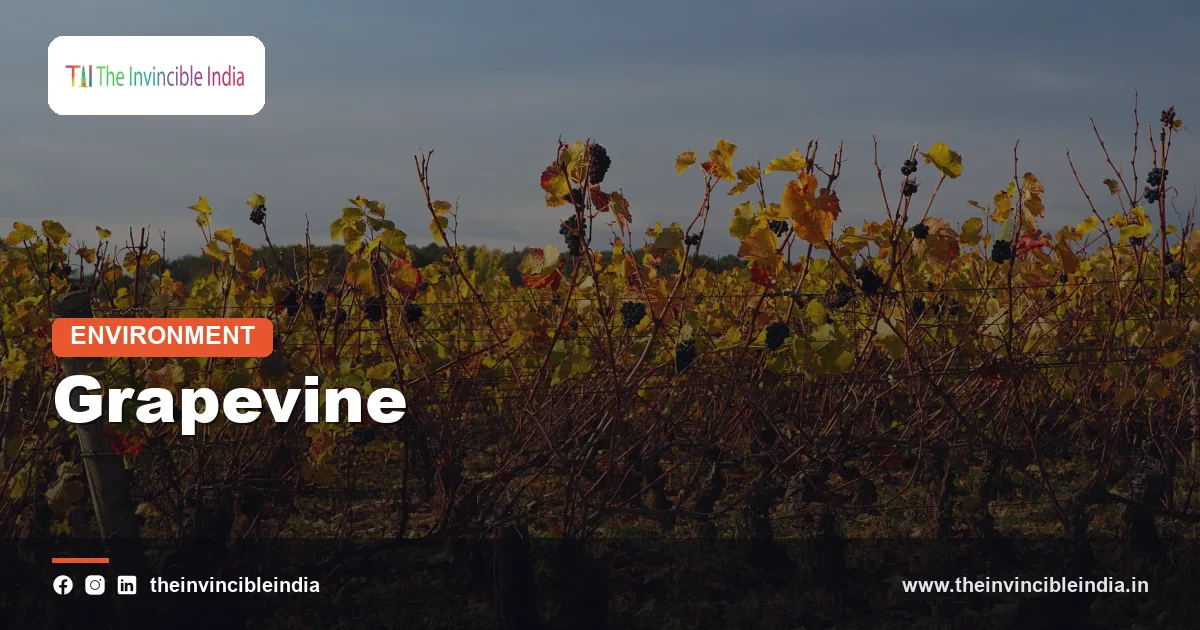
The grapevine (Vitis vinifera) is a woody, climbing, deciduous vine whose clustered berries, called grapes, are eaten fresh, dried into raisins and fermented into wine, and in India it is grown commercially in vineyards across Maharashtra, Karnataka, Tamil Nadu and Andhra Pradesh. Maharashtra, led by the Nashik region, accounts for the largest share of Indian grape production, and the grapevine there is trained over overhead frames to protect the fruit from sun and rain.
The grapevine is a perennial plant that can live and bear fruit for decades, and its fruit is India’s best-known temperate-type fruit grown in tropical conditions. This explainer, last updated 30 October 2026, covers the botany, Indian vineyards, varieties, cultivation, raisins and wine, and the everyday role of the grapevine in India.
| Quick Fact | Detail |
|---|---|
| Scientific name | Vitis vinifera (European grape); Vitis labrusca types also grown locally |
| Plant family | Vitaceae (the grape family) |
| Common Indian names | Angur (Hindi), draksha (Sanskrit, Marathi, Kannada, Telugu), thirakshai (Tamil) |
| Plant type | Perennial woody climbing vine with tendrils and lobed leaves |
| Where grown in India | Maharashtra (Nashik, Sangli, Solapur, Pune), Karnataka (Vijayapura, Bagalkot), Tamil Nadu (Theni), Andhra Pradesh and Telangana |
| Main season | Fruit pruning around October; harvest mostly from January to April in Maharashtra and Karnataka |
| Part used | Berries, dried raisins, juice, wine, seed oil and young leaves |
| Nutrition | Natural sugars, vitamin C, vitamin K, potassium and polyphenols such as resveratrol |
| Main uses | Table grapes, raisins, juice, wine, jams and exports |
Key Takeaways
- The grapevine, Vitis vinifera, is a perennial woody climber of the Vitaceae family that can bear fruit for decades.
- Maharashtra, especially the Nashik region, is the largest grape-producing state of India, and Karnataka and Tamil Nadu follow as important regions.
- Indian grapevines are usually pruned twice in a year, a foundation pruning to build the vine and a fruit pruning to trigger bunches.
- Thompson Seedless, locally called Sonaka, and its clones are the leading table and raisin grapes in India.
- Nashik is recognised as the centre of the Indian wine industry, and Nashik grapes carry a Geographical Indication (GI) tag.
- Most Indian vineyards train the vine on overhead bower, Y-shaped or other trellis systems to manage heat and disease.
What is the grapevine?
The grapevine is a long-lived, woody, climbing plant of the genus Vitis that produces bunches of juicy berries on new shoots each season. The plant climbs by forked tendrils, has large lobed leaves and sheds its leaves in cooler climates, although in the Indian tropics it may remain green for much of the year unless it is deliberately rested.
A mature grapevine has a thick, peeling trunk, arms or cordons that spread along a support, and canes that carry the fruiting buds. Flowers are tiny, greenish and borne in clusters, and most cultivated varieties are self-fertile, so no separate pollinator plant is needed. Each berry is a true berry, with a thin skin, juicy pulp and zero to four seeds.
Where does the grapevine come from?
The cultivated grapevine, Vitis vinifera, originated in the region between the Black Sea, the Caucasus and western Asia, where it was first domesticated thousands of years ago. From there, grape growing and winemaking spread across the Mediterranean, Persia and onward to the rest of the world.
Grapes reached the Indian subcontinent through trade and conquest, and travellers, rulers and gardeners cultivated them in the northwest, including Kashmir, Punjab and the Deccan, over many centuries. Modern commercial viticulture in peninsular India developed largely in the twentieth century, with the introduction of high-yielding seedless varieties and research from institutions such as the National Research Centre for Grapes in Pune, now part of the Indian Council of Agricultural Research (ICAR).
How does a grapevine grow and bear fruit?
A grapevine bears fruit on shoots that grow from buds on one-year-old canes, so the yearly pruning of the vine decides how many bunches the plant will carry. The vine first produces shoots, then flower clusters, then small green berries that swell and ripen over three to five months.
The annual cycle in Indian conditions
- Foundation pruning: usually in April to June, when the vine is cut back to build strong canes for the next crop.
- Fruit pruning: usually in October in Maharashtra, when canes are cut to a few buds, which then produce flowering shoots.
- Flowering and berry set: a few weeks after pruning, with careful control of humidity and disease.
- Berry growth and ripening: through the cool and dry winter months.
- Harvest: mostly between January and April, depending on the region and variety.
In parts of Tamil Nadu, such as the Theni and Cumbum valley, growers can take crops at different times of year because the climate has no cold winter. This double or staggered cropping is rare among the grape regions of the world and is a result of tropical conditions.
Where are grapes grown in India?
Grapes are grown mainly in Maharashtra, Karnataka, Tamil Nadu, Andhra Pradesh and Telangana, with smaller areas in Punjab and Haryana. Maharashtra produces the largest share of the national crop, and Nashik, Sangli, Solapur, Pune and Ahmednagar are its principal districts.
The Nashik region on the Deccan plateau has well-drained soils, warm days and cooler nights at altitude, which suit both table grapes and wine grapes. Karnataka grows grapes mostly around Vijayapura (earlier Bijapur) and Bagalkot, along with the Bengaluru region. Tamil Nadu’s Theni district grows the dark Panneer grape, which is a well-known local type. Exact area and tonnage change from year to year and are not given here, but India is generally counted among the larger grape producers of Asia.
What are the main grape varieties grown in India?
The main grape varieties grown in India are Thompson Seedless (Sonaka), Sharad Seedless, Tas-A-Ganesh, Anab-e-Shahi, Bangalore Blue, Flame Seedless and a set of wine grapes such as Cabernet Sauvignon, Sauvignon Blanc, Chenin Blanc and Shiraz. The same vine species supports many uses, so varieties are chosen for table, drying or wine making.
| Variety | Use and features |
|---|---|
| Thompson Seedless (Sonaka and clones) | Green-yellow seedless berries; leading variety for table use, exports and raisins |
| Tas-A-Ganesh, Sharad Seedless | Seedless mutants and selections popular for table grapes and exports |
| Anab-e-Shahi | Long, seeded white grape of the south, once widely grown in Andhra Pradesh and Karnataka |
| Bangalore Blue | Dark purple, small, seeded grape of Vitis labrusca type, used for juice and the table |
| Flame Seedless | Red seedless table grape with crisp texture |
| Cabernet Sauvignon, Shiraz | Red wine grapes grown mainly in Nashik and Karnataka |
| Sauvignon Blanc, Chenin Blanc | White wine grapes grown in the Deccan vineyards |
Grapes for the table are chosen for size, firmness, colour and seedlessness, whereas wine grapes are chosen for acidity, sugar and flavour at harvest and are often grown at lower yields to concentrate quality.
How are grapevines trained and cultivated in India?
Grapevines are cultivated in India by planting rooted cuttings or grafted vines, training them onto overhead supports and managing them through repeated pruning, drip irrigation and spraying. Planting uses cuttings grafted onto hardy rootstocks such as Dogridge, which tolerate salty soil and drought, in well-drained, light soil of moderate fertility.
Training systems
- Bower or pandal system: the vine is trained over a flat overhead framework, giving shade to bunches and high yields.
- Y-trellis: shoots are spread over two inclined planes, giving better light and spray coverage and easier work.
- Vertical shoot positioning: common for wine grapes, where shoots are tied upwards along wires.
Irrigation and nutrition
Drip irrigation is standard in modern Indian vineyards because it saves water and allows precise feeding. Water is reduced before pruning to bring the vine into a short rest and then supplied evenly during berry growth. Growers add farmyard manure and balanced fertiliser, with potash supporting sugar and colour.
Berry care
Seedless table grapes are often treated with the plant hormone gibberellic acid to lengthen the bunch and enlarge the berries, and growers thin the clusters by hand to improve size. Bunches are sometimes covered to protect them from rain, birds and sun scorch.
What diseases and pests affect grapevines?
The grapevine in India is mainly affected by fungal diseases such as downy mildew, powdery mildew and anthracnose, along with pests like mealybugs, thrips and flea beetles. Humid weather during flowering and early berry growth raises the risk of these diseases, so growers watch the weather and spray protectively.
Growers manage the problem with careful pruning to open the canopy, timed fungicide sprays, clean cultural practices and, in some cases, rain covers. Unseasonal rain or hail in the weeks before harvest can damage fruit, crack berries and cut export quality, which makes grape growing a high-investment, high-risk activity.
How are raisins made from grapes?
Raisins are made by drying ripe grapes, usually seedless Thompson Seedless berries, until most of their water is removed and the fruit becomes sweet, chewy and shelf-stable. In India raisin making is concentrated in Maharashtra and Karnataka, around towns such as Sangli, Tasgaon and Vijayapura, where dry winter and spring weather suits drying.
Bunches are often dipped in a drying emulsion that speeds drying, then spread on racks or in shaded drying sheds for about two to three weeks. The dried berries are cleaned, graded and packed. The Indian raisin trade is mostly domestic, serving sweets, dry fruit mixes and kitchens, and the product is also known as kishmish. India also uses seeded dried grapes and the larger dark munakka, which is widely used in traditional medicine and sweets.
Is India known for wine grapes?
India is an emerging wine-producing country, and Nashik in Maharashtra is generally recognised as its leading wine region, with other plantings in Karnataka and around Pune and Sangli. The modern Indian wine industry began to grow from the 1980s and expanded through the 1990s and 2000s as private wineries planted European wine grapes.
Vineyards in Nashik sit at altitudes of roughly 600 metres, which gives warm days and cooler nights that help flavour development. Wine grapes are harvested earlier than table grapes, often between January and March, and are crushed and fermented by wineries. Indian wine is regulated under food safety and state excise rules, and wine tourism has grown around Nashik, with vineyard visits and harvest-time events. Domestic consumption of wine in India is small compared with spirits and beer, though it has been growing.
Is grape good for you?
Grape is a sweet, hydrating fruit that provides natural sugars, vitamin C, vitamin K, potassium and polyphenols such as resveratrol, which is found mostly in the skin of dark grapes. A serving of grapes gives quick energy, and the dark types contain more antioxidant pigments than the pale ones.
Because grapes are high in natural sugar, people managing diabetes should follow medical advice on portions. Grapes should be washed well, since vineyard sprays may leave residues. Raisins are more concentrated in sugar and calories than fresh grapes, so smaller portions give the same amount of sugar.
How are grapes used in India?
Grapes are used in India mainly as a fresh table fruit, and they are also dried as raisins, pressed into juice, made into wine and used in desserts and traditional medicine. Exporters ship fresh table grapes from the Nashik and Sangli belts to markets in Europe, the Middle East and Asia during the Indian season, and compliance with residue standards is closely monitored.
- Fresh grapes: eaten as fruit, in fruit chaat and in salads.
- Raisins (kishmish, munakka): used in kheer, halwa, pulao, sweets and festival food.
- Juice and squash: made from local grape types such as Bangalore Blue.
- Wine and vinegar: produced by wineries and some traditional makers.
- Grape seed oil: pressed from seeds left over after winemaking.
Grape growing also sustains rural employment, as pruning, tying, thinning, harvesting and packing are labour-intensive tasks that provide seasonal work.
Bottom Line
The grapevine is a perennial woody climber that turned the Deccan plateau into one of Asia’s notable vineyard regions. Its fruit supplies the Indian table, raisin and wine trades, and its cultivation demands careful pruning, training and weather management.
Frequently Asked Questions
Which state is the largest producer of grapes in India?
Maharashtra is the largest producer of grapes in India, and the Nashik region is the main centre. Karnataka and Tamil Nadu follow as important grape-growing states. Exact production varies each year with weather and market conditions.
What is the scientific name of the grapevine?
The scientific name of the common cultivated grapevine is Vitis vinifera. It belongs to the Vitaceae family. Some Indian grapes, such as Bangalore Blue, belong to the related Vitis labrusca group.
When is the grape season in India?
The main grape season in India runs from about January to April, especially in Maharashtra and Karnataka. Growers prune in October and harvest after about three to four months. Some regions of Tamil Nadu can harvest at other times of year.
How long does a grapevine live and bear fruit?
A grapevine can live and bear fruit for several decades when well managed. A new vineyard usually gives its first commercial crop in the second or third year after planting. Yearly pruning keeps the plant productive.
Which Indian region is famous for wine grapes?
Nashik in Maharashtra is the most famous Indian region for wine grapes and is often called the wine capital of India. Its altitude, warm days and cool nights suit European wine varieties. Karnataka and the Pune and Sangli areas also grow wine grapes.
What is the difference between a raisin and a grape?
A raisin is simply a dried grape, with most of its water removed so that it becomes sweet, wrinkled and long-lasting. Raisins are usually made from seedless varieties like Thompson Seedless. They are more concentrated in sugar and calories than fresh grapes.
{“@context”:”https://schema.org”,”@graph”:[{“@type”:”FAQPage”,”mainEntity”:[{“@type”:”Question”,”name”:”Which state is the largest producer of grapes in India?”,”acceptedAnswer”:{“@type”:”Answer”,”text”:”Maharashtra is the largest producer of grapes in India, and the Nashik region is the main centre. Karnataka and Tamil Nadu follow as important grape-growing states. Exact production varies each year with weather and market conditions.”}},{“@type”:”Question”,”name”:”What is the scientific name of the grapevine?”,”acceptedAnswer”:{“@type”:”Answer”,”text”:”The scientific name of the common cultivated grapevine is Vitis vinifera. It belongs to the Vitaceae family. Some Indian grapes, such as Bangalore Blue, belong to the related Vitis labrusca group.”}},{“@type”:”Question”,”name”:”When is the grape season in India?”,”acceptedAnswer”:{“@type”:”Answer”,”text”:”The main grape season in India runs from about January to April, especially in Maharashtra and Karnataka. Growers prune in October and harvest after about three to four months. Some regions of Tamil Nadu can harvest at other times of year.”}},{“@type”:”Question”,”name”:”How long does a grapevine live and bear fruit?”,”acceptedAnswer”:{“@type”:”Answer”,”text”:”A grapevine can live and bear fruit for several decades when well managed. A new vineyard usually gives its first commercial crop in the second or third year after planting. Yearly pruning keeps the plant productive.”}},{“@type”:”Question”,”name”:”Which Indian region is famous for wine grapes?”,”acceptedAnswer”:{“@type”:”Answer”,”text”:”Nashik in Maharashtra is the most famous Indian region for wine grapes and is often called the wine capital of India. Its altitude, warm days and cool nights suit European wine varieties. Karnataka and the Pune and Sangli areas also grow wine grapes.”}},{“@type”:”Question”,”name”:”What is the difference between a raisin and a grape?”,”acceptedAnswer”:{“@type”:”Answer”,”text”:”A raisin is simply a dried grape, with most of its water removed so that it becomes sweet, wrinkled and long-lasting. Raisins are usually made from seedless varieties like Thompson Seedless. They are more concentrated in sugar and calories than fresh grapes.”}}]}]}


