

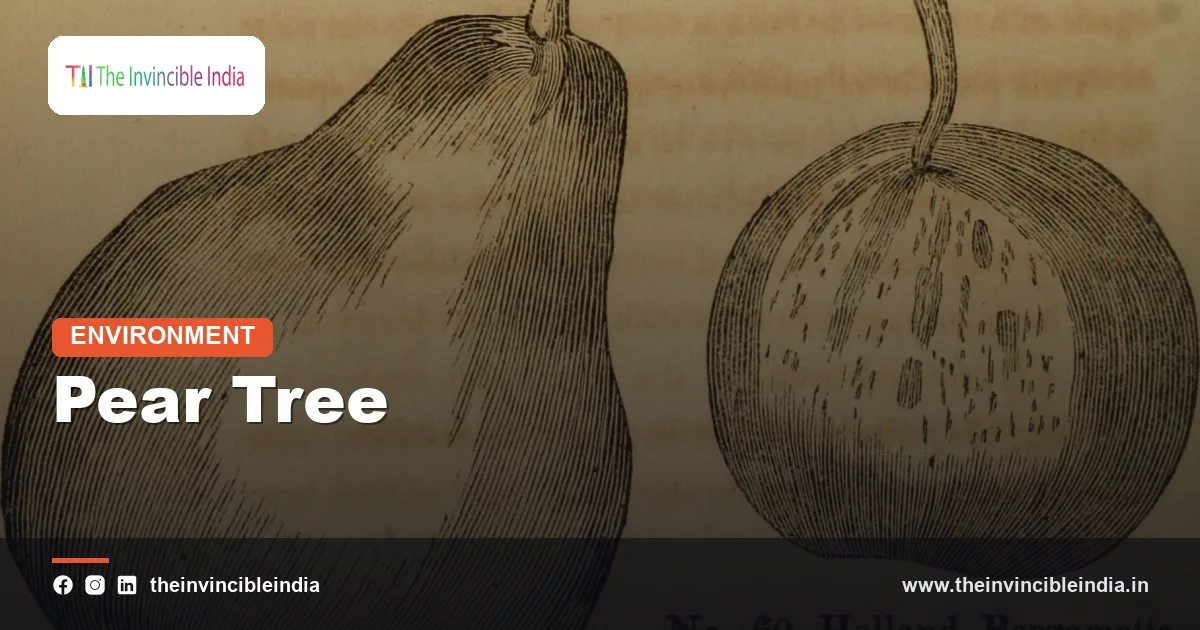
The pear tree (Pyrus species, family Rosaceae) is a deciduous fruit tree that bears the juicy, bell-shaped or round fruit known in India as nashpati, and it is grown mainly in the cool hills of the Himalayan states and, in hardier forms, in parts of the northern plains. The pear tree is a close relative of the apple, and its white spring blossom is one of the first signs of the season in Himalayan orchards. Pears are eaten fresh, stewed, dried and preserved, and the wild Himalayan pear has also served as a hardy rootstock for orchard trees.
This explainer sets out where the pear tree comes from, which species and varieties are grown in India, how the tree flowers and fruits, how an orchard is managed, and why the fruit and the tree matter to farmers in the hills and plains alike. The facts here are stable botanical and agricultural points; figures are given only as ranges or qualified estimates.
| Quick Facts: Pear Tree | |
|---|---|
| Common names | Pear tree; nashpati (Hindi); patharnakh for the hard Asian type in Punjab |
| Scientific names | Pyrus communis (European pear), Pyrus pyrifolia (Asian or sand pear), Pyrus pashia (wild Himalayan pear) |
| Family | Rosaceae, the rose family, which also includes apple, quince, plum and cherry |
| Where grown in India | Himachal Pradesh, Jammu and Kashmir, Uttarakhand, Punjab and parts of Uttar Pradesh and the north-eastern hills |
| Season | Blossom in late winter to spring; fruit ripens from early summer to early autumn depending on variety and altitude |
| Part used | Fruit (a pome); wood of some species for carving; wild seedlings as rootstock |
| Uses | Fresh eating, cooking, juice, dried slices, preserves; ornamental blossom; timber for small crafts |
| Importance | A major temperate fruit after apple in the Indian hills, supporting orchard incomes and pollinator habitat |
Key Takeaways
- The pear tree is a deciduous member of the rose family, Rosaceae, and its fruit is a pome that is called nashpati in Hindi.
- Indian pear growing rests on three groups: European pears (Pyrus communis), Asian or sand pears (Pyrus pyrifolia) and the wild Himalayan pear (Pyrus pashia).
- A pear tree needs a cold winter rest, measured as chilling hours, which is why commercial pear orchards concentrate in the Himalayan states and the cooler parts of Punjab.
- Most pear varieties need pollen from a different, compatible variety, so orchards plant pollinizer trees and depend on bees during the short blossom window.
- European pears are picked firm and ripen after harvest, while Asian pears are usually left to mature on the tree and stay crisp when eaten.
- The wild Himalayan pear, Pyrus pashia, produces small astringent fruit but is valued as a hardy seedling rootstock and as a part of mountain woodland.
What Is the Pear Tree and Where Did It Come From?
The pear tree is a medium-sized, long-lived deciduous tree in the genus Pyrus whose wild ancestors grew across a broad belt of temperate Europe and Asia. People have cultivated pears for thousands of years, and selection over that long period produced the soft, sweet European dessert pears as well as the crisp, round Asian pears. Botanists recognise roughly two dozen to thirty Pyrus species, and many of them cross freely, which is why a large number of garden varieties are hybrids.
In the wild a pear tree can grow to well over ten metres, with a narrow upright crown and glossy, oval leaves with a finely toothed edge. In an orchard the same tree is pruned and trained to a much lower height, typically a few metres, so that flowers can be thinned and fruit picked from the ground or a short ladder. The bark of an old tree becomes dark and breaks into small square plates, a feature that helps in identifying it in winter when the branches are bare.
The pear tree belongs to the same group of pome fruits as the apple and the quince. Because they are related, pear and apple share some pests and diseases, and orchards in the hills often grow both. The word nashpati in Hindi is used for the fruit generally; in Punjab the hard, gritty-skinned local pear is often called patharnakh, a name that refers to its firm, stone-like texture compared with softer types.
Which Pear Species and Varieties Are Grown in India?
Three groups of pear are grown in India: the European pear (Pyrus communis), the Asian or sand pear (Pyrus pyrifolia) and hybrids between them, with the wild Himalayan pear (Pyrus pashia) present mainly as a native tree and rootstock. Each group differs in flesh texture, chilling need and ripening behaviour, and these differences decide where each can be grown.
European pears
European pears, such as Bartlett (also sold as Williams), Conference and Packham’s Triumph, have soft, buttery flesh when ripe. They are the types most associated with the temperate hills of Himachal Pradesh and Kashmir, where winters are cold enough to give the long chilling period they need. Baggugosha is a well-known local European-type pear grown in the north Indian hills and parts of Punjab.
Asian and hybrid pears
Asian pears have round, apple-like fruit and a crisp, juicy, slightly gritty flesh that stays firm after ripening. Patharnakh is the classic Indian example and has been the main pear of the Punjab plains for a long time. Hybrids such as Kieffer and Le Conte, which come from crosses between European and Asian parents, tolerate warmer winters and have been grown in the lower foothills and plains. Punjab Agricultural University in Ludhiana has also released improved selections such as Punjab Beauty and Punjab Nectar for plain-area conditions.
The wild Himalayan pear
Pyrus pashia grows wild across the Himalayan foothills at middle altitudes, where it is known by names such as kainth or mehal in different hill languages. Its fruit is small, hard and astringent and is usually eaten only after it has softened with frost or storage. Nurseries raise its seedlings as a hardy rootstock on which cultivated varieties are grafted.
| Group | Example varieties | Texture | Typical region |
|---|---|---|---|
| European pear | Bartlett, Conference, Packham’s Triumph, Baggugosha | Soft and buttery when ripe | Cold hills of Himachal Pradesh, Kashmir, Uttarakhand |
| Asian or sand pear | Patharnakh, Early China | Crisp, juicy, slightly gritty | Punjab plains and foothills |
| Hybrid pear | Kieffer, Le Conte, Punjab Beauty, Punjab Nectar | Firm to semi-soft; often used for cooking and canning | Low hills and northern plains |
| Wild Himalayan pear | Pyrus pashia | Small, hard, astringent | Mid-altitude Himalayan woodland |
Where Does the Pear Tree Grow in India?
The pear tree grows best in the temperate hills of Himachal Pradesh, Jammu and Kashmir and Uttarakhand, with significant plantings in Punjab and smaller areas in Uttar Pradesh and the north-eastern hill states. The common thread is a winter cold enough to satisfy the tree’s dormancy requirement and a spring that is free of severe late frost.
Altitude does much of the work in the hills. European pears do well at middle to higher elevations where winter temperatures fall regularly below about 7 degrees Celsius for many weeks. Asian and hybrid pears, which need fewer chilling hours, can be taken lower down the slopes and into the plains of Punjab, Haryana and western Uttar Pradesh. In the plains the hot, humid monsoon brings its own difficulties, such as leaf spots and fruit rot, so growers there favour tougher varieties.
The soil requirement is modest compared with the climate requirement. A deep, well-drained loam with a slightly acidic to neutral reaction suits the tree, while waterlogged ground damages the roots and invites root rot. Pear trees tolerate heavier soils better than many other orchard fruit, but standing water during the growing season remains the most common cause of tree loss.
How Does the Pear Tree Flower and Bear Fruit?
The pear tree flowers once a year in spring, producing clusters of white blossoms with five petals and conspicuous red or purple anthers, and each pollinated flower can develop into a single pome. Flower buds form in the previous summer and rest through winter, and the pear tree breaks that rest only after it has accumulated enough cold hours, which is why a warm winter can delay or weaken flowering.
Pollination is a central issue. Most pear varieties are self-incompatible, which means their own pollen does not set a good crop, so growers interplant two or three compatible varieties that flower at the same time. Honey bees and wild bees carry the pollen, and the blossom period is short, so orchardists often place beehives near the rows during flowering. Pear nectar is less rich than that of many other fruit trees, so bees may visit it less eagerly when other flowers are in bloom nearby.
The fruit is a pome, a type in which the fleshy part develops mostly from the swollen flower base around the true fruit. The core holds several small dark seeds called pips. The gritty feel of many pears comes from clusters of hard cells called stone cells or sclereids, which are more numerous in Asian and wild pears than in the smooth European dessert types.
A young grafted tree usually begins to bear within a few years of planting and reaches full cropping in around eight to ten years. A well-kept pear tree stays productive for several decades, and some old trees continue to flower for far longer, which makes the pear a durable long-term investment for a hill family.
How Is a Pear Orchard Planted and Managed?
A pear orchard is established by planting grafted saplings in winter while the trees are dormant, in well-prepared pits with organic manure, and then training the young trees into a strong framework of branches. Good orchard management depends on four tasks: choosing compatible varieties, pruning, nutrition and irrigation.
Rootstock and propagation
Pear varieties do not come true from seed, so they are propagated by grafting or budding onto a rootstock. Seedlings of Pyrus pashia, Pyrus communis or Pyrus pyrifolia are used in India, and quince rootstocks are used in some places to give smaller, earlier-bearing trees. The choice of rootstock affects tree size, vigour and tolerance of wet soil.
Pruning and training
Pruning is done in the dormant season to open the canopy to light and air. Orchardists use a central leader or modified leader system for a well-spaced framework. Thinning of fruitlets in early summer improves fruit size and prevents the tree from bearing heavily one year and lightly the next, a habit called alternate bearing.
Feeding and water
Pear trees respond to balanced nutrition with farmyard manure plus nitrogen, phosphorus and potassium, and to micronutrients such as boron and zinc where soils are deficient. Water is most important at fruit set and during fruit enlargement. Many hill orchards are rainfed and rely on mulching to hold moisture, while plains orchards use basin or drip irrigation.
- Plant compatible pollinizer varieties within a short distance of the main variety.
- Prune in winter and thin fruit in early summer for better size and regular bearing.
- Mulch the tree basin to conserve moisture and limit weeds.
- Avoid waterlogging, which is the leading cause of root disease in pears.
What Pests and Diseases Affect the Pear Tree?
The pear tree is affected by a set of sap-feeding insects, fruit-boring caterpillars and fungal and bacterial diseases, the commonest in Indian orchards being pear psylla, fruit flies, codling moth, scab and leaf spot. Their severity depends on the local climate, and humid monsoon conditions generally raise disease pressure.
Pear psylla is a small jumping insect that sucks sap from young shoots and leaves and leaves behind a sticky honeydew on which black sooty mould grows. Fruit flies lay their eggs in ripening fruit, and the larvae spoil the flesh. The codling moth caterpillar tunnels into the fruit towards the core, and similar damage is also caused by other fruit borers in warm areas.
Pear scab, a fungal disease, produces dark patches on leaves and fruit and spreads in cool, damp spring weather. Leaf spots and canker diseases appear mainly during the rainy season. Fire blight, a bacterial disease that blackens shoots and flowers, is a well-known threat to pears in several parts of the world, and growers and plant-protection officers watch for it as part of orchard health.
Integrated pest management is the approach recommended by horticulture departments. It combines sanitation, such as removing fallen fruit and pruned diseased wood, with monitoring traps, timely and targeted spraying, and the protection of natural enemies of pests. Using resistant or tolerant varieties wherever available reduces the need for chemical sprays.
When Is Pear Fruit Harvested and How Is It Ripened?
Pear fruit in India is harvested from early summer to early autumn, with the exact date set by the variety and the altitude, and the fruit is picked at a stage called maturity rather than at full ripeness. Early varieties at lower elevations come first, often by June or July, while late varieties from higher orchards may be picked as late as September.
European pears are a climacteric fruit, which means they continue to ripen after being detached. Growers pick them while still hard and green and let them soften in storage or at the market, because pears allowed to ripen fully on the tree often turn mealy at the core. A traditional cue for picking is that the fruit separates easily from the spur when lifted and tilted. Asian pears such as patharnakh are generally left on the tree longer and are eaten while firm and crisp.
After harvest the fruit is graded by size and blemish, packed in cartons or crates with soft padding and sent to markets. Pears bruise easily, so careful handling matters. Cold storage extends shelf life for several weeks to months in some varieties, and growers sometimes ripen a batch at room temperature with a ripe fruit alongside, since a ripe pear releases ethylene gas that triggers softening in its neighbours.
| Stage | What happens | Approximate timing in the hills |
|---|---|---|
| Dormancy | Tree rests and accumulates chilling hours | Winter |
| Bud break and blossom | White flower clusters open; pollination by bees | Late winter to spring |
| Fruit set and thinning | Small fruitlets form; extra ones removed | Spring to early summer |
| Fruit enlargement | Fruit grows and sweetens | Summer |
| Harvest | Fruit picked mature; European types ripen off the tree | Early summer to early autumn |
| Leaf fall | Leaves turn yellow, red or brown and drop | Autumn |
What Are the Uses and Nutritional Value of Pears?
Pears are used mainly as a fresh dessert fruit, and they are also cooked, juiced, dried, canned and made into preserves; nutritionally the fruit is a source of dietary fibre, vitamin C and potassium, with a high water content and little fat. Pear skin carries a large share of the fibre, so eating the fruit unpeeled gives more of it.
Ripe European pears are eaten fresh or sliced into fruit salads and desserts, while firm hybrid types such as Kieffer are better suited to cooking, canning and jam. Pear juice and pear purée are used in processed foods, and slices can be dried in the sun or in dryers for storage. In Indian homes the fruit is also served simply, cut and sprinkled with salt or chaat masala.
The fruit contains natural sugars, notably fructose, together with sorbitol, a sugar alcohol that can have a mild laxative effect when pears are eaten in large amounts. Pears are generally regarded as a gentle fruit for many diets. Anyone managing a medical condition should rely on advice from a qualified doctor or dietitian rather than on general statements about fruit.
Beyond the fruit, the pear tree has minor uses. Its fine-grained, hard wood is valued for carving, turnery and small furniture, and its spring blossom makes it an attractive ornamental. Dry pear wood has also been used as a fuel that burns with a pleasant smell.
Why Does the Pear Tree Matter to Hill Economies and Ecology?
The pear tree matters because it gives hill farmers a second temperate fruit alongside apple, spreading risk and income across a longer harvest season, and because its blossom supports bees and other pollinators in early spring. In many hill households pear orchards are small, family-run plots that add to income from other crops.
Pear growing also draws on a network of institutions. State horticulture departments, agricultural universities and the Indian Council of Agricultural Research (ICAR) institutes provide planting material, training and varietal trials. Nurseries in Himachal Pradesh, Jammu and Kashmir and Punjab supply grafted saplings, and research aims at low-chill and disease-tolerant varieties that can widen the area suited to pear.
The ecological role of the tree extends beyond the orchard. Wild Pyrus pashia trees in the Himalayan forests offer spring nectar and autumn fruit for birds and small mammals, and their roots help hold slopes. Climate change is a growing concern for temperate fruit: warmer winters reduce chilling accumulation, and erratic spring frost can destroy open blossom, so growers and scientists monitor how the suitable zones for pear may shift.
Bottom Line
The pear tree is a long-lived Himalayan and north Indian orchard tree whose blossom, pollination needs and chilling requirement shape where and how it is grown. Its fruit, nashpati, is valued as a fresh, cooked and preserved food, and the tree itself supports hill livelihoods and pollinators. Understanding its three main groups, European, Asian and wild, makes it easier to see why a single name covers such a varied family of fruit.
Frequently Asked Questions
What is a pear tree?
A pear tree is a deciduous fruit tree of the genus Pyrus in the rose family that bears sweet, juicy pome fruit. In India the fruit is called nashpati and the tree is grown mostly in the Himalayan states and Punjab. The tree flowers in spring and can live and bear fruit for several decades.
Where is the pear tree grown in India?
The pear tree is grown mainly in Himachal Pradesh, Jammu and Kashmir, Uttarakhand and Punjab. Smaller plantings exist in Uttar Pradesh and the north-eastern hills. Cold-winter European varieties suit the high hills, while patharnakh and hybrid pears are grown in the foothills and plains.
When does a pear tree bear fruit?
A grafted pear tree usually starts bearing a few years after planting and reaches full yield in about eight to ten years. Each year it flowers in spring and the fruit is harvested from early summer to early autumn, depending on the variety and altitude. A healthy tree can remain productive for many decades.
Do pear trees need another tree for pollination?
Most pear varieties need a second compatible variety nearby because they are largely self-incompatible. Growers plant pollinizer trees that flower at the same time and rely on honey bees to carry pollen. Without cross-pollination, a tree often sets a poor crop even when it blossoms heavily.
What is the difference between nashpati and patharnakh?
Nashpati is the general Hindi name for pear, while patharnakh is a specific hard, crisp Asian-type pear grown mainly in Punjab. Nashpati may be soft and buttery, as in European varieties, whereas patharnakh stays firm and slightly gritty. Both belong to the genus Pyrus but to different species groups.
Is the pear tree affected by climate change?
Yes, because pear trees need a cold winter rest, warmer winters can reduce flowering and fruit set. Unseasonal spring frost can also damage open blossom. Researchers are therefore working on low-chill and more tolerant varieties and watching how suitable growing zones may shift.
{“@context”:”https://schema.org”,”@graph”:[{“@type”:”FAQPage”,”mainEntity”:[{“@type”:”Question”,”name”:”What is a pear tree?”,”acceptedAnswer”:{“@type”:”Answer”,”text”:”A pear tree is a deciduous fruit tree of the genus Pyrus in the rose family that bears sweet, juicy pome fruit. In India the fruit is called nashpati and the tree is grown mostly in the Himalayan states and Punjab. The tree flowers in spring and can live and bear fruit for several decades.”}},{“@type”:”Question”,”name”:”Where is the pear tree grown in India?”,”acceptedAnswer”:{“@type”:”Answer”,”text”:”The pear tree is grown mainly in Himachal Pradesh, Jammu and Kashmir, Uttarakhand and Punjab. Smaller plantings exist in Uttar Pradesh and the north-eastern hills. Cold-winter European varieties suit the high hills, while patharnakh and hybrid pears are grown in the foothills and plains.”}},{“@type”:”Question”,”name”:”When does a pear tree bear fruit?”,”acceptedAnswer”:{“@type”:”Answer”,”text”:”A grafted pear tree usually starts bearing a few years after planting and reaches full yield in about eight to ten years. Each year it flowers in spring and the fruit is harvested from early summer to early autumn, depending on the variety and altitude. A healthy tree can remain productive for many decades.”}},{“@type”:”Question”,”name”:”Do pear trees need another tree for pollination?”,”acceptedAnswer”:{“@type”:”Answer”,”text”:”Most pear varieties need a second compatible variety nearby because they are largely self-incompatible. Growers plant pollinizer trees that flower at the same time and rely on honey bees to carry pollen. Without cross-pollination, a tree often sets a poor crop even when it blossoms heavily.”}},{“@type”:”Question”,”name”:”What is the difference between nashpati and patharnakh?”,”acceptedAnswer”:{“@type”:”Answer”,”text”:”Nashpati is the general Hindi name for pear, while patharnakh is a specific hard, crisp Asian-type pear grown mainly in Punjab. Nashpati may be soft and buttery, as in European varieties, whereas patharnakh stays firm and slightly gritty. Both belong to the genus Pyrus but to different species groups.”}},{“@type”:”Question”,”name”:”Is the pear tree affected by climate change?”,”acceptedAnswer”:{“@type”:”Answer”,”text”:”Yes, because pear trees need a cold winter rest, warmer winters can reduce flowering and fruit set. Unseasonal spring frost can also damage open blossom. Researchers are therefore working on low-chill and more tolerant varieties and watching how suitable growing zones may shift.”}}]}]}


