

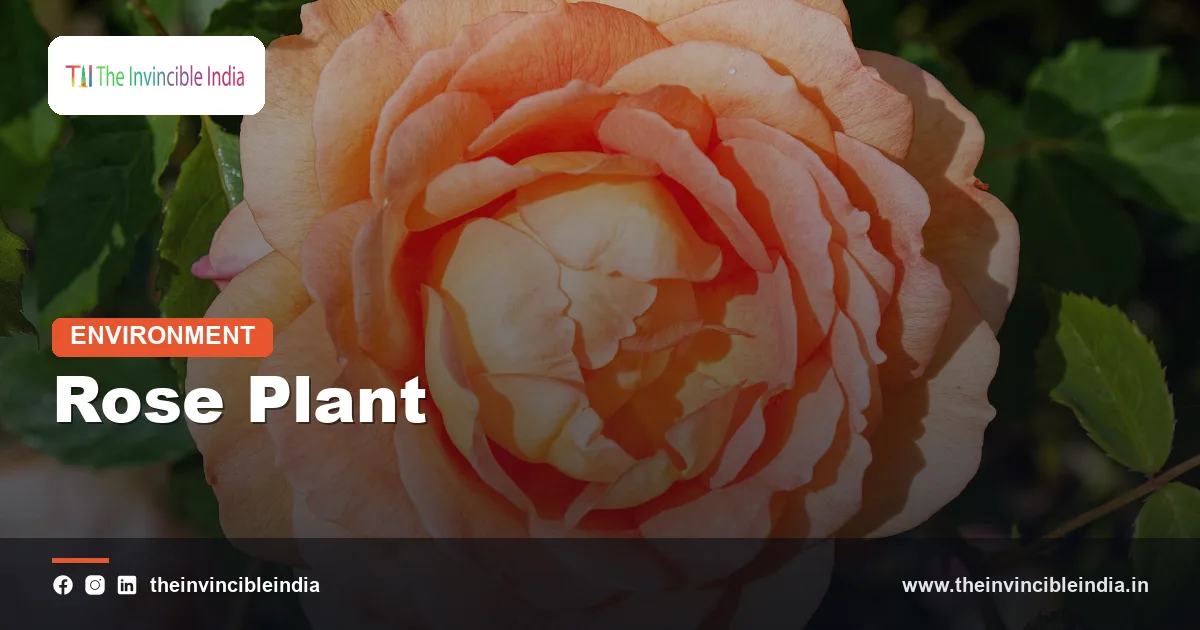
The rose plant is a perennial, usually thorny flowering shrub of the genus Rosa in the family Rosaceae, grown across India for garden blooms, garlands, rose water, gulkand and fragrant oils. Of the one hundred or more wild species of rose found across the temperate and subtropical Northern Hemisphere, only a few grow naturally in India, yet cultivated roses are among the most widely planted flowers in Indian gardens, temples, weddings and farms.
The rose plant matters in India for three overlapping reasons: it is a leading ornamental and cut-flower crop, it is the raw material of traditional rose products such as gulkand, rose water and attar, and it carries cultural meaning in poetry, festivals and worship. This explainer covers what a rose plant is, its main types, how it is grown, and how Pushkar, Haldighati and Kannauj became famous for rose products.
| Common name | Rose, rose plant (Hindi: gulab) |
|---|---|
| Scientific name | Rosa species and hybrids (for example Rosa x damascena, Rosa chinensis, Rosa bourboniana) |
| Family | Rosaceae (the rose family, which also includes apple, pear, almond and strawberry) |
| Habit | Perennial shrub or climber with prickly stems, usually 0.5 to 3 metres, some climbers much longer |
| Native range | Temperate and subtropical regions of the Northern Hemisphere; a few wild species in the Indian Himalaya |
| Where grown in India | Home gardens and parks nationwide; commercial fields in Rajasthan, Uttar Pradesh, Karnataka, Tamil Nadu and Maharashtra; polyhouses near Pune and Bengaluru |
| Flowering | Mainly late winter to spring in the plains; repeat flowering in many modern types |
| Main uses | Ornamental plant, cut flower, garlands, gulkand, rose water, attar and essential oil |
| Notable fact | Several thousand kilograms of petals are needed to produce a single kilogram of rose essential oil |
Key Takeaways
- The rose plant belongs to the genus Rosa in the family Rosaceae, and most garden roses are hybrids developed over centuries from a handful of wild species.
- The damask rose, Rosa x damascena, is the main rose used in India for rose water, gulkand and attar, and it is grown in belts around Pushkar, Haldighati and Kannauj.
- Gulkand is a traditional preserve made by layering fragrant rose petals with sugar, and it is eaten in India as a cooling sweet and in paan.
- Roses grow best in at least six hours of sun, well-drained fertile soil and yearly pruning, which in the northern plains is usually done in October.
- Modern roses are mostly grafted or budded onto a hardy rootstock, so shoots that sprout below the graft union should be removed.
- The thorns on a rose stem are botanically prickles, which are outgrowths of the outer tissue and not true thorns.
What Is a Rose Plant?
A rose plant is a woody, usually prickly perennial of the genus Rosa that produces showy, often fragrant flowers and, after flowering, fleshy red or orange fruits called hips. The genus belongs to the rose family, Rosaceae, one of the most economically important plant families in the world.
The wild rose has five petals, a ring of stamens and a central cluster of carpels. Cultivated roses have been bred to carry many more petals, giving the full, layered flower that most people picture. Leaves are pinnate, meaning that they are divided into several leaflets, usually five or seven, with toothed edges and small leaf-like stipules at the base of the leaf stalk.
The stems carry sharp prickles. People call them thorns, but botanically a thorn is a modified stem, while a prickle is a sharp outgrowth of the surface that can be removed without damaging the stem. Prickles help the plant climb and defend it from browsing animals.
Which Roses Grow Wild in India?
A small number of wild roses grow naturally in the Indian Himalaya, chiefly in temperate and subtropical hills from Jammu and Kashmir through Himachal Pradesh and Uttarakhand to the north-east. Species such as Rosa brunonii (the Himalayan musk rose), Rosa webbiana and Rosa macrophylla are the best known.
These wild roses are usually single-flowered, with white, pink or deep red petals, and they form tall, arching shrubs or scrambling climbers along forest edges, streams and hill slopes. Their small orange-red hips are eaten by birds and, in some hill communities, gathered for local use.
The roses people grow in gardens, however, are mostly of foreign origin or hybrid descent. Over centuries, roses from China, Persia, Europe and the Mediterranean were crossed, and many cultivated forms reached India through Mughal gardens, colonial botanical gardens and later through modern nurseries.
What Are the Main Types of Garden Rose?
The main types of garden rose are hybrid teas, floribundas, grandifloras, polyanthas, miniatures, climbers, shrub roses and old garden roses, each defined by plant habit and flower form. Knowing the type helps in choosing a rose for a bed, a pot, a trellis or a cut-flower crop.
| Type | Key features | Common use |
|---|---|---|
| Hybrid tea | Large, high-centred flowers, usually one per stem; upright plants | Cut flowers, exhibition, formal beds |
| Floribunda | Clusters of medium flowers; bushy and free-flowering | Mass bedding and hedges |
| Grandiflora | Tall plants with large flowers borne singly or in clusters | Backs of beds and cutting |
| Polyantha | Small flowers in large sprays on compact plants | Edging and pots |
| Miniature | Tiny plants of 20 to 40 cm with small flowers | Containers and balconies |
| Climbing rose | Long, arching canes that need support | Walls, arches and pergolas |
| Old garden and desi roses | Often highly fragrant; includes damask and Bourbon types | Fragrance, rose water, gulkand, garlands |
Two groups are especially important in India. The damask rose, Rosa x damascena, is the classic fragrant rose of the rose-water and attar industries. The Edward rose, a Bourbon-type rose widely known as “Edward gulab”, is grown in the south and elsewhere for loose flowers used in garlands and temple offerings.
Where Are Roses Grown Commercially in India?
Roses are grown commercially in India in two broad systems: open-field cultivation of fragrant desi roses for petals, garlands and distillation, and protected cultivation of hybrid tea roses for the cut-flower trade. Rajasthan, Uttar Pradesh, Karnataka, Tamil Nadu and Maharashtra are the leading rose-growing states.
Open-field desi rose belts
- Pushkar (Rajasthan): a town near Ajmer known for its fragrant rose fields, whose petals supply gulkand, rose water and temple offerings.
- Haldighati (Rajasthan): a historic area in the Aravalli hills near Udaipur, where the local pink rose, often called Chaiti gulab, is grown for petals and products.
- Kannauj (Uttar Pradesh): the traditional perfume town of north India, where roses are distilled into attar and rose water.
- Karnataka and Tamil Nadu: large fields of Edward rose and other desi roses for garlands and loose flower markets.
Protected cut-flower farming
Hybrid tea roses for bouquets and exports are grown in polyhouses and greenhouses, notably around Pune in Maharashtra and around Bengaluru and Hosur in Karnataka and Tamil Nadu. Controlled temperature and humidity allow year-round production of long, straight stems.
What Is Gulkand and How Is It Made?
Gulkand is a sweet preserve made by layering fragrant rose petals with sugar and letting the mixture mature, traditionally in sunlight, until it becomes a thick, jam-like paste. The word comes from the Persian gul, meaning rose, and qand, meaning sugar.
Traditional makers prefer the pink damask rose, because its petals carry a strong scent and a soft texture. The petals are washed, mixed with sugar, sometimes with a touch of cardamom in some local recipes, and kept in glass jars in the sun for several weeks, being stirred regularly.
In Indian households gulkand is eaten by the spoonful, added to milk, falooda and ice cream, and stuffed into paan. In Ayurvedic and Unani tradition it is described as a cooling food, especially during summer, and is taken for its pleasant taste and fragrance. These are traditional beliefs about food, and a person with diabetes or any health condition should remember that gulkand is high in sugar.
How Are Rose Water and Attar Produced?
Rose water is made by steam distillation of fresh rose petals with water, and the fragrant liquid that condenses is collected as rose water, while attar is a concentrated perfume oil captured in a base of sandalwood oil. Both products have been made in India for centuries.
The traditional deg-bhapka method
In the classic method, still used around Kannauj, petals and water are heated in a large copper pot called a deg. A bamboo pipe leads the vapour into a receiver vessel called a bhapka, which sits in a tank of cool water. The distillate is collected in the bhapka. For attar the vapour is passed into sandalwood oil, which slowly absorbs the rose fragrance over days of repeated distillation.
Why rose oil is costly
Rose oil is one of the most expensive natural perfume materials because the petals contain only a tiny amount of oil. Several thousand kilograms of petals are needed for one kilogram of oil, and the petals must be picked at dawn, before the sun evaporates the scent. A popular legend credits the Mughal empress Nur Jahan with discovering rose attar, but historians treat this as a tradition rather than a documented fact.
How Do You Grow and Care for a Rose Plant?
To grow a rose plant well, plant it in a sunny spot with at least six hours of direct light, in deep, fertile and well-drained soil, and prune it every year. Roses are heavy feeders that need steady watering, regular feeding and good air movement around the leaves.
Planting and soil
The best planting time in most of north India is October to November, when the weather is cool, while in the hills early spring is preferred. Roses like a slightly acidic to neutral soil with a pH of about 6 to 7. Dig a pit about 45 cm deep, mix in compost or farmyard manure, and plant so that the graft union sits just at or slightly above soil level.
Watering and feeding
- Water deeply two or three times a week in summer and less often in winter, keeping water off the leaves.
- Mulch the base with dry leaves or compost to hold moisture and cool the roots.
- Feed with compost or a balanced fertiliser after pruning and again when buds appear.
Pruning
Pruning keeps the plant healthy and flowering. In the northern plains the main prune is done in October, when old, dead, weak and crossing stems are cut out and the remaining canes are shortened to a few healthy buds above an outward-facing bud. Spent flowers should be removed through the season to encourage new blooms.
Why Are Roses Grafted?
Roses are grafted or budded onto a separate rootstock because many modern hybrids grow poorly on their own roots, and a vigorous rootstock gives stronger growth and better adaptation to local soil. The rootstock supplies the roots, while the grafted variety on top supplies the flowers.
In India, nurseries commonly use hardy rootstocks such as Rosa indica var. odorata and the variety known as Dr Huey. The point where the two parts join is called the graft or bud union and appears as a knobby swelling near the base of the plant.
Shoots that arise from below this union come from the rootstock, not the variety, and are called suckers. Gardeners should remove them at the point of origin because they steal the plant’s energy and may eventually take over. Old garden roses and many desi roses can also be grown from cuttings on their own roots, which is why they are easy to share between neighbours.
What Pests and Diseases Affect Rose Plants?
The main problems of rose plants in India are fungal diseases such as black spot, powdery mildew and dieback, and sap-sucking pests such as aphids, thrips and scale insects. Most of these can be limited by good air movement, clean tools and timely pruning.
| Problem | What it looks like | Basic management |
|---|---|---|
| Black spot | Round black patches on leaves that turn yellow and drop | Remove fallen leaves, avoid wet foliage, prune for airflow |
| Powdery mildew | White powdery coating on young shoots and buds | Improve air circulation, avoid excess nitrogen, remove infected tips |
| Dieback | Shoots dry from the tip downward, with dark stem patches | Cut back to healthy green wood and seal large cuts |
| Aphids | Clusters of small insects on buds and tender shoots | Wash off with water or use a soap spray |
| Thrips | Browned, deformed petals and streaked flowers | Remove affected buds and avoid dense planting |
Choosing disease-tolerant varieties and keeping the base of the plant clear of old leaves prevents many problems before they begin.
What Does the Rose Mean in Indian Culture?
In Indian culture the rose stands for love, beauty, devotion and hospitality, and it appears in worship, weddings, poetry and everyday welcome. Rose petals are offered to deities, strewn at ceremonies and woven into garlands, while rose water is sprinkled on guests as a sign of respect.
The flower is closely linked with Persian and Mughal court culture, in which gardens and the rose were central images, and this influence runs through Urdu and Hindi poetry. In popular memory, India’s first Prime Minister, Jawaharlal Nehru, is often pictured wearing a fresh rose on his jacket.
Rose-flavoured foods and drinks are also part of daily life. Rose water scents sweets such as gulab jamun and rasmalai, as well as sherbets, kheer and biryani in several regional cuisines. Large public rose gardens, such as the Zakir Hussain Rose Garden in Chandigarh, draw many visitors each season and display a wide range of varieties.
Bottom Line
The rose plant is both a garden favourite and a working crop in India, supplying cut flowers, garlands, gulkand, rose water and attar from belts such as Pushkar, Haldighati and Kannauj. With sun, good soil, yearly pruning and attention to the graft union, roses can bloom reliably in most Indian gardens.
Frequently Asked Questions
Which rose is used for gulkand and rose water in India?
The damask rose, Rosa x damascena, is the main rose used for gulkand and rose water in India. Its pink, strongly scented petals are grown in belts around Pushkar, Haldighati and Kannauj, and the same plant also supplies petals for attar and for offerings.
When should you prune a rose plant in India?
Roses are usually pruned in October in the northern plains, and in late winter or early spring in the hills. Cut out dead, weak and crossing stems, shorten the remaining canes to healthy outward-facing buds, and remove faded flowers during the season to encourage fresh blooms.
How much sun does a rose plant need?
A rose plant needs at least six hours of direct sunshine a day. In very hot parts of India, morning sun with light afternoon shade helps prevent scorched petals, but too little light gives weak growth and few flowers.
Why does my rose plant produce shoots with different leaves?
Shoots with different leaves usually come from the rootstock below the graft union, and they are called suckers. Because the rootstock is a different plant from the grafted variety, these shoots should be cut off cleanly at their base, as they weaken the flowering plant.
Is gulkand healthy to eat?
Gulkand is a traditional cooling preserve in Indian food culture, but it is mostly petals and sugar, and its health benefits are matters of tradition rather than proof. People with diabetes or those watching their sugar intake should limit it and take medical advice.
Are rose thorns real thorns?
No, the sharp structures on a rose stem are botanically prickles and not thorns. Prickles are outgrowths of the outer tissue of the stem and can be snapped off, whereas true thorns are modified stems with vascular tissue running through them.
{“@context”:”https://schema.org”,”@graph”:[{“@type”:”FAQPage”,”mainEntity”:[{“@type”:”Question”,”name”:”Which rose is used for gulkand and rose water in India?”,”acceptedAnswer”:{“@type”:”Answer”,”text”:”The damask rose, Rosa x damascena, is the main rose used for gulkand and rose water in India. Its pink, strongly scented petals are grown in belts around Pushkar, Haldighati and Kannauj, and the same plant also supplies petals for attar and for offerings.”}},{“@type”:”Question”,”name”:”When should you prune a rose plant in India?”,”acceptedAnswer”:{“@type”:”Answer”,”text”:”Roses are usually pruned in October in the northern plains, and in late winter or early spring in the hills. Cut out dead, weak and crossing stems, shorten the remaining canes to healthy outward-facing buds, and remove faded flowers during the season to encourage fresh blooms.”}},{“@type”:”Question”,”name”:”How much sun does a rose plant need?”,”acceptedAnswer”:{“@type”:”Answer”,”text”:”A rose plant needs at least six hours of direct sunshine a day. In very hot parts of India, morning sun with light afternoon shade helps prevent scorched petals, but too little light gives weak growth and few flowers.”}},{“@type”:”Question”,”name”:”Why does my rose plant produce shoots with different leaves?”,”acceptedAnswer”:{“@type”:”Answer”,”text”:”Shoots with different leaves usually come from the rootstock below the graft union, and they are called suckers. Because the rootstock is a different plant from the grafted variety, these shoots should be cut off cleanly at their base, as they weaken the flowering plant.”}},{“@type”:”Question”,”name”:”Is gulkand healthy to eat?”,”acceptedAnswer”:{“@type”:”Answer”,”text”:”Gulkand is a traditional cooling preserve in Indian food culture, but it is mostly petals and sugar, and its health benefits are matters of tradition rather than proof. People with diabetes or those watching their sugar intake should limit it and take medical advice.”}},{“@type”:”Question”,”name”:”Are rose thorns real thorns?”,”acceptedAnswer”:{“@type”:”Answer”,”text”:”No, the sharp structures on a rose stem are botanically prickles and not thorns. Prickles are outgrowths of the outer tissue of the stem and can be snapped off, whereas true thorns are modified stems with vascular tissue running through them.”}}]}]}


