

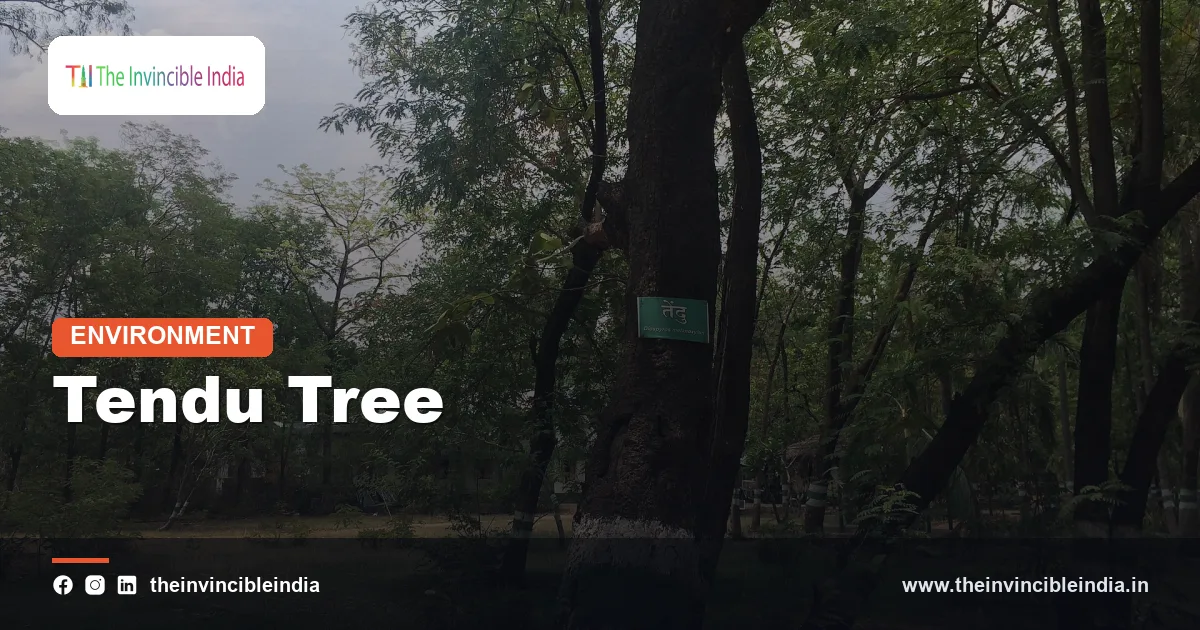
The tendu is a medium-sized deciduous forest tree of India, known scientifically as Diospyros melanoxylon and commonly called the Coromandel ebony, whose leaves are used to wrap hand-rolled bidis and whose sweet, yellow fruit is eaten across central India. Tendu is one of the most important minor forest produce species in the country, and the collection of its leaves gives seasonal income to millions of forest-dwelling families.
The tendu belongs to the ebony family, which also includes the true ebony and the persimmon. This explainer describes what the tendu looks like, where it grows, how its leaves are collected and traded, what the tree gives besides leaves, and how forest law protects the people who depend on it.
Quick Facts: Tendu Tree
| Scientific name | Diospyros melanoxylon |
|---|---|
| Common names | Tendu, Coromandel ebony, East Indian ebony; kendu in Odisha, temru in Gujarati, tembhurni in Marathi |
| Family | Ebenaceae (the ebony family) |
| Where grown in India | Dry deciduous and mixed forests of Madhya Pradesh, Chhattisgarh, Odisha, Maharashtra, Jharkhand, Telangana, Andhra Pradesh and neighbouring states |
| Part used | Leaves (for bidis), fruit (eaten), bark and seeds (folk uses) and heartwood (small, dark core) |
| Main use | Tendu leaves, called tendu patta, are the wrapper for bidis, India’s hand-rolled leaf cigarettes |
| Tree form | Deciduous tree usually 10 to 25 m tall with dark, rough bark that cracks into small blocks |
| Notable facts | Leaf trade was brought under state control in several states from the 1960s; Madhya Pradesh nationalised it in 1964 |
| Legal context | Classified as minor forest produce; collection rights for forest dwellers are recognised under the Forest Rights Act, 2006 |
Key Takeaways
- The tendu is the Indian forest tree Diospyros melanoxylon, also called the Coromandel ebony, and it belongs to the ebony family Ebenaceae.
- Tendu leaves are the traditional wrapper for bidis, which makes the tendu one of the most commercially important minor forest produce species in India.
- Tendu leaf collection takes place mostly in April to June, after leaves from pruned or fresh shoots reach the right size and texture.
- The tendu fruit is edible, round, yellowish-orange when ripe and sweet, and it is a seasonal food in many forest villages.
- Several states, beginning with Madhya Pradesh in 1964, brought the tendu leaf trade under public control so that collectors would receive fairer payment.
- The Forest Rights Act, 2006 recognises the right of eligible forest dwellers to collect and sell minor forest produce, and tendu leaf is one of its best-known examples.
What is the tendu tree?
The tendu tree is a deciduous tree of the ebony family, Diospyros melanoxylon, native to the dry and moist forests of the Indian subcontinent. The species name melanoxylon is Greek in origin and means black wood, a reference to the dark heartwood found in mature trunks.
The tendu grows as a slow-to-medium tree, commonly 10 to 25 metres tall in good forest and much shorter and shrubby on poor, dry or frequently burnt ground. The trunk is often crooked, and the crown is dense and rounded. The bark is dark grey to blackish and breaks into small rectangular plates, a feature that helps in identifying the tree even without leaves.
The leaves are simple, alternate, oval to oblong and leathery, with a smooth edge. Young leaves are often tinged pinkish or coppery before turning green, and they are covered with fine hairs when very young. Tendu flowers are small and urn-shaped, creamy-white to pale yellow, and male and female flowers usually occur on different trees, so the species is dioecious.
Why is the tendu called the Coromandel ebony?
The tendu is called the Coromandel ebony because its dark heartwood resembles true ebony and the tree grows widely in the peninsular region once known to traders as the Coromandel coast. The name East Indian ebony is also used in timber and botanical literature.
The tendu is related to Diospyros ebenum, the tree that yields the black ebony of commerce, but the tendu heartwood is smaller in quantity and often streaked. Most tendu trunks are mainly pale sapwood with a dark centre, so the tree is valued far more for its leaves than for its timber. Where heartwood is available, it is hard, heavy and fine-grained and is used for small turned items, handles and carved articles.
Where does the tendu tree grow in India?
The tendu grows mainly in the dry deciduous and mixed deciduous forests of central and peninsular India, with its densest stands in Madhya Pradesh, Chhattisgarh, Odisha, Maharashtra, Jharkhand, Telangana and Andhra Pradesh. The tree also extends to parts of Rajasthan, Gujarat, Karnataka and Uttar Pradesh, and it is found in Sri Lanka and Myanmar.
The tendu is a hardy species. It tolerates poor soils, long dry seasons and low rainfall, and it often occurs with sal, teak, mahua and other deciduous trees. It is also fire-hardy. After forest fires or cutting, the roots and stumps send up fresh shoots, and this ability to coppice is the reason tendu leaf collection can be repeated year after year.
Because the tree thrives in the same belt of forests where large numbers of Adivasi and other forest-dwelling communities live, tendu has become closely tied to rural livelihoods in these regions.
What are tendu leaves used for?
Tendu leaves are used to wrap the tobacco filling of bidis, the thin, hand-rolled leaf cigarettes that are widely smoked in India. The leaf is chosen because it is thin yet tough, flexible when slightly damp, slow to tear and able to hold its shape and burn evenly.
Bidi-making is largely a household and small-unit industry. Workers cut the dried leaves to shape, fill each piece with a small portion of tobacco, roll it and tie it with a thread. Bidis are also a public health concern because tobacco smoking causes serious disease, and Indian health policy treats bidis under the same tobacco-control framework as other tobacco products. The tendu leaf trade therefore sits at the meeting point of livelihoods, forest policy and public health.
Apart from bidi wrapping, tendu leaves have limited secondary uses in some villages, such as temporary plates or covers, but bidi manufacture accounts for the great majority of demand.
How are tendu leaves collected and processed?
Tendu leaves are collected by hand during a short season, usually from April to June, when the new flush of leaves that appears after pruning is mature enough to pluck. Families, including women and children in many villages, go into the forest early in the day and pick the leaves one by one from the lower branches.
The usual steps in the traditional process are listed below.
- Pruning: In the cooler months before the season, branches are cut back, which encourages a uniform flush of large, tender leaves instead of small, hard ones.
- Plucking: Collectors pluck leaves with the stalk, avoiding torn or damaged ones.
- Bundling: Leaves are sorted by size and quality and tied in bundles of a fixed number, traditionally about 50 leaves, called a bhandal or gaddi in many regions.
- Sun drying: Bundles are spread in the sun for a few days so that the leaves become dry but stay pliable.
- Storage and sale: Dried bundles are delivered to government-approved collection centres, called phads, where they are counted, graded and stored before auction or sale to manufacturers.
Careful drying and storage matter because damp or mouldy bundles lose their value, and poor handling can lead to heavy losses in the trade.
How is the tendu leaf trade regulated?
The tendu leaf trade is regulated by state governments, which control collection, pricing and sale through their forest departments or forest development corporations. Madhya Pradesh took over the trade in 1964 and many other tendu-producing states followed in the next decades.
Before public control, private contractors often paid collectors very low rates, and the system was widely criticised as exploitative. State control aimed to fix a standard collection rate, pay collectors directly and reduce the role of intermediaries. In a number of states, part of the net profit from tendu sales is shared with collectors as a bonus, and some funds are used for village development, health or education schemes.
Important features of the state systems are summarised here.
| Feature | How it usually works |
|---|---|
| Ownership of the trade | State forest department or a state corporation controls collection and sale in most producing states |
| Collection rate | A fixed rate per standard bundle, set by the state each season |
| Collection centres | Official centres, called phads, where bundles are received and counted |
| Sale method | Auction or tender to licensed bidi manufacturers |
| Collector benefits | Payment at the fixed rate, with a share of the profit in several states |
| Community role | In some states, village bodies and cooperatives take part in collection and trade |
Is the tendu leaf trade a source of livelihood?
Yes, the tendu leaf trade is a major seasonal livelihood in central and eastern India, since collection falls in the hot months when farm work is scarce. Tendu leaf collection supplies cash to families who may have few other earning opportunities during the dry season.
The activity involves millions of collector-days across the producing states each season, and a large number of bidi rollers earn their living further down the chain. Women make up a very large share of both collectors and rollers. For many households, tendu income pays for school fees, seed, tools and medical costs before the monsoon begins.
This dependence also creates risks. Prices are set by the state and the manufacturers, demand depends on the bidi industry, and any fall in bidi consumption would directly affect collectors. Policy discussions therefore often stress the need for alternative forest-based and non-forest income, such as processing other minor forest produce, along with better price information for collectors.
What rights do forest dwellers have over tendu leaves?
Eligible forest dwellers have a legal right to collect, use and sell minor forest produce, including tendu leaf, under the Scheduled Tribes and Other Traditional Forest Dwellers (Recognition of Forest Rights) Act, 2006, commonly called the Forest Rights Act (FRA). The Act lists the ownership, collection, use and disposal of minor forest produce among the rights it recognises.
Earlier, the Provisions of the Panchayats (Extension to the Scheduled Areas) Act, 1996, known as PESA, gave gram sabhas in Scheduled Areas ownership of minor forest produce. Together, these laws have changed the debate from a state monopoly to community-managed trade, and several village assemblies have since organised their own tendu collection and sale.
The central government also classified a long list of products as minor forest produce, and a support scheme with minimum support prices for selected items has helped to stabilise rural earnings. Tendu leaf remains one of the largest items by value in this category.
What does the tendu fruit taste like and how is it used?
The tendu fruit is round, about 2 to 4 centimetres across, yellowish to orange-brown when ripe, with a soft pulp that is sweet and slightly astringent. The ripe fruit ripens in summer and early monsoon, and children and villagers eat it fresh straight from the tree or from the ground.
The fruit has a persistent calyx at its base and contains a few large, flat seeds. Unripe fruit is astringent because of its tannin content and is not usually eaten. In rural markets, tendu fruit is sold in small quantities in season. Some communities also use the fruit and bark in traditional household remedies, but these uses rest on folk knowledge and should not be treated as medical advice.
The tendu is related to the persimmon, and the fruit shares a similar astringent character when underripe.
How does the tendu help forests and wildlife?
The tendu supports forest ecosystems by providing fruit and leaves for wildlife and by growing in fire-prone forests where few other trees recover as quickly. Birds, monkeys, langurs, bears and deer feed on the ripe fruit, and the tree is a regular part of the diet of sloth bears in central Indian forests.
The tree also has an unusual relationship with fire. In some regions, forest staff have historically used small, controlled burning or cutting of old tendu bushes to encourage a new flush of leaves. Uncontrolled fires, however, can damage forests, and forest officials warn that fires set to improve leaf growth can spread widely. For this reason, sustainable harvesting is encouraged, including plucking without breaking branches and leaving some leaves on each shoot.
What are the main uses of the tendu tree?
The main uses of the tendu are for its leaves, which are used to roll bidis, and its fruit, which is eaten, with smaller uses of its wood, bark and seeds. The list below shows each part and its typical use.
- Leaves: Bidi wrapper and the basis of a large rural trade.
- Fruit: Eaten fresh in season and sometimes sold locally.
- Heartwood: Dark, hard wood used for small articles, tool handles and carving when available.
- Sapwood and branches: Used for fuel and farm implements.
- Bark and seeds: Used in folk practice by some communities for household purposes.
Bottom Line
The tendu, or Coromandel ebony, is a hardy deciduous tree whose leaves have made it a cornerstone of India’s minor forest produce economy. Its value lies chiefly in the seasonal work it provides to forest communities, and in the legal recognition of their rights over it.
Frequently Asked Questions
What is the scientific name of the tendu tree?
The scientific name of the tendu tree is Diospyros melanoxylon. It belongs to the ebony family, Ebenaceae, and is commonly called the Coromandel ebony or East Indian ebony.
Why are tendu leaves used for making bidis?
Tendu leaves are used for bidis because they are thin, tough and flexible, and they burn evenly without tearing easily. When dried and slightly dampened, the leaf can be shaped around tobacco and tied with a thread.
In which states is tendu mostly found?
The tendu is found mostly in Madhya Pradesh, Chhattisgarh, Odisha, Maharashtra, Jharkhand, Telangana and Andhra Pradesh. These states have large tracts of dry and mixed deciduous forest where the tree grows well.
When are tendu leaves collected?
Tendu leaves are collected mainly between April and June. This is the period when the fresh leaves that appear after pruning are the right size and texture for plucking.
Is the tendu fruit edible?
Yes, the ripe tendu fruit is edible and has a sweet, slightly astringent taste. It is yellowish-orange when ripe and is eaten fresh by villagers, children and many forest animals.
Do forest dwellers have rights over tendu leaves?
Yes, eligible forest dwellers have a recognised right to collect and sell minor forest produce, including tendu leaf, under the Forest Rights Act, 2006. In Scheduled Areas, the PESA Act, 1996 also gives gram sabhas ownership of minor forest produce.
{“@context”:”https://schema.org”,”@graph”:[{“@type”:”FAQPage”,”mainEntity”:[{“@type”:”Question”,”name”:”What is the scientific name of the tendu tree?”,”acceptedAnswer”:{“@type”:”Answer”,”text”:”The scientific name of the tendu tree is Diospyros melanoxylon. It belongs to the ebony family, Ebenaceae, and is commonly called the Coromandel ebony or East Indian ebony.”}},{“@type”:”Question”,”name”:”Why are tendu leaves used for making bidis?”,”acceptedAnswer”:{“@type”:”Answer”,”text”:”Tendu leaves are used for bidis because they are thin, tough and flexible, and they burn evenly without tearing easily. When dried and slightly dampened, the leaf can be shaped around tobacco and tied with a thread.”}},{“@type”:”Question”,”name”:”In which states is tendu mostly found?”,”acceptedAnswer”:{“@type”:”Answer”,”text”:”The tendu is found mostly in Madhya Pradesh, Chhattisgarh, Odisha, Maharashtra, Jharkhand, Telangana and Andhra Pradesh. These states have large tracts of dry and mixed deciduous forest where the tree grows well.”}},{“@type”:”Question”,”name”:”When are tendu leaves collected?”,”acceptedAnswer”:{“@type”:”Answer”,”text”:”Tendu leaves are collected mainly between April and June. This is the period when the fresh leaves that appear after pruning are the right size and texture for plucking.”}},{“@type”:”Question”,”name”:”Is the tendu fruit edible?”,”acceptedAnswer”:{“@type”:”Answer”,”text”:”Yes, the ripe tendu fruit is edible and has a sweet, slightly astringent taste. It is yellowish-orange when ripe and is eaten fresh by villagers, children and many forest animals.”}},{“@type”:”Question”,”name”:”Do forest dwellers have rights over tendu leaves?”,”acceptedAnswer”:{“@type”:”Answer”,”text”:”Yes, eligible forest dwellers have a recognised right to collect and sell minor forest produce, including tendu leaf, under the Forest Rights Act, 2006. In Scheduled Areas, the PESA Act, 1996 also gives gram sabhas ownership of minor forest produce.”}}]}]}


