

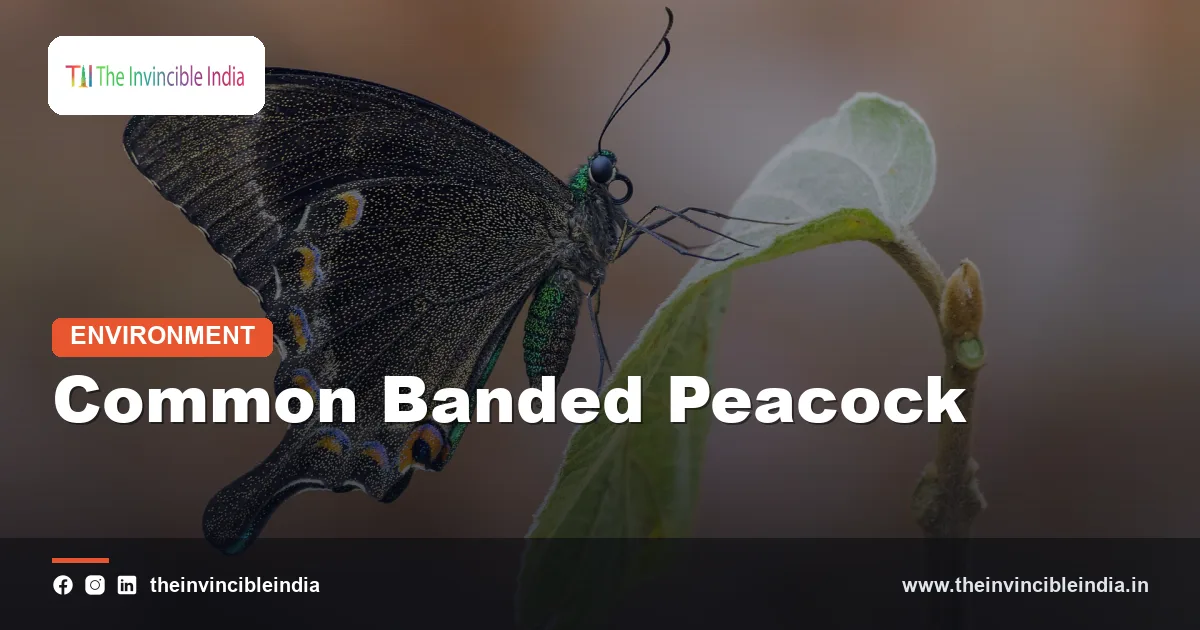
The common banded peacock is a black swallowtail butterfly, Papilio crino, with a shimmering band of blue-green scales across its wings, found in forests, plantations and well-wooded gardens across much of India and South Asia. It is a strong, quick flier that visits flowers and damp ground, and its caterpillars feed on plants of the citrus family.
The common banded peacock is the more widespread relative of the Malabar banded peacock, which lives only in the Western Ghats. This explainer describes how to recognise the common banded peacock, where it lives in India, what it eats, how its life cycle works and how to watch it without harming it.
Quick Facts: Common Banded Peacock
| Scientific name | Papilio crino |
|---|---|
| Common names | Common banded peacock; sometimes called the banded peacock |
| Family | Papilionidae (swallowtails) |
| Wingspan | Medium to large, roughly 9 to 12 cm |
| Host plants | Plants of the citrus family (Rutaceae), including wild forest species and cultivated citrus |
| Range and habitat | Himalayan foothills, north-east India, peninsular hills and the Ghats; forests, plantations, shaded gardens and forest edges; also Sri Lanka, Nepal, Bangladesh and Myanmar |
| Broods | Several broods in a year, most numerous in and after the rainy season |
| Flight | Fast and strong; flies from low shrubs to the mid canopy |
| Adult food | Flower nectar and minerals from damp soil, with males often seen mud-puddling |
Key Takeaways
- The common banded peacock, Papilio crino, is a black swallowtail butterfly with a band of shimmering blue-green scales on its wings.
- The common banded peacock occurs across a wide range, including the Himalayan foothills, north-east India, the peninsula and the Western Ghats, and extends into neighbouring countries.
- Caterpillars of the common banded peacock feed on plants of the citrus family, Rutaceae, and pass through five instars before pupating.
- The colour of the common banded peacock’s band is a structural colour, produced by the tiny ridges on the wing scales and not purely by pigment.
- The common banded peacock is a frequent visitor to flowers and wet ground, and males often gather in groups to drink minerals from mud.
- The common banded peacock is more widely distributed than the Malabar banded peacock, which is restricted to the Western Ghats.
What is the common banded peacock?
The common banded peacock is a medium-to-large swallowtail butterfly, Papilio crino, of the family Papilionidae, named for the shimmering band on its dark wings that resembles the colours of peacock feathers. It is a forest butterfly, but it also visits plantations and well-planted gardens, especially where wild citrus relatives grow.
The genus Papilio contains many of the best-known swallowtails, including the common mormon, the blue mormon and the lime butterfly. The common banded peacock was described by the Danish zoologist Johan Christian Fabricius in 1793. The word crino is part of its scientific name and has been in use for more than two centuries.
In many guides the butterfly is treated as the typical banded peacock of the Indian region, while its close relative, Papilio buddha, is distinguished as the Malabar form of the Western Ghats.
How can you identify the common banded peacock?
You can identify the common banded peacock by its black wings crossed by a broad band of shining blue-green or green scales, together with red or crimson spots on the hindwing near the margin and a short tail. The colour often seems to change from green to blue as the butterfly moves in the light.
Key identification points include the following.
- Upper side: Velvety black wings with a diffuse band of metallic blue-green scales, often broader on the hindwing.
- Hindwing: A short, spoon-shaped tail and reddish spots, especially near the lower margin.
- Underside: Browner and duller than the upper side, with pale patches and red spots.
- Behaviour: Fast, direct flight, rarely settling for long, with the wings often held open at flowers.
- Sexes: Males and females look broadly similar, though females tend to be a little larger with a slightly different pattern.
A photograph of both the upper and lower side of the wings helps to confirm the identification, since other dark swallowtails, such as the paris peacock, also carry green bands.
Why does the common banded peacock look so shimmering?
The common banded peacock looks shimmering because its blue-green band is made of structural colour, produced by the fine ridges and layers on the wing scales that reflect light in specific wavelengths. The effect is similar to the colours in a peacock feather, a soap bubble or a compact disc.
Butterfly scales are flattened hairs, overlapping like roof tiles on the wing membrane. In the shining area, each scale has microscopic ribs and thin layers that bend and interfere with light, so that the colour changes with the angle of view. In the black areas, scales contain dark pigment, mainly melanin, which absorbs light and gives the wing its deep velvet look.
This combination of dark pigment and structural colour gives swallowtails such as the common banded peacock their striking contrast.
Where does the common banded peacock live in India?
The common banded peacock lives across a wide part of India, including the Himalayan foothills, the north-east, the Eastern and Western Ghats and some hill forests of the peninsula, besides parts of Sri Lanka, Nepal, Bangladesh and Myanmar. It prefers humid, wooded country, from the plains to mid-elevation hills.
The butterfly is usually found in the following habitats.
- Moist deciduous and evergreen forest: Along streams, trails and clearings.
- Forest edges: Where sunlight reaches flowering shrubs.
- Plantations: Coffee, tea and mixed plantations that retain trees and shade.
- Gardens: Well-planted gardens near forest, especially where citrus plants or wild relatives grow.
The butterfly is not restricted to pristine forest, and this adaptability explains why it is described as common. Even so, numbers decline where forest cover is lost completely.
What do common banded peacock caterpillars eat?
Common banded peacock caterpillars eat the leaves of plants in the citrus family, Rutaceae, including several wild forest shrubs and trees and, at times, cultivated citrus. The mother butterfly lays her eggs singly on young leaves, which are soft and easy for the newly hatched caterpillars to eat.
Records of host plants vary with region, and observers in different parts of India have noted different Rutaceae species, so no single plant is the only host. Wild relatives such as Glycosmis and Atalantia and trees in the genus Zanthoxylum are commonly mentioned in butterfly literature for related swallowtails, although the exact list should be checked against local field guides.
The caterpillar is not usually a serious pest. In forests and plantations, its numbers are limited by predators and parasites, and damage to host plants is small.
What is the life cycle of the common banded peacock?
The life cycle of the common banded peacock has four stages, namely egg, caterpillar, pupa and adult, and it is completed within roughly a month or two in warm, wet conditions. Like all butterflies, the common banded peacock undergoes complete metamorphosis.
- Egg: A single round, creamy egg is laid on a young leaf of the host plant.
- Caterpillar: The young larva resembles a bird dropping, being brown with a pale patch. Later instars are green and plump, with markings that form false eyes.
- Pupa: The caterpillar attaches itself to a twig with a silk girdle and forms a pupa that is green or brown, resembling a broken stub or a leaf.
- Adult: The butterfly emerges, pumps fluid into its crumpled wings, dries them for some time and then takes its first flight.
In regions with distinct seasons, the numbers of adults rise after the first rains, when new leaves grow on host plants. In places with year-round moisture, broods overlap and adults can be seen in most months.
How does the common banded peacock defend itself?
The common banded peacock defends itself with fast flight as an adult, camouflage as an egg, young larva and pupa, and a smelly forked organ in the grown caterpillar. Predators of butterflies include birds, lizards, spiders, dragonflies and praying mantises.
The osmeterium is a bright, forked, fleshy organ that the caterpillar pushes out from just behind its head when it is touched. It releases a strong-smelling chemical secretion and is shared by nearly all swallowtail caterpillars. The sudden display, along with the false eyes on the body, can startle small predators for long enough for the caterpillar to escape.
The adult may also be damaged by attacks without being killed, and torn or notched hindwings are a common sight in older butterflies in the field.
What does the common banded peacock feed on?
The adult common banded peacock feeds on flower nectar and also drinks water and minerals from damp soil, wet sand and animal droppings. Males are often seen in small groups at stream banks, a behaviour known as mud-puddling.
The nutrients from mud are important to males, as they obtain sodium and other minerals that help them in mating and egg production. At flowers, the butterfly usually hovers or flutters its wings while sipping, instead of closing them like many smaller butterflies. It visits flowering plants such as lantana, ixora, jasmine relatives and many forest-edge shrubs.
How does the common banded peacock differ from similar swallowtails?
The common banded peacock differs from similar swallowtails in the exact colour, position and breadth of its shining band, and by its range and size. Several Indian swallowtails have a green or blue sheen, so careful comparison is needed.
| Butterfly | Scientific name | Main identification point |
|---|---|---|
| Common banded peacock | Papilio crino | Broad blue-green band; widespread distribution |
| Malabar banded peacock | Papilio buddha | Larger; endemic to the Western Ghats |
| Paris peacock | Papilio paris | Bright green patches on the hindwing and a distinct blue patch |
| Common peacock | Papilio bianor | Glossy blue-green sheen over the wings, found in hill regions |
| Blue mormon | Papilio polymnestor | Broad blue sheen on dark wings, with red body spots |
For beginners, the best approach is to note the place, the habitat and the shape of the band, and then to compare with a regional field guide or an observation platform.
When is the common banded peacock most active?
The common banded peacock is most active on warm, bright days, from the morning until the early afternoon, and it is seen in the greatest numbers during and just after the monsoon. In the cooler months and in dry spells, fewer adults are on the wing.
The butterfly spends much of its day patrolling along forest trails, stream lines and clearings, following the same route again and again. Males may defend a patch of flowers or a stretch of path for short periods. In the heat of the afternoon, it often rests among leaves in shade, wings closed, and in the evening it roosts on the underside of foliage.
Rainfall controls the timing, because fresh leaves for caterpillars appear after rain and flowers for adults bloom in the same season. Observers in hill areas therefore report the peak between the rains and the early winter.
How can you watch the common banded peacock responsibly?
You can watch the common banded peacock responsibly by observing it from a distance, photographing it without handling it and keeping to forest paths. The butterfly is easiest to approach in the morning when it is feeding, and a macro lens or binoculars lets you see the colour without disturbing it.
- Do not touch or net butterflies, since the scales on the wings are delicate.
- Do not collect specimens, because several Indian butterflies are protected and collecting without permission is illegal.
- Plant native citrus-family shrubs and nectar flowers in the garden to attract swallowtails.
- Avoid pesticides near host plants, which kill caterpillars.
- Record sightings in citizen-science projects, which help to track butterfly distributions.
Bottom Line
The common banded peacock is a widespread, black-and-blue-green swallowtail of Indian forests and gardens. It is a good starting species for butterfly watchers, and protecting its habitat and host plants keeps it flying.
Frequently Asked Questions
What is the scientific name of the common banded peacock?
The scientific name of the common banded peacock is Papilio crino. It is a swallowtail butterfly of the family Papilionidae.
Where is the common banded peacock found?
The common banded peacock is found in the Himalayan foothills, north-east India, the Ghats and other wooded parts of the peninsula. It also occurs in neighbouring countries such as Sri Lanka, Nepal, Bangladesh and Myanmar.
What do common banded peacock caterpillars eat?
Common banded peacock caterpillars eat the leaves of plants in the citrus family, Rutaceae. They include wild forest shrubs and trees and sometimes cultivated citrus.
Why is the common banded peacock shimmering green and blue?
The common banded peacock appears shimmering because of structural colour, which comes from microscopic ridges and layers on the wing scales. These reflect light differently depending on the angle, so the band looks blue or green.
What is the difference between the common and Malabar banded peacock?
The main difference is range, as the Malabar banded peacock is found only in the Western Ghats while the common banded peacock is widespread. The Malabar species is also generally larger and has a broad green-blue band.
Is the common banded peacock a rare butterfly?
No, the common banded peacock is not generally rare, and it is described as common across much of its range. Its numbers can fall quickly where forests are cleared, so it still needs wooded habitat and host plants.
{“@context”:”https://schema.org”,”@graph”:[{“@type”:”FAQPage”,”mainEntity”:[{“@type”:”Question”,”name”:”What is the scientific name of the common banded peacock?”,”acceptedAnswer”:{“@type”:”Answer”,”text”:”The scientific name of the common banded peacock is Papilio crino. It is a swallowtail butterfly of the family Papilionidae.”}},{“@type”:”Question”,”name”:”Where is the common banded peacock found?”,”acceptedAnswer”:{“@type”:”Answer”,”text”:”The common banded peacock is found in the Himalayan foothills, north-east India, the Ghats and other wooded parts of the peninsula. It also occurs in neighbouring countries such as Sri Lanka, Nepal, Bangladesh and Myanmar.”}},{“@type”:”Question”,”name”:”What do common banded peacock caterpillars eat?”,”acceptedAnswer”:{“@type”:”Answer”,”text”:”Common banded peacock caterpillars eat the leaves of plants in the citrus family, Rutaceae. They include wild forest shrubs and trees and sometimes cultivated citrus.”}},{“@type”:”Question”,”name”:”Why is the common banded peacock shimmering green and blue?”,”acceptedAnswer”:{“@type”:”Answer”,”text”:”The common banded peacock appears shimmering because of structural colour, which comes from microscopic ridges and layers on the wing scales. These reflect light differently depending on the angle, so the band looks blue or green.”}},{“@type”:”Question”,”name”:”What is the difference between the common and Malabar banded peacock?”,”acceptedAnswer”:{“@type”:”Answer”,”text”:”The main difference is range, as the Malabar banded peacock is found only in the Western Ghats while the common banded peacock is widespread. The Malabar species is also generally larger and has a broad green-blue band.”}},{“@type”:”Question”,”name”:”Is the common banded peacock a rare butterfly?”,”acceptedAnswer”:{“@type”:”Answer”,”text”:”No, the common banded peacock is not generally rare, and it is described as common across much of its range. Its numbers can fall quickly where forests are cleared, so it still needs wooded habitat and host plants.”}}]}]}


