

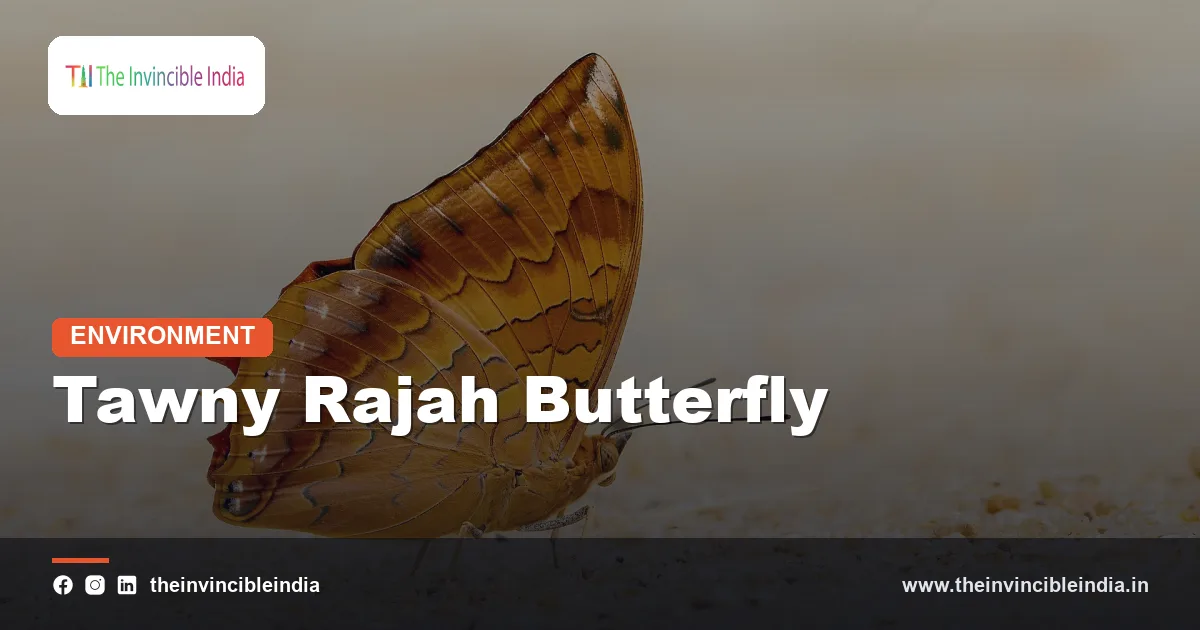
The tawny rajah is a large, powerful, tailed butterfly, Charaxes bernardus, with warm tawny-orange wings edged in black, found in the forests of the Himalayan region, north-east India and the hills of the peninsula. It is a fast, aggressive flier that feeds on tree sap, rotting fruit and dung and almost never visits flowers.
The tawny rajah belongs to the brush-footed butterfly family, Nymphalidae, and to a group known as the rajahs and nawabs. This explainer describes how to recognise the tawny rajah, where it lives in India, what its caterpillars eat, how its life cycle works and why it behaves so differently from the swallowtails and other well-known butterflies.
Quick Facts: Tawny Rajah
| Scientific name | Charaxes bernardus |
|---|---|
| Common names | Tawny rajah; the group is also called rajahs and emperors |
| Family | Nymphalidae (brush-footed butterflies), subfamily Charaxinae |
| Wingspan | Large, roughly 7 to 9 cm |
| Host plants | Trees and woody climbers, including legumes of the family Fabaceae such as Albizia species |
| Range and habitat | Himalayan foothills, north-east India and forested hills of the peninsula; also parts of South-East Asia; moist forest, forest edges and hill roads |
| Broods | Several broods in a year, with adults on the wing for much of the warmer season |
| Adult food | Tree sap, rotting fruit, dung and carrion; rarely flower nectar |
| Flight | Very fast and powerful, with sudden darts and glides |
Key Takeaways
- The tawny rajah, Charaxes bernardus, is a large tawny-orange and black butterfly of the family Nymphalidae and the subfamily Charaxinae.
- The tawny rajah has two short tails on each hindwing and a wingspan of roughly 7 to 9 cm, and it flies with great speed and power.
- Adult tawny rajahs feed on tree sap, rotting fruit, dung and carrion, and they very rarely take nectar from flowers.
- Caterpillars of the tawny rajah feed on the leaves of forest trees and climbers, including members of the pea family, and have a horned head.
- Male tawny rajahs are territorial and often perch on hilltops or high branches to watch for females and chase intruders.
- The tawny rajah belongs to a genus of about 190 or more species worldwide, and several of them occur in India.
What is the tawny rajah?
The tawny rajah is a large nymphalid butterfly, Charaxes bernardus, that is known for its tawny upper side, strong flight and habit of feeding on sap and dung. It is one of the Indian members of the genus Charaxes, a group of powerful, tailed butterflies that are called rajahs, nawabs or emperors.
The species was described by the Danish zoologist Johan Christian Fabricius in 1793. The name tawny refers to its warm orange-brown colouring, and the word rajah, meaning king, points to the status of these butterflies as dominant, territorial fliers among forest insects.
The butterfly is a member of the Nymphalidae, the largest family of butterflies, whose members are called brush-footed butterflies because the front legs of adults are small and hairy and are not used for walking.
How can you identify the tawny rajah?
You can identify the tawny rajah by its large size, tawny-orange upper side with a dark border and two small tails on each hindwing. The underside is a complex pattern of browns, greys and creamy lines that resembles dead leaves or bark.
The key features are summarised below.
- Upper side: Bright tawny-orange across much of the wings, with a broad dark brown or blackish border and dark spots.
- Tails: Two short, pointed tails on the hindwing, which are a defining feature of many rajahs.
- Underside: Cryptic, with mottled shades of brown and grey, and fine pale lines that blend into tree bark.
- Body: Thick and muscular, which supports the powerful flight muscles.
- Sexes: Females are usually larger than males, and the pattern may differ slightly.
Another similar rajah, the plain tawny rajah (Charaxes psaphon), has a plainer tawny upper side with fewer dark markings, so careful observation of the wing pattern is needed.
Where does the tawny rajah live in India?
The tawny rajah lives mainly in the wooded hills of the Himalayan region and north-east India, with populations also reported from the hills of the Western Ghats, and the species extends into parts of South-East Asia. It favours moist forest, forest edges, hill roads and stream valleys from low to mid elevations.
The butterfly usually keeps to mature tree cover, since both its caterpillars and its adult food depend on forest trees. It is seen along shaded trails, at forest clearings and near fruiting or sap-oozing trees, and it prefers warm, humid locations.
Because local subspecies and distribution records are revised from time to time, observers should check regional field guides for the exact range in each state.
What does the tawny rajah feed on?
The tawny rajah feeds on fermenting tree sap, rotting fruit, animal dung and carrion, and it seldom visits flowers. Its diet provides sugars, salts and amino acids, which are important to a powerful, energetic flier.
Many butterflies of the genus Charaxes share this feeding habit. They are attracted by the smell of fermenting fruit and droppings, and they can be lured with bait such as overripe banana, a method used by butterfly researchers. When feeding, the butterfly settles with its wings closed or half open and unfolds its long proboscis, a tube-like mouthpart, to suck up liquids.
This feeding habit is the reason the tawny rajah is rarely photographed on flowers, and it is better looked for on tree trunks, on fallen fruit and at animal droppings along forest paths.
How does the tawny rajah behave?
The tawny rajah behaves as a fast, territorial and alert butterfly, and males often perch on a prominent leaf or hilltop and dash out to chase other insects, birds and even humans that pass nearby. After a chase, the butterfly usually returns to the same perch.
This behaviour is called perching and territorial patrol. A male waits for a female and drives off rivals in short, fierce flights. The butterfly flies with rapid wing beats followed by glides, and it is extremely hard to catch in a net. When at rest, it keeps its wings closed and appears like a dead leaf on a tree trunk.
Typical features of its behaviour are as follows.
- It is wary and takes off quickly when approached.
- It settles for long periods at sap and fruit while feeding, which is when it is easiest to observe.
- It basks in sunlight on leaves or ground with the wings partly open.
- It is most active in warm, sunny weather, mostly in the morning and again in the late afternoon.
What do tawny rajah caterpillars eat?
Tawny rajah caterpillars eat the leaves of forest trees and woody climbers, including legumes in the pea family, Fabaceae, such as Albizia. The mother butterfly lays eggs singly on the leaf, and the young caterpillar feeds on the tender growth.
The caterpillar has a distinctive appearance. It is green, slug-like and tapering, with a head that carries short horns or projections, which is a trait shared by many in the subfamily Charaxinae. It rests on a mat of silk it spins on the upper surface of a leaf, where the green colour matches the leaf, and it feeds mainly at night or in cooler parts of the day.
As host plants differ in different regions, field guides and local records are the best source for any particular area.
What is the life cycle of the tawny rajah?
The life cycle of the tawny rajah has four stages, which are egg, caterpillar, pupa and adult, and it can be completed several times in a year in warm, humid regions. As with all butterflies, the tawny rajah undergoes complete metamorphosis.
- Egg: A round, pale green egg is laid singly on a leaf of the host plant.
- Caterpillar: The larva passes through several growth stages, called instars, resting on its silk pad and moulting between stages.
- Pupa: The grown caterpillar hangs from a twig or leaf and forms a compact, plump pupa that is often green and well camouflaged.
- Adult: The butterfly emerges after one to three weeks, depending on temperature, and may live for several weeks if it avoids predators.
Broods follow the warm and humid season, and adults are most numerous when trees put out new leaves and fruit is abundant.
How is the tawny rajah related to other Indian rajahs and nawabs?
The tawny rajah is related to other Indian members of the genus Charaxes, which are known as rajahs and nawabs, and all share a robust build, tailed hindwings and a taste for sap and dung. The group is placed in the subfamily Charaxinae of the Nymphalidae.
| Butterfly | Scientific name | Notable feature |
|---|---|---|
| Tawny rajah | Charaxes bernardus | Tawny-orange upper side with dark border and two tails |
| Plain tawny rajah | Charaxes psaphon | Plainer tawny colour with fewer markings |
| Black rajah | Charaxes solon | Dark wings with pale markings |
| Common nawab | Charaxes athamas | Dark wings with green or yellowish-green bands |
| Indian nawab | Charaxes bharata | Large dark butterfly with a pale, broad band |
The genus Charaxes is found in Africa, Asia and Australasia, with its greatest variety in Africa. Because the butterflies fly fast and often feed high in the canopy, they are less well known than many flower-visiting species.
Why does the tawny rajah matter for forests?
The tawny rajah matters for forests because it is part of the food web, recycles materials by feeding on sap, fruit and dung, and serves as an indicator of mature, undisturbed forest. A healthy population suggests that tree cover, fruiting trees and host plants are intact.
The butterfly is food for birds, lizards and spiders, and the caterpillar is eaten by predatory insects and birds. Its dependence on large trees means that deforestation, road building and clear-felling of forest reduce its habitat.
Conservation of the tawny rajah follows general forest conservation. Protecting fruiting and sap-yielding trees, keeping forest corridors connected and avoiding pesticide use near forest edges all help. Many Indian butterflies are protected under the Wildlife (Protection) Act, 1972, and collecting without authorisation is illegal.
How can you watch the tawny rajah?
You can watch the tawny rajah by visiting forest trails in warm weather and looking for butterflies on sap-oozing trees, fallen fruit and dung rather than on flowers. Butterfly researchers sometimes use overripe fruit as bait to attract rajahs, but this should be done only on private land or with permission, and never inside a protected area without authorisation. Rajahs are also drawn to damp patches where animals have passed, so sitting quietly beside a forest track for a while often brings one into view.
- Walk slowly and quietly, and scan tree trunks and the ground ahead.
- Look for a rapid, darting flight along forest edges and ridgelines.
- Watch perches such as high leaves and rock tops where males wait.
- Photograph from a distance, as the butterfly is easily disturbed.
- Follow park rules and avoid collecting specimens.
What threatens the tawny rajah?
The main threats to the tawny rajah are the loss and fragmentation of forest, the felling of large fruiting and sap-yielding trees, and the use of pesticides near forest edges. The butterfly needs mature trees both for its caterpillars and for the sap and fruit that feed the adults.
Expanding roads, quarries and plantations in hill regions break up forest into small patches, and strong fliers like the tawny rajah may still cross gaps but find less food and fewer host plants on the way. Climate change may also shift the ranges of forest butterflies towards higher elevations over time, though the detail differs from one species and region to another.
Scientists use butterflies such as the rajahs as indicator species. Counts made year after year along fixed forest trails show whether a forest is staying healthy, and this makes careful sightings recorded by amateur observers valuable.
Bottom Line
The tawny rajah is a powerful, tawny-orange nymphalid butterfly that lives on sap, fruit and dung in the forests of India. Its fast flight and territorial habits make it a rewarding species for patient observers, and its survival depends on mature forest.
Frequently Asked Questions
What is the scientific name of the tawny rajah?
The scientific name of the tawny rajah is Charaxes bernardus. It is a butterfly of the family Nymphalidae and the subfamily Charaxinae.
What does the tawny rajah butterfly eat?
The adult tawny rajah eats tree sap, rotting fruit, dung and carrion, and it rarely visits flowers. The caterpillars eat the leaves of forest trees and climbers, including some in the pea family.
How big is the tawny rajah?
The tawny rajah has a wingspan of roughly 7 to 9 cm. This makes it a large and powerful butterfly, with a stout body and strong flight muscles.
Why is the tawny rajah called a rajah?
The tawny rajah is called a rajah because the word means king, and butterflies of this group are large, dominant and territorial. The word tawny describes its orange-brown colour.
Where can I see the tawny rajah in India?
The tawny rajah can be seen in wooded hills of the Himalayan region, north-east India and parts of the Western Ghats. Look for it near sap-oozing trees, fallen fruit and dung along forest paths.
Does the tawny rajah visit flowers?
No, the tawny rajah very rarely visits flowers. It prefers fermenting sap, rotting fruit, dung and carrion, which supply the salts and nutrients it needs.
{“@context”:”https://schema.org”,”@graph”:[{“@type”:”FAQPage”,”mainEntity”:[{“@type”:”Question”,”name”:”What is the scientific name of the tawny rajah?”,”acceptedAnswer”:{“@type”:”Answer”,”text”:”The scientific name of the tawny rajah is Charaxes bernardus. It is a butterfly of the family Nymphalidae and the subfamily Charaxinae.”}},{“@type”:”Question”,”name”:”What does the tawny rajah butterfly eat?”,”acceptedAnswer”:{“@type”:”Answer”,”text”:”The adult tawny rajah eats tree sap, rotting fruit, dung and carrion, and it rarely visits flowers. The caterpillars eat the leaves of forest trees and climbers, including some in the pea family.”}},{“@type”:”Question”,”name”:”How big is the tawny rajah?”,”acceptedAnswer”:{“@type”:”Answer”,”text”:”The tawny rajah has a wingspan of roughly 7 to 9 cm. This makes it a large and powerful butterfly, with a stout body and strong flight muscles.”}},{“@type”:”Question”,”name”:”Why is the tawny rajah called a rajah?”,”acceptedAnswer”:{“@type”:”Answer”,”text”:”The tawny rajah is called a rajah because the word means king, and butterflies of this group are large, dominant and territorial. The word tawny describes its orange-brown colour.”}},{“@type”:”Question”,”name”:”Where can I see the tawny rajah in India?”,”acceptedAnswer”:{“@type”:”Answer”,”text”:”The tawny rajah can be seen in wooded hills of the Himalayan region, north-east India and parts of the Western Ghats. Look for it near sap-oozing trees, fallen fruit and dung along forest paths.”}},{“@type”:”Question”,”name”:”Does the tawny rajah visit flowers?”,”acceptedAnswer”:{“@type”:”Answer”,”text”:”No, the tawny rajah very rarely visits flowers. It prefers fermenting sap, rotting fruit, dung and carrion, which supply the salts and nutrients it needs.”}}]}]}


