

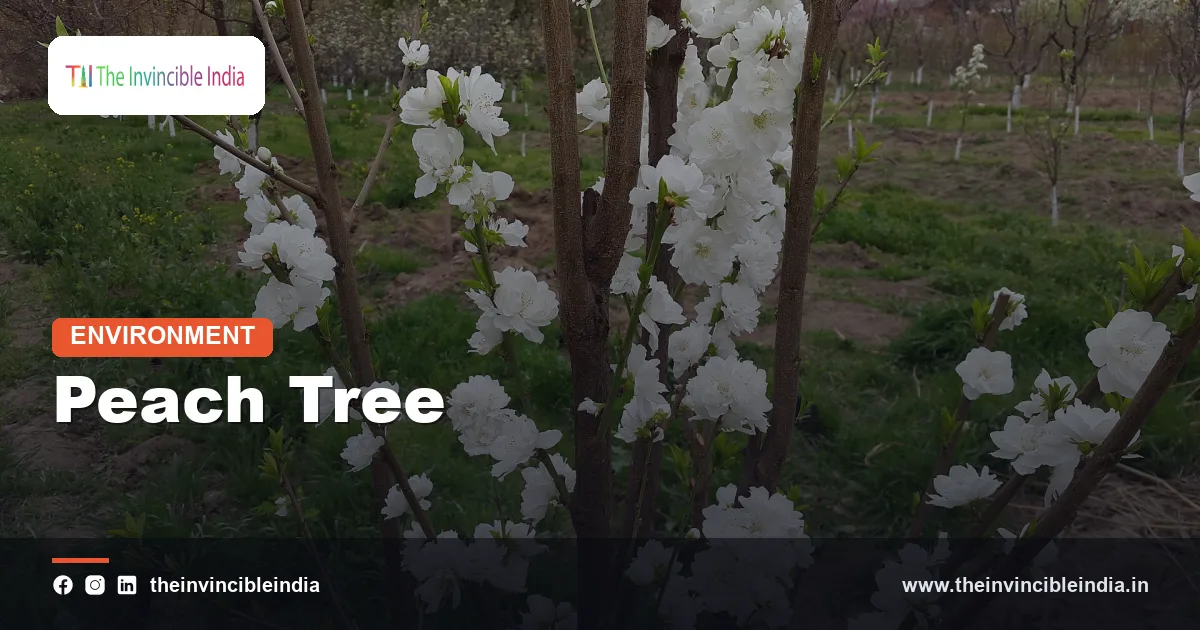
The peach (Prunus persica) is a deciduous stone-fruit tree of the rose family, grown in the Indian hills and in the subtropical plains of Punjab for its soft, juicy, fuzzy-skinned fruit, known in Hindi as aadu. It flowers with pink blossom in late winter or early spring and bears ripe fruit between May and August, depending on the variety and the altitude. Although the peach is native to China, it is now one of the most familiar temperate fruits in India’s hill orchards and in many home gardens.
This article explains what a peach tree is, where and how it is grown in India, which types and varieties exist, when it flowers and fruits, which pests and diseases affect it, and how the fruit is eaten and used.
Quick Facts
| Common name | Peach (Hindi: aadu; Persian and Urdu: shaftalu) |
|---|---|
| Scientific name | Prunus persica |
| Family | Rosaceae (the rose family) |
| Where grown in India | Himachal Pradesh, Jammu and Kashmir, Uttarakhand, the Punjab plains (low-chill varieties), the Nilgiris and hill areas of the north-east |
| Season | Pink blossom in February to March; fruit ripens from about May in the plains to August in the higher hills |
| Fruit | A round, fuzzy-skinned drupe with juicy yellow or white flesh and a single hard stone |
| Uses | Fresh eating, canning, jams, juice, desserts and ornamental blossom |
| Origin | China, where the peach has been cultivated for several thousand years |
| Notable fact | The smooth-skinned nectarine is the same species as the peach, Prunus persica |
Key Takeaways
- The peach (Prunus persica) is a deciduous tree in the rose family, Rosaceae, and is closely related to the apricot, plum, cherry and almond.
- The peach is native to China, but its species name persica comes from the old European belief that the fruit came from Persia.
- In India, the peach is grown mainly in Himachal Pradesh, Jammu and Kashmir and Uttarakhand, and low-chill varieties also succeed in the Punjab plains.
- A peach tree produces pink blossom before its leaves open, and the fruit is a fuzzy-skinned drupe that ripens from about May to August depending on altitude.
- The nectarine is not a separate species but a smooth-skinned form of the same species, Prunus persica.
- Peach growers face peach leaf curl, fruit flies and spring frost, and the tree has a relatively short productive life of roughly 12 to 20 years.
What is a peach tree?
A peach tree is a small deciduous tree, usually 3 to 6 metres tall, in the genus Prunus of the rose family, Rosaceae. It bears narrow, glossy, finely toothed leaves, pink five-petalled flowers and a rounded stone fruit with soft, fuzzy skin.
The fruit is botanically a drupe, a fleshy fruit with a single hard stone that encloses the seed. In the peach, the stone has a deeply grooved, wrinkled surface. The outer skin is covered with fine hairs, which makes it different from the smooth skin of the plum and the nectarine.
The peach is a short-lived tree compared with many fruit trees. Orchard trees usually bear well for around 12 to 20 years, after which yields fall and growers replace them with new plants. The tree responds well to pruning and is usually trained into an open, vase-like shape so that sunlight reaches the fruit.
Where did the peach come from?
The peach came from China, where it was domesticated several thousand years ago and became a symbol of spring, long life and good fortune. From China the tree spread westward along trade routes through Central Asia to Persia, and from there to the Mediterranean and Europe.
The species name persica, meaning “Persian”, records this westward journey. European botanists first met the fruit in Persia and assumed that it had originated there. The Hindi word aadu and the Persian-derived name shaftalu are both used in India, showing the long contact between the subcontinent and Central Asia.
In India, peach cultivation expanded in the hill regions through introductions of improved varieties over the last two centuries, and later through research stations and agricultural universities that developed varieties suited to low-chill conditions in the plains.
Where is the peach grown in India?
The peach is grown in India mainly in the temperate hills of Himachal Pradesh, Jammu and Kashmir and Uttarakhand, with additional cultivation in the Punjab plains, the Nilgiris and the hill states of the north-east. These regions provide the cool winter that the tree needs to flower and fruit properly.
- Himachal Pradesh: Orchards are found in Kullu, Shimla, Solan, Sirmaur and Mandi districts, mostly at mid-altitudes.
- Jammu and Kashmir: Peaches are grown in the foothills and valleys, often alongside apple, pear and plum.
- Uttarakhand: The tree grows in the Garhwal and Kumaon hills, including around Nainital and Almora.
- Punjab: Low-chill varieties are cultivated in districts near Ludhiana and in the sub-mountain belt, where the fruit ripens early in the season.
- Nilgiris and north-eastern hills: Smaller plantings and home gardens produce peaches for local markets.
Early-ripening fruit from the plains and the lower hills reaches markets first, and later crops from higher orchards extend the season through the summer.
What are the main types of peach?
The main types of peach are distinguished by the colour of the flesh, the way the flesh separates from the stone, and the texture of the skin. Growers and consumers describe peaches as yellow-fleshed or white-fleshed, clingstone or freestone, and fuzzy or smooth-skinned.
| Type | Description |
|---|---|
| Freestone | The flesh separates easily from the stone; preferred for eating fresh |
| Clingstone | The flesh clings to the stone; often used for canning and processing |
| Yellow-fleshed | Firmer, more acidic and richer in carotenoids |
| White-fleshed | Very sweet and fragrant, with low acidity and delicate flesh |
| Nectarine | Smooth-skinned form of Prunus persica, arising from a single gene difference |
| Flat (doughnut) peach | Flattened fruit with sweet white flesh, grown in small quantities |
The nectarine often surprises people because it looks like a different fruit. It is in fact the same species as the peach and differs mainly in lacking the fine surface hairs.
What varieties of peach are grown in India?
India grows both introduced and locally bred peach varieties, with low-chill selections such as Flordasun, Partap, Prabhat and Shan-e-Punjab in the plains and varieties such as Redhaven and July Elberta in the hills. The choice depends mainly on the number of cold hours available in winter.
The idea of a chilling requirement is central to peach growing. A peach tree must be exposed to a certain number of hours of cool temperature in winter to break its dormancy. If it does not receive them, flowering is poor and fruit set is weak. High-chill varieties suit the higher hills, while low-chill varieties allow cultivation in warmer regions.
- Low-chill varieties: Flordasun, Partap, Prabhat and Shan-e-Punjab are examples used in the plains and lower foothills, where winters are mild.
- Medium and high-chill varieties: Varieties such as Redhaven and July Elberta are grown in higher hill orchards, and they fruit later in the season.
- Local seedling peaches: Trees grown from stones are common in village orchards, and their fruit varies in size and taste.
Agricultural universities in Punjab and Himachal Pradesh have played a major role in testing, selecting and releasing varieties adapted to Indian conditions.
When does the peach flower and fruit?
The peach flowers in late winter or early spring, usually February to March, and the fruit ripens about three to five months later. Flowers appear before the leaves and cover the bare branches in pink, which is one of the most striking sights in the spring hills.
Peach flowers are mostly self-fertile, so a single tree can bear fruit, though bees improve the set. The blossom is, however, vulnerable. Because it opens early, a late frost or a spell of heavy rain can damage the flowers and reduce the crop.
After pollination the ovary develops into the fruit, which grows through a green stage into a coloured, scented fruit with a blush of red or pink. Peaches are picked when they are mature but still firm, and they continue to soften and sweeten after harvest. The picking window in India runs from about May in the plains to July and August in the highest orchards.
How is the peach grown?
The peach is grown from grafted or budded saplings planted in well-drained, fertile soil in full sun, with regular pruning and fruit thinning to maintain size and quality. The tree is sensitive to waterlogging, so good drainage is essential.
Main steps in cultivation include:
- Site and soil: A sunny slope with light, well-drained loam and protection from frost pockets.
- Planting: Saplings are planted in winter while dormant, with enough spacing for the open canopy.
- Pruning: Annual pruning keeps an open-centre shape and encourages new fruiting wood, since peaches bear fruit on one-year-old shoots.
- Thinning: Removing some young fruitlets gives larger, better fruit and prevents branches from breaking.
- Irrigation and nutrition: Regular watering during fruit growth and balanced fertiliser support yield.
Because the tree is relatively short-lived, orchards need a planned programme of replanting to maintain production.
What pests and diseases affect the peach?
The most common problems of the peach are peach leaf curl, fruit flies, aphids, stem borers and bacterial or fungal rots of the fruit. These problems vary by region, but leaf curl and fruit flies are widely reported in Indian orchards.
- Peach leaf curl: A fungal disease caused by Taphrina deformans, it makes young leaves thick, red and curled and can weaken the tree. It is controlled by sprays applied while the tree is dormant, before bud swell.
- Fruit flies: Female flies lay eggs under the skin of ripening fruit, and the larvae spoil the flesh. Orchard sanitation, traps and timely harvest reduce damage.
- Aphids and scale insects: They feed on sap from shoots and leaves.
- Borers: They tunnel in the trunk and branches and can kill weak trees.
- Brown rot: A fungal disease that rots ripe fruit, especially in humid weather.
Good orchard hygiene, pruning for air flow and the use of recommended plant protection practices help to limit these problems.
How is the peach eaten and used?
The peach is eaten mainly as a fresh fruit, and it is also processed into jam, juice, canned slices, squash and desserts. Because ripe peaches bruise easily and spoil quickly, processing helps growers to use fruit that cannot travel to distant markets.
In India, fresh peaches are sold in hill towns and city markets throughout the summer. They are also cut into fruit salads, added to ice cream and custard, and made into pickles and chutneys in some households. In the hills, the stone is sometimes cracked, and the kernel is used in traditional preparations, though bitter kernels should not be eaten in quantity because they contain amygdalin.
The ripe fruit is a good source of vitamin C, carotenoids (especially in yellow-fleshed types), potassium and dietary fibre, and it is relatively low in calories because of its high water content. As with any fruit, nutritional values vary by variety and ripeness.
Why is the peach culturally significant?
The peach is culturally significant mainly in East Asia, where it has symbolised spring, renewal, long life and protection for thousands of years, and its blossom has inspired poetry and art. In India, the peach has no single religious or national role, but its blossom marks the arrival of spring in many Himalayan villages.
In hill communities, the flowering of peach, apricot and plum trees is a seasonal signal, and the first fruit of the year is often shared with neighbours. Spring blossom also draws visitors to orchard valleys, which gives growers an extra source of income through local tourism.
How does the peach compare with the apricot and plum?
The peach, apricot and plum are close relatives in the genus Prunus, and they differ mainly in skin, size, flowering time and climate needs. All three are drupes with a single stone, and all three are grown in the Indian hills.
| Feature | Peach | Apricot | Plum |
|---|---|---|---|
| Scientific name | Prunus persica | Prunus armeniaca | Prunus salicina, Prunus domestica |
| Skin | Fuzzy (smooth in nectarine) | Velvety | Smooth, often waxy |
| Blossom | Pink | White to pale pink | White |
| Fruit size | Medium to large | Small to medium | Small to medium |
| Typical Indian region | Mid-altitude hills and Punjab plains | Cold, dry high valleys | Lower and middle hills |
These differences affect where each fruit can be grown. The apricot tolerates the coldest, driest valleys, the peach suits milder hills and, in low-chill forms, the plains, and the plum occupies a wide middle range.
Bottom Line
The peach is a Chinese-origin stone fruit that has settled well into India’s hill orchards and, through low-chill varieties, into the plains of Punjab. Its pink spring blossom, juicy summer fruit and close kinship with the nectarine make it one of the best-known temperate fruits in the country.
Frequently Asked Questions
What is the scientific name of the peach?
The scientific name of the peach is Prunus persica. It belongs to the rose family, Rosaceae, along with the apricot, plum, cherry and almond. The word persica means Persian, although the tree is native to China.
Where are peaches grown in India?
Peaches are grown in India mainly in Himachal Pradesh, Jammu and Kashmir and Uttarakhand, with low-chill varieties also cultivated in the Punjab plains. Smaller plantings exist in the Nilgiris and in the hill states of the north-east. The tree needs a cool winter to flower and fruit properly.
When is the peach season in India?
The peach season in India runs from about May to August, depending on variety and altitude. Early low-chill varieties from the plains ripen first, followed by hill orchards in June and July. Trees flower in February or March, well before the fruit appears.
Is a nectarine the same as a peach?
Yes, a nectarine is the same species as a peach, Prunus persica, but it has smooth skin instead of fuzzy skin. The difference comes from a single gene. Nectarines and peaches can even appear on the same tree in rare cases.
What is a low-chill peach?
A low-chill peach is a variety that needs only a small number of cold hours in winter to flower and fruit properly. Such varieties, including Flordasun, Partap and Shan-e-Punjab, allow peaches to be grown in warmer areas such as the Punjab plains. High-chill varieties need a longer cold period and suit higher hill orchards.
What is peach leaf curl?
Peach leaf curl is a fungal disease caused by Taphrina deformans that makes young peach leaves thick, curled and reddish. It weakens the tree and can reduce the crop. Growers usually control it with protective sprays applied while the tree is dormant.
{“@context”:”https://schema.org”,”@graph”:[{“@type”:”FAQPage”,”mainEntity”:[{“@type”:”Question”,”name”:”What is the scientific name of the peach?”,”acceptedAnswer”:{“@type”:”Answer”,”text”:”The scientific name of the peach is Prunus persica. It belongs to the rose family, Rosaceae, along with the apricot, plum, cherry and almond. The word persica means Persian, although the tree is native to China.”}},{“@type”:”Question”,”name”:”Where are peaches grown in India?”,”acceptedAnswer”:{“@type”:”Answer”,”text”:”Peaches are grown in India mainly in Himachal Pradesh, Jammu and Kashmir and Uttarakhand, with low-chill varieties also cultivated in the Punjab plains. Smaller plantings exist in the Nilgiris and in the hill states of the north-east. The tree needs a cool winter to flower and fruit properly.”}},{“@type”:”Question”,”name”:”When is the peach season in India?”,”acceptedAnswer”:{“@type”:”Answer”,”text”:”The peach season in India runs from about May to August, depending on variety and altitude. Early low-chill varieties from the plains ripen first, followed by hill orchards in June and July. Trees flower in February or March, well before the fruit appears.”}},{“@type”:”Question”,”name”:”Is a nectarine the same as a peach?”,”acceptedAnswer”:{“@type”:”Answer”,”text”:”Yes, a nectarine is the same species as a peach, Prunus persica, but it has smooth skin instead of fuzzy skin. The difference comes from a single gene. Nectarines and peaches can even appear on the same tree in rare cases.”}},{“@type”:”Question”,”name”:”What is a low-chill peach?”,”acceptedAnswer”:{“@type”:”Answer”,”text”:”A low-chill peach is a variety that needs only a small number of cold hours in winter to flower and fruit properly. Such varieties, including Flordasun, Partap and Shan-e-Punjab, allow peaches to be grown in warmer areas such as the Punjab plains. High-chill varieties need a longer cold period and suit higher hill orchards.”}},{“@type”:”Question”,”name”:”What is peach leaf curl?”,”acceptedAnswer”:{“@type”:”Answer”,”text”:”Peach leaf curl is a fungal disease caused by Taphrina deformans that makes young peach leaves thick, curled and reddish. It weakens the tree and can reduce the crop. Growers usually control it with protective sprays applied while the tree is dormant.”}}]}]}


