

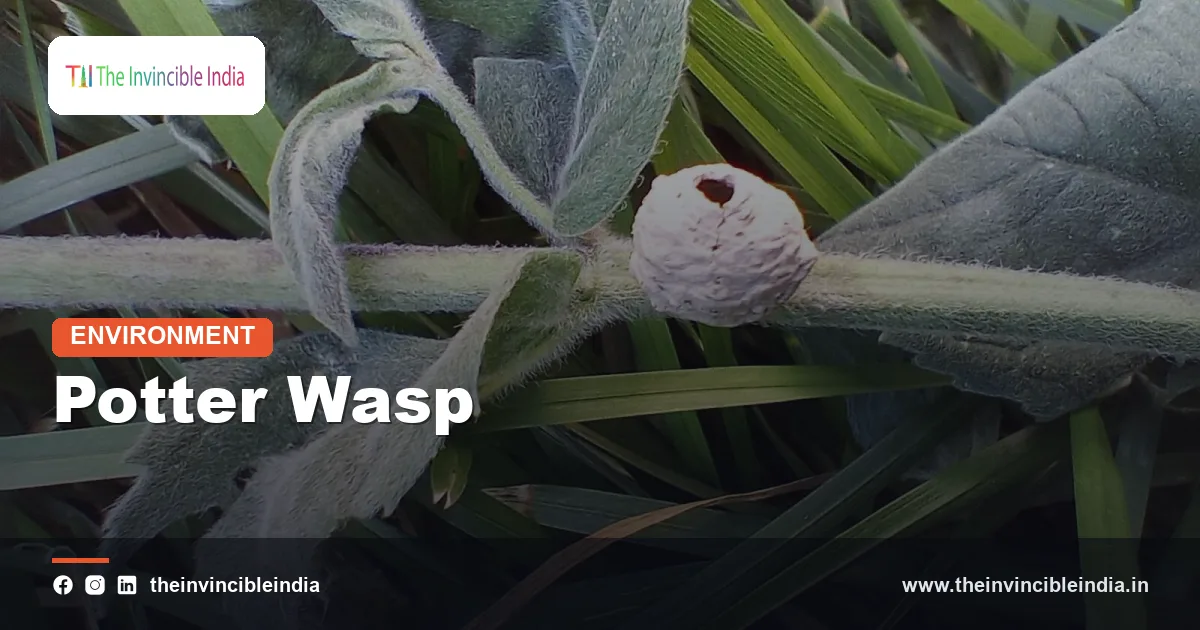
A potter wasp is a solitary wasp of the subfamily Eumeninae, family Vespidae, that moulds small round pots of mud on walls, twigs and rock faces and fills each pot with paralysed caterpillars to feed a single grub. In India, potter wasps such as species of Delta and Eumenes are common around houses, and they are harmless to people unless handled roughly.
The potter wasp is one of the most skilful builders among Indian insects, and its tiny clay jars are often mistaken for something made by a human potter. This article explains what a potter wasp is, how it builds and stocks its pot, whether it can sting, and why it is a welcome visitor.
| Quick Facts | Potter wasp |
|---|---|
| Scientific group | Subfamily Eumeninae (genera such as Delta and Eumenes) |
| Family | Vespidae, the family that also includes paper wasps and hornets |
| Size | Roughly 1 to 3 cm long, depending on species, with a slender waist |
| Habitat in India | Houses, verandas, walls, ceilings, garden twigs, rock faces and forest edges |
| Diet | Adults drink nectar; larvae eat paralysed caterpillars (some species use beetle larvae) |
| Nest | A small mud pot, often round with a short neck, attached to a wall, twig or stone |
| Life cycle | Egg, grub inside the sealed pot, pupa, then adult; often several generations a year in warm climates |
| Social behaviour | Solitary; each female builds and stocks her own nest, with no colony |
| Ecological role | Controls caterpillar populations and visits flowers for nectar |
Key Takeaways
- A potter wasp is a solitary wasp in the subfamily Eumeninae of the family Vespidae that builds small pots out of mud.
- Each potter wasp pot is stocked by the mother with paralysed caterpillars, which serve as fresh food for her single developing grub.
- A potter wasp does not live in a colony and does not defend a large nest, so it is much less likely to sting than a hornet or paper wasp.
- The potter wasp builds the pot from soil moistened with water, shaping it by hand like a tiny potter and leaving a small opening for entry.
- Adult potter wasps feed on nectar, while the larvae feed only on the caterpillars that the mother brings.
- Potter wasps help to control caterpillar pests in gardens and are best left undisturbed.
What is a potter wasp?
A potter wasp is a member of the wasp subfamily Eumeninae, which is part of the same family, Vespidae, as hornets, yellowjackets and paper wasps. The name comes from the neat clay jars these insects build for their young.
Unlike the better-known social wasps, a potter wasp lives alone. A female does not belong to a colony and has no workers. She builds, provisions and seals her nests by herself, and she does not guard them after sealing. The family therefore consists of a mother and her offspring, who never meet.
The subfamily Eumeninae is very large, with well over a thousand species worldwide, and members are often called mason wasps or potter wasps. In India, commonly noticed genera include Delta and Eumenes, which make pots in or near buildings. Other genera nest in hollow stems, beetle burrows or the ground.
A potter wasp is elegant in shape. It is usually black, often with yellow, orange or reddish bands, and has a narrow waist that connects the thorax to the abdomen. Some species have a long, stalk-like first abdominal segment, which gives them a slender, graceful outline.
How does a potter wasp build its pot?
A potter wasp builds its pot by collecting wet mud, carrying it in her jaws and shaping it layer by layer into a small hollow vessel. The mud is made by mixing soil with water, which the wasp often carries in her body and spits onto dry ground.
The process follows a clear order:
- The female selects a site, such as a wall, ceiling corner, twig, door frame or rock.
- She collects a pellet of moist soil, sometimes softening dry earth with water.
- She carries the pellet to the site and presses it into a ring.
- She adds ring upon ring, shaping the walls with her jaws and front legs, until the pot is formed.
- She forms a small opening at the top, often with a neck or flared rim.
One pot may need many trips for mud, and a finished pot is usually the size of a small marble or a large pea, depending on the species. The surface often shows tiny ridges where the pellets were laid.
Why a pot shape?
The rounded shape gives strength with little material, and the narrow opening makes the nest easier to seal and harder for enemies to enter. A smooth inside also helps keep the stored caterpillars and the growing larva safe.
Where are pots found?
Pots may be found under eaves, behind pictures, in unused drawers, on window frames, on the underside of leaves and on stems. Some species build a row of pots joined together, while others place one pot at a time. In houses, a nest is often tucked into a corner that is quiet and dry.
What does a potter wasp put inside its pot?
A potter wasp puts paralysed caterpillars inside its pot as food for its larva, along with a single egg. The caterpillars are stung by the mother so that they stay alive but cannot move, which keeps them fresh until the larva eats them.
The mother hunts small caterpillars, often of moths and leaf-rolling species, and carries each one back to the pot. She stings the prey with precise venom that blocks movement. A pot may be stocked with several caterpillars, and the number depends on the species and the size of the prey.
Before filling the pot, many potter wasps lay the egg first. In some Eumenes species, the egg is suspended on a fine silk-like thread from the pot’s ceiling. This hanging position keeps the egg safe from struggling prey. After the larva hatches, it feeds on the caterpillars one by one.
When the pot is stocked, the mother seals the opening with a mud plug and leaves. The sealed pot then works as nursery, pantry and shelter for the developing young.
Which prey?
Most potter wasps take caterpillars, but some species also hunt small beetle larvae. By removing caterpillars from the garden, the wasp acts as a natural pest controller.
What is the life cycle of a potter wasp?
The potter wasp has a complete life cycle of egg, larva, pupa and adult, with development taking place inside the sealed pot. The time depends on temperature, and in warm parts of India there can be more than one generation in a year.
| Stage | What happens | Where |
|---|---|---|
| Egg | Laid by the mother in a newly built pot, often hung from a thread | Inside the pot |
| Larva | A pale, legless grub that eats the stored caterpillars | Inside the sealed pot |
| Pupa | The larva spins a thin cocoon and transforms | Inside the sealed pot |
| Adult | Chews a hole through the mud wall, emerges, feeds on nectar and mates | Outside, around flowers and nest sites |
In warm weather, a generation may take only a few weeks, but in cooler or drier months the larva may remain inactive for a longer period. Some species spend the dry or cold season as a fully grown larva inside the pot and finish development when conditions improve.
The adult wasp emerges by gnawing a round exit hole in the pot’s wall. Old pots with a single neat hole are the evidence that a wasp has completed its development inside.
Is a potter wasp dangerous or aggressive?
A potter wasp is not considered dangerous, because it is solitary, has no colony to defend and rarely stings people. Stings are possible if the wasp is squeezed, trapped in clothing or handled, but they are uncommon and typically mild compared with those of social wasps.
Social wasps such as hornets and paper wasps defend a large nest packed with larvae, and they respond quickly to disturbance. A potter wasp has no comparable reason to attack. A female keeps her venom largely for hunting caterpillars, and she is usually busy building or foraging.
- Do not crush or swat a potter wasp, because a frightened insect may sting.
- Do not poke or pick at a nest. A broken pot may hold a live grub.
- If a potter wasp comes indoors, open a window and let it fly out.
- People with known insect-sting allergies should still take care and seek medical advice after any sting.
Anyone who is stung should wash the area, apply a cold pack and watch for unusual symptoms. Swelling that spreads, breathing trouble or dizziness needs urgent medical care.
How is a potter wasp different from a mud dauber?
A potter wasp differs from a mud dauber mainly in its nest shape and its prey: potter wasps build round pots and stock them with caterpillars, while mud daubers build tube-like or organ-pipe nests and stock them with spiders. Both are solitary wasps that use mud, so people often confuse them.
| Feature | Potter wasp | Mud dauber |
|---|---|---|
| Family | Vespidae (Eumeninae) | Sphecidae or Crabronidae |
| Nest | Small round pot with a neck | Tube or cluster of mud tubes |
| Prey | Caterpillars (sometimes beetle larvae) | Spiders |
| Wings at rest | Folded lengthwise, like other vespid wasps | Held flat over the back |
| Body | Often banded black and yellow or orange | Often very slender, black or metallic |
The folded wings are a reliable clue. Vespid wasps, including potter wasps, fold their wings lengthwise when at rest. This feature separates them from many other solitary wasps.
Where do potter wasps live in India?
Potter wasps live across India, in towns, villages, farmland, scrub and forest, wherever there is mud for building and caterpillars for prey. They are especially visible in the warmer months and in the rainy season, when mud is plentiful.
Houses provide many sheltered nest sites, and old buildings with exposed brick, rough plaster or wooden beams are good targets. In gardens, wasps use twigs, the undersides of leaves, fence posts and flower pot rims. In forest areas, they may nest on rocks or tree trunks.
Because potter wasps rely on mud, they are often seen near damp ground, leaking taps, rain puddles or the edges of water tanks. A female collecting mud is a typical sight: she hovers or lands, kneads a lump with her jaws and flies off with it.
Seasonal activity
Activity usually peaks after the first rains, when soil is soft and caterpillars are abundant. In cooler hill regions, building slows in winter. In warmer plains, wasps may nest for much of the year.
Why are potter wasps useful?
Potter wasps are useful because they remove caterpillars that damage crops and garden plants, and they also pollinate flowers when feeding on nectar. A single female can hunt dozens of caterpillars in her lifetime, which supports natural pest control without any chemicals.
Adults are regular flower visitors, particularly of small, open blossoms. While they do not carry as much pollen as bees, they transfer some pollen between plants and thus contribute to pollination.
Old potter wasp pots also serve other animals. Small bees, spiders and other insects sometimes reuse empty pots as shelters. Over time, a wall can become a small habitat patch.
Living alongside potter wasps
- Leave pots alone unless they are in a spot where people will constantly brush against them.
- If removal is needed, scrape off an old pot after the adult has emerged.
- Avoid using insecticide sprays, which harm many beneficial insects.
- Provide a shallow muddy patch in the garden so that females have building material nearby.
Bottom Line
The potter wasp is a skilled solitary builder that makes clay pots and fills them with paralysed caterpillars for its young. It is harmless in normal conditions and valuable to the garden.
Frequently Asked Questions
What is a potter wasp?
A potter wasp is a solitary wasp of the subfamily Eumeninae, family Vespidae, that builds small mud pots. It stocks each pot with paralysed caterpillars and lays an egg inside. In India it is often seen around houses and gardens.
Does a potter wasp sting?
A potter wasp can sting, but it rarely does so. It is solitary and has no colony to defend, so it does not attack in groups. A sting usually happens only when the wasp is trapped, squeezed or handled.
Why does a potter wasp put caterpillars in its pot?
A potter wasp puts caterpillars in its pot to feed its larva. The mother paralyses the caterpillars with her sting so that they remain fresh and alive but cannot move. The grub then eats them over the following days.
How long does a potter wasp take to develop?
Development time depends on the species and the weather, but a generation can take a few weeks in warm conditions. The larva grows inside the sealed pot, pupates and then chews its way out as an adult. In cool or dry seasons, development may pause for a longer time.
Should I remove a potter wasp nest from my house?
You usually do not need to remove it, because the pot is small and the wasp is not aggressive. If the nest is in a busy spot, wait until the adult has emerged and then scrape it off. Avoid knocking it down while the grub is still inside.
Is a potter wasp the same as a mud dauber?
No, a potter wasp and a mud dauber are different wasps. A potter wasp builds round pots and stocks them with caterpillars, while a mud dauber builds tube-shaped nests and stocks them with spiders. Both are solitary and use mud.
{“@context”:”https://schema.org”,”@graph”:[{“@type”:”FAQPage”,”mainEntity”:[{“@type”:”Question”,”name”:”What is a potter wasp?”,”acceptedAnswer”:{“@type”:”Answer”,”text”:”A potter wasp is a solitary wasp of the subfamily Eumeninae, family Vespidae, that builds small mud pots. It stocks each pot with paralysed caterpillars and lays an egg inside. In India it is often seen around houses and gardens.”}},{“@type”:”Question”,”name”:”Does a potter wasp sting?”,”acceptedAnswer”:{“@type”:”Answer”,”text”:”A potter wasp can sting, but it rarely does so. It is solitary and has no colony to defend, so it does not attack in groups. A sting usually happens only when the wasp is trapped, squeezed or handled.”}},{“@type”:”Question”,”name”:”Why does a potter wasp put caterpillars in its pot?”,”acceptedAnswer”:{“@type”:”Answer”,”text”:”A potter wasp puts caterpillars in its pot to feed its larva. The mother paralyses the caterpillars with her sting so that they remain fresh and alive but cannot move. The grub then eats them over the following days.”}},{“@type”:”Question”,”name”:”How long does a potter wasp take to develop?”,”acceptedAnswer”:{“@type”:”Answer”,”text”:”Development time depends on the species and the weather, but a generation can take a few weeks in warm conditions. The larva grows inside the sealed pot, pupates and then chews its way out as an adult. In cool or dry seasons, development may pause for a longer time.”}},{“@type”:”Question”,”name”:”Should I remove a potter wasp nest from my house?”,”acceptedAnswer”:{“@type”:”Answer”,”text”:”You usually do not need to remove it, because the pot is small and the wasp is not aggressive. If the nest is in a busy spot, wait until the adult has emerged and then scrape it off. Avoid knocking it down while the grub is still inside.”}},{“@type”:”Question”,”name”:”Is a potter wasp the same as a mud dauber?”,”acceptedAnswer”:{“@type”:”Answer”,”text”:”No, a potter wasp and a mud dauber are different wasps. A potter wasp builds round pots and stocks them with caterpillars, while a mud dauber builds tube-shaped nests and stocks them with spiders. Both are solitary and use mud.”}}]}]}


