

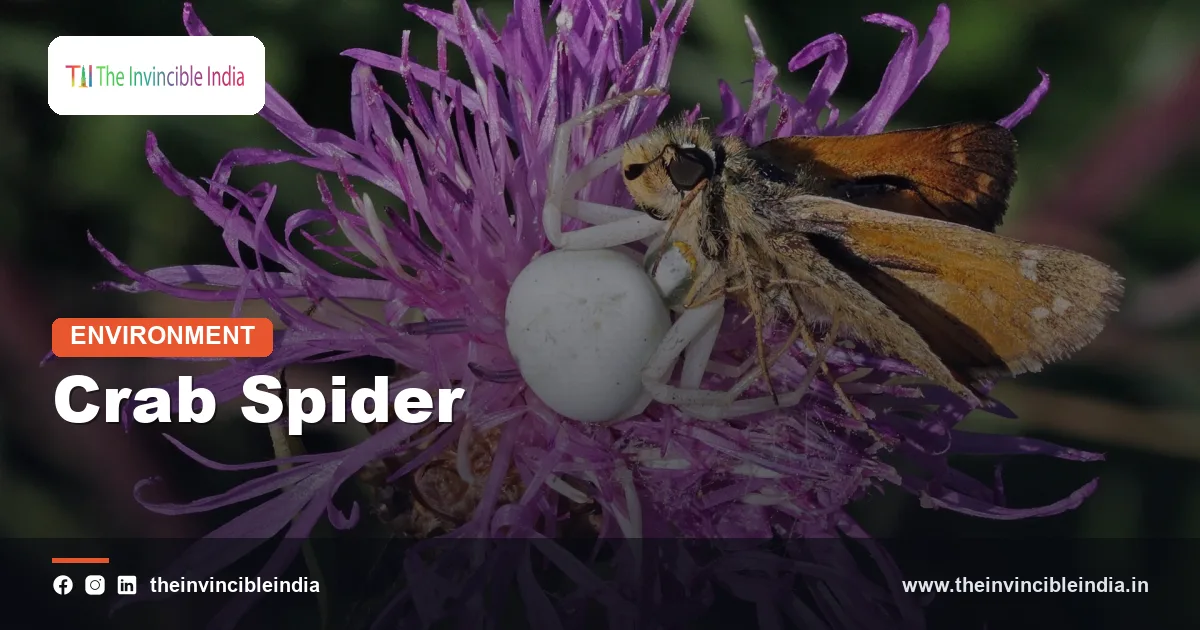
A crab spider is a spider of the family Thomisidae that walks sideways like a crab and, instead of spinning a web, sits camouflaged on flowers, leaves or bark to ambush insects that come within reach. In India, crab spiders are common on garden blossoms, where they are harmless to people and quietly reduce the number of visiting flies, bees and butterflies.
The crab spider is one of the best examples of hunting by patience rather than by pursuit. This article explains what a crab spider is, how it catches prey without a web, how some species change colour, and whether it is dangerous.
| Quick Facts | Crab spider |
|---|---|
| Scientific group | Family Thomisidae (genera include Thomisus, Oxytate, Runcinia and Amyciaea) |
| Order | Araneae (true spiders), class Arachnida |
| Size | Adult females usually about 5 to 12 mm in body length; males are much smaller |
| Habitat in India | Flowers, leaves, grass, bark and shrubs in gardens, farms, scrub and forests |
| Diet | Insects such as flies, bees, butterflies and moths, caught by ambush |
| Hunting method | Sit-and-wait ambush with no capture web |
| Life cycle | Egg sac, spiderlings, several moults, adult; the female guards the egg sac |
| Danger to humans | Not dangerous; venom is aimed at insects |
| Ecological role | Predator that regulates insects, and prey for birds and wasps |
Key Takeaways
- A crab spider belongs to the family Thomisidae, which contains more than 2,000 species worldwide.
- A crab spider does not build a web to catch prey and instead waits motionless on flowers, leaves or bark.
- The front two pairs of legs of a crab spider are longer and held outward like crab claws, and the spider often walks sideways.
- Some flower-dwelling crab spiders can slowly change body colour between white and yellow to match the blossom they sit on.
- A crab spider is harmless to humans, and its venom is intended for killing insects, not for defence against people.
- Crab spiders can capture prey larger than themselves, including honeybees and butterflies.
What is a crab spider?
A crab spider is a member of the spider family Thomisidae, a large group of ambush hunters that are named for their crab-like posture and sideways movement. The family contains well over two thousand described species and is found on every continent except Antarctica.
Spiders belong to the order Araneae in the class Arachnida, which also includes scorpions, mites and ticks. Not all spiders spin webs to catch food. Wolf spiders, jumping spiders and huntsman spiders hunt actively, while crab spiders occupy a middle path: they stay in one spot and strike when a victim arrives.
In India, common genera include Thomisus, which often sits on flowers, Oxytate, a slender green spider of leaves, and Runcinia, a long-bodied spider found on grasses and shrubs. The family also includes species that mimic ants, bird droppings or bark.
The common name comes from the body shape and stance. The legs are arranged so that the front pairs reach forward and sideways, ready to grasp prey, much like the claws of a crab.
How do you identify a crab spider?
You identify a crab spider by its broad, flattened body, long forward-facing front legs, shorter back legs and its habit of sitting still on a flower or leaf. Its sideways walk and crab-like pose are good field marks.
Body shape and legs
The front two pairs of legs are longer and stronger than the back two. They are held out sideways and forward, with the spider ready to snap them shut around an approaching insect. The abdomen is often wide and sometimes has small bumps or points, especially in flower-dwelling species.
Eyes
Like most spiders, crab spiders have eight eyes, arranged in two rows. They are small and tend to be on raised bumps. Crab spiders rely on movement detection rather than sharp vision, and they sense vibration through the legs.
Colour
Colours vary from white, cream and yellow to green, brown or pink, and many individuals match their background. A white or yellow crab spider on a daisy-like flower is a typical sight. Some species have contrasting markings or a pale stripe along the sides.
| Genus | Typical look | Common perch |
|---|---|---|
| Thomisus | Stout; white, yellow or pink; pointed bumps on the abdomen | Flower heads |
| Oxytate | Slim and green with long legs | Leaf surfaces |
| Runcinia | Long, narrow body; yellow-brown or green | Grass stems and shrubs |
| Amyciaea | Resembles an ant, especially a weaver ant | Near ant trails or ant-infested trees |
How does a crab spider catch prey without a web?
A crab spider catches prey by sitting motionless in a well-chosen spot, seizing an insect with its strong front legs and biting it with venom that quickly paralyses it. This sit-and-wait method is called ambush predation, and it needs no web.
Once the prey is held, the spider pierces it with its fangs and injects venom, which immobilises and starts to digest the soft tissues. The spider then sucks up the liquefied contents, leaving a dry husk. Its jaws are small, so many crab spiders feed through a single puncture point and may spend an hour or more over a meal.
Why flowers?
Flowers are busy places. Bees, flies, butterflies and beetles come to feed on nectar and pollen, so a spider on a flower sees a steady stream of potential meals. A camouflaged spider is hard for the visitors to spot.
Can a crab spider take large prey?
Yes, a crab spider can overcome insects larger than itself, including honeybees and butterflies. This is possible because the venom acts quickly and the spider often bites behind the head, where an insect has little ability to retaliate.
Can a crab spider change colour?
Yes, some flower-dwelling crab spiders can change colour between white and yellow, helping them blend in with the blossoms on which they hunt. The change is gradual and takes several days rather than seconds.
The best-known examples of this ability are certain species that sit on flowers, such as those in the genus Misumena and related flower spiders. A pale spider may turn yellow over a few days when placed on a yellow flower, then return to white on a white one. The colour comes from pigments in the spider’s skin, which it can deposit or remove.
The ability is limited. Many crab spiders keep one colour for life, and colour change is generally restricted to certain species and to females. Even the species that can change cannot match any colour; they usually switch within a narrow range of pale shades.
Scientists have debated how well this camouflage works against different viewers. A spider may be hidden from a bird yet be visible to a bee that sees ultraviolet light. Some studies suggest that insects sometimes visit flowers with a spider on them anyway, so the exact balance is complicated.
Is a crab spider dangerous to humans?
No, a crab spider is not dangerous to humans. Its venom is designed to subdue small insects, and its fangs are generally too small to harm human skin. Bites are extremely rare and do not cause serious illness.
Crab spiders are shy and non-aggressive. If a person touches one, it is more likely to drop from the flower on a thread of silk or run sideways out of reach than to bite. Because they stay on plants, they seldom enter houses.
- Do not handle a crab spider with bare hands, as with any wild animal.
- If bitten, wash the spot and apply a cold compress.
- Seek medical advice only if the area shows spreading redness or unusual symptoms.
A crab spider is often confused with spiders that people fear. The name “giant crab spider” sometimes used for huntsman spiders is misleading, because a huntsman belongs to a different family, Sparassidae, and is only superficially similar.
What is the life cycle of a crab spider?
The crab spider life cycle begins with eggs laid in a silk sac, continues through spiderlings that moult several times and ends with mature adults that mate and reproduce. The female usually dies after the eggs are laid or hatched.
| Stage | What happens |
|---|---|
| Mating | A much smaller male approaches the female and mates after courtship |
| Egg sac | The female lays eggs in a silk sac, often hidden in a folded leaf or flower |
| Spiderlings | Young hatch and disperse, sometimes by ballooning on silk threads |
| Growth | Spiderlings moult several times and grow |
| Adult | The spider matures and begins breeding |
Many female crab spiders guard the egg sac until the young hatch, staying on or near it and not feeding much. Males are noticeably smaller than females and usually have darker colours and longer legs. They wander in search of females and may die soon after mating.
Young spiders hatch in warm months, and their numbers are often highest during or after the rains when insect prey is abundant. In India, flower-dwelling crab spiders are most visible when gardens and fields are in bloom.
Where are crab spiders found in India?
Crab spiders are found throughout India in gardens, farms, grasslands, scrub and forests, wherever vegetation supports insect prey. They are present from the plains to the lower Himalayan slopes and from dry regions to wet forests.
Typical places include:
- Flowering garden plants such as marigold, hibiscus, zinnia and wild roadside blooms.
- Crop fields with flowering plants, such as mustard, cotton, sunflower and vegetables.
- Grass and shrub layers in open land.
- Tree trunks and bark, where bark-living species hide.
- Trails of weaver ants, where ant-mimicking species hunt.
Ant mimics
One of the most interesting Indian crab spiders is Amyciaea, which resembles a weaver ant. By copying the shape and movement of an ant, it can approach real ants closely and capture them. The mimicry works because ants are aggressive defenders and few predators bother them.
Best time to look
The best time to look for crab spiders is during daylight in the flowering season, particularly after the rains. Look closely at the centre of flowers, where a pale spider may be hidden among petals.
Why do crab spiders matter?
Crab spiders matter because they are natural controllers of insects, they show how camouflage works in practice and they form part of the food web in Indian farms and gardens. A healthy garden often has a few crab spiders hiding in the flowers.
Because they hunt on crops such as cotton, sunflower and vegetables, crab spiders feed on pests including flies and small moths. They can also catch pollinators, which is a cost to flowers, but the overall impact on a plant community is small. Spiders as a group are predators that keep insect numbers in balance.
Crab spiders are also prey. Birds, lizards and predatory wasps feed on them. Some wasps specialise in hunting spiders to feed their larvae, which links the crab spider to other insects described in nature guides.
For students, the crab spider is an easy way to observe animal behaviour. A single flower can show camouflage, ambush hunting and a food chain in a few minutes.
Bottom Line
The crab spider is a patient, web-free hunter that waits on flowers and leaves for insects to arrive. It is harmless to people, ecologically useful and a fascinating example of camouflage in Indian gardens.
Frequently Asked Questions
What is a crab spider?
A crab spider is a spider of the family Thomisidae that walks sideways like a crab and hunts by ambush. It does not build a capture web. Instead, it waits on flowers or leaves and grabs insects with its strong front legs.
Is a crab spider poisonous to humans?
No, a crab spider is not dangerous to humans. Its venom is meant for small insects, and bites on people are rare and mild. The spider usually runs away or drops on a thread when disturbed.
Why is it called a crab spider?
It is called a crab spider because its body shape and posture resemble a crab. The front legs are longer and held out sideways, and the spider often moves sideways or backwards. This gives it a distinctly crab-like appearance.
Can crab spiders change colour?
Yes, some flower-dwelling crab spiders can slowly change colour between white and yellow. The change takes days, not seconds, and is limited to certain species. Many crab spiders keep a single colour throughout life.
Do crab spiders make webs?
No, crab spiders do not make webs to catch prey. They use silk for safety lines and for the egg sac, but they hunt by waiting and ambushing. This differs from orb-weaving spiders, which depend on a web.
What do crab spiders eat?
Crab spiders eat insects that visit flowers and plants, including flies, bees, butterflies, moths and small beetles. They can capture prey larger than themselves. The spider injects venom and then sucks out the insect’s softened body contents.
{“@context”:”https://schema.org”,”@graph”:[{“@type”:”FAQPage”,”mainEntity”:[{“@type”:”Question”,”name”:”What is a crab spider?”,”acceptedAnswer”:{“@type”:”Answer”,”text”:”A crab spider is a spider of the family Thomisidae that walks sideways like a crab and hunts by ambush. It does not build a capture web. Instead, it waits on flowers or leaves and grabs insects with its strong front legs.”}},{“@type”:”Question”,”name”:”Is a crab spider poisonous to humans?”,”acceptedAnswer”:{“@type”:”Answer”,”text”:”No, a crab spider is not dangerous to humans. Its venom is meant for small insects, and bites on people are rare and mild. The spider usually runs away or drops on a thread when disturbed.”}},{“@type”:”Question”,”name”:”Why is it called a crab spider?”,”acceptedAnswer”:{“@type”:”Answer”,”text”:”It is called a crab spider because its body shape and posture resemble a crab. The front legs are longer and held out sideways, and the spider often moves sideways or backwards. This gives it a distinctly crab-like appearance.”}},{“@type”:”Question”,”name”:”Can crab spiders change colour?”,”acceptedAnswer”:{“@type”:”Answer”,”text”:”Yes, some flower-dwelling crab spiders can slowly change colour between white and yellow. The change takes days, not seconds, and is limited to certain species. Many crab spiders keep a single colour throughout life.”}},{“@type”:”Question”,”name”:”Do crab spiders make webs?”,”acceptedAnswer”:{“@type”:”Answer”,”text”:”No, crab spiders do not make webs to catch prey. They use silk for safety lines and for the egg sac, but they hunt by waiting and ambushing. This differs from orb-weaving spiders, which depend on a web.”}},{“@type”:”Question”,”name”:”What do crab spiders eat?”,”acceptedAnswer”:{“@type”:”Answer”,”text”:”Crab spiders eat insects that visit flowers and plants, including flies, bees, butterflies, moths and small beetles. They can capture prey larger than themselves. The spider injects venom and then sucks out the insect’s softened body contents.”}}]}]}


