

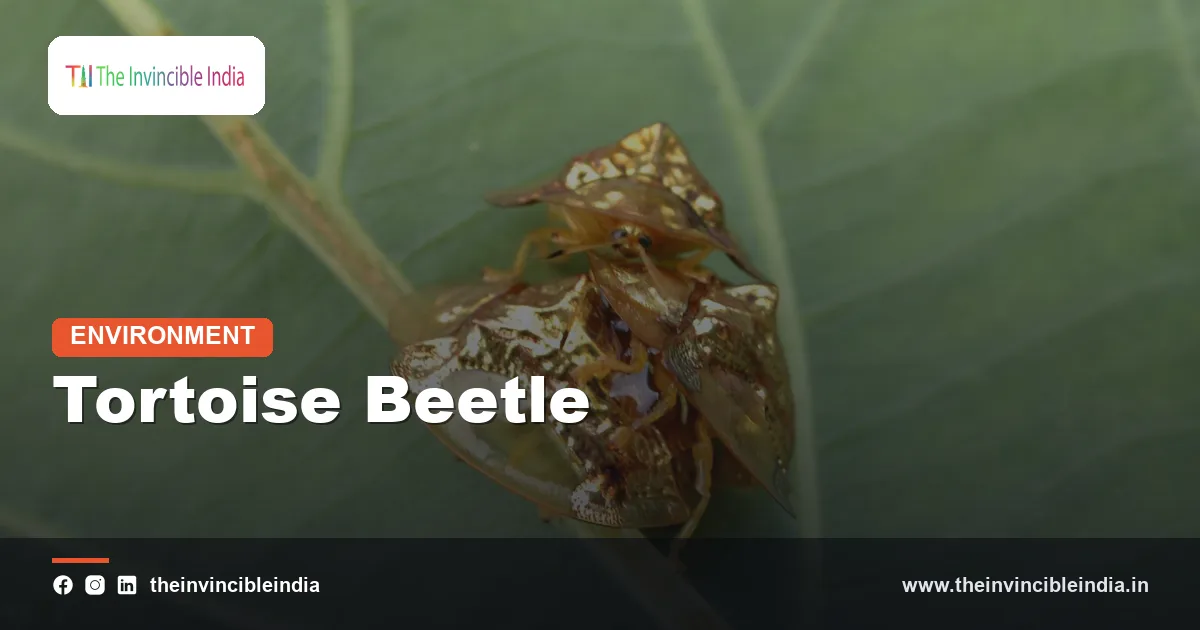
The tortoise beetle is a small, shield-shaped leaf beetle of the subfamily Cassidinae, often gleaming gold or bronze, that clings flat to leaves like a tiny tortoise and feeds on plants such as sweet potato and morning glory. In India, the best-known example is the golden tortoise beetle Aspidimorpha miliaris, which is easy to spot on creepers in gardens, hedges and roadside vegetation during the monsoon.
The tortoise beetle is harmless to people and is mostly a minor leaf-eater, but it attracts attention for its metallic colour, its clear flared shell and the odd “faecal shield” carried by its larvae. This article explains what the tortoise beetle is, how it lives, why it shines, and what it means for gardens and crops.
| Quick Fact | Detail |
|---|---|
| Common names | Tortoise beetle, golden tortoise beetle, golden shield beetle, shield beetle |
| Scientific classification | Order Coleoptera; family Chrysomelidae (leaf beetles); subfamily Cassidinae; example: Aspidimorpha miliaris |
| Size | Adults usually about 5 to 12 mm long |
| Habitat in India | Gardens, hedgerows, field edges, wasteland and forest margins wherever host creepers grow |
| Diet | Leaves, mainly of plants in the morning glory family (Convolvulaceae), such as sweet potato and Ipomoea species |
| Life cycle | Complete metamorphosis: eggs, spiny larvae, pupae attached to leaves, and adults |
| Ecological role | Herbivore of creepers and food for predators; a minor pest of sweet potato |
| Notable features | Broad, transparent-edged shell that covers the head and legs, often with a golden metallic sheen, and larvae that carry a shield of waste |
Key Takeaways
- The tortoise beetle is a leaf beetle in the subfamily Cassidinae, named for its rounded, shell-like back that hides the head and legs.
- The golden tortoise beetle Aspidimorpha miliaris is a common Indian species that feeds on sweet potato, morning glory and related creepers.
- A tortoise beetle can look like polished gold because layered structures in its outer shell reflect light, and the colour may fade or change when the beetle is stressed or dies.
- Tortoise beetle larvae carry a “faecal shield” of cast skins and droppings on a movable tail fork to deter predators.
- A tortoise beetle clings to leaves with tiny adhesive hairs on its feet and can resist strong pulls from predators.
- The tortoise beetle is harmless to humans and causes only limited damage, mainly to sweet potato and ornamental creepers.
What is a tortoise beetle?
A tortoise beetle is a member of the leaf beetle family Chrysomelidae, placed in the subfamily Cassidinae, in which the wing-cases and the shield of the thorax are expanded into a broad, domed or flattened cover over the body. The shape gives it the look of a tiny tortoise or shield, which explains both its common name and the older alternative names shield beetle and helmet beetle.
The subfamily Cassidinae is large, with thousands of species worldwide and many in tropical Asia. Many tortoise beetles are small, bright and decorated with spots, borders and metallic patterns. They are relatives of the better-known flea beetles and the Colorado potato beetle, as all belong to the leaf beetles, which feed on living plants as adults and larvae.
The tortoise beetle is therefore a plant-eating insect rather than a predator. It does not bite or sting people, and it uses its flattened body and sticky feet, not venom or claws, to defend itself.
What does a tortoise beetle look like?
A tortoise beetle looks like a miniature domed shield, typically 5 to 12 mm across, with a smooth, broad outline and a margin that extends beyond the body. The colour varies by species, and many are green, brown or reddish, while some, such as the golden tortoise beetle, shine like bright metal.
The main visible features are:
- A wide, flared shell formed by the wing-cases and the pronotum (the shield behind the head), which covers the head, legs and antennae when the insect is at rest.
- A transparent border around the edge in many species, so that the leaf surface can be seen through the margin.
- Dark spots or patterns on the golden surface of A. miliaris, often a central marking on a gold background.
- Short legs and short antennae, usually tucked beneath the shell.
When the beetle is disturbed, it pulls its legs under the shell and presses itself tightly to the leaf. The result is a nearly smooth button of an insect that is hard for a bird or ant to grip or pry off.
Why is the tortoise beetle golden?
The tortoise beetle is golden because the outer layers of its shell are built from thin, stacked films that reflect light, producing a metallic sheen without needing gold pigment. This effect is called structural colour, and it is the same principle that makes soap bubbles and peacock feathers shimmer.
In some tortoise beetles, the golden colour is changeable. The shell contains liquid between its layers, and when the beetle is stressed, disturbed or dying, the amount of liquid shifts and the metallic gold may turn dull orange, red or brown. When the beetle relaxes, the sheen may return. Dead specimens in collections often lose their gold, which is why photographs of live insects look far more striking than dried museum ones.
Scientists think that the shine may confuse predators, because the reflections break up the outline of the beetle and may look like drops of dew or sunlight on the leaf. The exact function is still discussed, and several explanations may apply at once.
Where does the tortoise beetle live in India?
The tortoise beetle lives in India wherever its food plants grow, which includes gardens, hedges, field edges, roadsides, wasteland and forest margins from the plains to the hills. Different species are found in different regions, and the greatest variety is in the moist forests of the Western Ghats and the north-east.
The golden tortoise beetle is most often seen:
- On sweet potato vines in farms and kitchen gardens.
- On wild morning glories and other Ipomoea creepers along fences, railway lines and canal banks.
- On the leaves of some ornamental and wild climbers.
- In the monsoon and the weeks after it, when new leaf growth is abundant.
The beetle is mainly active in the daytime, resting on the upper or lower leaf surface, which makes it far easier to find than many other small insects.
What does the tortoise beetle eat?
The tortoise beetle eats the leaves of its host plants, and the golden tortoise beetle feeds mainly on plants of the morning glory family, Convolvulaceae. Adults and larvae scrape and chew the leaf tissue, leaving small round or irregular holes, sometimes a skeletonised, lace-like surface.
Tortoise beetles are usually specialists rather than generalists. Each species typically feeds on a small group of related plants, and this narrow diet is the reason that a beetle may be common on one creeper and absent on a neighbouring plant. The host choice is guided by chemical cues from the leaf, which the beetle detects through its antennae and feet.
Because the leaf damage is usually scattered, a healthy plant tolerates it easily. Problems arise only when the population is unusually large on a young crop.
How does the tortoise beetle reproduce and grow?
The tortoise beetle reproduces by laying eggs on the host plant, and it goes through four stages, egg, larva, pupa and adult, in a complete metamorphosis. The cycle is short in warm, wet weather and may be completed in several weeks, so there can be more than one generation in a season.
| Stage | Appearance | Notes |
|---|---|---|
| Egg | Small, laid in clusters on leaves, often covered by a protective membrane or case | The covering protects the eggs from drying and from small predators |
| Larva | Flattened, spiny, oval grub | Feeds on leaves and carries a shield of cast skins and droppings |
| Pupa | Flattened and spiny, fixed to the leaf | Often carries the old larval skin and shield |
| Adult | Domed, shell-like, often golden or green | Feeds, mates and lays eggs |
In some Cassidinae, the female stays near the eggs or the young larvae and protects them from ants and other enemies, which is a form of parental care. The details differ from species to species, so it is better not to assume that all tortoise beetles guard their young.
What is the faecal shield of a tortoise beetle larva?
The faecal shield is a protective mass of old skins and droppings that a tortoise beetle larva carries over its back on a forked tail structure. The larva can raise, lower or swing the shield, so that it covers the body like an umbrella or a parasol.
The shield works in several ways:
- It forms a physical barrier that blocks ants, bugs and small wasps from reaching the soft body.
- It can be flicked towards an attacker as a distraction.
- It hides the outline of the larva, so that the animal looks like a bit of debris on the leaf.
- It may contain plant chemicals that make it unpleasant to enemies.
As the larva grows and moults, it adds each cast skin to the shield. This unusual habit is one of the best-known examples of insects using their own waste as armour, and it is a favourite subject for macro photographers and school nature projects.
How does the tortoise beetle defend itself?
The tortoise beetle defends itself mainly by clamping down on the leaf, using its shell as armour and, in some species, by using chemical protection. The legs end in pads of tiny adhesive hairs that stick to the surface, and the beetle can hold with a force many times its own weight.
The defences work in layers:
- Clamping: the beetle presses its flared edge against the leaf, leaving no gap for a predator to bite.
- Camouflage and shine: the reflective shell and transparent edge blend into the leaf and light.
- Chemical defence: some tortoise beetles store unpleasant plant compounds that deter birds, lizards and spiders.
- Dropping or flying: if grabbed, the beetle may release its grip, drop from the leaf, or fly off.
Despite these methods, tortoise beetles are eaten by predators such as assassin bugs, spiders, wasps and some birds. They also host parasitic wasps and flies, which lay their eggs in the larvae and pupae.
When is the tortoise beetle seen, and how can you observe it?
The tortoise beetle is seen most often during and just after the monsoon, when creepers put out fresh leaves and the beetle populations build up. A slow walk along a hedge or fence covered with morning glory in the morning, when the light is soft, is usually enough to find several.
A few simple habits make observation easy and kind to the insect:
- Look on both the upper and the lower surface of leaves, because the beetle often shifts to the underside in strong sun.
- Approach slowly, since sudden shadows make the beetle clamp down or drop off the leaf.
- Use a phone or a camera with a macro mode, and avoid touching the beetle, as handling can dull its colour and stress it.
- Look for the spiny larvae with their dark waste shields and for the pale, clustered eggs, which show that the beetle is breeding on the plant.
- Leave the plant undisturbed afterwards, so that the life cycle can continue.
Because the tortoise beetle is small and slow, it is a good first subject for children and beginners in insect watching, and it needs no special equipment.
Is the tortoise beetle a pest?
The tortoise beetle is a minor pest, since it can damage the leaves of sweet potato and some ornamental creepers, but it rarely causes serious economic loss. In most gardens and wild habitats, the plant tolerates the damage and natural enemies keep the numbers in check.
Heavy infestations on sweet potato may reduce the leaf area and, in young crops, slow growth. Such cases are managed by hand-picking the beetles and larvae, removing weedy morning glories that harbour them, and encouraging natural predators. Spraying is rarely justified, and broad-spectrum insecticides would also kill the beneficial insects that help control the beetle.
The tortoise beetle is also useful in a small way. It feeds on weedy creepers that can smother crops and hedges, and it is part of the food web that supports spiders, birds and parasitic insects. It is also valued as an indicator of a healthy, diverse garden.
Bottom Line
The tortoise beetle is a small, harmless leaf beetle whose shield-like body, metallic gold colour and waste-carrying larvae make it one of the most remarkable everyday insects of Indian gardens. Leaving the creepers it lives on undisturbed is usually the best way to enjoy it.
Frequently Asked Questions
What is a tortoise beetle?
A tortoise beetle is a small leaf beetle of the subfamily Cassidinae with a broad, shell-like back that covers its head and legs. Many species are green, brown or metallic gold. The group is named for its resemblance to a tiny tortoise.
Why is the golden tortoise beetle gold?
The golden tortoise beetle is gold because thin layers in its shell reflect light and give a metallic sheen. This structural colour can fade to orange or brown when the beetle is stressed or dies. Pigment alone does not explain the effect.
Is the tortoise beetle harmful to humans or plants?
The tortoise beetle is harmless to humans, because it does not bite or sting. It can nibble the leaves of sweet potato and ornamental creepers, but serious damage is uncommon. Hand-picking and natural predators usually keep it under control.
What does a tortoise beetle eat?
A tortoise beetle eats leaves, and the golden tortoise beetle prefers plants of the morning glory family, such as sweet potato and Ipomoea. Both adults and larvae feed on the leaf tissue. Each species usually specialises on a small group of related plants.
What is the waste shield on tortoise beetle larvae?
The waste shield is a pile of cast skins and droppings carried on a forked tail by a tortoise beetle larva. The larva holds it over its back like an umbrella to deter predators. It acts as both a physical barrier and a disguise.
How can I tell a tortoise beetle from a ladybird?
A tortoise beetle has a flared shell with a flattened or transparent edge, while a ladybird has a tighter, dome-shaped body with a smooth, closely fitting outline and usually spots on red or orange. Ladybirds mostly eat aphids and other small insects, while tortoise beetles eat leaves. The feeding habit and the shell margin are the easiest clues.
{“@context”:”https://schema.org”,”@graph”:[{“@type”:”FAQPage”,”mainEntity”:[{“@type”:”Question”,”name”:”What is a tortoise beetle?”,”acceptedAnswer”:{“@type”:”Answer”,”text”:”A tortoise beetle is a small leaf beetle of the subfamily Cassidinae with a broad, shell-like back that covers its head and legs. Many species are green, brown or metallic gold. The group is named for its resemblance to a tiny tortoise.”}},{“@type”:”Question”,”name”:”Why is the golden tortoise beetle gold?”,”acceptedAnswer”:{“@type”:”Answer”,”text”:”The golden tortoise beetle is gold because thin layers in its shell reflect light and give a metallic sheen. This structural colour can fade to orange or brown when the beetle is stressed or dies. Pigment alone does not explain the effect.”}},{“@type”:”Question”,”name”:”Is the tortoise beetle harmful to humans or plants?”,”acceptedAnswer”:{“@type”:”Answer”,”text”:”The tortoise beetle is harmless to humans, because it does not bite or sting. It can nibble the leaves of sweet potato and ornamental creepers, but serious damage is uncommon. Hand-picking and natural predators usually keep it under control.”}},{“@type”:”Question”,”name”:”What does a tortoise beetle eat?”,”acceptedAnswer”:{“@type”:”Answer”,”text”:”A tortoise beetle eats leaves, and the golden tortoise beetle prefers plants of the morning glory family, such as sweet potato and Ipomoea. Both adults and larvae feed on the leaf tissue. Each species usually specialises on a small group of related plants.”}},{“@type”:”Question”,”name”:”What is the waste shield on tortoise beetle larvae?”,”acceptedAnswer”:{“@type”:”Answer”,”text”:”The waste shield is a pile of cast skins and droppings carried on a forked tail by a tortoise beetle larva. The larva holds it over its back like an umbrella to deter predators. It acts as both a physical barrier and a disguise.”}},{“@type”:”Question”,”name”:”How can I tell a tortoise beetle from a ladybird?”,”acceptedAnswer”:{“@type”:”Answer”,”text”:”A tortoise beetle has a flared shell with a flattened or transparent edge, while a ladybird has a tighter, dome-shaped body with a smooth, closely fitting outline and usually spots on red or orange. Ladybirds mostly eat aphids and other small insects, while tortoise beetles eat leaves. The feeding habit and the shell margin are the easiest clues.”}}]}]}


