

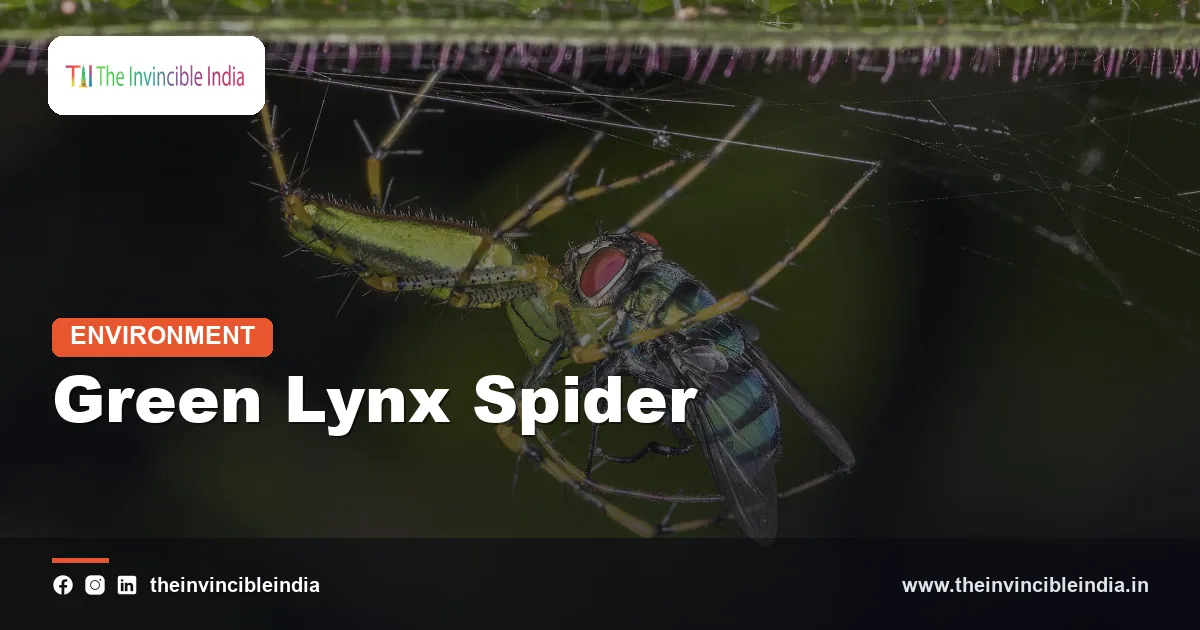
The green lynx spider is a bright green, long-legged, spiny hunting spider that lives on flowers, shrubs and crops in India and catches insects by stalking and pouncing instead of trapping them in a web. The common Indian species is Peucetia viridana, a member of the lynx spider family Oxyopidae, and it is often spotted on roadside weeds, garden plants and farm crops during and after the monsoon.
The green lynx spider is harmless to humans and useful to farmers, because it preys on many plant-eating insects. This article explains what the green lynx spider is, how it hunts, how it protects its eggs, and why it is a welcome visitor in gardens and fields.
| Quick Fact | Detail |
|---|---|
| Common names | Green lynx spider, lynx spider |
| Scientific classification | Order Araneae; family Oxyopidae (lynx spiders); genus Peucetia; Indian example: Peucetia viridana |
| Size | Females about 1 to 2 cm in body length; males smaller and slimmer |
| Habitat in India | Shrubs, weeds, flowers, grassland edges, gardens and crops such as cotton and pulses |
| Diet | Insects such as flies, moths, bees, bugs, caterpillars and small beetles |
| Life cycle | Egg sac guarded by the mother; spiderlings disperse and moult as they grow; adults live roughly a year |
| Ecological role | Predator that helps to control insect pests in gardens and fields |
| Notable features | Translucent green body, long spines on the legs, sharp eyesight, no web for catching prey |
Key Takeaways
- The green lynx spider is a hunting spider of the family Oxyopidae that catches prey by ambush and a quick pounce, not with a web.
- The green lynx spider gets its name from the cat-like way it stalks and leaps, as a lynx does, and its body is bright green to blend with leaves.
- Long, black-tipped spines on the legs of the green lynx spider act like a cage that holds captured insects in place.
- A female green lynx spider guards her egg sac against predators and parasites until the spiderlings hatch.
- The green lynx spider is not dangerous to people, and its bite is rare and usually no worse than a mild sting.
- Green lynx spiders eat many crop and garden pests, which makes them valuable natural allies in pest control.
What is a green lynx spider?
A green lynx spider is a vividly green, long-legged spider of the genus Peucetia in the family Oxyopidae, known as an active hunter that stalks and pounces on its prey. Spiders of this family are called lynx spiders because their quick, springing movements resemble those of a cat hunting.
The green lynx spider belongs to the order Araneae, the true spiders, within the class Arachnida. Like other spiders it has eight legs, two body regions (the cephalothorax and the abdomen), and no antennae or wings. The family Oxyopidae has hundreds of species worldwide, and the genus Peucetia includes the large green lynx spiders of Asia, Africa and the Americas.
In India, Peucetia viridana is the species most often recorded and photographed. It is common across the plains and hills, from agricultural fields in the Deccan to flowering shrubs in cities.
What does a green lynx spider look like?
A green lynx spider has a translucent green body, often with a slim, tapering abdomen marked by small red or dark spots, and long, pale legs covered with erect black-based spines. The female is noticeably heavier than the male, with a body about 1 to 2 cm long, while the male is smaller and more slender.
The key features are:
- Green colour: a shade that matches young leaves and stems, giving good camouflage.
- Long leg spines: each spine rises from a small dark spot, and together they form a basket around any insect the spider catches.
- Eight eyes: arranged in a hexagon-shaped group on top of the head with two more at the front, giving wide vision.
- A pointed abdomen: which narrows towards the rear, with lines or reddish marks in many individuals.
- Spiny, upright posture: the spider often holds its front legs forward and slightly raised when waiting.
The colour can vary slightly with age and with the flowers on which the spider lives. Newly hatched spiderlings are paler, and some individuals look yellowish-green or have a faint red tinge.
Does a green lynx spider spin a web?
A green lynx spider does not spin a web to catch prey, because it is an active hunter that depends on camouflage, eyesight and speed. It does produce silk, but uses it for other tasks, such as a safety line, egg sacs and a few threads on which it hangs from a plant.
As it moves, the spider trails a thin silk line called a dragline behind it. If it jumps or falls, the dragline acts as a safety rope, and the spider can climb back up. Lynx spiders also use silk to wrap and attach the egg sac to a twig or flower head.
This difference in hunting style separates the green lynx spider from the familiar orb-weavers and house spiders. Instead of waiting in a trap, the green lynx spider waits on a plant for the prey to arrive within range.
How does a green lynx spider hunt?
A green lynx spider hunts by sitting motionless on a flower, bud or leaf, spotting an insect with its sharp eyes, and then leaping or running at it in a quick burst. It usually targets insects that visit flowers, which makes blossoms a rich hunting ground.
The steps of a typical hunt are:
- The spider waits, often head down, on a flower or the tip of a shoot.
- It detects movement with its eyes and the fine hairs on its legs.
- It creeps or pounces on the prey and seizes it with its front legs.
- The spines on the legs close around the insect and stop it from escaping.
- The spider bites, injects venom through its fangs, and feeds by liquefying and sucking the soft tissue.
Lynx spiders can leap several body lengths, and they can change direction in mid-air. They do not spend time or energy on building a trap, which lets them move across many plants in search of food.
What does a green lynx spider eat?
A green lynx spider eats a wide range of insects, including flies, moths, bugs, caterpillars, small beetles, grasshopper nymphs and even honeybees and other bees. Because of its size, the spider can take prey as large as itself, and it sometimes eats other spiders.
The prey list includes many insects that are agricultural pests. In crop fields, green lynx spiders have been recorded feeding on bollworm moths, plant bugs, leafhoppers, flies and similar insects. In a garden they take hoverflies, cabbage butterflies and the pests of ornamental plants.
Not all of its prey is harmful, and the spider also catches pollinators, such as bees, that visit flowers. This is a minor cost, and overall the contribution of the spider to pest control is considered positive.
How does the green lynx spider reproduce and protect its young?
The green lynx spider reproduces by laying eggs in a silk sac that the female attaches to a plant and guards until the spiderlings hatch. This maternal care is the most remarkable part of its life cycle, and it greatly improves the chance that the eggs will survive.
The life cycle can be summarised in these stages:
| Stage | What happens |
|---|---|
| Courtship and mating | The smaller male finds a female by following silk and chemical signals, then courts her with leg movements before mating |
| Egg sac | The female spins a silk sac, often a rounded, light brown or greenish cluster, and attaches it to twigs or stems with silk threads |
| Guarding | The female stays close to the sac, drives away ants, wasps and other intruders, and may lose weight during this period |
| Hatching | Spiderlings emerge after a few weeks, remain near the sac and then disperse |
| Growth | The young moult several times, grow quickly in the warm, wet season and mature within months |
Many young spiderlings disperse by climbing to the top of a plant and releasing a silk thread that is carried by the wind, a method known as ballooning. The adult spiders typically live for around a year, and the female often dies soon after the eggs hatch.
Is the green lynx spider dangerous to humans?
The green lynx spider is not dangerous to humans, since its venom is aimed at small insects and its bite is rare. The spider is shy, prefers to run or drop from a leaf when disturbed, and bites only if it is squeezed or trapped against the skin.
If a bite does occur, the effects are normally limited to brief local pain, slight redness and mild swelling, similar to a small insect sting. Washing the area with soap and water and applying a cold compress is enough in nearly every case. People with known allergies to insect stings should be careful, as with any other animal bite.
Some lynx spiders in other regions are reported to squirt venom as a defence, which is a harmless nuisance unless it reaches the eyes. A rinse with clean water is the standard response. In general, the safest approach is to watch the spider and leave it undisturbed.
How is the green lynx spider different from other green spiders?
The green lynx spider differs from other green spiders in having long leg spines, a hunting lifestyle on plants, and a slender, pointed abdomen, while other green spiders may be web builders or flower-crab spiders. Identifying the spider correctly depends on looking at posture, spines and behaviour.
| Spider | Hunting method | Key identification clue |
|---|---|---|
| Green lynx spider (Oxyopidae) | Ambush and pounce, no web | Long black-based spines on legs; pointed abdomen; upright posture |
| Crab spiders (Thomisidae) | Ambush on flowers with front legs held out sideways | Crab-like stance; legs held wide; no long spines |
| Jumping spiders (Salticidae) | Stalk and leap | Large forward-facing eyes; compact body; short legs |
| Orb-weaver spiders (Araneidae) | Round web | Seen in webs; no active hunting on flowers |
Why is the green lynx spider important to farmers and gardeners?
The green lynx spider is important to farmers and gardeners because it eats many plant-feeding insects and so reduces the need for chemical sprays. Spiders as a group are among the most abundant natural predators in agricultural fields, and lynx spiders form a significant part of that group.
Several practical steps help to protect them:
- Avoid blanket spraying of broad-spectrum insecticides, which kill spiders along with pests.
- Leave some flowering plants and weedy borders near fields, so that the spiders have hunting perches.
- Do not remove egg sacs or crush the guarding females.
- Plant mixed crops and hedges to provide shelter and prey throughout the year.
Studies of integrated pest management in Indian crops such as cotton and pulses recognise spiders as a key group of natural enemies. A green lynx spider on a plant is generally a sign of a food web that is working well.
Bottom Line
The green lynx spider is a bright, harmless, web-free hunter that patrols Indian flowers and shrubs and helps control insect pests. Leaving it in place, and sparing its egg sac, is a simple way to support natural pest control in any garden or field.
Frequently Asked Questions
What is a green lynx spider?
A green lynx spider is a bright green hunting spider of the genus Peucetia, in the lynx spider family Oxyopidae. It stalks and pounces on insects instead of using a web. In India, Peucetia viridana is the species most often seen on flowers and shrubs.
Is the green lynx spider poisonous to humans?
The green lynx spider is not dangerous to humans. Its venom is meant for small insects, and bites are rare and usually mild, like a small insect sting. Washing the area and applying a cold compress is normally enough.
Does the green lynx spider make a web?
No, the green lynx spider does not use a web to catch prey. It hunts by ambushing insects on flowers and leaves and leaping on them. It uses silk only for safety lines, egg sacs and similar purposes.
What does a green lynx spider eat?
A green lynx spider eats insects such as flies, moths, bugs, caterpillars, small beetles and bees. It can also eat other spiders. Many of its prey are pests of crops and garden plants.
Why is it called a lynx spider?
It is called a lynx spider because it stalks and pounces on its prey in a cat-like way, like a lynx. The spider also has sharp eyesight and a spiny, alert posture. The name applies to the whole family Oxyopidae.
Does the female green lynx spider guard her eggs?
Yes, the female green lynx spider guards her egg sac until the spiderlings hatch. She stays near the sac on the plant and drives away ants, wasps and other threats. This care improves the survival of the eggs, and the mother often dies soon after the young leave.
{“@context”:”https://schema.org”,”@graph”:[{“@type”:”FAQPage”,”mainEntity”:[{“@type”:”Question”,”name”:”What is a green lynx spider?”,”acceptedAnswer”:{“@type”:”Answer”,”text”:”A green lynx spider is a bright green hunting spider of the genus Peucetia, in the lynx spider family Oxyopidae. It stalks and pounces on insects instead of using a web. In India, Peucetia viridana is the species most often seen on flowers and shrubs.”}},{“@type”:”Question”,”name”:”Is the green lynx spider poisonous to humans?”,”acceptedAnswer”:{“@type”:”Answer”,”text”:”The green lynx spider is not dangerous to humans. Its venom is meant for small insects, and bites are rare and usually mild, like a small insect sting. Washing the area and applying a cold compress is normally enough.”}},{“@type”:”Question”,”name”:”Does the green lynx spider make a web?”,”acceptedAnswer”:{“@type”:”Answer”,”text”:”No, the green lynx spider does not use a web to catch prey. It hunts by ambushing insects on flowers and leaves and leaping on them. It uses silk only for safety lines, egg sacs and similar purposes.”}},{“@type”:”Question”,”name”:”What does a green lynx spider eat?”,”acceptedAnswer”:{“@type”:”Answer”,”text”:”A green lynx spider eats insects such as flies, moths, bugs, caterpillars, small beetles and bees. It can also eat other spiders. Many of its prey are pests of crops and garden plants.”}},{“@type”:”Question”,”name”:”Why is it called a lynx spider?”,”acceptedAnswer”:{“@type”:”Answer”,”text”:”It is called a lynx spider because it stalks and pounces on its prey in a cat-like way, like a lynx. The spider also has sharp eyesight and a spiny, alert posture. The name applies to the whole family Oxyopidae.”}},{“@type”:”Question”,”name”:”Does the female green lynx spider guard her eggs?”,”acceptedAnswer”:{“@type”:”Answer”,”text”:”Yes, the female green lynx spider guards her egg sac until the spiderlings hatch. She stays near the sac on the plant and drives away ants, wasps and other threats. This care improves the survival of the eggs, and the mother often dies soon after the young leave.”}}]}]}


