

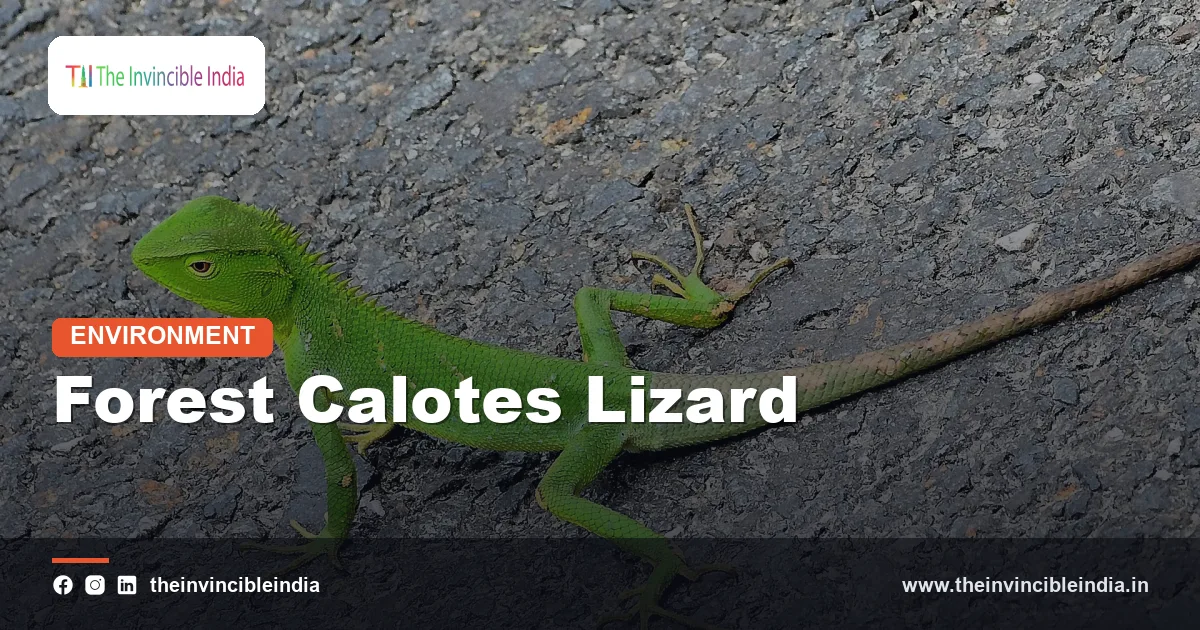
The forest calotes (Calotes rouxii) is a slender, long-tailed tree lizard of the agamid family that lives in the forests of peninsular India and the Western Ghats, where it clings to trunks and low branches and hunts insects. It is a close relative of the familiar garden lizard, but it is a shyer animal that prefers shade, damp woodland and the edges of forest clearings.
Like other calotes lizards, the forest calotes can change its colour with temperature, mood and breeding condition, and it has a row of small spines along the neck and back. It is harmless to people, it is useful as an insect predator, and it is often seen but rarely noticed by visitors to hill forests and plantations.
Quick Facts: Forest Calotes
| Common name | Forest calotes (also called Roux’s forest calotes) |
|---|---|
| Scientific name | Calotes rouxii |
| Family | Agamidae (agamid lizards) |
| Size | Roughly 30 to 40 cm in total length, with the tail forming about two-thirds of it |
| Range in India | Western Ghats and adjoining forests and plantations of peninsular India |
| Habitat | Moist and semi-evergreen forest, forest edges, plantations, shrubs and trees near streams |
| Diet | Insectivorous: ants, beetles, grasshoppers, caterpillars, spiders and other small invertebrates |
| Breeding | Egg-laying; the female buries a small clutch of eggs in soil, usually in the rainy season |
| Status | Not considered threatened (IUCN Least Concern); a native wild reptile that should not be captured |
Key Takeaways
- The forest calotes (Calotes rouxii) is a slender agamid tree lizard that lives in the forests of the Western Ghats and peninsular India.
- The forest calotes belongs to the same genus as the common garden lizard, Calotes versicolor, but it lives in cooler, shadier and more wooded places.
- The forest calotes can change colour between brown, olive and green shades depending on its temperature, stress and breeding condition.
- The forest calotes feeds almost entirely on insects and spiders, which makes it a natural controller of pests in forests and plantations.
- The forest calotes is not venomous, poisonous or dangerous to people, and the old name “bloodsucker” for calotes lizards is a misleading myth.
- The forest calotes lays its eggs in soil, and the young hatch fully formed and independent at the start of the damp season.
What Is the Forest Calotes?
The forest calotes is a medium-sized, tree-living lizard in the genus Calotes of the family Agamidae, found mainly in the forests of southern and western peninsular India. The genus Calotes contains a good number of species across South and South-East Asia, and several of them live in India.
The name “forest calotes” is used for a lizard of wooded habitats as opposed to the more familiar Calotes versicolor, the oriental garden lizard of gardens, hedges and farmland. Field guides use the name for Calotes rouxii, which is sometimes called Roux’s forest calotes, in honour of the naturalist whose name the species carries. A few similar forest-dwelling relatives are also grouped under related names, so identification by an expert is helpful when a lizard looks unusual.
Agamids are lizards with rough, keeled scales, strong hind legs and a body adapted to life on tree trunks and bushes. They are not related to the geckos found on house walls, and they are different from skinks, which have smooth, shiny scales.
How Can You Identify a Forest Calotes?
A forest calotes can be identified by its slim body, long whip-like tail, small crest of spines along the neck and back, and a head that is fairly large compared with the body. The colour is usually a mix of brown, olive and grey with darker bands, but it can shift to brighter shades.
- Body shape: narrow and laterally flattened, which suits climbing on trunks and thin branches.
- Tail: very long and slender, used for balance among branches.
- Crest: a low ridge of raised scales, longer on the nape, running down the back.
- Scales: rough and keeled, giving the skin a textured look.
- Throat: a small fold of skin, the dewlap, that can be expanded in displays.
- Colour change: the lizard becomes paler and greener when relaxed and warm, and darker when cold or alarmed.
Males are usually larger than females and show stronger colours during the breeding season. Juveniles are smaller, plainer and often greener, which helps them hide in leaves.
Where Does the Forest Calotes Live in India?
The forest calotes lives in the forests of the Western Ghats and in neighbouring areas of peninsular India, including parts of Karnataka, Kerala, Goa, Maharashtra and Tamil Nadu. It is a lizard of wooded hill country rather than open plains.
The Western Ghats are one of the world’s recognised biodiversity hotspots, with many reptiles and amphibians found nowhere else. The forest calotes is one of the more widespread members of this community, and it is seen in evergreen and semi-evergreen forest, moist deciduous woods, bamboo thickets and shaded coffee, tea, cardamom and areca plantations.
Preferred microhabitat
The animal generally sits on tree trunks, fallen logs, shrubs and fence posts, between knee height and the middle of the tree. It prefers places with filtered sunlight, such as forest edges, trails and the banks of streams, where it can bask for a short time and then retreat into shade.
What Does the Forest Calotes Eat?
The forest calotes eats mainly insects and other small invertebrates such as ants, beetles, grasshoppers, caterpillars, moths and spiders. It is an ambush predator that waits on a trunk or branch and darts forward when prey passes within reach.
Young lizards take the smallest insects, and adults can take larger beetles and grasshoppers. Occasionally the animal may eat small fruit, flowers or nectar-covered insects, but animal prey makes up nearly all of its diet. By eating large numbers of insects, including crop and plantation pests, the forest calotes quietly supports the health of forest and farm ecosystems.
The lizard has good eyesight and relies on movement to spot prey. It catches food with a quick strike of its jaws rather than a sticky tongue, unlike the chameleon, which is another reptile that people sometimes compare with calotes lizards.
Why Does the Forest Calotes Change Colour?
The forest calotes changes colour mainly in response to body temperature, stress, social signals and breeding condition, and not to match its background the way a chameleon is popularly believed to do. The skin contains pigment cells that expand or contract, which shifts the shade from dull brown to brighter olive or green.
A cold lizard becomes darker to absorb more heat from the sun, while a warm and relaxed lizard becomes lighter. A frightened animal may flatten itself and turn dull, and a male defending a territory can show stronger colour and an inflated dewlap. These changes are slow compared with a chameleon’s, and they are a form of communication as much as camouflage.
The same mechanism explains why the common garden lizard is sometimes said to “turn red” in the breeding season. The change is a courtship and territorial signal, and it has nothing to do with blood.
How Does the Forest Calotes Breed?
The forest calotes breeds by laying eggs, and the female digs a shallow hole in soft, shaded soil to bury a small clutch before covering it and leaving. Breeding is linked to the rains, when insects are abundant and the soil is moist enough to keep the eggs from drying out.
Males set up small territories on trees and display to rivals and to females by bobbing the head, doing push-ups with the forelimbs and extending the dewlap. After mating, the female searches for a suitable nesting site on the ground. She does not guard the eggs, which develop for several weeks before the hatchlings emerge.
The young are fully formed, feed on tiny insects and climb into low vegetation almost at once. They face many predators, and only a small share survive to adulthood. In the wild, a calotes lizard that survives the early months can live for a few years.
How Is the Forest Calotes Different From the Garden Lizard?
The forest calotes differs from the oriental garden lizard (Calotes versicolor) mainly in habitat, behaviour and range: the forest calotes lives in shaded woodland, while the garden lizard thrives in gardens, farms, towns and open scrub across most of India. The two are related, but the garden lizard is the more adaptable and the more commonly seen of the pair.
| Feature | Forest calotes | Oriental garden lizard |
|---|---|---|
| Scientific name | Calotes rouxii | Calotes versicolor |
| Main habitat | Forests, plantations and shaded hill country | Gardens, hedges, farmland, towns and scrub |
| Range in India | Western Ghats and peninsular forests | Almost the whole country |
| Behaviour | Shy; keeps to shade and trunks | Bold; basks openly and tolerates people |
| Breeding display | Colour and dewlap signals | Males well known for reddish head and throat colour |
| Diet | Insects and spiders | Insects, other small animals and occasionally fruit and flowers |
Another similar species, the green forest lizard (Calotes calotes), also lives in the Western Ghats region and has a distinctly green body, so colour alone is not a safe guide to identification.
Is the Forest Calotes Dangerous or Poisonous?
No, the forest calotes is not dangerous, poisonous or venomous, and it poses no threat to humans or pets. It may open its mouth, puff out its throat and try to bite if it is picked up, but its bite is small and harmless apart from minor scratches.
A widespread myth in India says that calotes lizards are “bloodsuckers” that bite people or drink blood, or that their bite is deadly. This is wrong. The name probably arose from the reddish colour males develop during courtship. The lizard feeds on insects and has no interest in human blood.
The best advice is to watch the animal quietly and let it go on its way. Wild lizards that are caught stress easily, and they usually suffer in captivity because they need live insects, the right temperature and space to climb.
Is the Forest Calotes Threatened?
The forest calotes is not generally regarded as threatened, and it is assessed as Least Concern on the IUCN Red List. Even so, its dependence on forest cover means that loss of woodland in the Western Ghats can reduce local populations.
The main pressures on forest lizards are the following.
- Deforestation and fragmentation: clearing of forest for roads, mining, housing and monoculture plantations.
- Pesticides: insecticides remove prey and can poison lizards directly.
- Road mortality: lizards crossing forest roads are easily killed by traffic.
- Persecution through ignorance: killing of harmless lizards because of myths.
- Climate change: shifts in rainfall and temperature in the hill forests may alter insect abundance and breeding success.
Wildlife law in India protects native animals in national parks and sanctuaries, and capturing wild reptiles without permission is not allowed. Keeping shaded forest patches, hedgerows and native trees on farms and estates helps the forest calotes and its relatives.
What Role Does the Forest Calotes Play in the Forest Ecosystem?
The forest calotes plays a middle role in the forest food web, because it controls insect numbers as a predator and in turn becomes food for birds, snakes and small mammals. Lizards of this kind turn the energy stored in large numbers of insects into prey of a size that larger animals can use.
Its main predators include forest birds such as drongos and raptors, tree snakes, cat snakes, mongooses and civets. Many of these predators depend on a steady supply of small reptiles, so a healthy population of forest calotes is a sign that the food chain is working. Ecologists also use lizards and frogs as indicators, since they react quickly to changes in temperature, humidity and forest cover.
The lizard is only one small link, but a forest stripped of its small reptiles usually has fewer of the animals that feed on them, and more of the insects they would have eaten.
How Does the Forest Calotes Behave Through the Day and the Year?
The forest calotes is a diurnal lizard, which means it is active in daylight, and it spends most of its time on a perch scanning the surroundings for food, rivals and danger. It basks in the early sun, hunts through the warmer hours and moves to shade or into foliage when the heat peaks.
- Morning: the lizard climbs to a sunny patch of trunk to raise its body temperature.
- Midday: hunting from a shaded perch, with brief dashes to catch insects.
- Evening: a return to a regular sleeping branch or crevice, where the lizard rests overnight.
- Rainy season: more active, since insects are plentiful and nesting begins.
- Cooler months: slower and less visible, as lower temperatures reduce activity.
When threatened, the forest calotes freezes on a trunk and then scuttles to the opposite side of the tree to keep out of view. If the danger comes closer, it dashes up the tree or drops to the ground and runs. Like many lizards, it may shed its tail when it is grabbed, and the tail grows back only in a limited, simpler form.
Bottom Line
The forest calotes is a quiet, insect-eating tree lizard that adds to the rich reptile life of the Western Ghats. It is harmless, it is more than a plain relative of the garden lizard, and it benefits from the simple step of leaving forests and their wildlife undisturbed.
Frequently Asked Questions
What is a forest calotes?
A forest calotes is a slender, long-tailed tree lizard of the genus Calotes in the agamid family. The species Calotes rouxii lives in the forests of the Western Ghats and peninsular India. It feeds on insects and is harmless to people.
Is the forest calotes poisonous?
No, the forest calotes is not poisonous or venomous. Its bite is weak and may cause only a minor scratch if the lizard is handled. The belief that calotes lizards suck blood or have a deadly bite is a myth.
Can the forest calotes change colour like a chameleon?
Yes, the forest calotes can change colour, but not as dramatically as a chameleon. The shift between brown, olive and green is caused by temperature, stress and breeding signals. It is less a matter of matching the background and more a form of communication.
What does the forest calotes eat?
The forest calotes eats mainly insects and other small invertebrates such as ants, beetles, grasshoppers, caterpillars and spiders. It waits on a trunk or branch and lunges at passing prey. Its diet makes it a useful natural pest controller.
Where is the forest calotes found in India?
The forest calotes is found mainly in the Western Ghats and in forests and plantations of peninsular India. It prefers shaded, wooded habitats rather than open plains. States where it is reported include Karnataka, Kerala, Goa, Maharashtra and Tamil Nadu.
How is the forest calotes different from the common garden lizard?
The forest calotes lives in shaded forest and is shy, whereas the garden lizard (Calotes versicolor) is bold and common in gardens, farms and towns across India. The two belong to the same genus and look somewhat alike. The garden lizard is far more widespread and more often seen near people.
{“@context”:”https://schema.org”,”@graph”:[{“@type”:”FAQPage”,”mainEntity”:[{“@type”:”Question”,”name”:”What is a forest calotes?”,”acceptedAnswer”:{“@type”:”Answer”,”text”:”A forest calotes is a slender, long-tailed tree lizard of the genus Calotes in the agamid family. The species Calotes rouxii lives in the forests of the Western Ghats and peninsular India. It feeds on insects and is harmless to people.”}},{“@type”:”Question”,”name”:”Is the forest calotes poisonous?”,”acceptedAnswer”:{“@type”:”Answer”,”text”:”No, the forest calotes is not poisonous or venomous. Its bite is weak and may cause only a minor scratch if the lizard is handled. The belief that calotes lizards suck blood or have a deadly bite is a myth.”}},{“@type”:”Question”,”name”:”Can the forest calotes change colour like a chameleon?”,”acceptedAnswer”:{“@type”:”Answer”,”text”:”Yes, the forest calotes can change colour, but not as dramatically as a chameleon. The shift between brown, olive and green is caused by temperature, stress and breeding signals. It is less a matter of matching the background and more a form of communication.”}},{“@type”:”Question”,”name”:”What does the forest calotes eat?”,”acceptedAnswer”:{“@type”:”Answer”,”text”:”The forest calotes eats mainly insects and other small invertebrates such as ants, beetles, grasshoppers, caterpillars and spiders. It waits on a trunk or branch and lunges at passing prey. Its diet makes it a useful natural pest controller.”}},{“@type”:”Question”,”name”:”Where is the forest calotes found in India?”,”acceptedAnswer”:{“@type”:”Answer”,”text”:”The forest calotes is found mainly in the Western Ghats and in forests and plantations of peninsular India. It prefers shaded, wooded habitats rather than open plains. States where it is reported include Karnataka, Kerala, Goa, Maharashtra and Tamil Nadu.”}},{“@type”:”Question”,”name”:”How is the forest calotes different from the common garden lizard?”,”acceptedAnswer”:{“@type”:”Answer”,”text”:”The forest calotes lives in shaded forest and is shy, whereas the garden lizard (Calotes versicolor) is bold and common in gardens, farms and towns across India. The two belong to the same genus and look somewhat alike. The garden lizard is far more widespread and more often seen near people.”}}]}]}


