

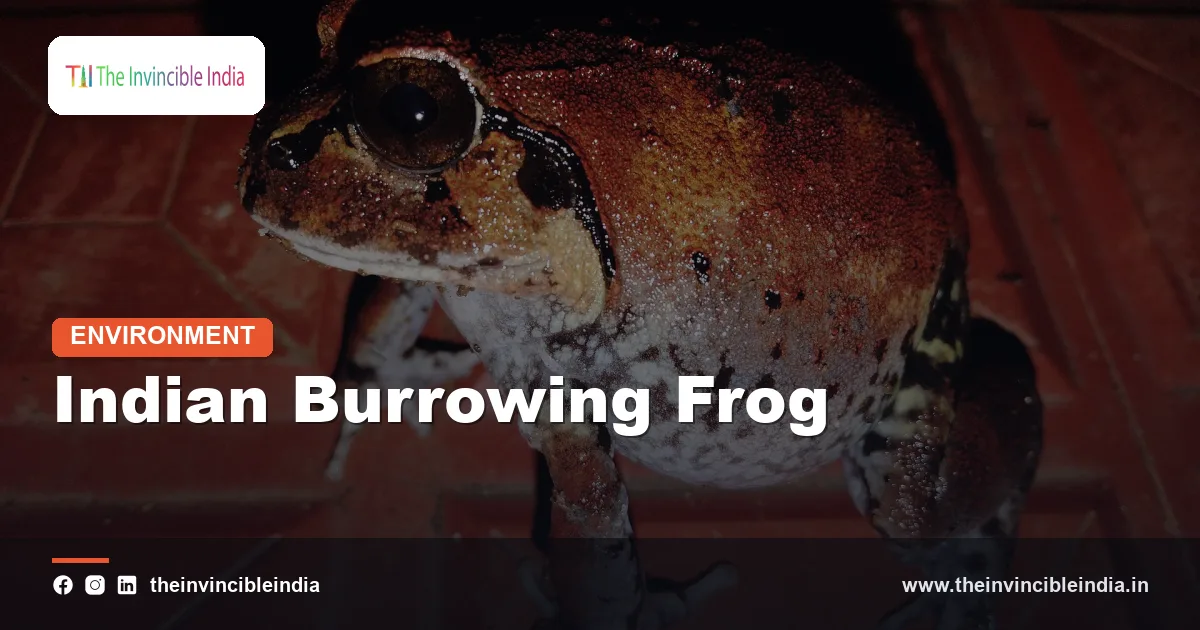
The Indian burrowing frog (Sphaerotheca breviceps) is a plump, short-limbed frog that spends the dry months buried underground and comes out in large numbers after the first heavy monsoon rains to breed. It is one of the commonest frogs of the Indian plains, found in fields, grassland, scrub and the edges of villages, and its loud night chorus is a sign that the rainy season has arrived.
The Indian burrowing frog digs backwards into loose soil using a hard, shovel-like projection on each hind foot. This habit lets it survive heat and drought, and it is the reason the species is often unseen for most of the year, even in places where it is very abundant.
Quick Facts: Indian Burrowing Frog
| Common name | Indian burrowing frog (often called simply the burrowing frog) |
|---|---|
| Scientific name | Sphaerotheca breviceps |
| Family | Dicroglossidae (fork-tongued frogs) |
| Size | Adults are usually about 4 to 7 cm long, with females slightly larger than males |
| Range | Widespread across peninsular and central India and the plains; also reported from Nepal, Pakistan, Bangladesh and Sri Lanka |
| Habitat | Open dry country, farmland, grassland, scrub, sandy or loose soil and the outskirts of towns |
| Diet | Insectivorous: ants, termites, beetles, crickets and other small invertebrates |
| Breeding | Explosive breeding in temporary rain pools after the first monsoon showers; eggs hatch into aquatic tadpoles |
| Status | Not considered threatened (IUCN Least Concern); a protected native amphibian in protected areas |
Key Takeaways
- The Indian burrowing frog (Sphaerotheca breviceps) is a stout, short-limbed frog of the family Dicroglossidae that lives mostly underground outside the rainy season.
- The Indian burrowing frog digs backwards into soil with a shovel-shaped tubercle on each hind foot and may stay buried for months during dry weather.
- The Indian burrowing frog emerges in large numbers after the first heavy monsoon showers and breeds within a few days in temporary pools.
- The Indian burrowing frog is widespread across much of peninsular India and the plains and is also found in neighbouring South Asian countries.
- The Indian burrowing frog eats ants, termites, beetles and other small insects, and it helps to limit pests in fields and gardens.
- The Indian burrowing frog is harmless to people, though it may puff up its body and give a loud cry when it is picked up or alarmed.
What Is the Indian Burrowing Frog?
The Indian burrowing frog is a medium-sized, round-bodied amphibian of the genus Sphaerotheca, built for digging rather than hopping or climbing. The genus belongs to the family Dicroglossidae, a large family of frogs from Africa and Asia that also includes the Indian bullfrog and the skipper frogs.
Frogs are amphibians, so they begin life in water as tadpoles and later become air-breathing adults. The Indian burrowing frog has adapted to dry habitats by spending its adult life mostly on land and underground, returning to water only to breed. Its short, strong legs, round body and compact shape are all adaptations for a digging life.
The name “Indian burrowing frog” is often applied to a group of closely related burrowing frogs in the genus, and scientists have in recent years separated some of them into distinct species. For this reason, the description in this article applies to the typical Indian burrowing frog and its near relatives.
How Can You Identify an Indian Burrowing Frog?
An Indian burrowing frog can be identified by its plump, rounded body, short blunt snout, short hind legs and olive-brown to greyish skin with darker blotches. Many individuals have small warts or ridges on the back, and some show a pale line running down the middle.
- Body: thick and rounded, often described as toad-like, though the frog is a true frog.
- Hind feet: a hard, sharp-edged inner tubercle that acts as a spade for digging backwards.
- Skin: fairly smooth to slightly warty, in brown, olive or grey tones that blend with soil.
- Eyes: prominent, with horizontal pupils, set high on a short head.
- Call: a loud, repeated, hollow or bleating sound given by males at breeding pools.
The frog is sometimes confused with toads and with the Indian bullfrog. Toads have drier, warty skin with large glands behind the eyes, while the bullfrog is much larger and sits in water, so a look at the hind feet and the habitat is usually enough to settle the matter.
Where Does the Indian Burrowing Frog Live?
The Indian burrowing frog lives across a large part of India, especially in the drier plains and peninsular regions, and it is found in open habitats with soil that is easy to dig. It is common in farmland, grassland, scrub, wastelands and the edges of towns and villages.
Outside India it is reported from Nepal, Pakistan, Bangladesh and Sri Lanka. In India it is less common in very wet evergreen forest and in high mountain areas, where other frogs dominate. Because it is so adaptable, the species often lives in modified places, including irrigated fields, plantations and garden lawns.
What kind of soil does it need?
The animal needs loose or sandy soil where it can burrow. Heavy clay can bake very hard in summer, and rocky ground is difficult to dig, so the frog is more abundant in light, well-drained soil. Moisture deeper in the ground allows it to survive without drinking from open water.
How Does the Indian Burrowing Frog Burrow?
The Indian burrowing frog burrows by pushing itself backwards into the soil with its hind feet, using the hard tubercle on each foot like a spade. It shuffles the soil aside, sinks down rump first and settles in a chamber a short distance below the surface.
Underground, the frog stays cool and holds on to moisture through its skin. In dry weather it can remain still for long periods, in a state of dormancy known as aestivation, which is a form of summer sleep. During this time its body processes slow down, and it uses only a little of its stored energy.
Burrowing protects the frog from heat, dry wind, fires and many predators. When the monsoon soaks the ground, the water softens the soil, and vibrations and falling rain are thought to be among the signals that wake the frog and push it to the surface.
Why Does the Indian Burrowing Frog Emerge After the First Monsoon Rains?
The Indian burrowing frog emerges after the first heavy monsoon rains because the rain fills temporary pools where its eggs and tadpoles can develop, and it triggers the breeding season. The sudden arrival of water is the main cue, and the frogs appear within a night or two of a downpour.
This pattern is called explosive breeding. Large numbers of frogs gather at the same pools for a very short time, often just a few days, and males call loudly to attract females. The advantage is that the eggs are laid when the pools are available and when insects are about to become abundant, so tadpoles and frogs both have plenty of food.
Many people first notice the frog when it appears in yards, roads and fields after the first showers. The sight is common across central and peninsular India at the start of the rainy season, and the chorus can be heard from some distance after dark.
How Does the Indian Burrowing Frog Breed?
The Indian burrowing frog breeds in shallow temporary pools, where males call from the water and females lay their eggs in the water after pairing. The eggs hatch into tadpoles in a short time, and the tadpoles grow quickly because the pools can dry out within weeks.
- Calling: males gather at the edges of pools and call to females.
- Pairing: the male clasps the female from behind, a position called amplexus.
- Egg laying: the female releases eggs, which the male fertilises as they are laid.
- Tadpole stage: the tadpoles feed on algae and tiny organic matter and grow limbs.
- Metamorphosis: the tadpoles turn into tiny frogs and leave the water to live on land and later dig in.
The speed of development is a clear adaptation to a short-lived habitat. Young frogs that complete the change before the pool dries up have the best chance of survival, and many tadpoles do not make it, which is why so many eggs are laid.
What Does the Indian Burrowing Frog Eat?
The Indian burrowing frog eats ants, termites, beetles, crickets, grasshoppers and other small invertebrates that it can catch on the ground at night. It is a sit-and-wait hunter that uses its sticky tongue to snatch prey that comes close.
The frog usually feeds after dark and in the wet season, when insects are plentiful and the ground is damp. After the rains it must eat enough to build up body reserves, since it may not feed for months once it burrows. Termite swarms, which often appear after rain, are an especially useful food source.
Tadpoles feed on algae and soft plant and animal matter in the pool. Because the frog eats many crop and household pests, it is helpful to farmers and gardeners, even if its habits go largely unnoticed.
How Is the Indian Burrowing Frog Different From Other Burrowing Frogs?
The Indian burrowing frog differs from other Indian burrowing amphibians in its habitat, size and breeding pattern, since several unrelated groups of frogs have evolved a digging lifestyle. The most famous of these is the purple frog of the Western Ghats, which is a very different animal.
| Feature | Indian burrowing frog | Purple frog (Nasikabatrachus sahyadrensis) |
|---|---|---|
| Family | Dicroglossidae | Nasikabatrachidae |
| Region | Widespread across plains and peninsular India | Western Ghats only |
| Habitat | Open dry country and farmland | Forest soil in wet hill country |
| Appearance | Olive-brown, plump, short snout | Purplish-brown, bloated body, pointed snout |
| Diet | Insects | Mainly termites |
| Surface activity | Appears each monsoon in large numbers | Surfaces for a very brief breeding period |
Other members of the same genus, such as Sphaerotheca rolandae and Sphaerotheca dobsonii, resemble the Indian burrowing frog but differ in size, markings and range.
Is the Indian Burrowing Frog Dangerous or Threatened?
The Indian burrowing frog is not dangerous to humans, and it is not currently considered a threatened species, as its IUCN status is Least Concern. It does not bite in any meaningful way and has no venom, though it may inflate its body and cry out loudly if grabbed.
The frog’s skin does produce secretions that can irritate the eyes or mouth of predators, so it is best not to handle it, and anyone who does touch a wild frog should wash their hands afterwards. Amphibians absorb substances through their skin, which makes them sensitive to soap, sunscreen and chemicals on human hands.
Threats to the species include the following.
- Pesticides and fertiliser run-off: chemicals in farmland harm tadpoles and adults.
- Loss of breeding pools: filling of temporary ponds and wetlands for construction.
- Road deaths: large numbers are killed on roads during rainy-night breeding movements.
- Climate change: unpredictable rainfall may disturb breeding timing.
- Disease: fungal infections affect amphibians worldwide.
How Does the Indian Burrowing Frog Defend Itself From Predators?
The Indian burrowing frog defends itself mainly by hiding underground, by blending with soil and by puffing up its body when it is caught. Its rounded shape and earthy colours make it hard to spot on bare ground, and a quick backward shuffle can take it out of sight within seconds.
Snakes, birds, monitor lizards, mongooses, jackals and large spiders are among the animals that feed on adult frogs, while fish, water beetle larvae, dragonfly nymphs and water birds eat the tadpoles. When seized, the frog may inflate itself with air to appear larger and harder to swallow, and it can give a loud, startling scream. Its skin also releases a bitter secretion that makes it unpleasant to eat.
Breeding in a huge synchronised burst is another form of defence. When thousands of frogs breed on the same few nights, predators can eat only a fraction of them, and most of the eggs and young are left to grow.
What Does the Call of the Indian Burrowing Frog Sound Like?
The call of the Indian burrowing frog is a loud, repeated, hollow sound that is often compared with a bleat, a quack or a bark, and it carries across fields on rainy nights. Only the males call, and they do so from the water’s edge or while floating in shallow pools.
Each male has a pair of vocal sacs under the throat that fill with air and work as a resonating chamber. A group of calling males creates a dense chorus that can be heard from a long way off. The noise has two purposes: it draws females to the pool, and it signals to neighbouring males to keep their distance.
Call activity depends strongly on rain, temperature and humidity, and it drops off quickly as the pools dry up. Naturalists often record frog calls to survey which species are present in an area, since many frogs are easier to hear than to see.
Bottom Line
The Indian burrowing frog is a hardy, underground specialist whose sudden mass appearance marks the start of the monsoon in much of India. It is harmless and useful as a predator of insects, and it can be protected simply by keeping seasonal pools and open soil free from pollution.
Frequently Asked Questions
What is the Indian burrowing frog?
The Indian burrowing frog (Sphaerotheca breviceps) is a plump, short-limbed frog that digs into soil and lives underground during dry weather. It is widespread across the plains and peninsular India. It emerges after the first monsoon rains to breed in temporary pools.
When does the Indian burrowing frog come out?
The Indian burrowing frog comes out in the first few days after heavy monsoon rains, usually at night. It stays buried through the dry months and emerges when water fills temporary pools. Breeding is fast and may last only a few days.
How does the Indian burrowing frog dig?
The Indian burrowing frog digs backwards into soil using a hard, shovel-shaped tubercle on each hind foot. It sinks down rump first and settles in a chamber below the surface. This allows it to avoid heat and drought.
Is the Indian burrowing frog poisonous?
No, the Indian burrowing frog is not dangerous to humans, but its skin secretions can irritate eyes and mouths, so it is best not to handle it. It has no fangs or venom. When alarmed it may puff up its body and give a loud cry.
What does the Indian burrowing frog eat?
The Indian burrowing frog eats ants, termites, beetles, crickets and other small insects. It hunts mainly at night on damp ground, catching prey with its sticky tongue. Its diet helps keep pests in check in fields and gardens.
Is the Indian burrowing frog endangered?
No, the Indian burrowing frog is not endangered and is listed as Least Concern on the IUCN Red List. It is common and adaptable across a wide range. Local populations can still decline because of pesticides, loss of breeding pools and road deaths.
{“@context”:”https://schema.org”,”@graph”:[{“@type”:”FAQPage”,”mainEntity”:[{“@type”:”Question”,”name”:”What is the Indian burrowing frog?”,”acceptedAnswer”:{“@type”:”Answer”,”text”:”The Indian burrowing frog (Sphaerotheca breviceps) is a plump, short-limbed frog that digs into soil and lives underground during dry weather. It is widespread across the plains and peninsular India. It emerges after the first monsoon rains to breed in temporary pools.”}},{“@type”:”Question”,”name”:”When does the Indian burrowing frog come out?”,”acceptedAnswer”:{“@type”:”Answer”,”text”:”The Indian burrowing frog comes out in the first few days after heavy monsoon rains, usually at night. It stays buried through the dry months and emerges when water fills temporary pools. Breeding is fast and may last only a few days.”}},{“@type”:”Question”,”name”:”How does the Indian burrowing frog dig?”,”acceptedAnswer”:{“@type”:”Answer”,”text”:”The Indian burrowing frog digs backwards into soil using a hard, shovel-shaped tubercle on each hind foot. It sinks down rump first and settles in a chamber below the surface. This allows it to avoid heat and drought.”}},{“@type”:”Question”,”name”:”Is the Indian burrowing frog poisonous?”,”acceptedAnswer”:{“@type”:”Answer”,”text”:”No, the Indian burrowing frog is not dangerous to humans, but its skin secretions can irritate eyes and mouths, so it is best not to handle it. It has no fangs or venom. When alarmed it may puff up its body and give a loud cry.”}},{“@type”:”Question”,”name”:”What does the Indian burrowing frog eat?”,”acceptedAnswer”:{“@type”:”Answer”,”text”:”The Indian burrowing frog eats ants, termites, beetles, crickets and other small insects. It hunts mainly at night on damp ground, catching prey with its sticky tongue. Its diet helps keep pests in check in fields and gardens.”}},{“@type”:”Question”,”name”:”Is the Indian burrowing frog endangered?”,”acceptedAnswer”:{“@type”:”Answer”,”text”:”No, the Indian burrowing frog is not endangered and is listed as Least Concern on the IUCN Red List. It is common and adaptable across a wide range. Local populations can still decline because of pesticides, loss of breeding pools and road deaths.”}}]}]}


