

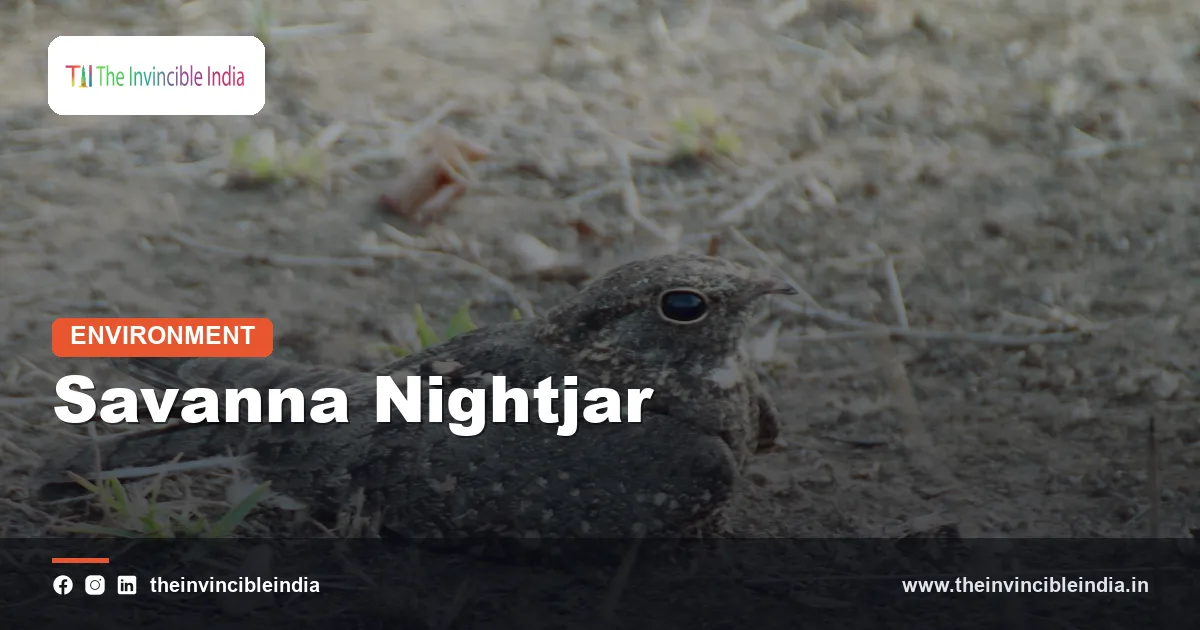
The savanna nightjar (Caprimulgus affinis) is a medium-sized, nocturnal, insect-eating bird of the nightjar family that spends its days motionless on the ground in open scrub and rocky country, and comes alive at dusk with a loud, wheezy call. It is a resident bird across much of peninsular India, the foothills of the Himalaya and parts of the north-east, yet most people have never knowingly seen one because its mottled plumage matches stony soil and dry leaves almost perfectly.
The savanna nightjar lays its eggs directly on bare ground, hunts moths and beetles on the wing, and is most often noticed as a pair of glowing eyes on a village road or as a sharp call at twilight. This article explains what the savanna nightjar is, how it lives, how it differs from other Indian nightjars and why its quiet survival tells us something about India’s open scrub habitats.
| Attribute | Detail |
|---|---|
| Common name | Savanna nightjar (also written savannah nightjar) |
| Scientific name | Caprimulgus affinis |
| Family | Caprimulgidae (nightjars) |
| Size | About 22 to 25 cm long, roughly the size of a large myna but with a longer wing and tail |
| Range and habitat in India | Open scrub, dry cultivation, rocky hillsides, riverbeds and forest edges across much of the peninsula, the Himalayan foothills and the north-east |
| Diet | Flying insects, especially moths, beetles, termites and grasshoppers, caught in flight at dusk and at night |
| Breeding | Two eggs laid on bare ground without a nest; breeding mostly in the dry months before and during early monsoon |
| Conservation status | Least Concern on the IUCN Red List |
Key Takeaways
- The savanna nightjar is a ground-roosting, nocturnal bird whose brown, grey and buff plumage works as near-perfect camouflage against soil, stones and leaf litter.
- The savanna nightjar builds no nest; the female lays two eggs directly on bare ground, usually in open scrub or on a stony patch.
- The savanna nightjar feeds almost entirely on flying insects, which it catches in flight with a wide mouth fringed by bristles.
- The most reliable way to identify a savanna nightjar is its voice, a loud, drawn-out and wheezy call given at dusk and on moonlit nights.
- The savanna nightjar is listed as Least Concern, but it depends on open scrub and rocky ground that are often converted into farmland, plantations and development sites.
- Nightjars including the savanna nightjar help control night-flying insects, including crop-feeding moths and beetles.
What is the savanna nightjar?
The savanna nightjar is a species of nightjar, a family of nocturnal and crepuscular birds that are active at dusk, at night and at dawn. Nightjars belong to the order Caprimulgiformes, which also includes frogmouths and potoos, and they are not related to owls even though they share a nocturnal lifestyle.
The scientific name Caprimulgus affinis places the bird in the genus that contains most Old World nightjars. The word Caprimulgus means goat milker in Latin and comes from an old European belief that nightjars drank milk from goats at night. The belief is false. Nightjars were probably seen near grazing animals because livestock attract the insects the birds hunt.
The species is widespread across South and South-East Asia. In India it is generally treated as a resident bird, which means it breeds and lives here through the year, although some local movement takes place depending on rain, food and cover. Naturalists in India have long noted that its call is among the most familiar night sounds of dry scrub, even when the bird itself goes unseen.
What does the savanna nightjar look like?
The savanna nightjar looks like a soft, flat-headed bird with long wings, a long tail, tiny bill and large dark eyes, dressed in a complex pattern of brown, grey, buff and black. Its upperparts are finely speckled and streaked, and the underparts are barred with buff and brown, which breaks up its outline when it sits on the ground.
Several features help to recognise the bird when it is seen at close range:
- Head: broad and flattened, with a very small bill that opens into an enormous gape.
- Eyes: large and dark, adapted to dim light, and reflecting orange to red when caught in a torch beam or headlight.
- Throat patch: a pale or whitish patch on the throat, more obvious in the male.
- Wings: long and pointed, with a pale band across the primaries in the male that shows in flight.
- Tail: the male shows white patches on the outer tail feathers, and the female has buff or much smaller patches.
- Legs: very short and weak, which is why nightjars sit lengthwise along a branch or lie flat on the ground rather than perching upright.
The sexes look broadly similar, but the white wing and tail patches are bolder in the male. This difference is easy to see when a bird flushes from under a bush in the evening and flashes white before dropping back to the ground.
Where does the savanna nightjar live in India?
The savanna nightjar lives in open, dry and semi-open country across much of India, from scrub-covered plains to rocky foothills. It prefers places with bare patches of soil, small stones and scattered bushes, rather than dense forest or tall grassland.
Typical habitats include:
- Dry thorn scrub and open scrubland on the Deccan plateau.
- Rocky hillsides and boulder-strewn slopes with sparse vegetation.
- Dry riverbeds, canal banks and the edges of fallow fields.
- Open forest clearings, forest tracks and the borders of plantations.
- Village outskirts and hard-packed laterite or gravel tracks.
The bird is found from the plains up to the lower hills, and in the Himalayan foothills it can occur at moderate elevations. It is less common in dense evergreen forest and in very high mountains. Because the savanna nightjar needs open ground and flying insects, its presence usually indicates that a patch of scrub still supports a working food chain.
Its distribution outside India stretches across the Indian subcontinent into South-East Asia, and various regional populations differ slightly in tone and size. Within India, observers in different states record birds with somewhat paler or darker plumage, a variation linked with local soil colour.
Why is the savanna nightjar so hard to see?
The savanna nightjar is hard to see because it combines cryptic colouring, stillness and a habit of resting in places where its pattern matches the ground. A bird sitting on a stony patch or a heap of dry leaves looks like part of the ground rather than an animal.
Three features work together:
- Disruptive patterning. The mix of dark streaks, pale speckles and buff bars breaks the outline of the body, so the eye reads it as a pattern of stones, twigs and shadow.
- Posture. During the day the bird lies low, often with its eyes nearly closed, and it may keep its body aligned with a stick or a stone so that its shape disappears.
- Stillness. A resting savanna nightjar often stays frozen until a person is within a few steps, and then flies a short distance on silent wings before settling again.
The same camouflage protects the eggs and chicks, which are also speckled and sit in the open with no nest. Nightjar parents often return to the same roosting or nesting spot, so a small patch of stony ground can hold the bird year after year without anyone noticing.
In practice, most sightings happen after dark. Nightjars sit on warm tracks and tar roads in the evening, probably because the surface retains heat and insects gather there. A vehicle’s headlights show the bird as two glowing orange spots close to the surface, and the bird usually flies up at the last moment.
What does the savanna nightjar’s call sound like?
The savanna nightjar’s call is a loud, drawn-out, wheezy or buzzing note, usually repeated at intervals, given from the ground, a low rock or a fence post at dusk and again before dawn. The sound is sharp and carries over open scrub, and many listeners describe it as a thin, rising squeal or a hoarse wheeze rather than a musical song.
Voice is the most useful identification tool for any nightjar, because several Indian species look alike in poor light. The savanna nightjar’s wheezy note differs from the stony tapping calls of other Indian nightjars, which are often compared with a hammer striking a hollow object or a pebble dropped on water.
Calling is most intense during the breeding season, when males advertise a territory and attract females. Nightjars call more actively on moonlit nights, when light helps them to hunt and to see rivals. Outside the breeding season the birds are quieter, so a bird that is easy to hear in April may be almost silent in November.
A few practical tips help birdwatchers to locate calling nightjars:
- Visit open scrub or a rocky hillside around sunset and wait quietly for the first call.
- Note the direction of the sound and approach slowly without a bright light.
- Use a dim red torch rather than white light, because strong light disturbs the bird and may cause it to abandon a nest.
What does the savanna nightjar eat and how does it hunt?
The savanna nightjar eats flying insects, mostly moths, beetles, termites, grasshoppers and flying ants, which it catches in the air after sunset and before sunrise. It feeds like a bat, flying low over open ground with a soft, buoyant flight and swooping on prey that passes within reach.
The anatomy of the bird is built for this job:
- Wide gape: a very wide mouth opens like a net and traps insects in flight.
- Rictal bristles: stiff hair-like feathers around the mouth help to funnel prey and may protect the eyes.
- Large eyes: a reflective layer behind the retina improves vision in dim light and causes the visible eyeshine.
- Soft feathers: the edges of the flight feathers are fringed, which muffles the sound of flight so that the bird can approach insects quietly.
The middle toe of a nightjar has a comb-like edge called a pectinate claw. Scientists have suggested that the bird uses it to groom its feathers and clear the bristles of insect scales, although the exact function is still debated.
Hunting is mostly done from the ground or from a low perch. The bird sits quietly, then flies up to grab an insect and returns to the same spot, or it patrols slowly over a field edge. Because a single nightjar can eat many insects in a night, the species has a small but real role in controlling moths and beetles around farmland.
How does the savanna nightjar breed?
The savanna nightjar breeds by laying two eggs directly on bare ground, with no nest, in a shallow scrape or on stones and dry leaves. The eggs are cream to pinkish with brown and grey marbling, which makes them hard to detect against the soil.
The breeding cycle follows a clear sequence:
- Territory and courtship: males call at dusk from the ground or a low perch, and display by flying with raised wings and flashing their white wing and tail patches.
- Egg laying: the female lays two eggs, usually in the dry months before the monsoon and extending into early rains, although the exact months vary between regions.
- Incubation: the female does most of the incubating by day, and the male may share duty at dusk.
- Chicks: the chicks hatch covered in down and can move a short distance soon after hatching, and the parents bring insects to them.
- Fledging: the young learn to fly in a few weeks and stay near the parents for some time.
When a predator approaches the nest, the adult may flush at the last moment and sometimes uses a distraction display, dragging a wing as if injured to lure the intruder away. Nightjar eggs and chicks remain vulnerable to dogs, crows, snakes, mongooses and trampling by livestock, and ploughing, grazing and road-making in the breeding season can destroy nests without anyone noticing.
How can you tell the savanna nightjar from other Indian nightjars?
The savanna nightjar is best told from other Indian nightjars by voice, habitat and a combination of size, tone and wing and tail patches rather than by a single field mark. Several nightjars share overlapping ranges, and plumage differences are subtle even for experienced birders.
| Species | Typical habitat | Notes for identification |
|---|---|---|
| Savanna nightjar | Open scrub, rocky ground, dry cultivation | Medium size; wheezy call; white wing and tail patches in the male |
| Indian nightjar | Scrub, fallow land, open woodland | Smaller and often sandy-toned; call is a series of hard clucking notes |
| Large-tailed nightjar | Forest edges, plantations, moist woodland | Larger; song is a repeated hollow tonk-like tapping |
| Jungle nightjar | Wooded country and forest tracks | Larger and darker; call is a repeated chunk-like note |
For beginners, a useful approach is to note the place first. A bird flushed from bare, stony scrub in a dry district is more likely a savanna or an Indian nightjar, while a bird in damper woodland with a pulsing hollow call suggests a large-tailed or jungle nightjar. Taking a clear sound recording and a photograph of the bird in a safe light is the best way to confirm a record.
Is the savanna nightjar threatened?
The savanna nightjar is not currently threatened and is listed as Least Concern on the IUCN Red List, because it has a very large range and a stable overall population. This status does not mean that local populations are safe everywhere.
The main pressures on the bird in India include:
- Habitat conversion: scrubland and rocky open ground are often classified as wasteland and converted to farmland, plantations, quarries or housing.
- Road traffic: nightjars rest on roads at night and are killed by vehicles.
- Disturbance at nests: ground nests are exposed to dogs, grazing animals, off-road vehicles and people.
- Pesticides: heavy insecticide use reduces insect prey and may poison birds that eat contaminated insects.
- Artificial light: bright lighting changes how insects gather and may disturb roosting and feeding.
Because the species is small, secretive and nocturnal, population trends are poorly measured. Citizen-science platforms and night surveys are slowly improving the picture, and they show that nightjars can be found in some surprising places, including quarries, cantonments and campus grounds.
Why do nightjars like the savanna nightjar matter?
Nightjars matter because they are predators of night-flying insects, indicators of healthy open habitats and an important part of India’s biodiversity that is easily overlooked. The savanna nightjar eats moths, beetles and other insects that include crop pests, so it contributes to natural pest control.
The bird also draws attention to ecosystems that are rarely valued. India’s scrub, rocky outcrops and dry grassy slopes are sometimes dismissed as unproductive land, yet they shelter many specialised plants, reptiles, insects and birds. The savanna nightjar is one of the quiet residents of these places, and protecting small patches of open habitat helps it along with many other species.
The bird has also entered folklore in many parts of the country, where nocturnal calls are linked with omens or spirits. Understanding that these sounds come from an insect-eating bird replaces fear with curiosity, and it makes a night walk in a scrub forest more rewarding.
Bottom Line
The savanna nightjar is a camouflaged, ground-nesting, insect-eating night bird of India’s open scrub and rocky country. It is secure as a species, but its habitat is shrinking quietly, and noticing its wheezy call at dusk is the easiest way to know that it is still there.
Frequently Asked Questions
What is a savanna nightjar?
A savanna nightjar is a medium-sized nocturnal bird of the nightjar family, scientifically named Caprimulgus affinis. It rests on the ground by day, camouflaged by mottled brown and grey plumage, and hunts flying insects at dusk and at night.
Where can you see a savanna nightjar in India?
You can see a savanna nightjar in open scrub, rocky hillsides, dry cultivation and forest edges across much of India. The best time is just after sunset, when the bird calls and sits on tracks or roads, and a torch beam reveals its glowing eyes.
What does a savanna nightjar eat?
A savanna nightjar eats flying insects such as moths, beetles, termites and grasshoppers. It catches them in flight with its wide mouth, hunting low over open ground at dusk, at night and at dawn.
Does the savanna nightjar build a nest?
No, the savanna nightjar does not build a nest. The female lays two speckled eggs directly on bare ground, on stones or on dry leaves, and relies on camouflage to keep them safe.
How can you tell a savanna nightjar by its call?
You can recognise a savanna nightjar by its loud, wheezy and drawn-out call, given mainly at dusk and on moonlit nights. This sound differs from the hollow tapping or clucking calls of other Indian nightjars, which makes voice the most reliable identification clue.
Is the savanna nightjar an endangered bird?
No, the savanna nightjar is not endangered and is classed as Least Concern by the IUCN. It still faces local threats from loss of open scrub, road traffic, pesticides and disturbance at ground nests.
{“@context”:”https://schema.org”,”@graph”:[{“@type”:”FAQPage”,”mainEntity”:[{“@type”:”Question”,”name”:”What is a savanna nightjar?”,”acceptedAnswer”:{“@type”:”Answer”,”text”:”A savanna nightjar is a medium-sized nocturnal bird of the nightjar family, scientifically named Caprimulgus affinis. It rests on the ground by day, camouflaged by mottled brown and grey plumage, and hunts flying insects at dusk and at night.”}},{“@type”:”Question”,”name”:”Where can you see a savanna nightjar in India?”,”acceptedAnswer”:{“@type”:”Answer”,”text”:”You can see a savanna nightjar in open scrub, rocky hillsides, dry cultivation and forest edges across much of India. The best time is just after sunset, when the bird calls and sits on tracks or roads, and a torch beam reveals its glowing eyes.”}},{“@type”:”Question”,”name”:”What does a savanna nightjar eat?”,”acceptedAnswer”:{“@type”:”Answer”,”text”:”A savanna nightjar eats flying insects such as moths, beetles, termites and grasshoppers. It catches them in flight with its wide mouth, hunting low over open ground at dusk, at night and at dawn.”}},{“@type”:”Question”,”name”:”Does the savanna nightjar build a nest?”,”acceptedAnswer”:{“@type”:”Answer”,”text”:”No, the savanna nightjar does not build a nest. The female lays two speckled eggs directly on bare ground, on stones or on dry leaves, and relies on camouflage to keep them safe.”}},{“@type”:”Question”,”name”:”How can you tell a savanna nightjar by its call?”,”acceptedAnswer”:{“@type”:”Answer”,”text”:”You can recognise a savanna nightjar by its loud, wheezy and drawn-out call, given mainly at dusk and on moonlit nights. This sound differs from the hollow tapping or clucking calls of other Indian nightjars, which makes voice the most reliable identification clue.”}},{“@type”:”Question”,”name”:”Is the savanna nightjar an endangered bird?”,”acceptedAnswer”:{“@type”:”Answer”,”text”:”No, the savanna nightjar is not endangered and is classed as Least Concern by the IUCN. It still faces local threats from loss of open scrub, road traffic, pesticides and disturbance at ground nests.”}}]}]}


