

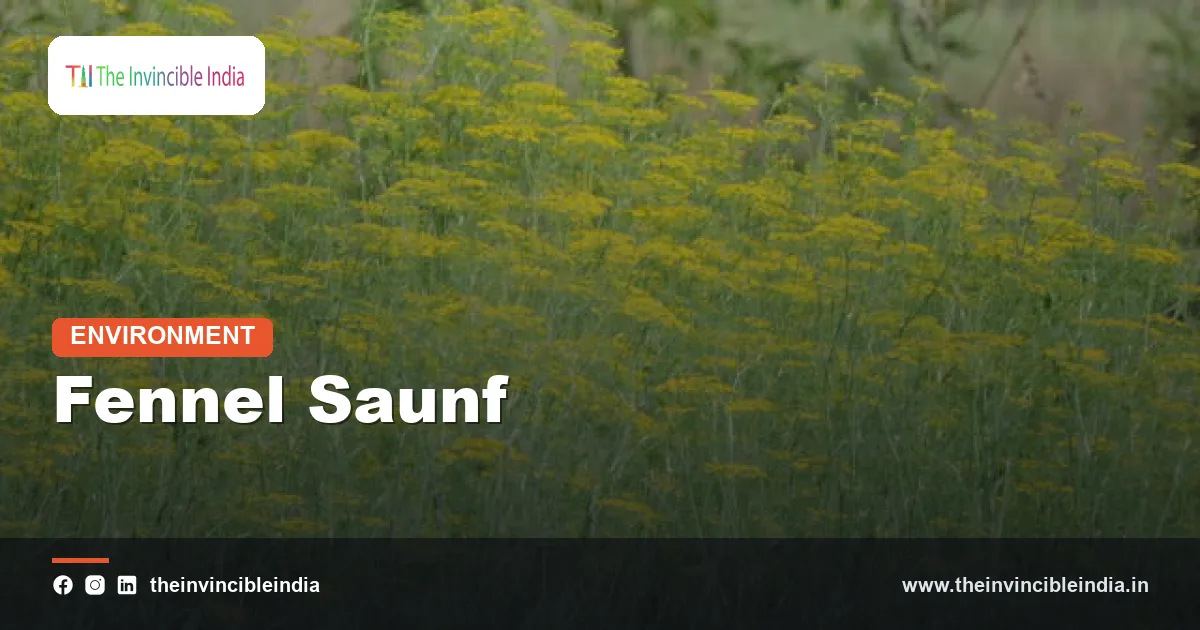
Saunf is the Hindi name for fennel, an aromatic plant of the carrot family whose small, ridged, sweet-smelling seeds are used as a spice and as a mouth freshener across India. Fennel is grown as a winter (rabi) crop, with Gujarat and Rajasthan the leading producing states, and its anise-like flavour comes mainly from a natural compound called anethole.
Fennel appears in Indian life in many ways: a bowl of roasted saunf is offered after meals in homes and restaurants, the seeds flavour Kashmiri and Bengali dishes, and the dried fruits are traded in large volumes through the spice markets of north Gujarat. This explainer covers what fennel is, how the plant grows, where it is cultivated and how it is used.
Quick Facts
| Attribute | Detail |
|---|---|
| Common names | Fennel, saunf (Hindi), variyali (Gujarati), perum jeeragam (Tamil), sombu (Tamil), badi saunf |
| Scientific name | Foeniculum vulgare |
| Family | Apiaceae (the carrot or parsley family) |
| Native region | Mediterranean region of southern Europe and western Asia |
| Where grown in India | Gujarat (Mehsana and Banaskantha districts), Rajasthan (Nagaur, Sirohi, Jodhpur, Bhilwara and nearby districts), and smaller areas of Uttar Pradesh, Haryana, Madhya Pradesh and Andhra Pradesh |
| Crop season | Rabi: sown around October-November and harvested from about February-March to April |
| Part used | Dried seed-like fruits (commonly called seeds); leaves and bulb of some types as vegetable or herb |
| Main uses | Spice, mouth freshener (mukhwas), tea, pickles, essential oil, traditional digestive remedy |
| Key trade centre | Unjha in north Gujarat, one of the largest spice markets in Asia |
Key Takeaways
- Fennel, known in Hindi as saunf, is a perennial herb of the Apiaceae family that is grown as an annual or biennial spice crop in India.
- India grows fennel as a rabi crop, sown in October-November and harvested from February-March onwards.
- Gujarat and Rajasthan together produce most of the fennel grown in India, and Unjha in north Gujarat is its main trading hub.
- The aroma of fennel seed comes largely from anethole, a compound shared with anise and star anise.
- Fennel seed is used whole or ground in cooking, roasted as a mouth freshener, and steeped as a digestive tea.
- Fennel is one of the major Indian seed spices, a group that also includes cumin, coriander, fenugreek and ajwain.
What is fennel?
Fennel is a tall, feathery-leaved herb, Foeniculum vulgare, that produces yellow flower clusters followed by small, oblong, greenish-yellow fruits used as a spice. The plant is related to carrot, coriander, cumin, dill and celery, all of which belong to the Apiaceae family.
The plant can reach about one to two metres in height. It has hollow, upright stems, finely divided thread-like leaves, and flat-topped clusters called umbels carrying many tiny yellow flowers. Every part of the plant smells of liquorice or anise when crushed. The “seed” sold as saunf is botanically a dry fruit, split into two halves, with five pale ridges running along its length.
Fennel is native to the Mediterranean, but it has been cultivated for many centuries and has naturalised in many warm temperate regions of the world. In India, it is grown mainly for the dried fruit, although tender leaves and, in some places, the swollen leaf bases of the vegetable type known as Florence fennel are also eaten.
Is saunf the same as fennel, anise or dill?
Saunf is the Indian name for fennel and is not the same as anise or dill, although all three share a similar sweet aroma. Mixing up these plants is common because Indian languages and shopkeepers use the names loosely.
- Fennel (saunf): Foeniculum vulgare; seeds are longer, greener and milder than anise.
- Anise (sweet saunf or “anisi saunf”): Pimpinella anisum; seeds are smaller, greyer and stronger in flavour, and the plant is less commonly grown in India.
- Dill (sowa): Anethum graveolens; its leaves are eaten as a vegetable in north India, and its seeds are flatter and sharper tasting than fennel seeds.
- Star anise (chakri phool): Illicium verum; an unrelated tree whose star-shaped pods share the anethole flavour.
The common thread is anethole, the sweet-smelling compound found in all four. Fennel seed is gentler and sweeter than anise or star anise, which is why it suits eating raw after meals.
Where is fennel grown in India?
Fennel is grown mainly in Gujarat and Rajasthan, which together account for the bulk of Indian production. Within Gujarat, the districts of Mehsana and Banaskantha in the north of the state are the main areas, while in Rajasthan the crop is concentrated in districts such as Nagaur, Sirohi, Jodhpur, Pali and Bhilwara.
Smaller quantities are grown in Uttar Pradesh, Haryana, Madhya Pradesh, Punjab, Andhra Pradesh and Telangana. The Lucknow region of Uttar Pradesh is associated with a small, green, sweet-tasting type known as Lucknowi saunf, which is often used for mukhwas and commands a higher price.
India is among the leading fennel producers in the world, along with countries such as Egypt, Syria, Bulgaria and China. The country exports whole and ground seed, and a part of its crop is also used by the domestic mukhwas and food industries. Exact yearly production and export figures vary with weather and prices, so current numbers should be checked with the Spices Board of India or the agriculture ministry.
How is fennel grown?
Fennel is grown as a cool-season crop that is sown in the post-monsoon months and harvested in spring, usually on well-drained loamy soil with moderate irrigation. The crop is sensitive to waterlogging and heavy frost at flowering, so farmers pick fields and sowing dates carefully.
Climate and soil
Fennel prefers a cool, dry climate during growth and warmer, dry weather at seed maturity. It grows well in well-drained sandy loam to clay loam soils with a neutral to slightly alkaline reaction. Heavy rain at flowering encourages fungal diseases, and severe frost at the same stage can cause flower loss and poor seed set. The arid and semi-arid conditions of north Gujarat and western Rajasthan, with irrigation from wells and canals, suit the crop.
Sowing and management
Fields are ploughed to a fine tilth and the seed is either sown directly in rows or raised in a nursery and transplanted. Direct sowing is common in October-November. Transplanting is used in some areas because it can improve uniformity and yield. The crop is irrigated at intervals through the growing period, with careful attention to flowering and seed filling. Weeds are removed by hand-hoeing, and a modest dose of fertiliser, with farmyard manure, is typical.
Common varieties
Improved varieties released by agricultural universities have been widely adopted. Gujarat Fennel-1 and later selections from Sardarkrushinagar Dantiwada Agricultural University, and Rajasthan-released varieties such as RF-101 and RF-125 from the Rajasthan agricultural research system, are examples associated with higher yield and better seed quality. Local land-race types are still grown in some villages.
When and how is fennel harvested?
Fennel is harvested from about February-March through April, when the umbels are fully developed and the seeds have changed from green to a yellowish green. Because the flower clusters on one plant mature at different times, farmers harvest the umbels in several rounds as each one ripens.
The timing of harvest affects the quality of the product. For the premium green fennel prized in the mukhwas trade, umbels are cut when the seeds have reached full size but are still green, and then dried slowly in shade so they keep their colour and aroma. Seeds left to ripen fully in the sun turn pale yellow-brown and lose some of the fresh green colour that buyers want. After drying, the umbels are threshed, the seeds are cleaned and graded, and the produce is bagged for sale.
The typical post-harvest steps are:
- Cutting the umbels at the correct maturity stage.
- Drying in shade or on clean floors, with turning, until moisture is low.
- Threshing and winnowing to remove stalks and dust.
- Grading by size, colour and cleanliness.
- Bagging and storage in a dry, cool place away from strong odours.
What gives fennel its flavour and aroma?
Fennel gets its sweet, anise-like flavour mainly from anethole, an aromatic compound that makes up the greater part of the seed’s essential oil. The oil also contains smaller amounts of fenchone, which adds a camphor-like bitterness, and estragole, which contributes a slightly herbal note.
The seeds typically contain a few per cent of volatile oil by weight. The oil is extracted by steam distillation for use in flavouring, confectionery, toothpaste, mouthwash and fragrance. Whole seeds keep their aroma well, but ground fennel loses its volatile oil more quickly, so cooks generally buy whole seed and grind small amounts as needed. Lightly roasting the seeds in a dry pan before use deepens the sweetness and makes the aroma more rounded.
How is saunf used in Indian food?
Saunf is used in Indian food as a whole or ground spice in curries, pickles and spice blends, and as a mouth freshener served after meals. Its sweetness balances heat and richness, which is why it features in so many regional cuisines.
In cooking
- Panch phoron: the Bengali and Odia five-spice mix, made from equal parts of fennel, cumin, mustard, fenugreek and nigella seeds, used for tempering vegetables and lentils.
- Kashmiri cuisine: ground fennel is a main flavouring in dishes such as rogan josh and yakhni, where it is often paired with dry ginger.
- Pickles: whole or crushed saunf is used in mango, lemon, carrot and mixed vegetable pickles for fragrance.
- Gravies and masalas: ground saunf adds mild sweetness to kormas, keema dishes and some biryani masalas.
- Bakery and sweets: the seed flavours biscuits, breads and some traditional sweets.
As mukhwas and tea
Roasted plain saunf, sugar-coated saunf, and mixtures with sesame, coconut and dried rose petals are standard mukhwas in homes, restaurants and weddings. In many households, fennel seeds are also steeped in hot water as a mild tea after heavy meals. Fennel is also an ingredient in the sherbet-like drinks of north India, where soaked saunf is used in cooling summer beverages.
What are the traditional and health uses of fennel?
Fennel has long been used in Indian household and Ayurvedic practice as a carminative, a substance traditionally taken to ease bloating and help digestion after meals. This is a traditional use and a common habit, but it should not be treated as medical advice.
Laboratory studies have examined the antioxidant, antimicrobial and antispasmodic properties of fennel’s compounds, and the seeds supply small amounts of fibre, calcium, iron and other minerals. These amounts are modest at the quantities normally eaten. Because fennel contains estragole, which has been the subject of regulatory attention at high doses, concentrated fennel oil and supplements are best taken only on professional advice, and pregnant women or people with medical conditions should consult a doctor before using fennel in medicinal amounts.
How does fennel compare with other Indian seed spices?
Fennel is one of several seed spices grown in India’s drier regions, and each differs in family, season and flavour. The table below places fennel next to its better-known relatives.
| Seed spice | Scientific name | Family | Main growing states | Flavour |
|---|---|---|---|---|
| Fennel (saunf) | Foeniculum vulgare | Apiaceae | Gujarat, Rajasthan | Sweet, anise-like |
| Cumin (jeera) | Cuminum cyminum | Apiaceae | Gujarat, Rajasthan | Warm, earthy |
| Coriander (dhania) | Coriandrum sativum | Apiaceae | Rajasthan, Madhya Pradesh, Gujarat | Citrusy, mild |
| Ajwain (carom) | Trachyspermum ammi | Apiaceae | Rajasthan, Gujarat | Sharp, thyme-like |
| Fenugreek (methi) | Trigonella foenum-graecum | Fabaceae | Rajasthan, Gujarat, Madhya Pradesh | Bitter, maple-like |
Why is Unjha important for fennel trade?
Unjha, a town in the Mehsana district of Gujarat, is important because it is one of the largest spice markets in Asia, where fennel, cumin and other seed spices are auctioned and traded in bulk. Farmers from Gujarat and neighbouring Rajasthan bring their produce to the market yards of the Agricultural Produce Market Committee (APMC) at Unjha, where it is graded and sold to dealers, processors and exporters.
Because the town is known for the volume and the price discovery that happens there, rates quoted at Unjha often serve as a reference for seed-spice prices across India. The trade is cyclical: when prices are high, more farmers sow fennel in the next season, and a large crop can then pull prices down again.
Bottom Line
Fennel, or saunf, is a Mediterranean-origin member of the carrot family that India has made its own as a winter spice crop. Grown mostly in Gujarat and Rajasthan and traded at Unjha, the seed flavours curries and pickles, ends meals as a mouth freshener and remains a household digestive habit.
Frequently Asked Questions
What is saunf called in English?
Saunf is called fennel in English. The word refers to the dried seed-like fruits of the plant Foeniculum vulgare. In some shops, a smaller, sweeter and stronger type is labelled “sweet saunf” and may actually be anise.
Is fennel a spice or a herb?
Fennel is both, depending on the part used. The dried seeds are used as a spice, while the fresh feathery leaves are used as a herb and the swollen bulb of Florence fennel is cooked as a vegetable. In India, the seed is by far the most common form.
Which state grows the most fennel in India?
Gujarat and Rajasthan are the two leading fennel-growing states in India. North Gujarat, especially the Mehsana and Banaskantha districts, is the best-known region, and Unjha is its main market. Rankings between the two states can change from year to year with weather and area sown.
When is fennel sown and harvested in India?
Fennel is sown in October-November and harvested from about February-March to April. It is a rabi, or winter, crop that needs a cool growing period. Farmers pick the flower clusters in several rounds as each ripens.
What is the difference between fennel and Lucknowi saunf?
Lucknowi saunf is a particular type of fennel that is smaller, greener and sweeter than the common bold seed. Both come from the same species, Foeniculum vulgare. The Lucknowi type is preferred for mukhwas and usually sells at a higher price.
Why do people eat saunf after meals?
People in India eat saunf after meals as a traditional mouth freshener and digestive aid. The seeds leave a sweet, cooling taste and freshen the breath. The digestive benefit is based on long-standing custom and is not a substitute for medical advice.
{“@context”:”https://schema.org”,”@graph”:[{“@type”:”FAQPage”,”mainEntity”:[{“@type”:”Question”,”name”:”What is saunf called in English?”,”acceptedAnswer”:{“@type”:”Answer”,”text”:”Saunf is called fennel in English. The word refers to the dried seed-like fruits of the plant Foeniculum vulgare. In some shops, a smaller, sweeter and stronger type is labelled “sweet saunf” and may actually be anise.”}},{“@type”:”Question”,”name”:”Is fennel a spice or a herb?”,”acceptedAnswer”:{“@type”:”Answer”,”text”:”Fennel is both, depending on the part used. The dried seeds are used as a spice, while the fresh feathery leaves are used as a herb and the swollen bulb of Florence fennel is cooked as a vegetable. In India, the seed is by far the most common form.”}},{“@type”:”Question”,”name”:”Which state grows the most fennel in India?”,”acceptedAnswer”:{“@type”:”Answer”,”text”:”Gujarat and Rajasthan are the two leading fennel-growing states in India. North Gujarat, especially the Mehsana and Banaskantha districts, is the best-known region, and Unjha is its main market. Rankings between the two states can change from year to year with weather and area sown.”}},{“@type”:”Question”,”name”:”When is fennel sown and harvested in India?”,”acceptedAnswer”:{“@type”:”Answer”,”text”:”Fennel is sown in October-November and harvested from about February-March to April. It is a rabi, or winter, crop that needs a cool growing period. Farmers pick the flower clusters in several rounds as each ripens.”}},{“@type”:”Question”,”name”:”What is the difference between fennel and Lucknowi saunf?”,”acceptedAnswer”:{“@type”:”Answer”,”text”:”Lucknowi saunf is a particular type of fennel that is smaller, greener and sweeter than the common bold seed. Both come from the same species, Foeniculum vulgare. The Lucknowi type is preferred for mukhwas and usually sells at a higher price.”}},{“@type”:”Question”,”name”:”Why do people eat saunf after meals?”,”acceptedAnswer”:{“@type”:”Answer”,”text”:”People in India eat saunf after meals as a traditional mouth freshener and digestive aid. The seeds leave a sweet, cooling taste and freshen the breath. The digestive benefit is based on long-standing custom and is not a substitute for medical advice.”}}]}]}


