

The castor plant (Ricinus communis), known in Hindi as arandi or erand, is a tall, fast-growing oilseed shrub whose seeds yield castor oil, a thick, pale industrial oil used in lubricants, soaps, paints, cosmetics and medicine. India is the world’s leading producer and exporter of castor seed and castor oil, and the crop is grown mostly in Gujarat, with smaller areas in Rajasthan and the southern states.
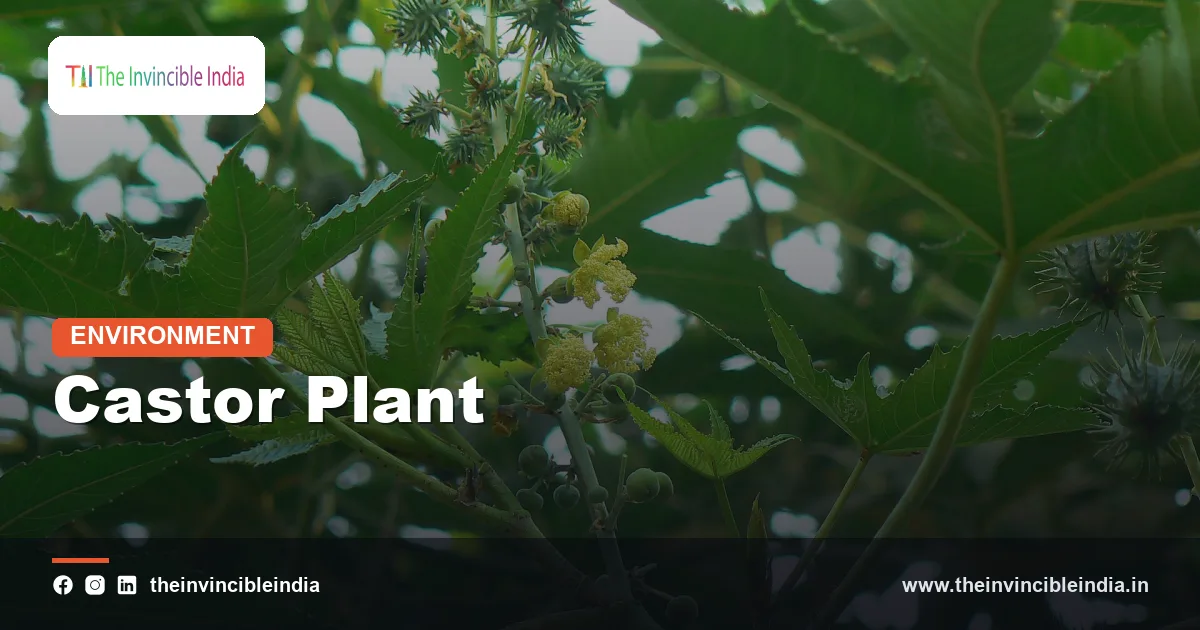
The castor plant is easily recognised by its huge, star-shaped leaves and its clusters of spiny seed capsules. Its seeds contain a powerful poison called ricin, which stays in the leftover meal and not in the properly processed oil. This double character, as a valuable industrial crop and a toxic plant, explains much of what is written about castor.
| Quick Facts: Castor Plant | |
|---|---|
| Scientific name | Ricinus communis |
| Plant family | Euphorbiaceae (the spurge family) |
| Common Indian names | Arandi, erand and erandi (varies by language and region) |
| Where grown in India | Mainly Gujarat (north Gujarat), with areas in Rajasthan, Telangana and Andhra Pradesh |
| Growing season | Mostly kharif: sown with the monsoon in June to July, harvested in several pickings from about November to March |
| Part used | Seeds for oil; leaves for feeding eri silkworms; stalks for fuel |
| Main products | Castor oil, ricinoleic acid derivatives, hydrogenated castor oil, castor cake used as manure |
| Importance | India is the leading world producer and exporter of castor oil; the oil is a key non-edible industrial raw material |
Key Takeaways
- The castor plant (Ricinus communis) is a tall oilseed shrub of the spurge family, Euphorbiaceae, grown for the oil in its seeds.
- India has for several decades been the world’s largest producer and exporter of castor oil, and Gujarat is the leading castor-growing state.
- Castor oil contains a very high proportion of ricinoleic acid, which gives it unusual chemical properties that make it useful in lubricants, plastics, soaps and coatings.
- Castor seeds contain ricin, a highly toxic protein, but ricin is not present in meaningful amounts in properly produced castor oil.
- Castor leaves are the traditional feed of the eri silkworm, which produces eri silk in Assam and other northeastern states.
- Castor oil is used in medicine as a laxative and in cosmetics, but it should be taken only in sensible doses and with medical advice where there is any doubt.
What is the castor plant?
The castor plant is a fast-growing shrub or small tree of the spurge family, Euphorbiaceae, with the scientific name Ricinus communis, and it is the only species in its genus. It is grown commercially for its seeds, which contain roughly half their weight in oil, and it is also found growing wild along roadsides, riverbanks and waste land across India.
The plant is believed to have originated in northeastern Africa, around the region of Ethiopia, and it spread across Asia and the Mediterranean in ancient times. Castor seeds have been found in Egyptian tombs thousands of years old, and the oil was used for lamps and as a medicine. In India, the plant has been known since antiquity, and it appears in Ayurvedic writings under the name eranda, where the oil is described as a purgative and a remedy for joint pain.
The English name “castor” is of uncertain origin. One common explanation is that the oil replaced castoreum, a substance from beavers used in older medicine, but historians do not fully agree. In many Indian languages the plant is simply called arandi, erand or a close variant.
What does the castor plant look like?
The castor plant looks like a bushy tree with large, deeply lobed, palm-shaped leaves, sturdy hollow stems and clusters of round, spiny seed capsules that ripen from green to brown. In cultivation as a crop it usually reaches between one and three metres, while in the wild, in frost-free areas, it may grow into a small tree several metres tall.
Leaves can be up to half a metre across and vary from green to deep reddish-purple, and the stem is often covered with a whitish waxy bloom. The flowers appear in a spike, called a raceme, with female flowers at the top and male flowers below. Each female flower develops into a three-chambered capsule that usually carries three seeds.
The seeds themselves are oval, glossy and mottled in shades of brown, grey and cream, and each bears a small spongy outgrowth called a caruncle at one end. Their attractive patterns are one reason children are sometimes tempted to play with them, which is dangerous. The root system is deep and strong, helping the plant withstand dry spells.
Where and when is castor grown in India?
Castor is grown in India mainly in Gujarat, which accounts for the largest share of national production, along with smaller areas in Rajasthan, Telangana and Andhra Pradesh, and some production in Tamil Nadu and Karnataka. North Gujarat districts such as Banaskantha, Patan, Mehsana and Sabarkantha are particularly well known as castor-growing areas.
The crop is mostly sown in the kharif season, during the monsoon in June or July, and it matures slowly. Because the flower spikes ripen unevenly, harvesting is done in several pickings between about November and March. In some areas, farmers also sow castor in the rabi season on irrigated land. Castor does best in warm weather, in well-drained, moderately fertile soils such as sandy loams, and it is damaged by waterlogging and frost.
India has produced the large majority of the world’s castor seed in recent decades, with other producers such as China, Brazil and some African countries contributing smaller shares. The exact amounts vary from season to season with rainfall and market prices, so current figures should be taken from the latest government or trade-body data. A large share of the oil produced in India is exported, with China, the European Union, the United States and Japan being among the traditional buyers.
How is castor cultivated and harvested?
Castor is cultivated by sowing seeds or hybrid seed in widely spaced rows at the start of the monsoon, and the crop is then managed with limited weeding, moderate fertiliser and occasional irrigation. The plant is a perennial in warm climates, but farmers treat it as an annual or short-lived crop for a single season.
Hybrid varieties have raised yields considerably. Agricultural researchers in Gujarat released some of the first commercial castor hybrids from the late 1960s onwards, and these were widely adopted and helped make Gujarat the national leader. Hybrids have a more uniform harvest and better yield than traditional types.
Pests and diseases
- Castor semilooper: a caterpillar that eats leaves and can defoliate plants.
- Capsule borer: a larva that bores into capsules and damages seeds.
- Wilt: a soil-borne fungal disease that can kill whole plants.
- Grey mould: a fungal rot on flower spikes in humid weather.
Harvesting
Harvest is done by hand, cutting each spike as its capsules turn brown. The capsules are then dried in the sun and threshed to release the seeds. Because the capsules of many older varieties burst open when dry, spreading seeds on the ground, the picking must be timely. Handling the seeds usually involves some dust from the husks, and workers can develop allergic reactions to the castor dust, so protective clothing is advisable.
How is castor oil made?
Castor oil is made by crushing or pressing the cleaned seeds, often after some heating, and then refining the oil to remove impurities and unpleasant odour. The seeds contain roughly 45 to 55 per cent oil by weight, which is higher than most other oilseeds.
In the traditional method, seeds are pressed in a mechanical expeller to produce “cold-pressed” oil, which is pale yellow and used for medicine and cosmetics. In industry, the leftover cake is further treated with a solvent to recover the remaining oil, which is typically used for technical purposes. The oil is then filtered, bleached and, where needed, deodorised.
Castor oil is unusual among vegetable oils. It is very thick (viscous), dissolves in alcohol and does not go rancid quickly. These properties come from ricinoleic acid, a fatty acid that makes up roughly 85 to 90 per cent of the oil and carries a hydroxyl group in its chemical structure. That group allows the oil to be converted by chemical reactions into many other useful compounds.
What is castor oil used for?
Castor oil is used mainly in industry, where it serves as a raw material for lubricants, greases, paints, coatings, plastics, soaps and cosmetics, and it is also used in medicine, mainly as a laxative. A large share of India’s castor production goes into industrial derivatives rather than edible or household uses.
| Use area | Examples |
|---|---|
| Lubricants and fluids | High-performance greases, hydraulic and brake fluids, lubricants for engines used in extreme conditions |
| Plastics and polymers | Nylon-11 and other specialty polymers, polyurethane foams and coatings |
| Paints and coatings | Dehydrated castor oil used in paints, varnishes and inks |
| Soaps and cosmetics | Soaps, lipsticks, hair oils, creams |
| Medicine | Laxative, ingredient in ointments |
| Fuel | Raw material for biodiesel in research and some pilot uses |
Hydrogenated castor oil, a hard wax-like solid, is used in greases, polishes and some cosmetics. Sebacic acid, made from castor oil, is used for making nylon and other polymers. Because castor oil stays fluid at low temperatures and remains stable at high ones, it has long been valued in aircraft and racing-engine lubricants.
In Indian households, castor oil has long been used as a traditional hair and skin oil, in oil lamps and in home remedies. Anyone considering internal use should take medical advice, because the oil is a strong laxative and is not suitable for everyone, including pregnant women.
Is the castor plant poisonous?
Yes, the castor plant is poisonous, because its seeds contain ricin, a toxic protein that can cause severe illness or death if the seeds are chewed and swallowed. Ricin is concentrated in the seed, and smaller quantities are found in other parts of the plant, so every part of the plant should be treated with caution.
Ricin is water-soluble and does not dissolve in the oil, which is why properly produced castor oil does not contain meaningful amounts of it. The poison remains in the leftover cake, which is why raw castor cake is used as manure, not as animal feed, unless it has been specially detoxified by heat or chemical treatment. Heating also destroys the toxin.
Seeds should be kept away from children and animals, and anyone who has swallowed castor seeds should seek urgent medical help. Because ricin is a recognised toxin, it is also regulated under international chemical-weapons agreements. In everyday life, however, the risk comes mainly from accidental swallowing of raw seeds, and not from castor oil sold for ordinary use.
What other uses does the castor plant have?
Besides its oil, the castor plant has other uses: its leaves feed the eri silkworm, its cake serves as an organic fertiliser, and its stalks are used as fuel and, in some places, as a raw material for paper and board. Each of these uses gives the crop extra value beyond the oil.
The eri silkworm, Samia ricini, is one of India’s traditional silkworms, raised mainly in Assam and other northeastern states. The silk it produces, known as eri or “ahimsa” silk, is spun from cocoons from which the moth is allowed to leave, and the worms feed on castor leaves. This makes castor a link between oilseed farming and the textile traditions of the Northeast.
The cake left after oil extraction is rich in nitrogen and is applied to soil as manure, and it is also said to help against some soil pests such as nematodes. The tough stalks are used as firewood and thatching material in rural areas. Research into castor as a source of bio-based chemicals has increased interest in the crop in recent years.
Why does castor matter to India?
Castor matters because it gives India a globally dominant export product from rain-fed and low-water land, and it supports a chain of farmers, crushers and chemical makers. As an industrial oil crop, it does not compete with edible oils for the kitchen, which makes it economically distinct from groundnut, mustard or soybean.
Gujarat’s castor belt has become a clear example of how improved hybrids, local crushing industry and export demand can strengthen a crop. Castor is also relatively tolerant of drought, which suits regions with limited water. At the same time, the crop is exposed to price swings in global markets, to competition from alternative crops such as cotton and cumin, and to the risk of pest outbreaks. Support from agricultural research, steady export markets and new uses of castor derivatives will shape its future.
Bottom Line
The castor plant is a tall, big-leaved oilseed shrub whose seeds produce a distinctive industrial oil, and India leads the world in producing and exporting it, mainly from Gujarat. The plant is both useful and toxic, which is why castor oil is a valued raw material while raw seeds must be handled with care.
Frequently Asked Questions
What is castor called in Hindi?
Castor is called arandi or erand in Hindi, and the oil is known as arandi ka tel or erand ka tel. The plant has related names in many other Indian languages. In classical Sanskrit texts it appears as eranda.
Which Indian state is the largest producer of castor?
Gujarat is the largest castor-producing state in India, particularly in its northern districts such as Banaskantha, Patan and Mehsana. Rajasthan, Telangana and Andhra Pradesh also grow the crop. Exact production varies from year to year with rainfall and market prices.
Is castor oil poisonous?
Properly produced castor oil is not considered poisonous in the way castor seeds are, because ricin, the toxin in the seed, does not dissolve in the oil. However, castor oil is a strong laxative and should be used sensibly and with medical advice where there is any doubt. The raw seeds, in contrast, are dangerous if chewed and swallowed.
What is castor oil used for?
Castor oil is used mainly in industry for making lubricants, paints, coatings, plastics, soaps and cosmetics. It is also used in medicine as a laxative and in traditional hair and skin care. Chemicals made from castor oil, such as sebacic acid, are used to make nylon and other polymers.
Why is castor oil so special chemically?
Castor oil is special because it contains roughly 85 to 90 per cent ricinoleic acid, a fatty acid with a hydroxyl group in its structure. This feature makes the oil thick, stable and chemically versatile. It is why castor oil can be turned into so many industrial products that other vegetable oils cannot easily produce.
Which silkworm feeds on castor leaves?
The eri silkworm, Samia ricini, feeds on castor leaves, and it produces eri silk in Assam and other northeastern states. The silk is spun from cocoons that the moth has already left, so it is sometimes called ahimsa silk. Castor is the main host plant for eri silkworm rearing.
{“@context”:”https://schema.org”,”@graph”:[{“@type”:”FAQPage”,”mainEntity”:[{“@type”:”Question”,”name”:”What is castor called in Hindi?”,”acceptedAnswer”:{“@type”:”Answer”,”text”:”Castor is called arandi or erand in Hindi, and the oil is known as arandi ka tel or erand ka tel. The plant has related names in many other Indian languages. In classical Sanskrit texts it appears as eranda.”}},{“@type”:”Question”,”name”:”Which Indian state is the largest producer of castor?”,”acceptedAnswer”:{“@type”:”Answer”,”text”:”Gujarat is the largest castor-producing state in India, particularly in its northern districts such as Banaskantha, Patan and Mehsana. Rajasthan, Telangana and Andhra Pradesh also grow the crop. Exact production varies from year to year with rainfall and market prices.”}},{“@type”:”Question”,”name”:”Is castor oil poisonous?”,”acceptedAnswer”:{“@type”:”Answer”,”text”:”Properly produced castor oil is not considered poisonous in the way castor seeds are, because ricin, the toxin in the seed, does not dissolve in the oil. However, castor oil is a strong laxative and should be used sensibly and with medical advice where there is any doubt. The raw seeds, in contrast, are dangerous if chewed and swallowed.”}},{“@type”:”Question”,”name”:”What is castor oil used for?”,”acceptedAnswer”:{“@type”:”Answer”,”text”:”Castor oil is used mainly in industry for making lubricants, paints, coatings, plastics, soaps and cosmetics. It is also used in medicine as a laxative and in traditional hair and skin care. Chemicals made from castor oil, such as sebacic acid, are used to make nylon and other polymers.”}},{“@type”:”Question”,”name”:”Why is castor oil so special chemically?”,”acceptedAnswer”:{“@type”:”Answer”,”text”:”Castor oil is special because it contains roughly 85 to 90 per cent ricinoleic acid, a fatty acid with a hydroxyl group in its structure. This feature makes the oil thick, stable and chemically versatile. It is why castor oil can be turned into so many industrial products that other vegetable oils cannot easily produce.”}},{“@type”:”Question”,”name”:”Which silkworm feeds on castor leaves?”,”acceptedAnswer”:{“@type”:”Answer”,”text”:”The eri silkworm, Samia ricini, feeds on castor leaves, and it produces eri silk in Assam and other northeastern states. The silk is spun from cocoons that the moth has already left, so it is sometimes called ahimsa silk. Castor is the main host plant for eri silkworm rearing.”}}]}]}


