

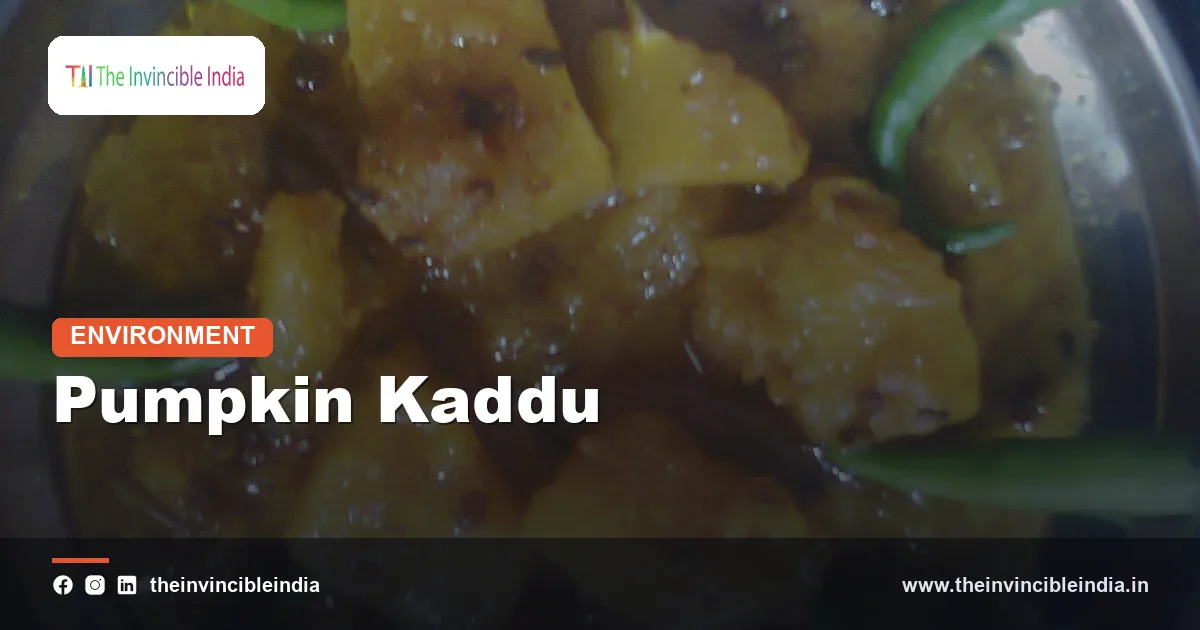
The pumpkin, called kaddu in Hindi, is a large, thick-skinned fruit of a trailing vine in the gourd family, grown across India as a vegetable and eaten in curries, sweets and fasting meals. It grows on a sprawling, hairy vine that can run several metres along the ground, a fence or even a village rooftop, and its orange flesh is one of the most common and affordable vegetables in Indian kitchens.
Although it feels thoroughly Indian today, the pumpkin is a New World crop that arrived after the 16th century and was quickly absorbed into regional cooking from Bengal to Kerala. This explainer covers what the pumpkin is, how it grows, how Indian farmers raise it, how it is eaten and stored, and what threatens the crop.
| Quick Facts | Details |
|---|---|
| Common names | Pumpkin; kaddu, sitaphal (Hindi); kumro (Bengali); bhopla (Marathi, Gujarati); mathanga (Malayalam) |
| Scientific name | Mostly Cucurbita moschata in India; also Cucurbita maxima and Cucurbita pepo |
| Family | Cucurbitaceae (the gourd or cucurbit family) |
| Origin | The Americas; introduced to India after the 16th century |
| Where grown in India | Almost every state, including Uttar Pradesh, Bihar, West Bengal, Odisha, Gujarat, Maharashtra and Kerala |
| Season | Summer crop sown February to March; rainy-season crop sown June to July; winter crop in parts of the plains |
| Time to harvest | Roughly 90 to 120 days from sowing for mature fruit |
| Part used | Ripe and unripe fruit flesh, seeds, flowers, young shoots and leaves |
| Uses | Vegetable curries, puri accompaniments, halwa, sambar, soups, seed snacks and animal feed |
Key Takeaways
- The pumpkin is a trailing annual vine of the family Cucurbitaceae, and most Indian pumpkins belong to the species Cucurbita moschata.
- Pumpkins are native to the Americas and reached India after European contact in the 16th century, yet kaddu is now a staple vegetable in nearly every Indian state.
- A pumpkin vine bears separate male and female flowers on the same plant, so bees and other insects are needed to carry pollen and set fruit.
- Indian farmers sow pumpkin in two main windows, February to March for a summer crop and June to July for a rainy-season crop, and harvest in about three to four months.
- Mature pumpkins with hardened rinds can be stored for several months in a cool, dry, ventilated place, which makes the crop valuable when other vegetables are scarce.
- Pumpkin flesh is a good source of beta-carotene, which the body converts to vitamin A, and it also supplies dietary fibre and potassium.
What is a pumpkin and how is it different from a squash or gourd?
A pumpkin is the fruit of certain Cucurbita species, usually round to oval, ribbed or smooth, with a hard rind, a hollow seed cavity and sweet orange or yellow flesh. In botanical terms the pumpkin is a berry of a special kind called a pepo, which is the technical word for the fleshy fruit of the gourd family with a firm outer skin.
The words pumpkin, squash and gourd overlap heavily and are used differently in different countries. In everyday English, squash is the wider group of Cucurbita fruits, while pumpkin is usually applied to the larger, rounder, orange types. Gourd is a loose term that in India also covers bottle gourd (lauki), bitter gourd (karela), ridge gourd (turai) and ash gourd (petha), none of which is a pumpkin.
Indian markets add further confusion by using local names for several different fruits. Kaddu most commonly refers to the common orange pumpkin and its relatives. Sitaphal is a Hindi name for pumpkin in some regions, although the same word also names the custard apple, so the context decides the meaning. The white-fleshed ash gourd, from which the famous Agra petha sweet is made, is a different plant from a different genus.
Where did the pumpkin come from and how did it reach India?
The pumpkin originated in the Americas, where several Cucurbita species were domesticated thousands of years ago, and it reached India only after European ships began carrying New World crops around the globe from the 16th century. The Portuguese, who established trading posts on the Indian coast in that century, are widely credited with introducing many American plants, and pumpkin and squash spread inland along with chillies, tomatoes, potatoes and maize.
The crop suited Indian conditions almost at once. It tolerates heat, grows on poor and sandy soils, needs little attention after the vines establish, and produces fruit that keeps for months. These traits made it easy for small farmers to adopt, and within a few centuries pumpkin had acquired local names, regional recipes and a place in festival food.
Older Indian cucurbits, such as the bottle gourd and ash gourd, were already part of the farm landscape long before the pumpkin arrived. The newcomer simply fitted into the same cropping slots, growing on the same sandy riverbeds, field boundaries and kitchen-garden fences where older gourds were grown.
What does a pumpkin plant look like and how does it grow?
A pumpkin plant is a fast-growing annual vine with long, bristly stems, large lobed leaves, coiled tendrils and bright yellow trumpet-shaped flowers. The stems can reach several metres, rooting at the nodes where they touch damp soil, and the large leaves shade the ground, which helps retain moisture and suppress weeds.
Flowers and pollination
Pumpkin is monoecious, meaning each plant bears separate male and female flowers. The male flowers appear first on slender stalks, and the female flowers follow, recognisable by a small swelling, the future fruit, directly beneath the petals. Bees, especially honeybees and other wild bees, carry pollen between the two kinds of flower in the early morning, when the blooms are open. If too few insects visit, the young fruit shrivels and drops, which is why farmers value hedgerows and flowering plants that sustain pollinators.
Fruit development
After pollination, the fruit swells over several weeks. The rind begins soft and green or pale, then gradually hardens and takes on its final colour, which may be orange, yellow, tan, deep green or grey-blue depending on the variety. Fruit weight ranges from under a kilogram to many kilograms, and Indian types are generally medium-sized and flat-round or slightly elongated.
How is pumpkin grown in India?
Pumpkin is grown in India as a warm-season crop sown directly by seed, and it is raised on farms, in kitchen gardens, on river sandbars and even on thatched or tiled roofs. The crop does best in warm weather with daytime temperatures roughly between 25 and 35 degrees Celsius, and it dislikes frost and prolonged waterlogging.
Season and sowing
In the northern plains farmers sow a summer crop in February and March, and a rainy-season crop in June and July. In the south and in coastal belts, sowing can occur across more months because of milder winters. Seeds are usually dropped into small pits or hills filled with farmyard manure, with a few seeds per hill, and later thinned to the strongest seedlings.
Soil, water and care
- Soil: well-drained loam or sandy loam with plenty of organic matter, and a slightly acidic to neutral reaction.
- Water: light irrigation at sowing and regularly during flowering and fruit set; the crop is sensitive to standing water around the crown.
- Spacing: wide, because the vines spread; hills are often placed two to three metres apart.
- Nutrition: organic manure at planting and moderate fertiliser as the vines run; too much nitrogen produces leaves at the cost of fruit.
- Weeding: early weeding is important until the vines cover the ground.
Riverbed and rooftop cultivation
One distinctive Indian practice is raising cucurbits, including pumpkins, on the sandy banks and exposed beds of rivers in the dry season, where the moisture below the sand supports vigorous vines. Another is training pumpkin vines up and over the roofs of village houses, which uses no cropland and keeps the fruit away from soil pests and ground rot.
How do you know when a pumpkin is ripe and how is it stored?
A pumpkin is ripe when its rind has hardened so that a fingernail cannot easily puncture it, its colour has deepened and the stalk attached to the fruit has dried and become woody. A mature fruit also gives a dull, hollow sound when tapped, and the tendril nearest the fruit stalk usually turns brown and dry.
Farmers harvest by cutting the stalk with a sharp knife, leaving a few centimetres of stem on the fruit because a pumpkin without its stalk rots sooner. The harvested fruit is often left in the sun for a few days to cure, which toughens the rind and heals minor cuts.
Cured pumpkins keep for several months when kept dry, off bare wet ground, away from direct rain and in a ventilated place, which is why many households store them in a corner of the kitchen or on a verandah. This long shelf life is a real advantage. A farmer can sell some fruit at harvest and hold the rest until prices improve, and a family can eat from the same stock for weeks.
Unripe or tender pumpkins are also harvested and sold as a seasonal vegetable. They cook faster than fully ripe fruit but are less sweet and do not store well.
What are the main kinds of pumpkin grown in India?
The main kinds of pumpkin in India are the common orange pumpkin of Cucurbita moschata, which dominates Indian markets, along with the smaller numbers of Cucurbita maxima and Cucurbita pepo types. Farmers and agricultural universities have bred and selected many varieties for yield, fruit shape, keeping quality and disease resistance, so named varieties differ from state to state.
| Species | Typical features | Common Indian use |
|---|---|---|
| Cucurbita moschata | Hard, ribbed rind; sweet orange flesh; heat tolerant; stalk flares at the fruit | The usual kaddu of vegetable markets and kitchens |
| Cucurbita maxima | Large, often rounded fruit; soft, thick flesh; stalk soft and corky | Sold in some regions as large sweet pumpkin, also used for stuffing and feeding livestock |
| Cucurbita pepo | Includes summer squashes and smaller pumpkins; ridged, angular stalk | Grown in smaller quantities, mostly in cooler hill areas and urban gardens |
Fruit shape varies from flat-round and ribbed to pear-like and long. Colour at maturity ranges from dull green with pale speckles to pale orange or deep orange, and buyers in different regions have clear preferences about size and sweetness.
How is pumpkin used in Indian food?
Pumpkin is used in Indian food as a vegetable cooked with spices, as a base for sweet dishes, as an ingredient in lentil stews and as a fasting food, with a distinct preparation in nearly every region. Its mild sweetness pairs well with chilli, mustard, fenugreek and jaggery, which explains why the same fruit appears in both savoury and sweet recipes.
Regional dishes
- North India: kaddu ki sabzi, a sweet-and-sour pumpkin curry, is traditionally served with puri at religious gatherings and community feasts, and pumpkin dishes are common during fasting days because they are cooked without onion and garlic.
- Bengal: kumro, cooked as chechki with other vegetables or fried in thin slices, and the flowers, dipped in batter and fried as fritters.
- Kerala: mathanga erissery, pumpkin cooked with red cowpeas or lentils and finished with a ground coconut and roasted coconut seasoning, is a standard part of a festival meal.
- Maharashtra and Gujarat: bhopla preparations such as bharit, a mashed pumpkin dish, and sweet-and-sour curries.
- South India: pumpkin pieces added to sambar, kootu and other lentil-based dishes.
- Sweets: kaddu ka halwa, cooked with milk, sugar and nuts, is a popular home sweet in northern states.
Other edible parts
The seeds are dried and roasted as a snack or ground into curries, the flowers are battered and fried, and the tender shoots and leaves are cooked as greens in some regions. Surplus or damaged fruit is commonly fed to cattle, so very little of the crop is wasted.
What nutrients does pumpkin provide?
Pumpkin provides mainly water, carbohydrate and fibre, together with beta-carotene, potassium and small amounts of several vitamins, while remaining low in fat and calories. The deeper the orange of the flesh, the more beta-carotene it generally contains, and the body converts beta-carotene to vitamin A, which supports vision and healthy skin.
Pumpkin seeds are far more energy-dense than the flesh. They supply protein, healthy fats, magnesium and zinc, which is why they are valued as a snack and as an addition to sweets and breads. As with any vegetable, how it is cooked matters: boiling or steaming keeps it light, while frying in oil or cooking in sugar adds considerably more energy.
Pumpkin is sometimes mentioned in general advice for diabetes or weight control because it has fibre and is filling for its calories. People managing a medical condition should still follow their doctor’s advice rather than rely on a single vegetable.
Which pests and diseases affect pumpkin?
Pumpkin is attacked mainly by red pumpkin beetles, fruit flies, aphids and whiteflies among pests, and by powdery mildew, downy mildew and mosaic viruses among diseases. Because several of these also attack other gourds, outbreaks tend to build up where cucurbits are grown repeatedly in the same area.
| Problem | What it does | Usual management |
|---|---|---|
| Red pumpkin beetle (Aulacophora foveicollis) | Adults chew holes in seedling leaves and flowers; grubs feed on roots | Early sowing, field sanitation, deep ploughing, protecting seedlings |
| Melon fruit fly (Bactrocera cucurbitae) | Females lay eggs in young fruit, and the maggots rot the flesh | Collecting and burying infested fruit, bait traps, protective bagging of fruit |
| Powdery mildew | White powdery growth on leaves, reducing yield | Resistant varieties, good air flow, timely treatment |
| Downy mildew | Yellow angular patches on leaves in humid weather | Avoiding overcrowding and wet leaves, crop rotation |
| Mosaic viruses | Mottled, stunted leaves and distorted fruit, spread by aphids and whiteflies | Removing infected plants, controlling insect carriers, clean seed |
Crop rotation with non-cucurbit crops, clean seed, removal of diseased vines and balanced irrigation are the basis of good practice. Integrated pest management, which combines these measures with careful use of pesticides only when needed, is generally recommended over routine spraying, partly because the bees that pollinate the flowers are easily harmed by insecticides.
Why does the pumpkin matter in Indian farming and culture?
The pumpkin matters in Indian farming because it is a low-cost, hardy, long-keeping crop that small and marginal farmers can grow with few inputs, and it matters in culture because it is woven into festival and fasting meals. A single vine can yield several fruits, and a household with a few vines can feed itself and sell the surplus.
The crop is especially useful in places where cropping options are limited, such as sandy riverbeds and rain-fed uplands. It also fits mixed farming, since the vines cover the ground between rows of other crops and the fruit doubles as livestock feed.
In food culture, the humble kaddu has moved between the everyday and the ceremonial. It is a weekday vegetable in many homes, an essential dish at community feasts in parts of North India, a festival item in Kerala, and a vegetable that people eat on fasting days. The Halloween jack-o’-lantern familiar from Western countries is not an Indian tradition, though carving festival pumpkins has appeared in some urban areas in recent years.
Bottom Line
The pumpkin is an American vine that Indian farmers and cooks have made their own over roughly five centuries. It grows easily in warm weather, stores for months and adapts to dozens of regional recipes, which is why kaddu remains one of the most dependable vegetables in India.
Frequently Asked Questions
What is kaddu in English?
Kaddu is the Hindi name for pumpkin, and it usually refers to the orange-fleshed gourd of the species Cucurbita moschata. In some regions the word is also used loosely for other large squash-type fruits, and the related name sitaphal is another Hindi term for pumpkin.
Is the pumpkin native to India?
No, the pumpkin is native to the Americas and reached India only after the 16th century. It was introduced through European trade, and it is now so common in Indian farming and cooking that many people assume it is an old local crop.
When is pumpkin sown in India?
Pumpkin is mainly sown from February to March for a summer crop and from June to July for a rainy-season crop. In milder southern and coastal areas, sowing can take place in other months as well, and fruit is usually ready in about three to four months.
How long can a pumpkin be stored?
A fully mature, cured pumpkin can be stored for several months in a cool, dry and well-ventilated place. The rind must be hard and the fruit should keep a short piece of its stalk, because damaged or stalkless fruit spoils much sooner.
Is pumpkin the same as ash gourd or bottle gourd?
No, the pumpkin, the ash gourd and the bottle gourd are different plants, although all are in the gourd family. Pumpkin belongs to the genus Cucurbita, whereas ash gourd (petha) and bottle gourd (lauki) belong to other genera and have different fruit and flavour.
Which parts of the pumpkin plant are edible?
The flesh, seeds, flowers and tender shoots and leaves of the pumpkin plant are all edible. The flesh is cooked as a vegetable or sweet, the seeds are roasted as a snack, and the flowers are often fried in batter, especially in Bengal.
{“@context”:”https://schema.org”,”@graph”:[{“@type”:”FAQPage”,”mainEntity”:[{“@type”:”Question”,”name”:”What is kaddu in English?”,”acceptedAnswer”:{“@type”:”Answer”,”text”:”Kaddu is the Hindi name for pumpkin, and it usually refers to the orange-fleshed gourd of the species Cucurbita moschata. In some regions the word is also used loosely for other large squash-type fruits, and the related name sitaphal is another Hindi term for pumpkin.”}},{“@type”:”Question”,”name”:”Is the pumpkin native to India?”,”acceptedAnswer”:{“@type”:”Answer”,”text”:”No, the pumpkin is native to the Americas and reached India only after the 16th century. It was introduced through European trade, and it is now so common in Indian farming and cooking that many people assume it is an old local crop.”}},{“@type”:”Question”,”name”:”When is pumpkin sown in India?”,”acceptedAnswer”:{“@type”:”Answer”,”text”:”Pumpkin is mainly sown from February to March for a summer crop and from June to July for a rainy-season crop. In milder southern and coastal areas, sowing can take place in other months as well, and fruit is usually ready in about three to four months.”}},{“@type”:”Question”,”name”:”How long can a pumpkin be stored?”,”acceptedAnswer”:{“@type”:”Answer”,”text”:”A fully mature, cured pumpkin can be stored for several months in a cool, dry and well-ventilated place. The rind must be hard and the fruit should keep a short piece of its stalk, because damaged or stalkless fruit spoils much sooner.”}},{“@type”:”Question”,”name”:”Is pumpkin the same as ash gourd or bottle gourd?”,”acceptedAnswer”:{“@type”:”Answer”,”text”:”No, the pumpkin, the ash gourd and the bottle gourd are different plants, although all are in the gourd family. Pumpkin belongs to the genus Cucurbita, whereas ash gourd (petha) and bottle gourd (lauki) belong to other genera and have different fruit and flavour.”}},{“@type”:”Question”,”name”:”Which parts of the pumpkin plant are edible?”,”acceptedAnswer”:{“@type”:”Answer”,”text”:”The flesh, seeds, flowers and tender shoots and leaves of the pumpkin plant are all edible. The flesh is cooked as a vegetable or sweet, the seeds are roasted as a snack, and the flowers are often fried in batter, especially in Bengal.”}}]}]}


