

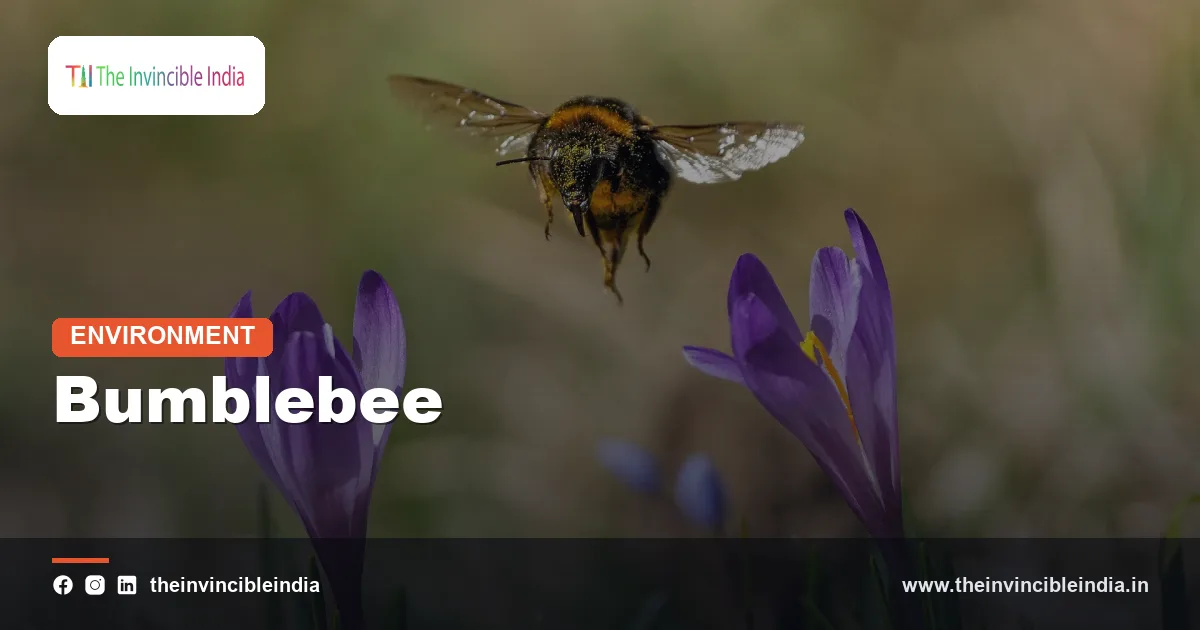
A bumblebee is a large, round, furry, social bee of the genus Bombus that feeds on nectar and pollen, makes a loud low buzz in flight, and is one of the most important pollinators of flowering plants in cool and hilly regions. In India the bumblebee is most familiar in the Himalayan belt, from Jammu and Kashmir and Himachal Pradesh to Sikkim and Arunachal Pradesh, although a few species also occur in the hills of the south.
Unlike the honey bee, the bumblebee lives in small annual colonies, does not store large amounts of honey, and is built to work in cold, wet and windy weather when other bees stay inside. This article explains what a bumblebee is, how its colony works, how it pollinates, whether it stings, and why its decline matters.
| Quick Facts | Details |
|---|---|
| Scientific name and family | Genus Bombus, family Apidae (the same family as honey bees, carpenter bees and stingless bees) |
| Size | Workers are roughly 1 to 2 cm long; queens are larger and can reach about 2.5 cm or more depending on the species |
| Habitat in India | Mainly Himalayan meadows, forest edges, orchards and alpine slopes; fewer species in the Western Ghats and other southern hills |
| Diet | Nectar for energy; pollen as protein for the larvae |
| Life cycle | Annual colony: a lone queen founds the nest in spring, workers raise the colony, new queens and males appear late in the season, and only mated young queens survive the winter |
| Nest | Small colonies, often tens to a few hundred bees, in abandoned rodent burrows, grass tussocks or hollows |
| Ecological role | Pollinator of wild flowers, orchard fruit and crops such as tomato, brinjal and many hill fruits |
| Notable features | Hairy body, pollen baskets on the hind legs, ability to buzz-pollinate, and shivering of flight muscles to generate body heat |
Key Takeaways
- A bumblebee is a large, hairy, social bee of the genus Bombus in the family Apidae, found mainly in cool and hilly regions.
- Bumblebee colonies are annual: the old colony dies each year and only mated young queens survive the winter to start new nests.
- Bumblebees perform buzz pollination, shaking pollen loose from flowers such as tomato and brinjal by vibrating their flight muscles.
- Bumblebees can fly in cold and drizzly weather because they warm their bodies by shivering their flight muscles.
- Only female bumblebees can sting, and they usually sting only when the nest or the bee itself is threatened.
- Bumblebee populations worldwide are under pressure from habitat loss, pesticides, climate change and disease.
What is a bumblebee?
A bumblebee is a social, hairy, stout-bodied bee that belongs to the genus Bombus, which contains several hundred species spread mostly across the cooler parts of the northern hemisphere. The name refers to the heavy, bumbling way the bee flies and to the deep humming sound of its wings.
The bumblebee body is covered in dense soft hair, usually arranged in coloured bands of black, yellow, orange, white or reddish brown. These bands vary greatly between species and even within a species, so colour alone is often not enough to identify a bumblebee. The hair traps a layer of warm air around the body, which is a major part of how the bee copes with cold.
Scientifically, the bumblebee sits in the family Apidae, in the tribe Bombini. Its relatives include the honey bees (genus Apis), the carpenter bees (genus Xylocopa) and the tiny stingless bees. Each female bumblebee has pollen baskets, called corbiculae, on the hind legs, where moist pollen is packed for carrying back to the nest.
How is a bumblebee different from a honey bee?
A bumblebee differs from a honey bee mainly in size, body hair, colony size and the way it stores food. The bumblebee is rounder and furrier, lives in a small colony that lasts one season, and stores only small pots of nectar rather than large honey reserves.
| Feature | Bumblebee | Honey bee |
|---|---|---|
| Genus | Bombus | Apis |
| Body | Large, round and densely furry | Slimmer, with shorter and sparser hair |
| Colony size | Tens to a few hundred bees | Thousands of bees |
| Colony life | One season; the colony dies out and only young queens overwinter | Perennial; the colony survives the year, often for many years |
| Food storage | Small wax pots of nectar and pollen | Large stores of honey in wax combs |
| Nest | Irregular clump of wax cells in a hollow or burrow | Orderly vertical wax combs |
| Stinger | Smooth, so the bee can sting more than once | Barbed in workers, so it usually dies after stinging |
| Cold-weather activity | Flies in cool, damp conditions | Generally needs warmer weather to forage |
Because of these differences, the bumblebee is not kept in boxes for honey in the way the Indian honey bee (Apis cerana) is. It matters instead as a free-living pollinator, and in some countries colonies are reared commercially specifically for greenhouse pollination.
Where do bumblebees live in India?
Bumblebees in India live mostly in the Himalayas and other hill regions, where summers are mild and flowers are abundant. Dozens of Bombus species have been recorded across the country, and the greatest variety is found in the western and eastern Himalaya, including Ladakh, Kashmir, Himachal Pradesh, Uttarakhand, Sikkim and Arunachal Pradesh.
Several of these species are found up to high altitudes, in alpine meadows above the tree line, where few other bees can survive. A smaller number of species live in the hills of peninsular India, such as parts of the Western Ghats, and some visit gardens at hill stations. In the hot plains the bumblebee is far less common, because heat is as stressful for it as cold is for tropical bees.
Typical bumblebee habitats in India include:
- Alpine and sub-alpine meadows with wildflowers.
- Apple, plum, apricot and other orchards of the hill states.
- Forest clearings, hedgerows and road verges with flowering shrubs.
- Hill-station gardens with plants such as lavender, salvia and sunflowers.
- Farm fields where crops such as tomato, brinjal and beans are grown at higher elevations.
How does a bumblebee colony work?
A bumblebee colony works as a seasonal society in which a single queen founds the nest, her daughters (the workers) look after it, and the colony ends each year after producing new queens. This annual cycle is the biggest difference between the bumblebee and the honey bee.
Spring: the queen starts alone
After winter hibernation in the soil, a mated queen emerges, feeds heavily on nectar and pollen, and searches for a nest site. Common sites are old rodent burrows, thick grass, leaf litter and cavities under stones. She makes a wax pot for nectar and a lump of pollen on which she lays the first eggs, then incubates them herself by pressing her warm body against the brood.
Summer: workers take over
The first eggs hatch into larvae, which grow, pupate and emerge as small female workers. These workers take over foraging, nest cleaning, guarding and the care of the young, while the queen stays inside and lays eggs. The colony grows through the summer, though it normally reaches only tens to a few hundred bees.
Late season: new queens and males
Late in the season the colony raises males, which develop from unfertilised eggs, and new queens, which are fed more food as larvae. Young queens and males leave the nest and mate. The males and the old workers die, the founding queen dies, and the mated young queens feed up and then dig into the ground to hibernate until the next spring.
Cuckoo bumblebees
Some bumblebee species are social parasites, often called cuckoo bumblebees. A cuckoo queen invades the nest of another bumblebee species, lays her eggs there and lets the host workers raise her young. These species have no worker caste of their own and also depend on healthy populations of their hosts.
What do bumblebees eat?
Bumblebees eat nectar and pollen, which they collect from flowers. Nectar is a sugary liquid that fuels the adult bees’ flight and body heat, while pollen provides the protein and fat that growing larvae need.
The bumblebee feeds using a tongue called a proboscis, whose length differs among species. Long-tongued bumblebees can reach deep inside tubular flowers such as foxglove, monkshood and delphinium, while short-tongued species prefer open flowers or sometimes bite a hole at the base of a flower to steal nectar. This division of labour among species is one reason a diverse set of bumblebees pollinates a wider range of plants than any single species could.
A bumblebee stores only a modest amount of food. It makes small wax pots with a little nectar, and any thickened nectar in these pots is not a harvestable crop of honey. Because the reserves are small, a few days of bad weather or a lack of flowers can seriously harm a colony.
What is buzz pollination?
Buzz pollination, also called sonication, is a technique in which a bumblebee grips a flower and vibrates its flight muscles at high speed to shake pollen out of the anthers. Many plants hold their pollen inside tube-like anthers with only a tiny opening, so the pollen is released only when the flower is shaken.
During buzz pollination the bumblebee clamps its jaws or legs on the flower and shivers its wing muscles without moving its wings much. The vibration makes a high-pitched buzz that is different from the sound of normal flight, and a cloud of pollen is ejected onto the bee’s furry body. When the bee visits the next flower, some of that pollen rubs onto the stigma and fertilises the flower.
Honey bees do not normally buzz-pollinate. This is why the bumblebee is valued for crops with such flowers, including:
- Tomato, where fruit set and fruit size improve with bumblebee visits.
- Brinjal (eggplant), which has similar pollen-holding anthers.
- Potato, whose flowers are buzz-pollinated though the crop is grown from tubers.
- Berries and some pulses and wild plants of hill ecosystems.
How do bumblebees stay warm in cold weather?
Bumblebees stay warm by shivering their large flight muscles, which generates heat without moving the wings, and by using their thick fur as insulation. This ability to warm up on their own lets them forage in cool, cloudy, misty or light rainy weather in the mountains.
Before take-off the bumblebee shivers for a while to bring its thorax to a temperature suitable for flight. In addition, a larger body loses heat more slowly than a small one, which helps big queens in early spring. Inside the nest, the queen and workers also warm the brood by pressing against it and shivering, and they can keep the nest much warmer than the air outside.
The same ability has a limit. In very hot weather a bumblebee can overheat, so it may reduce activity at midday or fan its wings at the nest entrance. This is one reason that warming climates are a concern for bumblebee species adapted to cool uplands.
Do bumblebees sting?
Yes, female bumblebees can sting, but they are generally gentle and sting only when they are squeezed, trapped or when their nest is disturbed. Male bumblebees have no stinger at all, and the workers of most species ignore people who keep their distance.
A bumblebee stinger is smooth rather than barbed, so the bee can sting more than once without being injured. When a nest is threatened, some species raise a middle leg or tilt their body as a warning before stinging. A sting is painful but short-lived for most people, and the usual first aid is to wash the area and apply a cold compress.
People with an allergy to bee venom can have a serious reaction, with swelling of the face or throat, breathing difficulty or dizziness, and these signs need urgent medical care. A nest in a garden or farm is best left alone or removed by a trained person rather than disturbed.
Why do bumblebees matter to farming and ecosystems?
Bumblebees matter because they pollinate a wide range of wild plants and food crops, especially in cool regions and on crops that need buzz pollination. Their work supports fruit and seed production, which in turn supports the birds, mammals and insects that feed on those fruits and seeds.
In the Indian Himalaya, bumblebees visit apple and other orchard trees, pulses, vegetables and the wildflowers of high meadows. They are especially useful in poor weather, when honey bees and other insects stay at home. Studies elsewhere in the world have shown that crops visited by a mix of wild bees tend to give better fruit set than crops visited by honey bees alone, so bumblebees add value even where honey bees are kept.
Bumblebees are also an indicator of the health of mountain ecosystems. Because they depend on a continuous sequence of flowers from spring to autumn and on undisturbed soil for nests and hibernation, their presence suggests that the landscape still has these features.
What threatens bumblebees?
Bumblebees are threatened mainly by loss of flower-rich habitat, pesticide exposure, climate change and disease, and several bumblebee species have declined sharply in parts of the world. Their annual colony cycle and small colony size make them more vulnerable to such shocks than perennial honey bee colonies.
- Habitat loss: conversion of meadows and hedgerows to farmland or buildings removes both food and nest sites.
- Pesticides: insecticides such as neonicotinoids can weaken bees or reduce the number of new queens a colony produces.
- Climate change: warming forces cold-adapted species uphill, and mountain species may run out of higher ground. Flowering times can also drift out of step with the queen’s emergence.
- Disease and parasites: commercially reared bumblebees moved between regions can spread pathogens to wild populations.
- Overgrazing and tourism pressure: trampled and grazed alpine meadows lose their flowers and burrows.
Practical steps to help include leaving patches of wildflowers and long grass, avoiding spraying flowering plants, protecting meadows and orchard margins, and planting a succession of nectar-rich flowers that bloom from early spring to autumn.
Bottom Line
The bumblebee is a hardy, furry, social bee that does the quiet work of pollinating hill flowers and crops, including those that need buzz pollination. Protecting meadows, nesting ground and a long season of flowers is the surest way to keep the bumblebee buzzing in Indian landscapes.
Frequently Asked Questions
What is a bumblebee?
A bumblebee is a large, furry, social bee of the genus Bombus in the family Apidae. It feeds on nectar and pollen and lives in small colonies, mostly in cool and hilly regions. It is an important pollinator of wild plants and crops.
Are there bumblebees in India?
Yes, India has many bumblebee species, and most of them live in the Himalayan region, from Kashmir to Arunachal Pradesh. A few species also occur in hill areas of southern India. They are far less common in the hot plains.
Do bumblebees sting?
Yes, female bumblebees can sting, but they do so only when they are trapped or when their nest is disturbed. Males cannot sting at all. The stinger is smooth, so a bumblebee can sting more than once.
Do bumblebees make honey?
No, bumblebees do not make honey in useful amounts. They store small quantities of nectar in wax pots to feed the colony for a short time. Their colonies die out each year, so they do not need large winter stores like honey bees.
What is buzz pollination?
Buzz pollination is a technique in which a bumblebee vibrates its flight muscles while holding a flower to shake out pollen. It works on flowers such as tomato and brinjal that release pollen only when shaken. Honey bees generally cannot do this.
How long does a bumblebee live?
Worker bumblebees live for a few weeks to a couple of months, while queens live for about a year. A queen emerges in spring, founds a colony, and dies after the new queens have been produced. Only the mated young queens survive the winter.
{“@context”:”https://schema.org”,”@graph”:[{“@type”:”FAQPage”,”mainEntity”:[{“@type”:”Question”,”name”:”What is a bumblebee?”,”acceptedAnswer”:{“@type”:”Answer”,”text”:”A bumblebee is a large, furry, social bee of the genus Bombus in the family Apidae. It feeds on nectar and pollen and lives in small colonies, mostly in cool and hilly regions. It is an important pollinator of wild plants and crops.”}},{“@type”:”Question”,”name”:”Are there bumblebees in India?”,”acceptedAnswer”:{“@type”:”Answer”,”text”:”Yes, India has many bumblebee species, and most of them live in the Himalayan region, from Kashmir to Arunachal Pradesh. A few species also occur in hill areas of southern India. They are far less common in the hot plains.”}},{“@type”:”Question”,”name”:”Do bumblebees sting?”,”acceptedAnswer”:{“@type”:”Answer”,”text”:”Yes, female bumblebees can sting, but they do so only when they are trapped or when their nest is disturbed. Males cannot sting at all. The stinger is smooth, so a bumblebee can sting more than once.”}},{“@type”:”Question”,”name”:”Do bumblebees make honey?”,”acceptedAnswer”:{“@type”:”Answer”,”text”:”No, bumblebees do not make honey in useful amounts. They store small quantities of nectar in wax pots to feed the colony for a short time. Their colonies die out each year, so they do not need large winter stores like honey bees.”}},{“@type”:”Question”,”name”:”What is buzz pollination?”,”acceptedAnswer”:{“@type”:”Answer”,”text”:”Buzz pollination is a technique in which a bumblebee vibrates its flight muscles while holding a flower to shake out pollen. It works on flowers such as tomato and brinjal that release pollen only when shaken. Honey bees generally cannot do this.”}},{“@type”:”Question”,”name”:”How long does a bumblebee live?”,”acceptedAnswer”:{“@type”:”Answer”,”text”:”Worker bumblebees live for a few weeks to a couple of months, while queens live for about a year. A queen emerges in spring, founds a colony, and dies after the new queens have been produced. Only the mated young queens survive the winter.”}}]}]}


